
Chat for a law firm carries a specific tension, a prospective client reaching out often wants a fast response and some initial reassurance, while the firm needs to avoid anything in that chat conversation resembling actual legal advice before a genuine attorney-client relationship exists.
This makes the qualification and intake function particularly valuable for a law firm's chat, capturing basic case information and scheduling a consultation, while carefully avoiding any substantive legal guidance within the chat itself.
Beyond new client intake, an established client relationship also generates chat volume, case status questions, document requests, scheduling, that's more administrative in nature and better suited to direct automation.
This guide covers why law firm chat requires particular care, what prospects and clients typically ask, a practical setup approach, and mistakes worth avoiding.
Why Law Firm Chat Requires Particular Care
Law firm chat needs to capture genuine prospective client interest and basic case information while carefully avoiding anything resembling actual legal advice before a formal attorney-client relationship is established.
The intake and qualification opportunity
A prospective client reaching out via chat represents genuine business opportunity, and fast, professional engagement here can meaningfully influence whether they proceed to schedule an actual consultation.
This makes chat a genuine intake and qualification tool for a law firm, similar in spirit to lead qualification in other industries, but with the added care legal services specifically require.
The legal advice boundary
Providing anything resembling actual legal advice or case-specific guidance through chat, before a formal attorney-client relationship and often before reviewing actual case details, carries genuine professional and liability risk.
This boundary needs to be built deliberately into both AI training and any scripted human response, not left to case-by-case judgment during a live conversation.
What Prospects and Clients Typically Ask
Prospective clients ask about practice areas, general process information, and consultation scheduling, while existing clients more often ask about case status, document requirements, and appointment scheduling.
Prospective client questions
Questions about whether the firm handles a specific type of case, general information about how a legal process typically works, and how to schedule an initial consultation dominate prospect chat volume.
This category can be handled with general, non-case-specific information, careful to stay at the level of "here's how this process generally works" rather than any guidance specific to the prospect's actual situation.
Existing client administrative questions
Case status updates, document submission requirements, and appointment scheduling make up significant existing-client chat volume, largely administrative and well suited to automation once connected to relevant case management systems.
This category carries meaningfully lower risk than prospective client conversations, since it involves an established client relationship and typically doesn't require new legal guidance.
General firm information
Questions about attorney backgrounds, firm location and hours, and fee structure for consultations come up regularly and are safely handled by AI given their non-case-specific, factual nature.
This category is worth training thoroughly, since it represents low-risk, high-value automation opportunity that doesn't touch the legal advice boundary at all.
Setup Playbook for Law Firm Chat
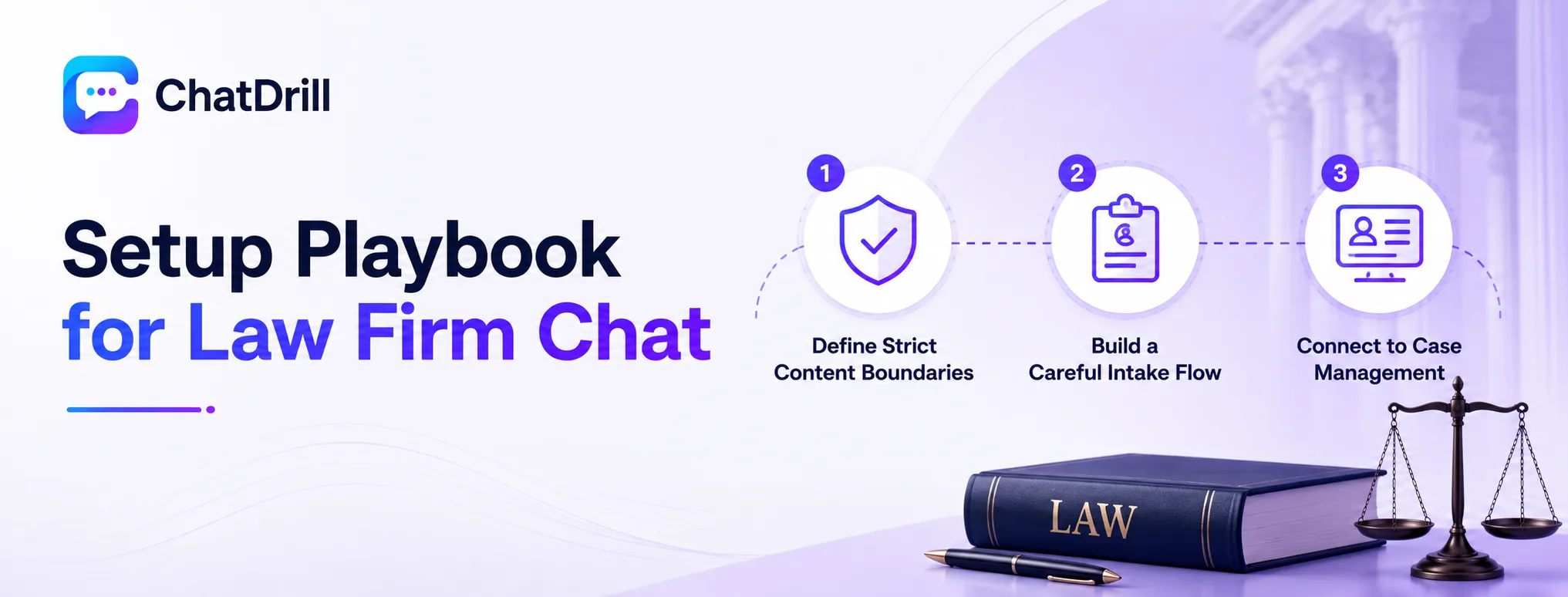
A responsible setup trains AI strictly on general, non-case-specific information, builds a clear intake flow for prospective clients that captures basic information without offering guidance, and connects to case management systems for existing client administrative questions.
Step 1: Define strict content boundaries
Explicitly limit AI training and responses to general firm information and process explanation, never anything that could be construed as advice specific to a prospect's actual legal situation.
This boundary is worth treating with the same seriousness as clinical boundaries in healthcare chat, given the comparable professional and liability stakes involved.
Step 2: Build a careful intake flow
Design a chat flow that captures basic prospective client information, name, general case type, contact details, and schedules a consultation, without attempting to discuss or advise on the actual legal matter itself.
This intake-focused approach captures the genuine business value of chat engagement while staying clearly on the safe side of the legal advice boundary.
Step 3: Connect to case management for existing clients
Integrating chat with your case management system lets AI provide basic status updates and administrative help for verified existing clients, a lower-risk, genuinely useful automation opportunity.
This connection extends chat's value to the existing client relationship, distinct from the more carefully bounded prospective client intake function.
Common Mistakes Law Firms Make With Chat
The most common mistakes are allowing chat, whether AI or an untrained staff member, to drift into anything resembling case-specific legal advice, failing to capture prospective client information effectively before they lose interest, and not connecting chat to case systems for existing client efficiency.
Drifting into case-specific advice
Even a seemingly helpful, reassuring response to a specific legal question can cross into advice territory if it addresses the prospect's actual situation rather than staying strictly general.
This is the single most important boundary to protect in law firm chat, given the direct professional and liability implications of getting it wrong.
Poor prospective client capture
A chat conversation that doesn't effectively capture basic contact information and schedule a follow-up consultation wastes genuine business opportunity, regardless of how professionally the conversation itself was handled.
Building a clear, deliberate intake flow, rather than an open-ended conversation with no structured next step, ensures genuine interest converts into an actual scheduled consultation.
No connection to case management systems
A chatbot unable to reference an existing client's actual case status forces every status question to a human, missing an efficiency opportunity that carries meaningfully lower risk than prospective client conversations.
This gap is worth addressing, given how much administrative volume this specific category typically represents for an established firm.
Measuring Success for Law Firm Chat
Track chat-to-consultation booking rate for prospective clients, AI deflection on existing client administrative questions, and review of AI conversations specifically to confirm the legal advice boundary is being consistently respected.
Chat-to-consultation conversion
Tracking what share of prospective client chat conversations result in an actual scheduled consultation quantifies chat's direct contribution to new business for the firm.
This metric is worth reviewing alongside intake flow completion rates, revealing whether visitors are dropping off before reaching the scheduling step.
Existing client deflection rate
Tracking how much case-status and administrative volume AI resolves for existing clients without staff involvement shows the efficiency gain from a well-connected, appropriately scoped setup.
This deflection frees staff time for genuinely substantive client communication that benefits from attorney or paralegal involvement.
Boundary compliance review
Regularly reviewing AI conversations specifically for any drift toward case-specific advice confirms the content boundaries are being respected consistently, not just at initial setup.
This review deserves ongoing attention given the genuine professional stakes involved, similar to the boundary review practice worth maintaining in healthcare and fintech chat.
Rolling Out Chat Across Intake and Client Services
Starting with a single practice area's intake flow before expanding firm-wide, and getting attorney sign-off on the content boundaries early, gives a firm's chat rollout the same careful review a legal services product genuinely needs.
Piloting intake in one practice area
Launching chat first for one practice area's prospective client intake lets attorneys in that group review real conversations closely, confirming the boundary between general information and case-specific advice is holding.
This narrower start makes it easier to catch a scripted response that reads as more advisory than intended, correcting the training content before it's replicated across a firm-wide launch.
A few weeks of attorney review during this pilot typically builds the confidence needed to expand the same intake approach to other practice areas with appropriate content adjustments.
Getting attorney sign-off on content boundaries
Having a supervising attorney formally review and approve exactly what the AI is trained to say, and explicitly what it should never attempt, gives the rollout a defensible, documented foundation.
This sign-off process is worth treating as seriously as any other firm policy requiring partner-level review, given the direct professional and liability implications of getting the boundary wrong.
Revisiting this review periodically, not just once at launch, catches any drift as training content is updated or new practice areas are added to the chat system.