
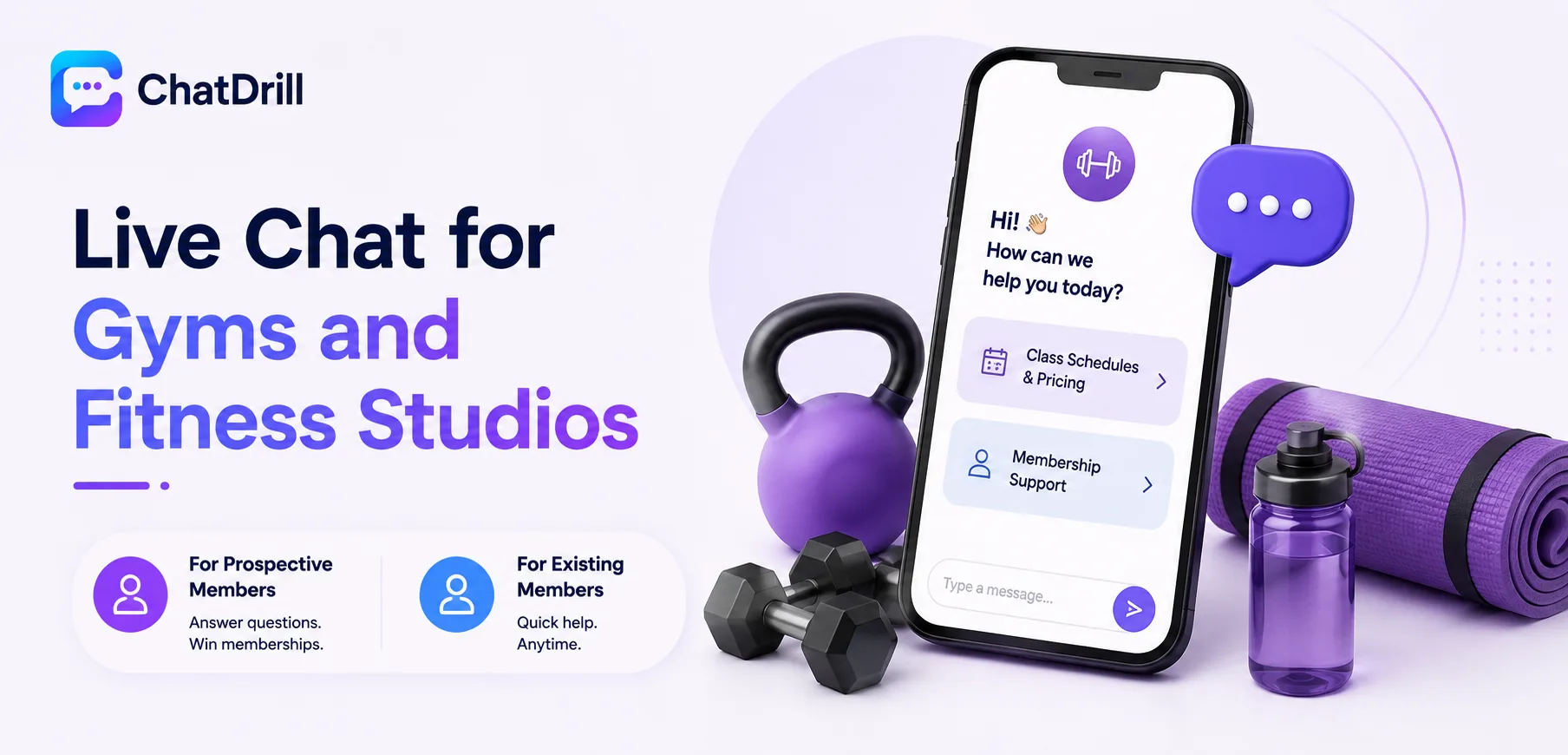
A gym or fitness studio's chat visitors are typically either a prospective member deciding whether to try the facility or an existing member with a scheduling or account question, two audiences with genuinely different needs and appropriate response styles.
The prospective member moment carries real conversion weight, someone asking about class schedules, membership pricing, or a trial offer is actively evaluating whether to commit, making a fast, encouraging response meaningfully influence that decision.
Existing member questions tend to be more routine, class booking, membership pause or cancellation requests, account questions, well suited to efficient automation once connected to your actual scheduling and membership systems.
This guide covers why these two audiences need different handling, what each typically asks, a practical setup approach, and mistakes worth avoiding.
Why Prospective and Existing Members Need Different Handling
A prospective member evaluating your facility benefits from an encouraging, conversion-focused chat approach, while an existing member with a routine scheduling or account question benefits more from fast, efficient resolution.
The prospective member conversion moment
Someone asking about a trial class, membership pricing, or facility amenities is actively deciding whether to commit, making a warm, fast, specific response genuinely influence whether they follow through.
This moment benefits from a tone and approach closer to sales engagement than pure support, similar to how trial-user chat matters distinctly in SaaS.
The existing member routine question
Class booking, membership pause requests, and account questions from existing members represent steady, largely administrative volume best served by efficient, direct resolution rather than an extended, sales-style conversation.
Recognizing this as a genuinely different need helps ensure existing members get quick, straightforward help rather than an unnecessarily elaborate response better suited to a prospective member.
What Prospects and Members Typically Ask
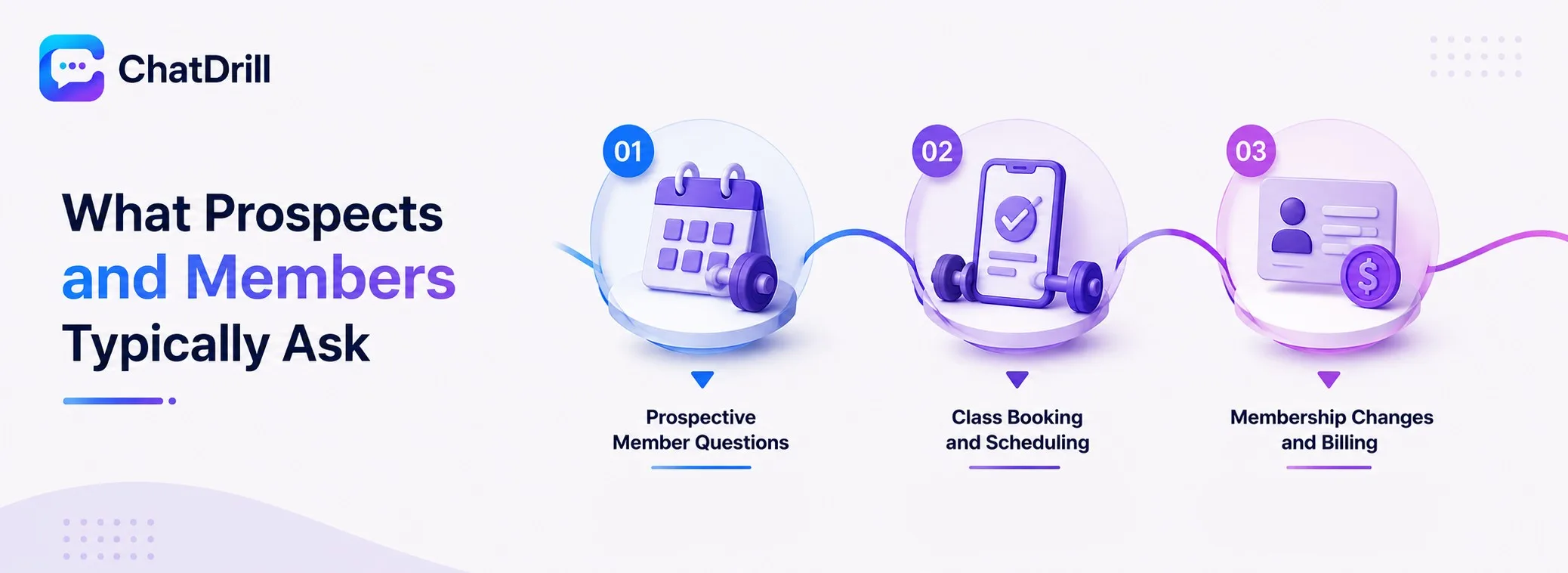
Prospective members ask about class schedules, membership pricing and trial offers, and facility amenities, while existing members more often ask about booking a specific class, pausing or canceling membership, and account or billing questions.
Prospective member questions
Class schedule details, membership pricing tiers, and available trial offers dominate prospect chat volume, best answered with AI trained on your actual current schedule and pricing structure.
This category directly ties to new member conversion, making accuracy and a genuinely encouraging tone particularly valuable given how directly it influences the sign-up decision.
Class booking and scheduling
Existing members frequently ask to book a specific class or check availability, a highly repetitive, easily automatable category once connected to your actual class scheduling system.
This category benefits significantly from embedded booking directly within chat, letting a member reserve a spot without navigating to a separate app or page.
Membership changes and billing
Pause requests, cancellation inquiries, and billing questions come up consistently and, while sometimes sensitive given the member may be considering leaving, benefit from clear, straightforward handling rather than excessive friction.
This category is worth handling honestly and efficiently rather than making cancellation deliberately difficult, which tends to damage the relationship and brand reputation more than it retains genuine member commitment.
Setup Playbook for Fitness Studio Chat
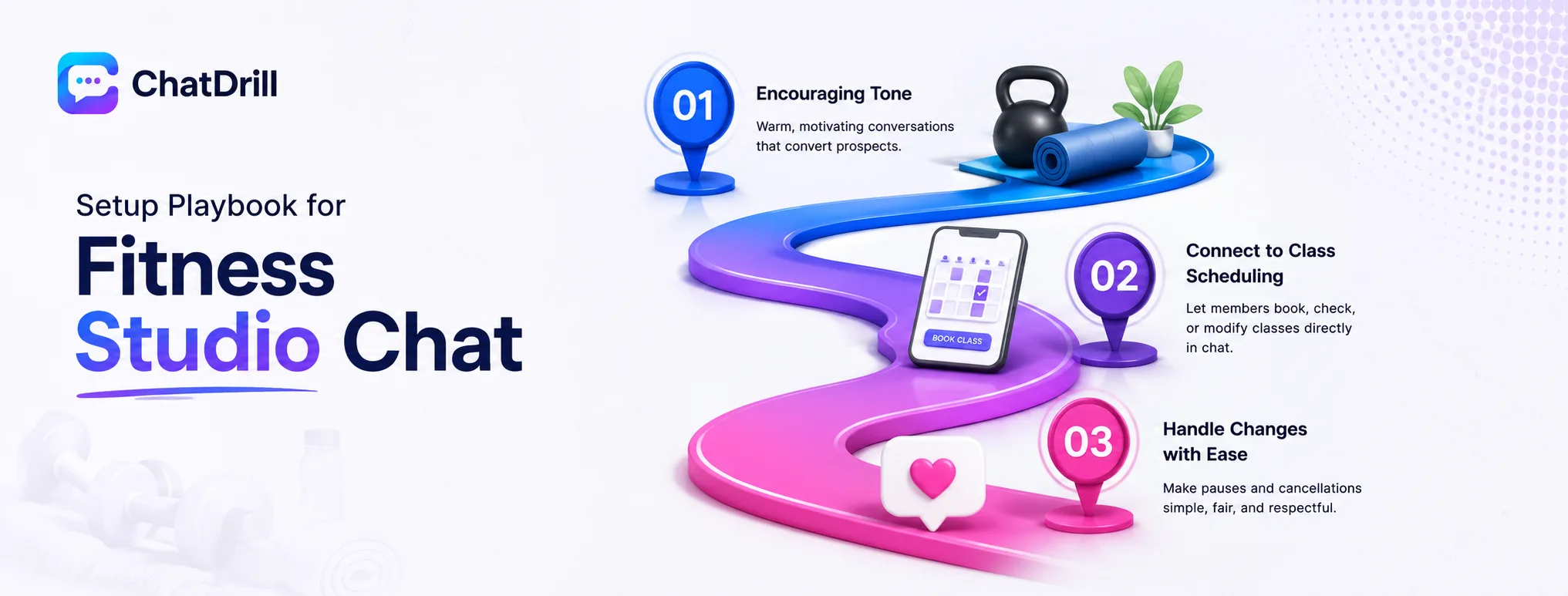
A strong setup trains AI with an encouraging, conversion-focused tone for prospect conversations, connects to your class scheduling system for direct booking, and handles membership changes honestly and efficiently rather than creating unnecessary friction.
Step 1: Set an encouraging tone for prospect conversations
Configure AI responses to prospective member questions with warmth and genuine enthusiasm about the facility, reflecting the conversion-focused nature of these specific conversations.
This tone distinction matters, a purely transactional, neutral tone tends to underperform compared to one that genuinely conveys the facility's community and energy.
Step 2: Connect to class scheduling for direct booking
Integrating chat with your scheduling system lets existing members book, check, or modify a class reservation directly within the conversation, without needing a separate app or call.
This connection delivers reliable, high-frequency value given how routine and repetitive class booking questions typically are for an active membership base.
Step 3: Handle membership changes without excessive friction
Design pause and cancellation handling to be honest and reasonably efficient, rather than deliberately obstructive, respecting that a difficult cancellation experience tends to damage brand reputation more than it retains genuine commitment.
This approach protects the relationship even with a departing member, who may return later or refer others based on how fairly they were treated during this specific interaction.
Common Mistakes Gyms and Studios Make With Chat
The most common mistakes are using a flat, transactional tone for prospective member conversations that should feel encouraging, having no real connection to class scheduling forcing every booking through a separate app anyway, and making cancellation deliberately difficult in a way that damages brand reputation.
A flat tone for prospect conversations
Responding to a prospective member's enthusiasm with a purely neutral, transactional tone misses the opportunity to genuinely convey the facility's energy and community, a meaningful factor in their sign-up decision.
This tone mismatch is worth correcting through deliberate training content and example responses that reflect appropriate warmth for this specific conversation type.
No real class scheduling connection
A chatbot unable to actually book or check a class reservation forces every scheduling request to a separate app or phone call, undermining much of the efficiency chat is meant to provide for this high-volume category.
This gap is worth prioritizing early, given how routine and frequent class booking questions typically are for an active membership base.
Deliberately difficult cancellation
Making cancellation intentionally hard to complete through chat, hoping to retain a member through friction rather than genuine value, tends to damage brand reputation and word-of-mouth more than it actually retains commitment.
A fair, straightforward cancellation experience protects the relationship even with a departing member, who may return or refer others later.
Measuring Success for Fitness Studio Chat
Track chat-to-trial or chat-to-membership conversion rate for prospects, class booking completion rate through chat, and member satisfaction specifically on billing and cancellation interactions.
Chat-to-membership conversion
Tracking what share of prospect chat conversations result in a trial visit or new membership quantifies chat's direct contribution to new member growth.
This metric benefits from comparison against your overall prospect conversion rate, revealing whether chat-engaged prospects convert notably better than the general inquiry average.
Class booking completion
Tracking what share of class-related chat conversations result in an actual completed booking confirms whether your scheduling integration is genuinely reducing friction as intended.
A ChatDrill setup connected to a real class scheduling system, for a studio using it, makes this specific metric straightforward to track directly.
Billing and cancellation satisfaction
Tracking satisfaction specifically for billing and cancellation conversations reveals whether your fair, low-friction approach to this sensitive category is genuinely landing well, protecting brand reputation even with departing members.
This distinct tracking matters given how directly this category connects to word-of-mouth reputation and the possibility of a member returning later.
Rolling Out Chat Across Front Desk and Membership Teams
Launching chat first for prospect-facing trial and pricing questions, then extending to class booking and membership management once the encouraging tone is validated, keeps a facility's rollout focused on conversion first.
Starting with prospect conversion
Focusing initial launch on trial offers, pricing, and class schedule questions from prospective members lets your team validate that AI's tone genuinely conveys warmth and community rather than reading as flat or transactional.
This phase is worth reviewing closely with input from front desk staff who talk to prospects daily, since they're well positioned to judge whether the AI's responses feel authentically aligned with your facility's actual character.
A couple of weeks tracking trial signups from chat-engaged prospects gives an early read on whether the tone and conversion flow are working before wider reliance on the setup.
Extending to class booking and membership management
Once prospect-facing chat is stable, connecting to your class scheduling system for existing member booking brings a different, more transactional need worth testing with active members directly.
Membership pause and cancellation handling deserves particular care during this expansion, reviewed against your actual policy to confirm the chat experience doesn't create more friction than intended.
Front desk staff should be briefed on how a cancellation request routes through chat, ensuring a member who does want to speak with a person can still do so easily.