
Chat for schools, colleges, and edtech businesses serves genuinely different audiences depending on the moment, prospective students evaluating enrollment, current students needing course or account help, and parents with their own distinct set of questions, each benefiting from a somewhat different chat approach.
The enrollment funnel specifically tends to be where chat delivers the most measurable value, a prospective student with a specific question about program details or admissions requirements often converts at a meaningfully higher rate when that question gets answered immediately rather than through a delayed email.
Beyond enrollment, ongoing student support, course access issues, account questions, deadline clarifications, represents a steady, largely automatable volume well suited to AI once trained on your specific institution's policies and systems.
This guide covers why chat matters differently across these audiences, what each group typically asks, a practical setup approach, and mistakes worth avoiding.
Why Chat Serves Multiple Distinct Audiences in Education
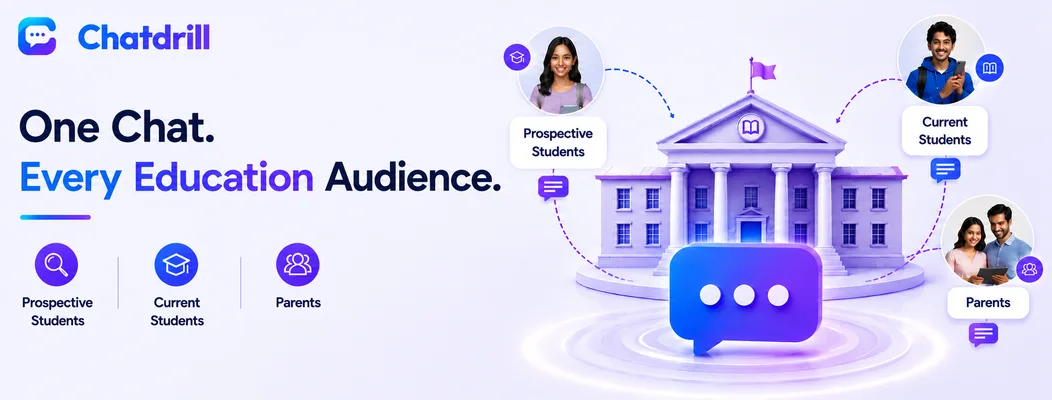
Educational chat needs to serve prospective students in the enrollment funnel, current students needing ongoing support, and sometimes parents, each with genuinely different questions and appropriate response approaches.
The enrollment funnel audience
A prospective student researching programs is often comparing several institutions simultaneously, making a fast, specific answer to their question a genuine factor in whether your institution stays under consideration.
This audience benefits from chat treated similarly to a sales or lead-generation function, prioritizing speed and specific, program-relevant answers.
The current student support audience
Enrolled students asking about course access, deadlines, or account issues represent a different need entirely, ongoing operational support rather than a conversion-focused interaction.
This audience benefits from efficient, accurate resolution of routine questions, freeing staff time for the genuinely complex academic or personal situations that need human attention.
What Prospective and Current Students Actually Ask
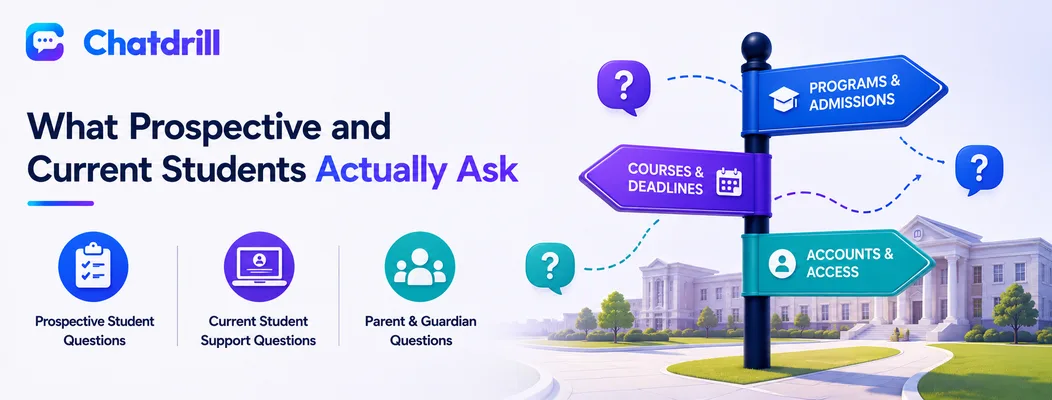
Prospective students ask about program details, admissions requirements, and tuition or financial aid, while current students more often ask about course access, deadlines, and account or portal issues.
Prospective student questions
Questions about specific program curriculum, admissions deadlines and requirements, and tuition or financial aid options dominate prospective student chat volume, each benefiting from AI trained on your actual, current program details.
This category directly ties to enrollment conversion, making accuracy and speed here particularly valuable compared to lower-stakes general inquiries.
Current student support questions
Course access issues, deadline clarifications, and account or portal login problems make up the bulk of current student chat volume, largely administrative and well suited to automation once connected to relevant systems.
This category tends to be highly repetitive across a student body, making it an efficient candidate for AI automation with strong potential deflection rates.
Parent and guardian questions
For institutions serving younger students, parents often ask about enrollment logistics, safety policies, or general program information, a distinct audience worth considering separately in training content.
Recognizing this as a genuinely separate audience, rather than assuming parent questions mirror student questions exactly, helps ensure training content actually addresses their specific concerns.
Setup Playbook for Educational Chat
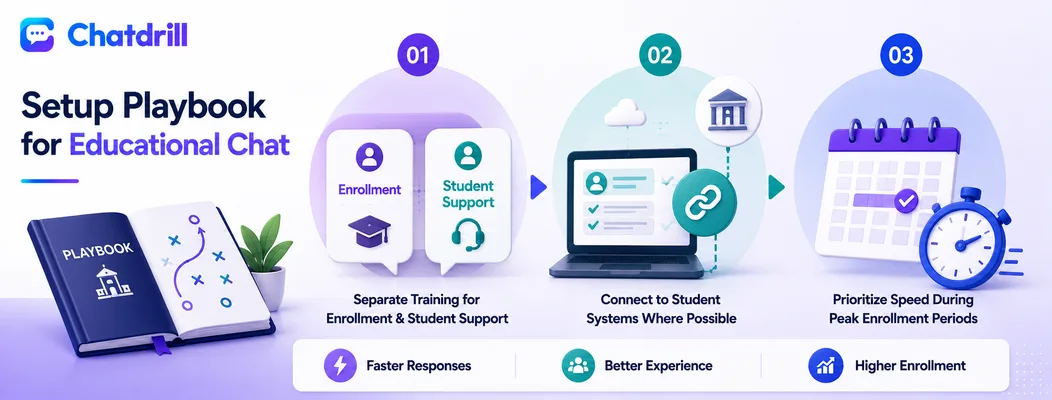
A strong setup trains AI separately on enrollment-focused and current-student-focused content, connects chat to relevant systems like a student portal where possible, and prioritizes fast response specifically during peak enrollment periods.
Step 1: Separate enrollment and student-support training
Given how different these two audiences' needs are, training AI with clearly distinguished content for each, program details and admissions for prospects, course and account help for enrolled students, produces more accurate responses than one blended training set.
This separation also supports appropriate routing, directing a conversation to the right context based on whether the visitor appears to be a prospect or a current student.
Step 2: Connect to student systems where possible
Integrating chat with a student information system or portal, where feasible, lets AI answer specific account or course-status questions directly rather than deferring every specific inquiry to a human.
This connection meaningfully expands what AI can handle for current students, similar to how order-data connection expands AI capability for an ecommerce store.
Step 3: Prioritize speed during peak enrollment periods
Application deadlines and enrollment periods see concentrated chat volume from prospective students actively deciding, making response speed during these specific windows especially worth prioritizing.
Planning staffing or AI coverage specifically around these known peak periods, rather than maintaining flat coverage year-round, matches resources to when they matter most.
Common Mistakes Educational Institutions Make With Chat
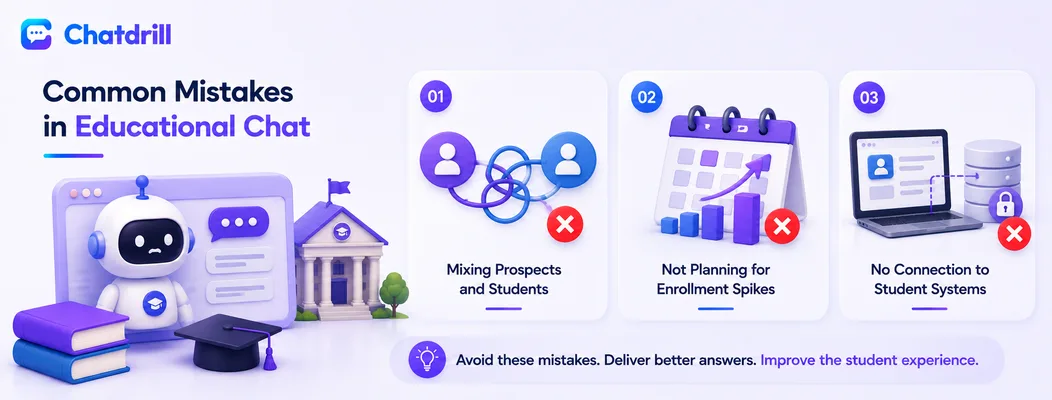
The most common mistakes are blending prospective and current student content into one undifferentiated training set, failing to plan for enrollment-period volume spikes, and leaving chat unconnected to the systems that could answer specific student account questions.
Blending audiences into one training set
Training AI without distinguishing prospective from current student content tends to produce less accurate, less relevant answers for both audiences than a deliberately separated approach.
This blending is a common oversight worth correcting early, since the fix, organizing training content by audience, is straightforward once recognized.
Not planning for enrollment-period spikes
Maintaining flat, year-round chat staffing or AI coverage misses the reality that enrollment periods see concentrated, high-stakes volume genuinely worth extra resourcing.
Reviewing historical volume patterns around known deadlines helps anticipate and prepare for these predictable spikes rather than being caught off guard each cycle.
No connection to student systems
A chatbot unable to reference actual course or account status for a current student ends up deflecting exactly the specific questions that make up much of ongoing student support volume.
This gap limits how much genuine efficiency gain the institution can realize from chat automation for its enrolled student population.
Measuring Success for Educational Chat
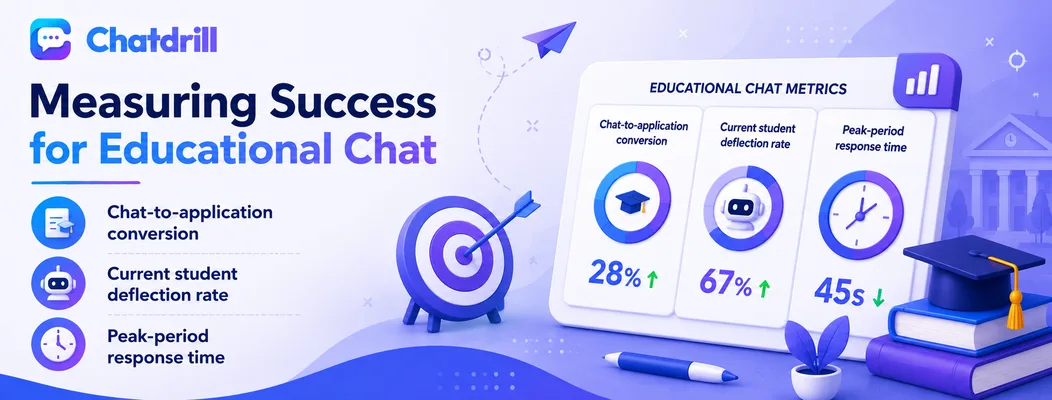
Track chat-to-application conversion rate for prospective students, AI deflection on routine current-student questions, and response time specifically during peak enrollment periods when speed matters most.
Chat-to-application conversion
Tracking what share of prospective-student chat conversations result in a started or completed application quantifies chat's direct contribution to enrollment, the institution's core funnel metric.
This is worth segmenting by program where possible, revealing whether certain programs see stronger chat-driven conversion than others.
Current student deflection rate
Tracking how much routine student support volume AI resolves without staff involvement shows the efficiency gain from a well-connected, well-trained setup for this audience.
A rising deflection rate here frees staff time for the genuinely complex academic or personal situations that benefit most from human attention.
Peak-period response time
Tracking response time specifically during known enrollment deadline periods, separately from year-round averages, confirms whether coverage during these high-stakes windows is genuinely adequate.
A strong overall average can hide a real coverage gap during these specific, critical periods, worth checking explicitly rather than assuming it's covered by a good general number.
Rolling Out Chat Across Departments
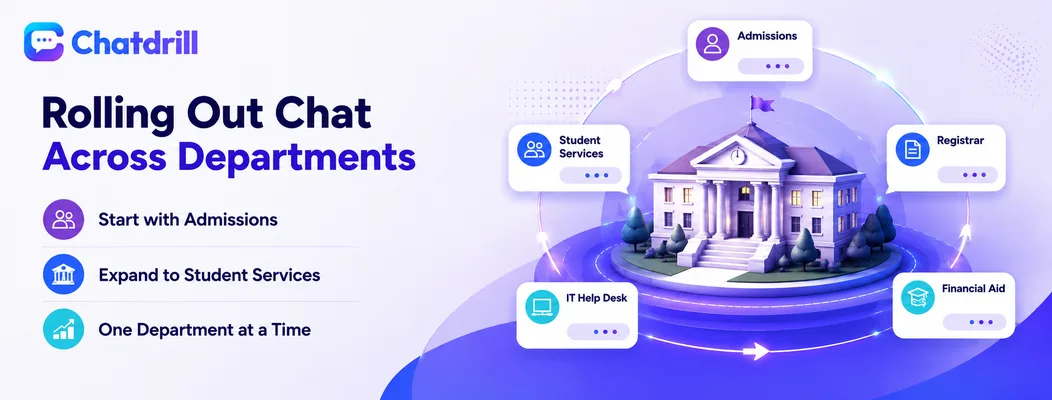
Starting with admissions before expanding to student services, and getting each department's staff comfortable with what the AI handles on their behalf, keeps a campus-wide rollout from overwhelming any one team.
Starting with admissions
Launching chat first for prospective-student questions gives admissions staff a contained environment to review conversion-focused AI answers before the tool takes on the more varied volume current students generate.
This phase is also where enrollment-period readiness gets tested for real, revealing whether the setup can handle a genuine deadline-driven volume spike before it's relied on institution-wide.
A few weeks of close review here typically surfaces most training gaps in program and admissions content while the audience and question set are still relatively narrow.
Expanding to student services
Once admissions chat is stable, extending coverage to registrar, financial aid, and IT help desk questions brings a wider, more repetitive volume that tends to deflect well once systems are connected.
Looping in each department's own staff to review early AI answers in their specific area catches inaccuracies a general reviewer might miss, given how department-specific much of this content is.
Rolling out this way, one department at a time, also makes it easier to attribute a service's deflection results back to that department's own training investment.