
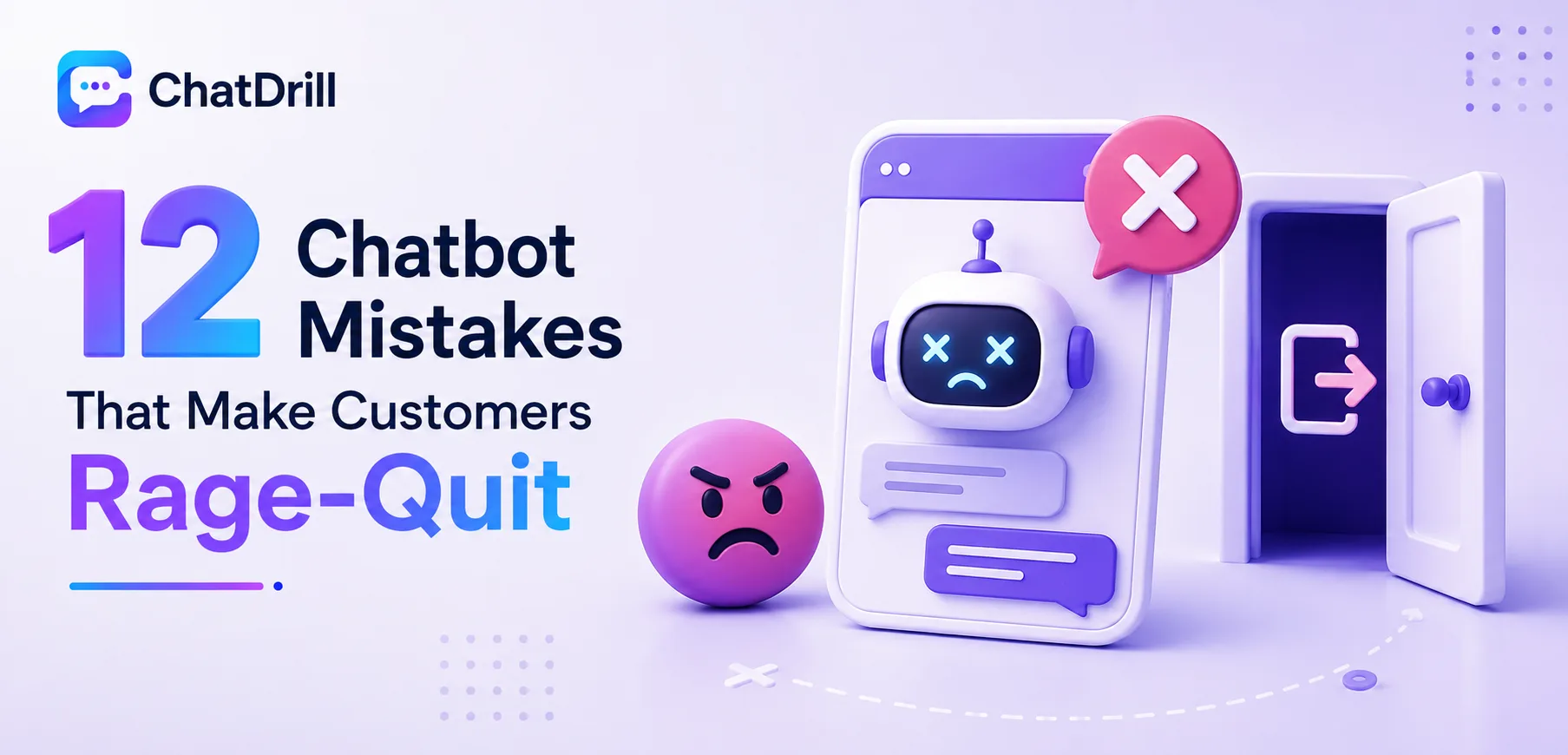
A chatbot doesn't need to be broken to drive a customer away, it just needs to waste their time, misunderstand their question repeatedly, or block a clear path to a human when one is genuinely needed.
Most of the mistakes that cause a customer to abandon a chat conversation in frustration fall into a fairly small, recognizable set of patterns, ones worth auditing your own chatbot against directly rather than assuming they don't apply.
These mistakes tend to cluster around three themes: breaking trust immediately, wasting the customer's time with poor understanding, and escalating frustration by making it hard to reach a human when the bot genuinely can't help.
This guide walks through 12 specific mistakes across these themes, and how to audit your own chatbot for each one.
Mistakes That Break Trust Immediately
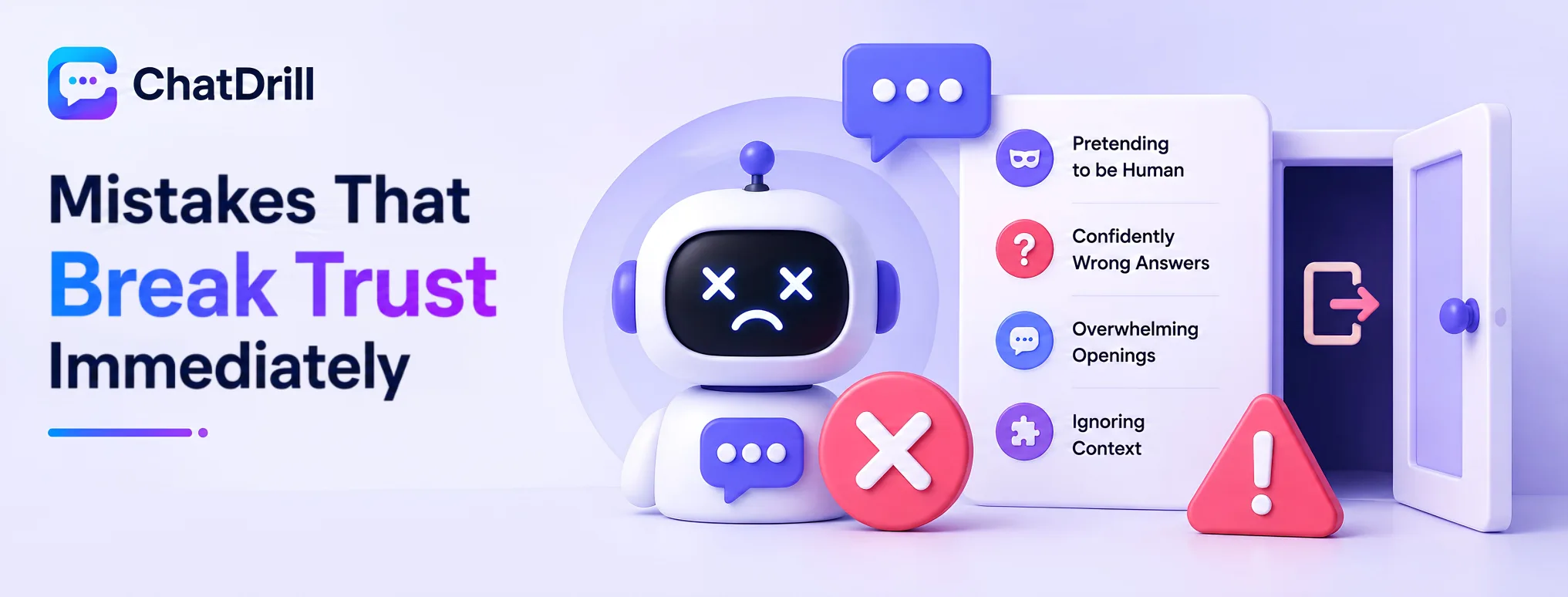
A chatbot that pretends to be human, gives an overly confident wrong answer, or opens with a wall of unnecessary text tends to lose customer trust before the actual conversation has even started.
1. Pretending to be human when directly asked
A chatbot that deflects or lies when a customer directly asks if they're talking to a bot damages trust the moment it's discovered, which it usually is.
Being upfront about AI involvement, while still being genuinely helpful, tends to build more trust than an evasive non-answer.
2. Giving a confidently wrong answer
A chatbot that states incorrect information with the same confidence as a correct one is often worse than saying nothing, since the customer may act on bad information before discovering the error.
Training AI to express appropriate uncertainty, or escalate when it isn't genuinely confident, prevents this specific failure mode.
3. Opening with an overwhelming wall of text
A long, unstructured opening message asking multiple questions at once tends to overwhelm a customer who just wants quick help, increasing the odds they abandon before even responding.
Keeping the opening message short and focused on one clear next step respects the customer's actual goal in reaching out.
4. Ignoring context the customer already provided
Asking a customer to repeat information they already typed earlier in the same conversation signals the bot isn't actually tracking the conversation, undermining confidence in everything that follows.
Ensuring context genuinely carries through a conversation is a basic reliability bar worth confirming directly through testing.
Mistakes That Waste the Customer's Time
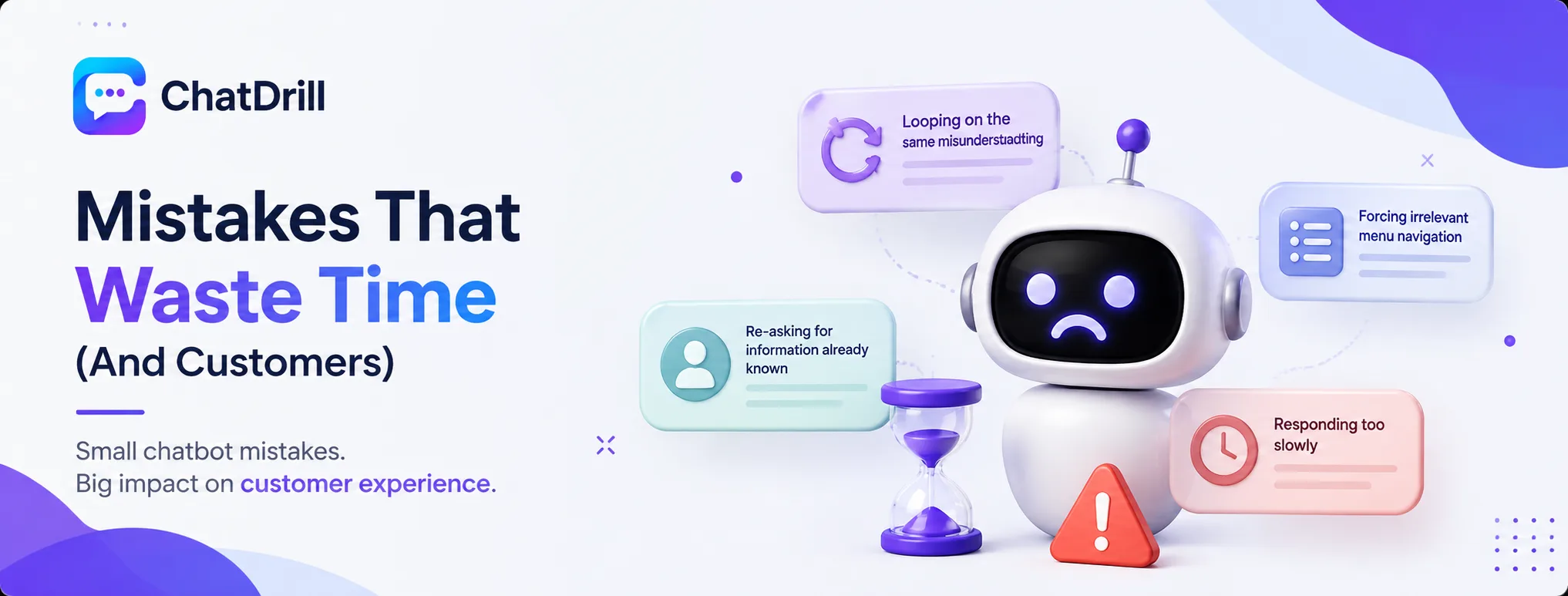
A chatbot that loops on misunderstanding, forces a customer through irrelevant menu options, or asks for information it should already have wastes time in ways that compound customer frustration quickly.
5. Looping on the same misunderstanding
A chatbot that responds to a rephrased question with the same wrong answer, rather than recognizing it's stuck, creates one of the most frustrating experiences a customer can have.
Building in a loop-detection pattern, escalating after a couple of failed attempts at the same question, prevents this from spiraling into abandonment.
6. Forcing irrelevant menu navigation
Making a customer click through several unrelated menu options before reaching anything relevant to their actual question adds friction that a more direct, conversational flow would avoid.
Letting a customer type their actual question upfront, rather than forcing a rigid menu path first, respects their time better.
7. Re-asking for information the system already has
Asking a logged-in customer for their account number or order details the platform should already have access to feels needlessly redundant and signals poor integration.
Connecting chat to relevant account and order data removes this friction and makes the bot feel genuinely aware of who it's talking to.
8. Responding too slowly to feel like a real conversation
A chatbot with a noticeable, inconsistent delay before each response breaks the conversational rhythm a customer expects from chat specifically, undermining the format's core advantage over email.
Testing and monitoring response latency directly ensures the bot's speed matches what customers expect from a real-time channel.
Mistakes That Escalate Frustration
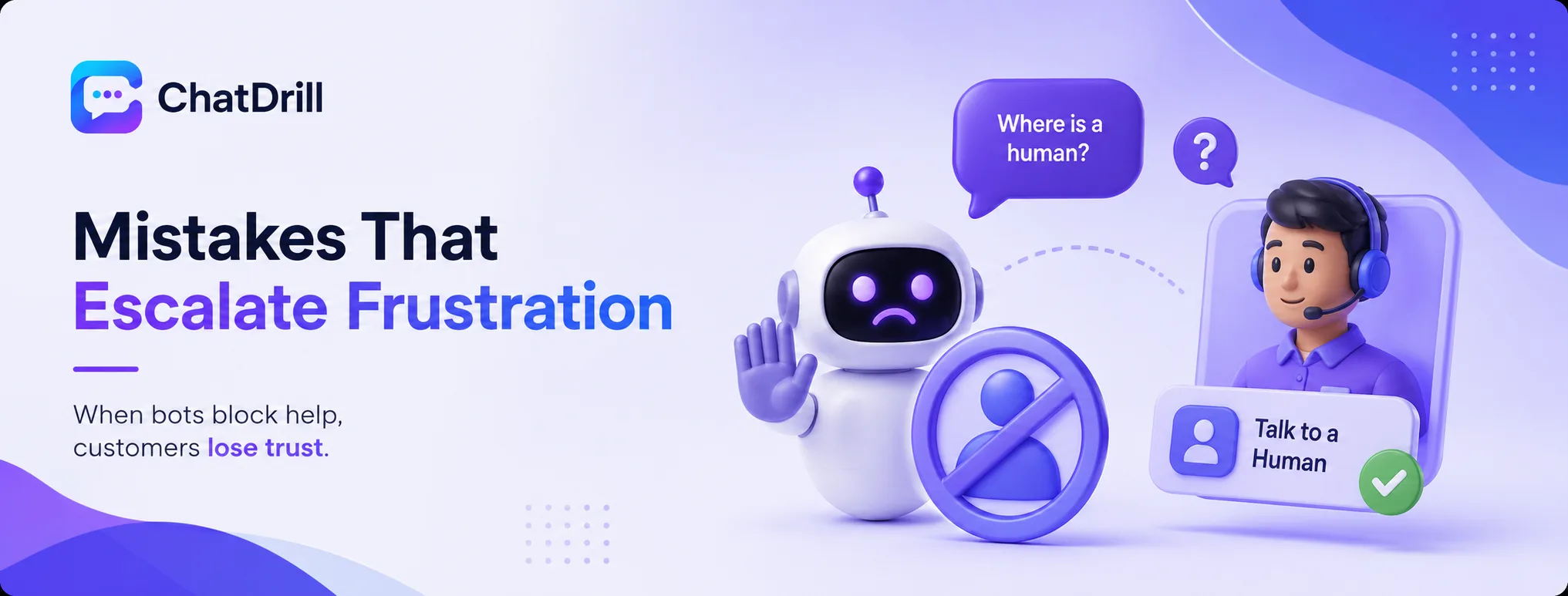
A chatbot that hides the option to reach a human, keeps trying after a customer clearly wants a person, or offers no acknowledgment of a genuine complaint turns a fixable frustration into a lost customer.
9. Hiding the path to a human agent
Making it hard to find how to reach a person, whether through buried menu options or a bot that avoids the request, turns manageable frustration into genuine anger.
Keeping a clear, easy escalation path visible throughout the conversation respects that not every issue is one a bot should handle.
10. Continuing to offer automated help after an explicit request for a human
A bot that keeps suggesting more automated options after a customer has clearly and directly asked for a human ignores an explicit signal, which reads as the system not actually listening.
Recognizing and immediately honoring a clear escalation request, without additional automated attempts first, prevents this specific frustration.
Mistakes That Undermine the Overall Experience
A chatbot with a tone mismatched to the situation, no memory across sessions, and
12. No clear indication of what the bot can actually help with
engaging with it is worth their time at all.
11. A tone mismatched to the situation
An overly cheerful or casual tone when a customer is describing a genuine problem or complaint can feel dismissive of their actual frustration.
Training AI to match tone to context, more measured and empathetic for a complaint, lighter for a routine question, avoids this mismatch.
12. No clear indication of what the bot can actually help with A chatbot that doesn't communicate its own scope leaves customers guessing whether it's worth attempting a complex question at all, sometimes causing them to abandon the channel entirely out of uncertainty.
A brief, honest indication of what the bot handles well upfront sets appropriate expectations and reduces this uncertainty-driven abandonment.
How to Audit Your Own Chatbot for These Mistakes
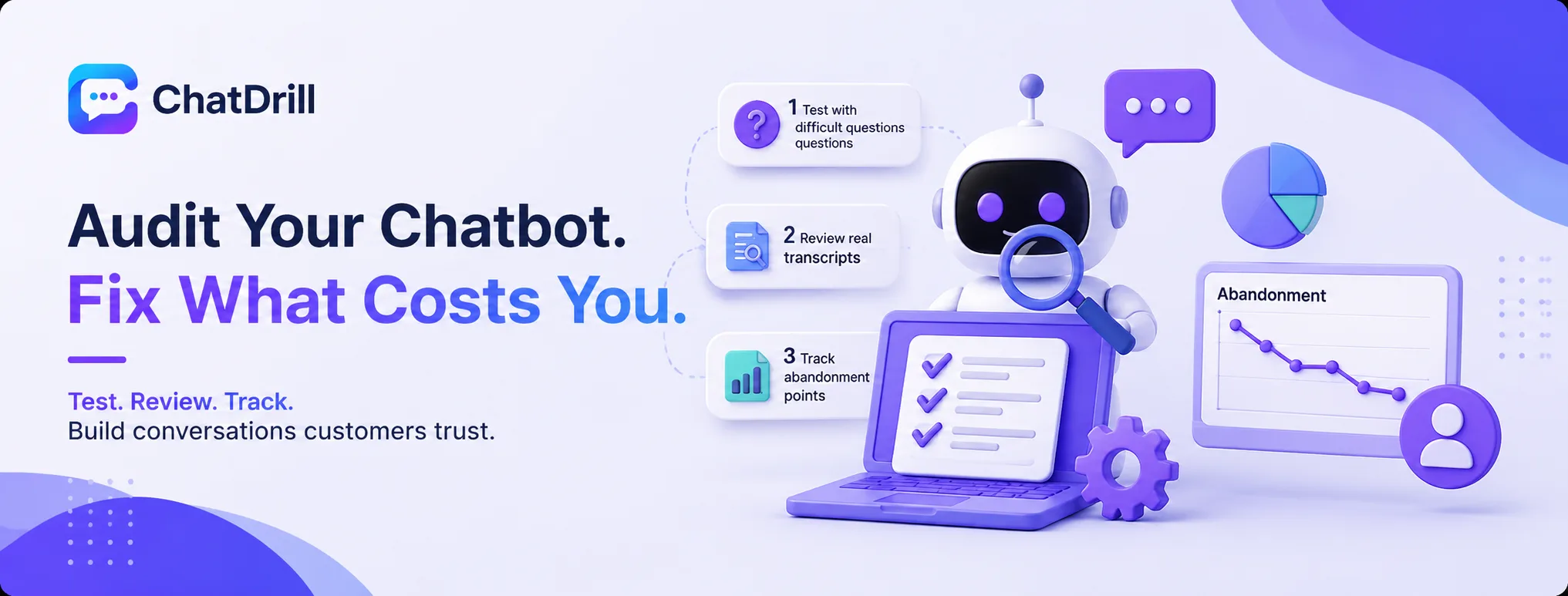
Auditing your own chatbot means testing it with realistic, sometimes deliberately
Review real transcripts for these specific patterns
and tracking abandonment at the points where these mistakes are most likely to occur.
Test with realistic, difficult questions
Running your own chatbot through a range of genuinely difficult, ambiguous, and multi-part questions, not just the easy cases, reveals which of these 12 mistakes it's actually prone to.
This testing is worth repeating periodically, not just at initial launch, since training content and underlying models can drift over time.
Review real transcripts for these specific patterns Reading a sample of actual customer conversations specifically looking for looping, context loss, or hidden escalation paths catches issues a synthetic test might miss.
This review is more valuable when done regularly rather than as a one-time audit, since new failure patterns can emerge as your product or policies change.
Track abandonment at likely failure points
Monitoring where in a conversation customers most often abandon reveals which of these mistakes, if any, is genuinely costing you engaged customers.
A rising abandonment rate at a specific conversation stage is worth investigating directly against this list of common patterns.