
Deflection rate on its own, the share of conversations a chatbot resolves without human involvement, tells you activity, not value, which is why translating that number into an actual return on investment matters if you want to make a real business case for continued or expanded AI investment.
The core idea behind deflection ROI is straightforward: multiply the number of conversations genuinely resolved by AI by what a human-handled conversation would have cost, then weigh that against what the AI setup itself costs to run.
Where this gets more nuanced is in deciding what counts as a genuinely resolved conversation, a customer who gets an AI answer and immediately asks a human the same question shouldn't count as a deflection success, even though a naive deflection-rate number might still include it.
This guide covers the core formula for deflection ROI, what to include and exclude, common measurement mistakes, and how to set up tracking that gives you a genuinely trustworthy number.
What Deflection ROI Actually Measures
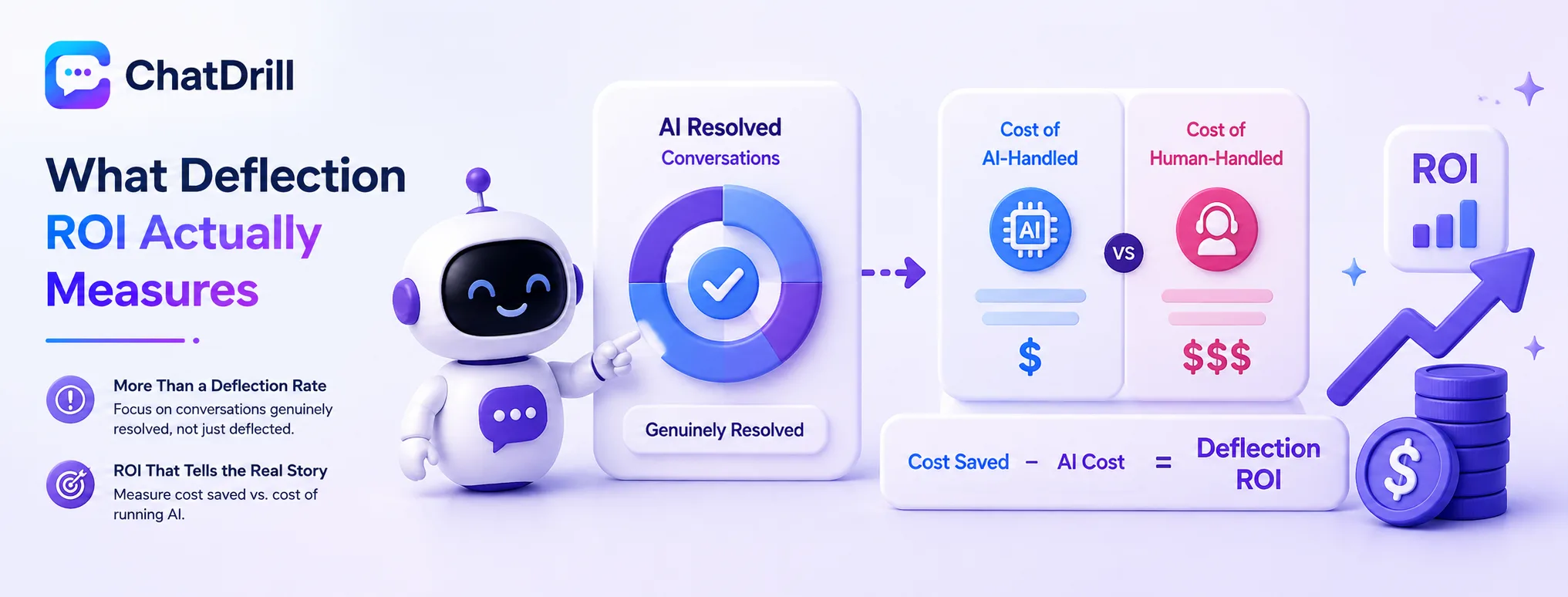
Deflection ROI translates a chatbot's resolved-conversation count into a dollar figure by comparing the cost of an AI-handled conversation against what a human agent would have cost to handle the same volume.
Why deflection rate alone isn't enough
A high deflection rate sounds impressive but doesn't tell you whether those deflected conversations were genuinely resolved or whether customers simply gave up and left, an outcome that would look identical in raw deflection numbers.
This is why deflection rate should be treated as an input to the ROI calculation, not the final answer on its own.
The basic ROI framing
At its simplest, deflection ROI is the cost saved from conversations AI genuinely resolved, minus the cost of running the AI system itself, expressed relative to that cost.
This framing forces a decision about what counts as "genuinely resolved," which is where most of the real nuance in this measurement lives.
The Core Formula and What to Include
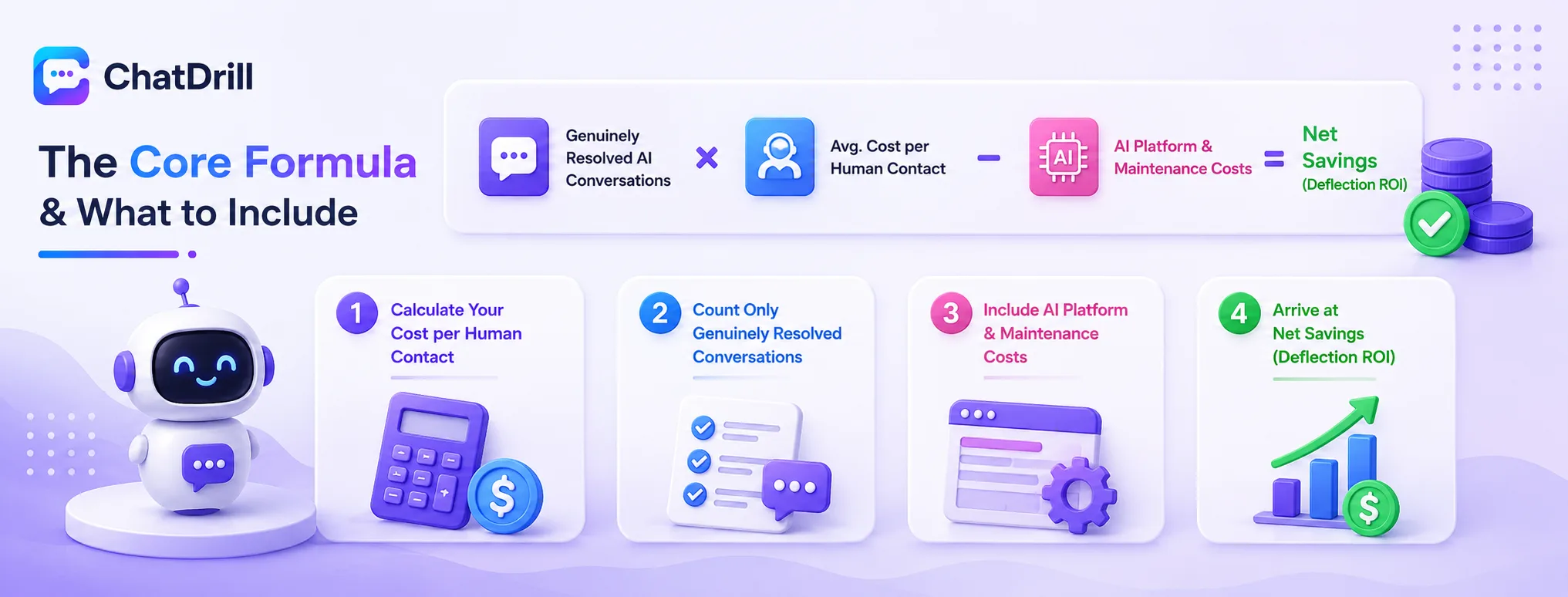
The core formula multiplies genuinely resolved AI conversations by your average cost per human-handled contact, then subtracts your AI platform and maintenance costs to arrive at net savings.
Calculating your cost per human contact
Start with your fully loaded cost per support conversation, agent time, overhead, and tooling, not just base salary divided by conversation count, since that understates the real cost.
This baseline number is what every AI-resolved conversation is effectively saving, making it worth calculating carefully rather than using a rough estimate.
Counting only genuinely resolved conversations
A conversation should only count toward ROI if the customer's actual need was met, not merely that they didn't escalate to a human within the chat session itself.
Tracking follow-up contact, did this same customer reach out again shortly after through another channel, helps filter out conversations that only looked resolved on the surface.
Including AI platform and maintenance costs
Subtracting your platform subscription cost, plus the ongoing time spent maintaining and improving AI training content, gives a genuinely net rather than gross savings figure.
Skipping this subtraction is one of the most common ways deflection ROI gets overstated, especially early on when maintenance time is still being actively invested.
Common Measurement Mistakes
The most common mistakes are counting abandoned conversations as successful deflections, using an understated cost-per-contact baseline, and never subtracting the AI system's own ongoing costs.
Counting abandonment as deflection
A customer who leaves a chat conversation without a human handoff isn't necessarily a satisfied, resolved customer, they may have simply given up, an outcome that shouldn't count as a genuine ROI win.
Distinguishing true resolution from silent abandonment, often through a quick satisfaction prompt or follow-up contact tracking, keeps the ROI number honest.
Using an understated cost baseline
Calculating cost per human contact using only base agent salary, without overhead, tooling, and management costs, tends to understate the real savings AI is providing.
A more complete, fully loaded cost figure produces a more defensible ROI number when presenting the case for continued investment.
Never subtracting AI system costs
Presenting only gross savings, without subtracting what the AI platform and its maintenance actually cost, overstates the genuine return and risks credibility if challenged.
A net ROI figure, savings minus AI costs, is the more honest and ultimately more persuasive number to present internally.
Setting Up Deflection ROI Tracking
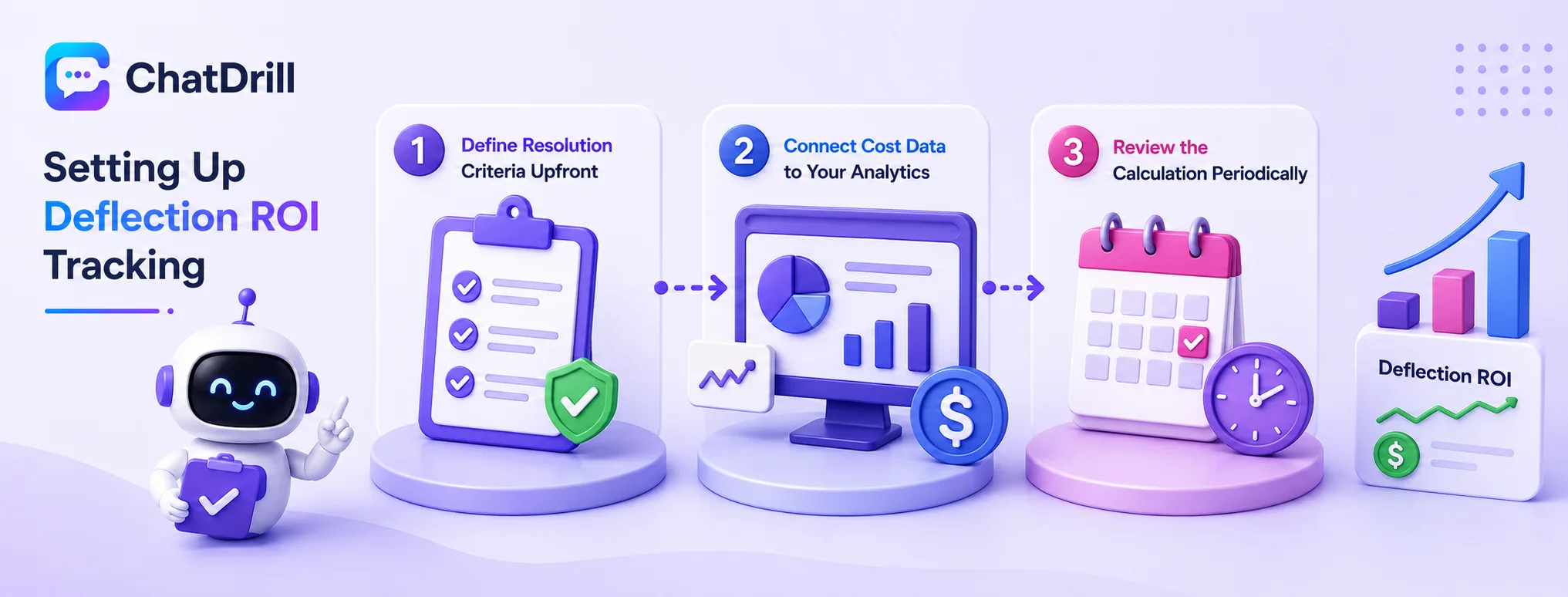
Setting up reliable tracking means defining what counts as genuine resolution, connecting cost data to your chat platform's analytics, and reviewing the calculation regularly as both volume and costs shift.
Define resolution criteria upfront
Before calculating anything, agree internally on what counts as a genuinely resolved AI conversation, no follow-up contact within a defined window is a common, reasonable standard.
Having this definition agreed upon in advance avoids later disputes about whether the ROI figure is being calculated fairly.
Connect cost data to your analytics
Feeding your actual cost-per-contact figure into your chat platform's reporting, rather than calculating ROI manually and separately each time, keeps the number current as volume and staffing change.
A ChatDrill setup with deflection tracking built in makes this connection more straightforward than manually cross-referencing separate systems.
Review the calculation periodically
Revisiting your cost-per-contact baseline and AI platform costs periodically, rather than calculating ROI once and treating it as fixed, keeps the figure accurate as your business and support operation evolve.
This review is worth scheduling on a regular cadence, quarterly is common, rather than leaving it until someone asks for an updated number.