
Traditional QA review means a manager manually reads a small, random sample of conversations each month, often under 5%, leaving the vast majority of customer interactions completely unreviewed and any systemic issue invisible until it's already caused real damage.
AI-powered QA scoring changes that math entirely, a model can review every single conversation against consistent criteria, surfacing patterns and outliers a manual sampling process would almost certainly miss.
The genuine value isn't just coverage, it's consistency, an AI scorer applies the same criteria to every conversation, removing the variability that comes from different human reviewers interpreting quality standards slightly differently.
This guide covers why full-coverage scoring changes what's possible, what a strong AI QA setup needs, a practical implementation approach, and mistakes worth avoiding.
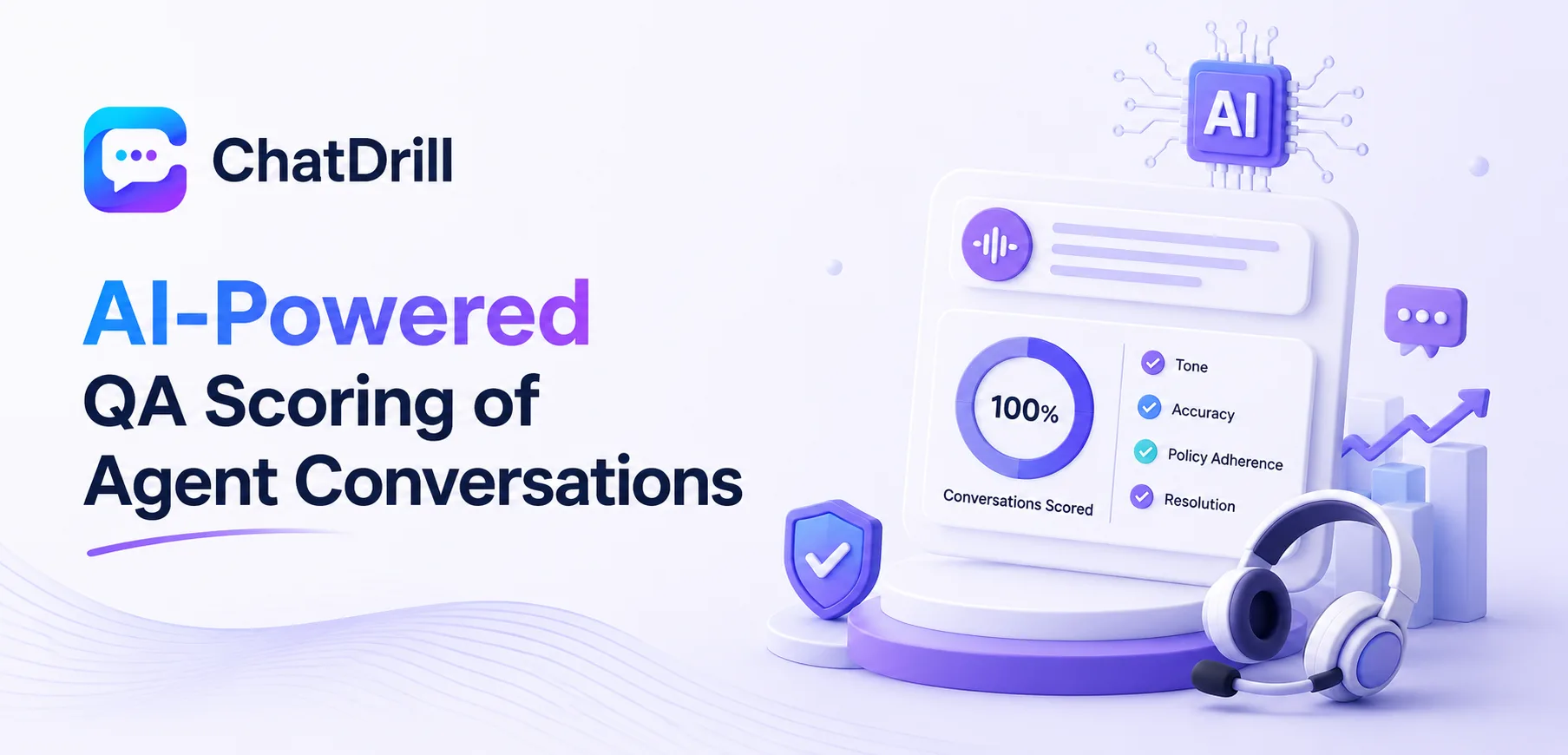
Quick answer: AI-powered QA scoring uses a language model to review every agent conversation against defined quality criteria, tone, accuracy, policy adherence, resolution, replacing the old approach of manually reviewing a small random sample and giving support leaders visibility into 100% of interactions instead of a tiny fraction.
Why Full-Coverage Scoring Changes What's Possible
Reviewing every conversation instead of a small manual sample surfaces systemic patterns and specific outlier issues that a traditional QA sampling process would almost certainly miss entirely.
The blind spot of manual sampling
A manager reviewing under 5% of conversations has no visibility into the other 95%, meaning a systemic issue, a training gap, a policy misunderstanding, can persist for months before it's caught by chance.
AI scoring at full coverage closes this blind spot, surfacing the same issue the first time it shows a meaningful pattern rather than waiting for a random sample to catch it.
Consistency across every review
A human reviewer's judgment can vary day to day and reviewer to reviewer, while an AI scorer applies identical criteria to every conversation, removing this specific source of inconsistency.
This consistency matters especially for identifying genuine trends over time, since the scoring baseline doesn't shift with whoever happens to be doing the reviewing that week.
What a Strong AI QA Setup Needs
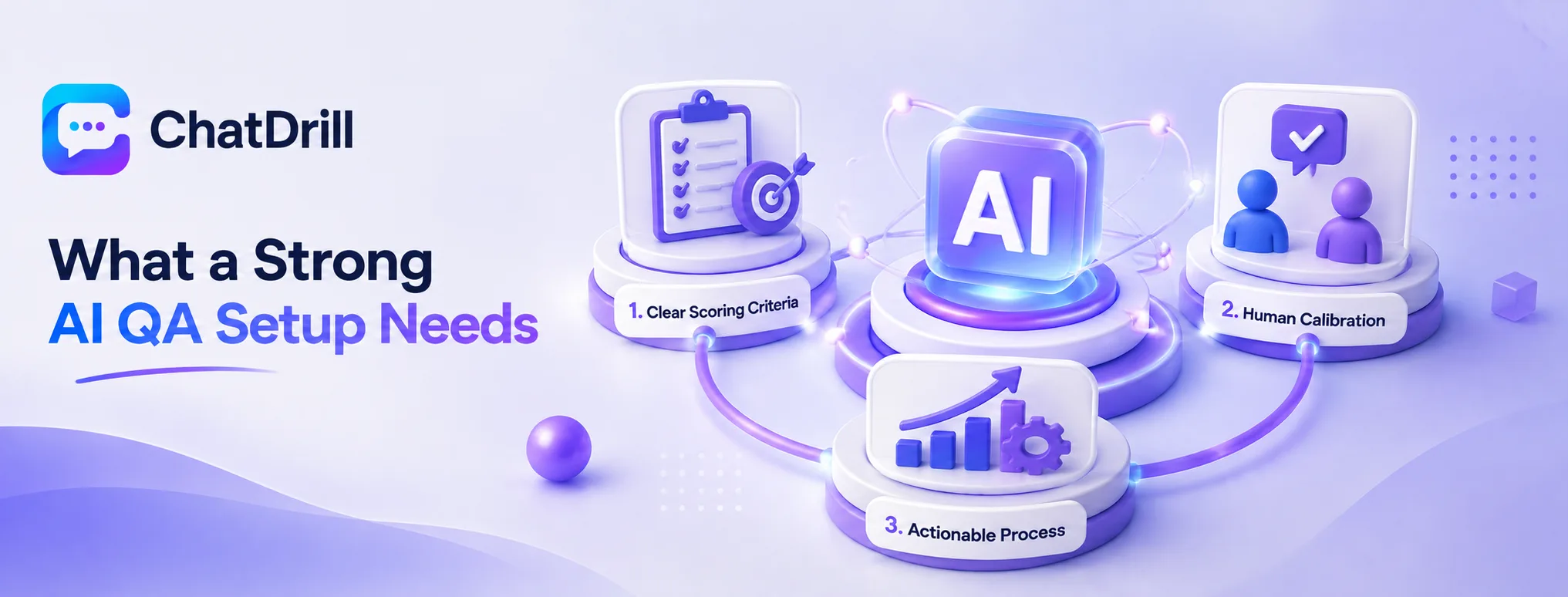
A genuinely effective AI QA setup needs clearly defined scoring criteria specific to your team, human calibration to confirm the AI's judgment matches your actual standards, and a clear process for acting on what the scoring surfaces.
Clearly defined, specific scoring criteria
Generic criteria like "was the agent polite" produce far less useful scoring than specific, actionable standards tied to your actual support policies and common conversation types.
Investing time upfront in defining what genuinely good and genuinely poor performance look like in your specific context pays off directly in the usefulness of the scoring output.
Human calibration against AI scoring
Regularly comparing AI-generated scores against a human reviewer's independent judgment on the same conversations confirms the AI's criteria interpretation genuinely matches your actual standards.
This calibration is worth doing periodically, not just once at setup, since drift can occur as either your standards or the AI's underlying behavior evolves.
A clear process for acting on results
Scoring data delivers no value if it doesn't feed into actual coaching conversations, training updates, or policy clarifications, making this downstream process as important as the scoring mechanism itself.
Building this action loop deliberately, rather than treating scoring as an end in itself, is what actually improves agent performance over time.
Implementation Approach for AI QA Scoring
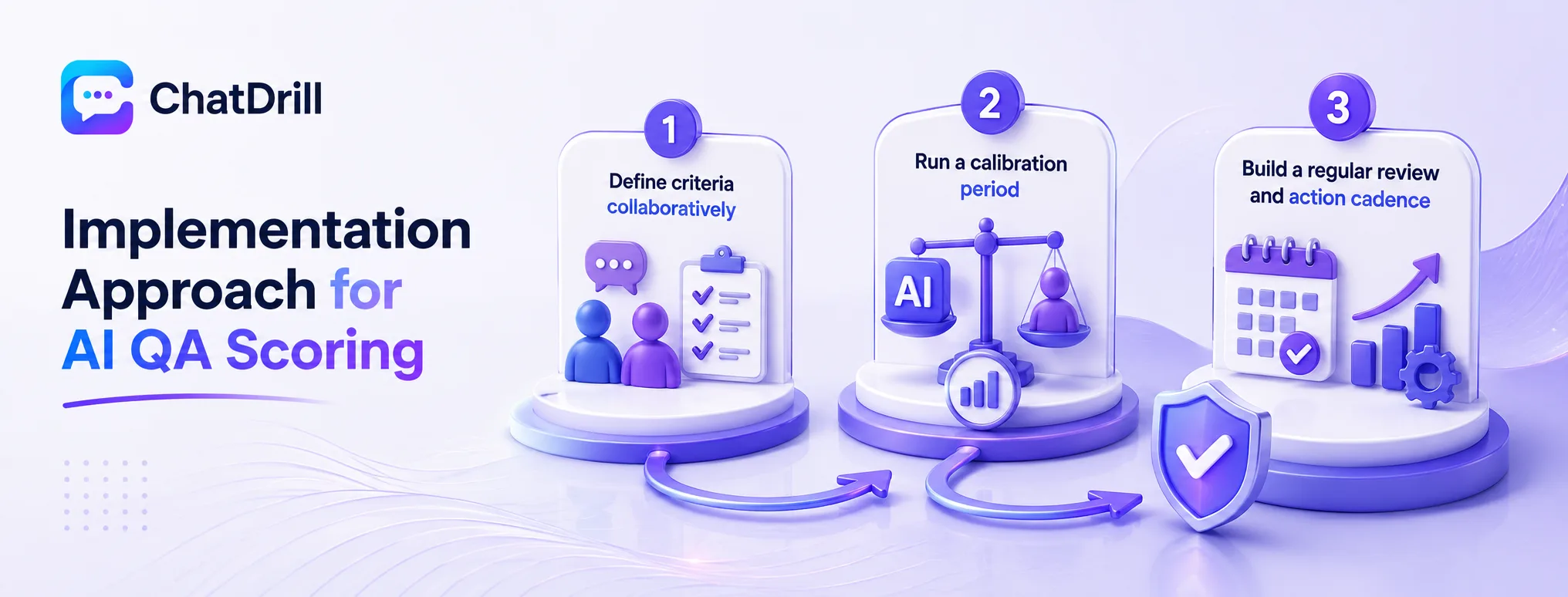
A practical implementation defines scoring criteria collaboratively with your team, runs a calibration period comparing AI and human scores, and builds a regular review cadence before scaling to full coverage.
Step 1: Define criteria collaboratively
Involving experienced agents and team leads in defining what quality actually looks like produces more accurate, more accepted criteria than a top-down definition alone.
This collaborative process also builds buy-in for the scoring system, since agents who helped shape the criteria are less likely to view it as an arbitrary or unfair measure.
Step 2: Run a calibration period
Comparing AI scores against human reviewer scores on the same set of conversations for several weeks confirms the AI's interpretation is genuinely aligned before relying on it at scale.
This calibration period is worth treating as a genuine checkpoint, not a formality, adjusting criteria if AI and human judgment diverge meaningfully.
Step 3: Build a regular review and action cadence
Establishing a consistent rhythm for reviewing scoring trends and translating them into coaching or policy updates ensures the system delivers ongoing value rather than becoming a dashboard nobody checks.
This cadence should involve the people who can actually act on the findings, not just generate a report that sits unused.
Common Mistakes With AI QA Scoring
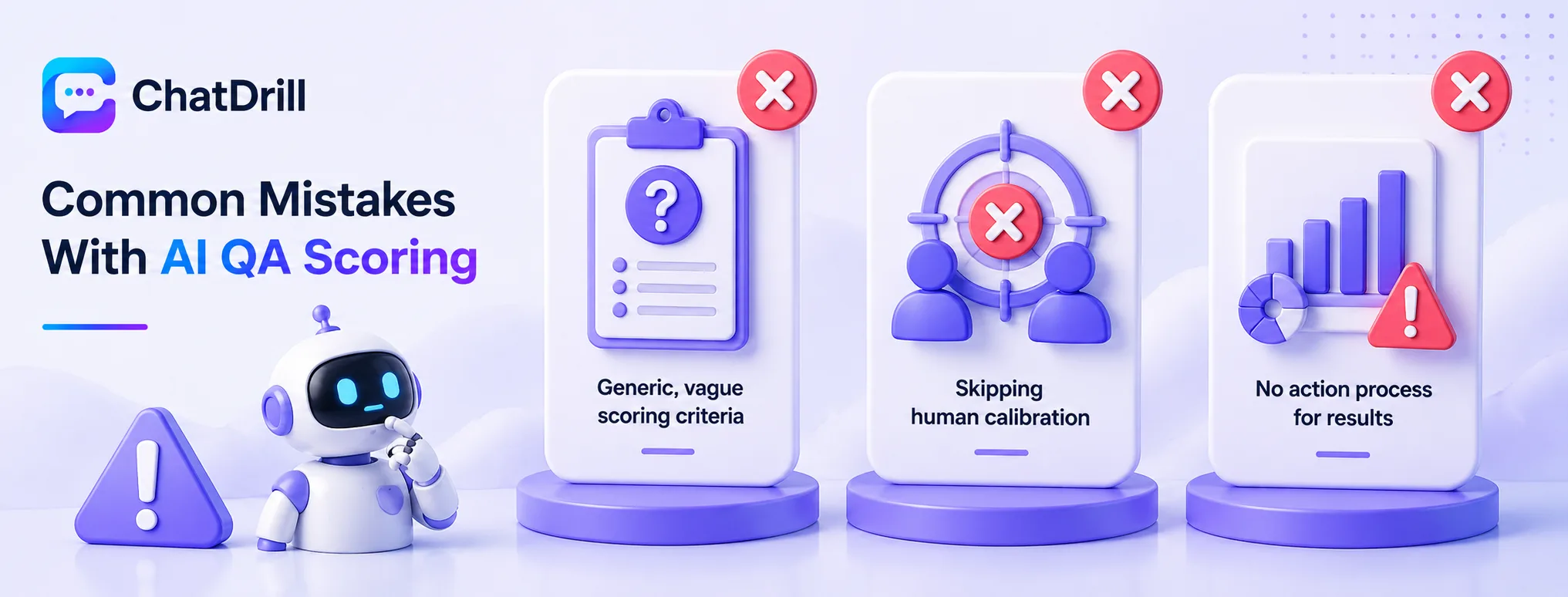
The most common mistakes are using generic, vague scoring criteria, skipping the human calibration step, and generating scoring data with no clear process for acting on what it reveals.
Generic, vague scoring criteria
Criteria like "was the response helpful" without further specificity produce scoring that's technically consistent but not genuinely useful for identifying specific, actionable improvement areas.
Investing in specific, context-appropriate criteria upfront is what separates genuinely useful AI QA scoring from a technically functional but low-value implementation.
Skipping human calibration
Deploying AI scoring at full scale without first confirming it matches human judgment on a calibration sample risks building an entire coaching program around a scoring system that's subtly miscalibrated.
This calibration step is worth the upfront time investment given how much downstream value depends on the scoring actually being trustworthy.
No action process for results
Generating comprehensive scoring data that never translates into actual coaching conversations or policy updates wastes the entire value proposition of moving to full-coverage review.
Building the action loop deliberately from the start ensures the scoring investment actually improves outcomes rather than just producing reports.