
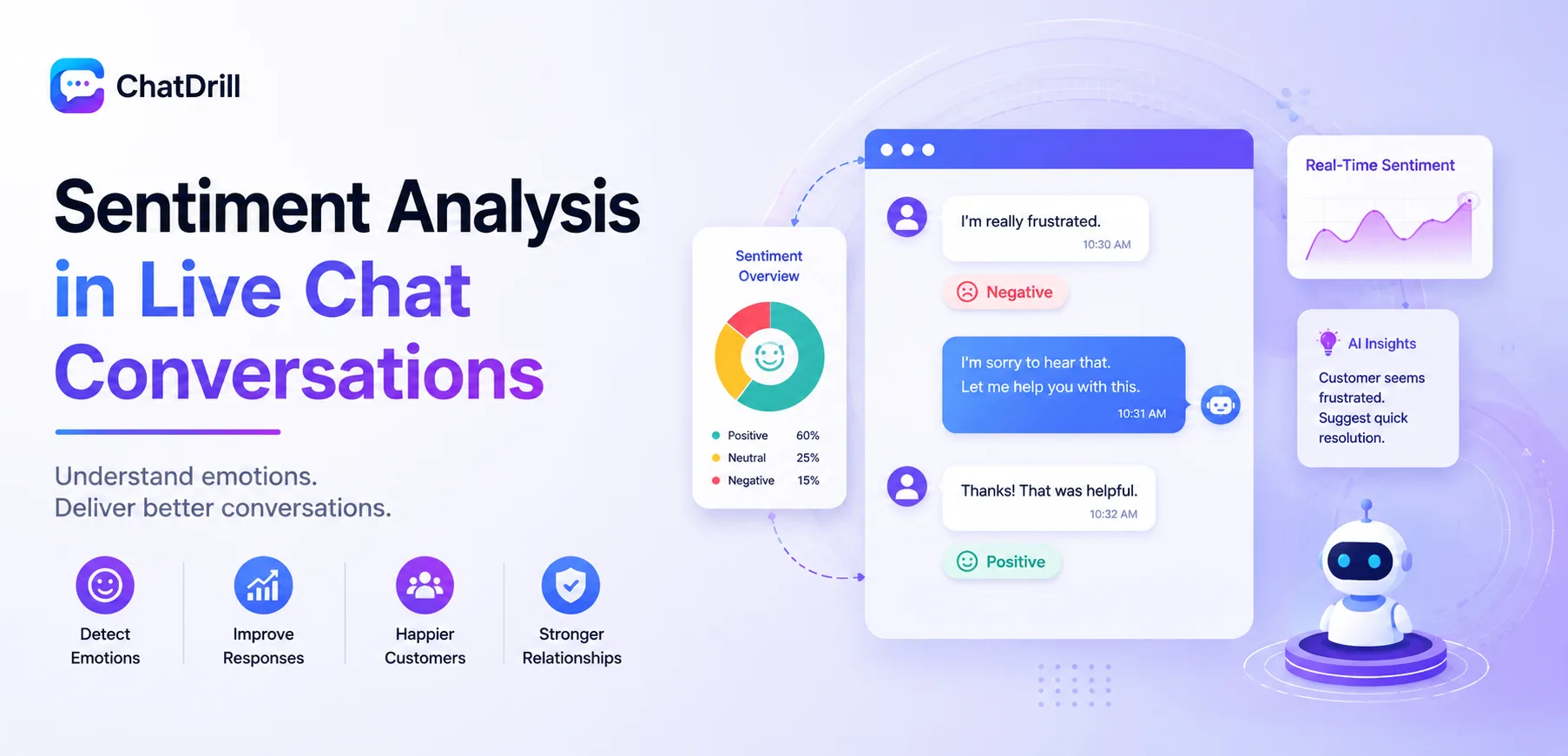
Sentiment analysis in live chat automatically evaluates the emotional tone of a customer's messages, positive, negative, or neutral, giving a business real-time or aggregated insight into how customers actually feel during a conversation, beyond just whether their question got answered.
This adds a genuinely different dimension to chat data than resolution or response time metrics alone, a conversation can technically resolve a customer's question while the sentiment data reveals they were frustrated throughout the interaction.
Used well, sentiment data helps a business catch a deteriorating conversation in real time, prioritize follow-up on customers who showed genuine frustration, and identify broader patterns worth addressing at a process level.
Like most AI-driven analysis, sentiment detection isn't perfectly accurate, understanding its genuine capabilities and limitations helps a business use the data appropriately rather than over-relying on it as a precise, infallible measurement.
This guide covers what sentiment analysis actually measures, how it technically works, practical uses for this data, its real limitations, how to act on sentiment data effectively, and how ChatDrill incorporates sentiment analysis.
What Sentiment Analysis Actually Measures
Sentiment analysis evaluates the emotional tone embedded in a customer's written messages, typically classifying it as positive, negative, or neutral, sometimes with more granular categories like frustration or urgency depending on the specific system.
Simple definition
The system analyzes word choice, phrasing, and sometimes punctuation or capitalization patterns to infer the emotional tone behind a customer's message, distinct from simply analyzing the literal factual content.
This emotional layer adds context resolution metrics alone can't capture, a technically resolved conversation can still reflect genuine customer frustration the resolution status alone wouldn't reveal.
Most implementations provide this as an ongoing score throughout a conversation, rather than a single static rating, letting a business see how sentiment shifts as the interaction progresses.
Why this differs from a satisfaction survey
Sentiment analysis happens automatically and continuously throughout a conversation, without requiring the customer to actively participate in a survey, capturing real-time emotional signal rather than a single post-hoc rating.
This continuous, passive measurement is a genuine advantage over survey-based feedback, which only captures a snapshot at the very end and depends on the customer choosing to actually respond.
How Sentiment Analysis Works
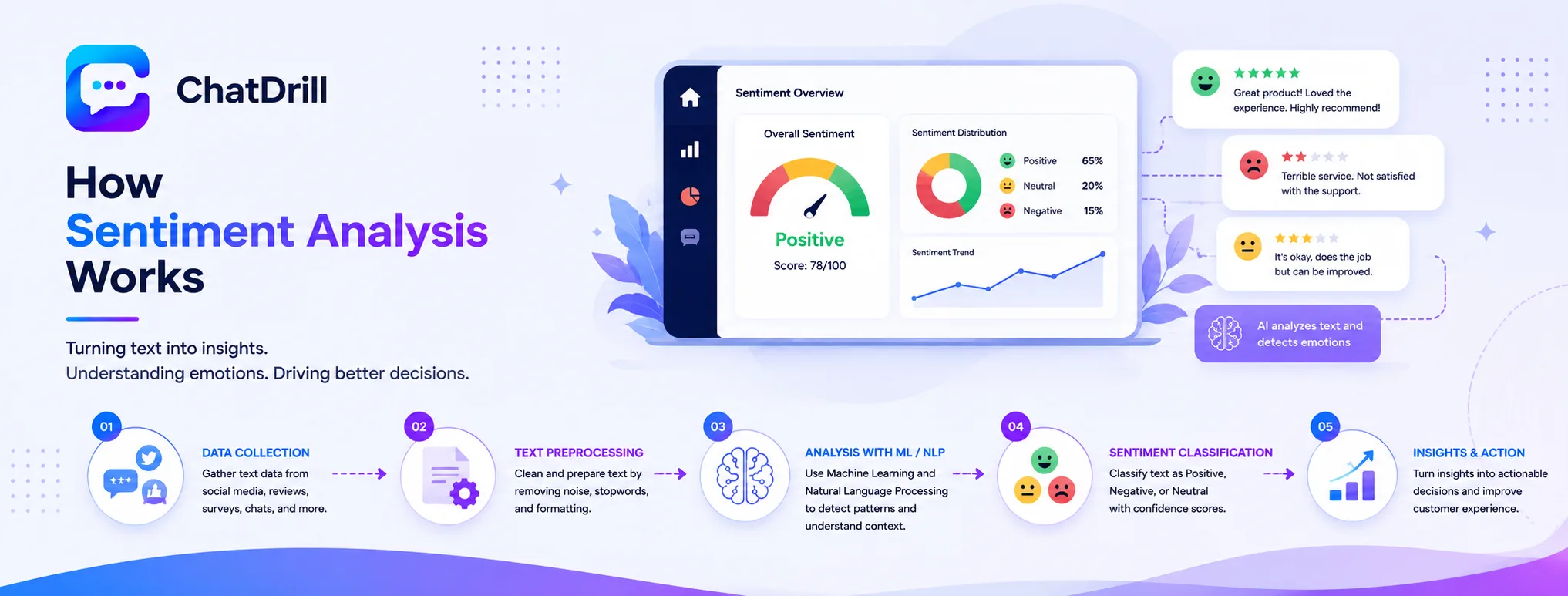
Sentiment analysis uses AI language models trained to recognize emotional patterns in text, analyzing word choice, phrasing, and context to produce a sentiment classification that updates as a conversation unfolds.
The underlying technology
Modern sentiment analysis relies on language models trained specifically to recognize emotional signal in text, a more sophisticated approach than older keyword-based methods that simply flagged specific negative or positive words.
This context-aware approach handles nuance better than simple keyword matching, recognizing that the same word can carry different sentiment depending on surrounding context.
Real-time versus aggregate analysis
Some systems provide live, real-time sentiment scoring visible to an agent during an active conversation, while others focus on aggregate analysis across many conversations for broader reporting purposes.
Both approaches offer genuine value for different purposes, real-time scoring for in-the-moment intervention, aggregate analysis for identifying broader patterns worth addressing systematically.
Practical Uses for Sentiment Data
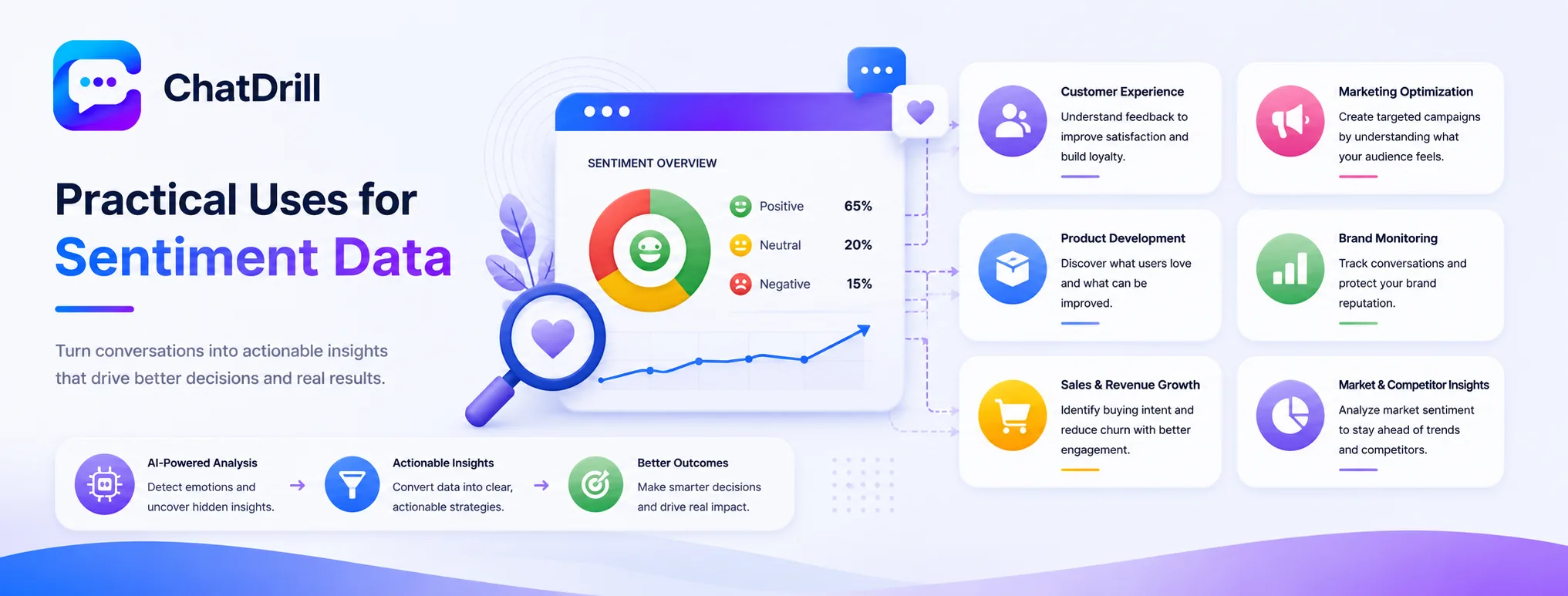
Sentiment data supports real-time intervention when a conversation is deteriorating, prioritized follow-up for customers who showed genuine frustration, and pattern identification revealing which topics or situations consistently generate negative sentiment.
Real-time intervention
A conversation showing rapidly declining sentiment can trigger an alert for supervisor attention or automatic escalation, catching a deteriorating interaction before it fully sours.
This real-time catch is particularly valuable for a business handling high-stakes or complex conversations, where early intervention can meaningfully change the eventual outcome.
Prioritized follow-up
Conversations flagged with notably negative sentiment, even if technically resolved, can be flagged for proactive follow-up, an opportunity to address lingering frustration a resolution status alone wouldn't reveal.
This proactive outreach, informed by sentiment data specifically, often recovers a relationship that might otherwise have quietly soured despite the original issue being technically resolved.
Identifying broader patterns
Aggregating sentiment data across many conversations reveals which specific topics, products, or situations consistently generate negative sentiment, informing where a business should focus improvement efforts.
This pattern-level insight is often more valuable than any single conversation's sentiment score, pointing toward systemic issues worth addressing at a process or product level.
Limitations of Sentiment Analysis
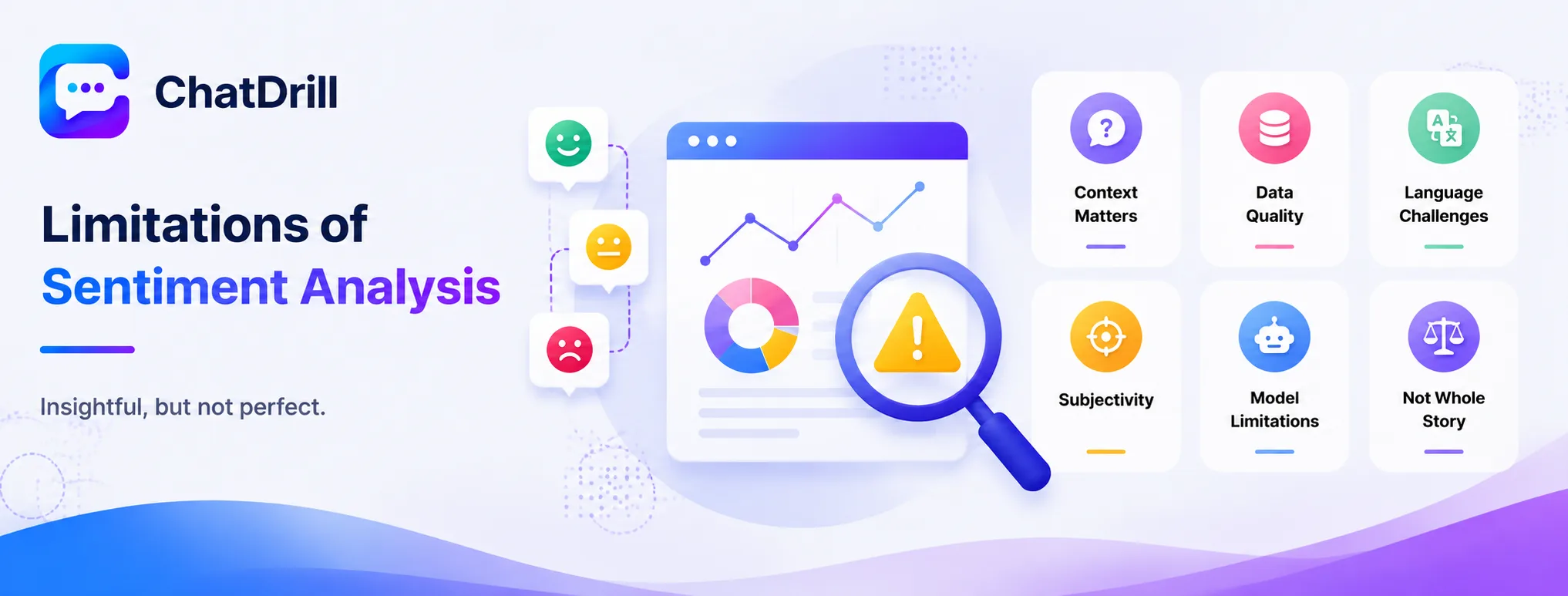
Sentiment analysis can misread sarcasm or subtle tone, doesn't always account for cultural or individual communication style differences, and shouldn't be treated as a perfectly precise measurement rather than a directional signal.
Difficulty with sarcasm and subtle tone
Sarcastic or ironic messages can genuinely confuse sentiment analysis, sometimes being classified opposite to their actual intended meaning, a known limitation worth understanding rather than treating the output as infallible.
This limitation matters more for some customer bases or industries than others, worth being aware of specifically if sarcasm or dry humor is common in your typical customer communication style.
Cultural and individual communication variance
Communication styles vary meaningfully across cultures and individuals, what reads as neutral phrasing from one person might reflect genuine frustration from another, a nuance sentiment analysis doesn't always fully capture.
This variance is worth keeping in mind when interpreting sentiment data, particularly for a business with a genuinely diverse, international customer base.
Acting on Sentiment Data Effectively
Using sentiment data effectively means treating it as a directional signal rather than an infallible measurement, combining it with other data like CSAT for a fuller picture, and building clear processes for how the team should respond to flagged negative sentiment.
Treating it as directional, not absolute
Given its known limitations, sentiment data is best used as one useful signal among several, rather than an infallible, precisely accurate measurement to act on without any human judgment.
This calibrated trust prevents over-reacting to a single, possibly misread sentiment classification while still capturing the genuine value the data provides in aggregate.
Combining with other quality metrics
Pairing sentiment data with CSAT and resolution metrics provides a fuller, more reliable picture of conversation quality than any single metric alone.
This combined view helps distinguish a genuinely concerning pattern from a possible sentiment-analysis misread, since multiple aligned signals carry more weight than one in isolation.
Building clear response processes
Defining specifically what should happen when a conversation is flagged with strongly negative sentiment, an automatic supervisor alert, a prioritized follow-up, keeps the data actionable rather than simply collected and unused.
This process clarity is what actually converts sentiment data into real business value, rather than it becoming an interesting but ultimately unused dashboard metric.
How ChatDrill Uses Sentiment Analysis
ChatDrill incorporates sentiment tracking into its conversation analytics, helping surface conversations worth proactive follow-up and revealing broader patterns worth addressing, alongside its other core reporting metrics.
Sentiment as part of broader conversation analytics
ChatDrill tracks sentiment alongside resolution and satisfaction data, giving a business a fuller picture of conversation quality rather than relying on any single metric in isolation.
This integrated approach reflects the best practice of combining sentiment with other quality signals, rather than treating it as a standalone, disconnected data point.
Surfacing conversations worth attention
Conversations showing notably negative sentiment can be surfaced for review or follow-up, helping a team catch and address frustration that a purely resolution-based view might miss entirely.
This surfacing capability supports the proactive follow-up practice covered earlier, turning sentiment data into a genuinely actionable business tool rather than passive reporting alone.