
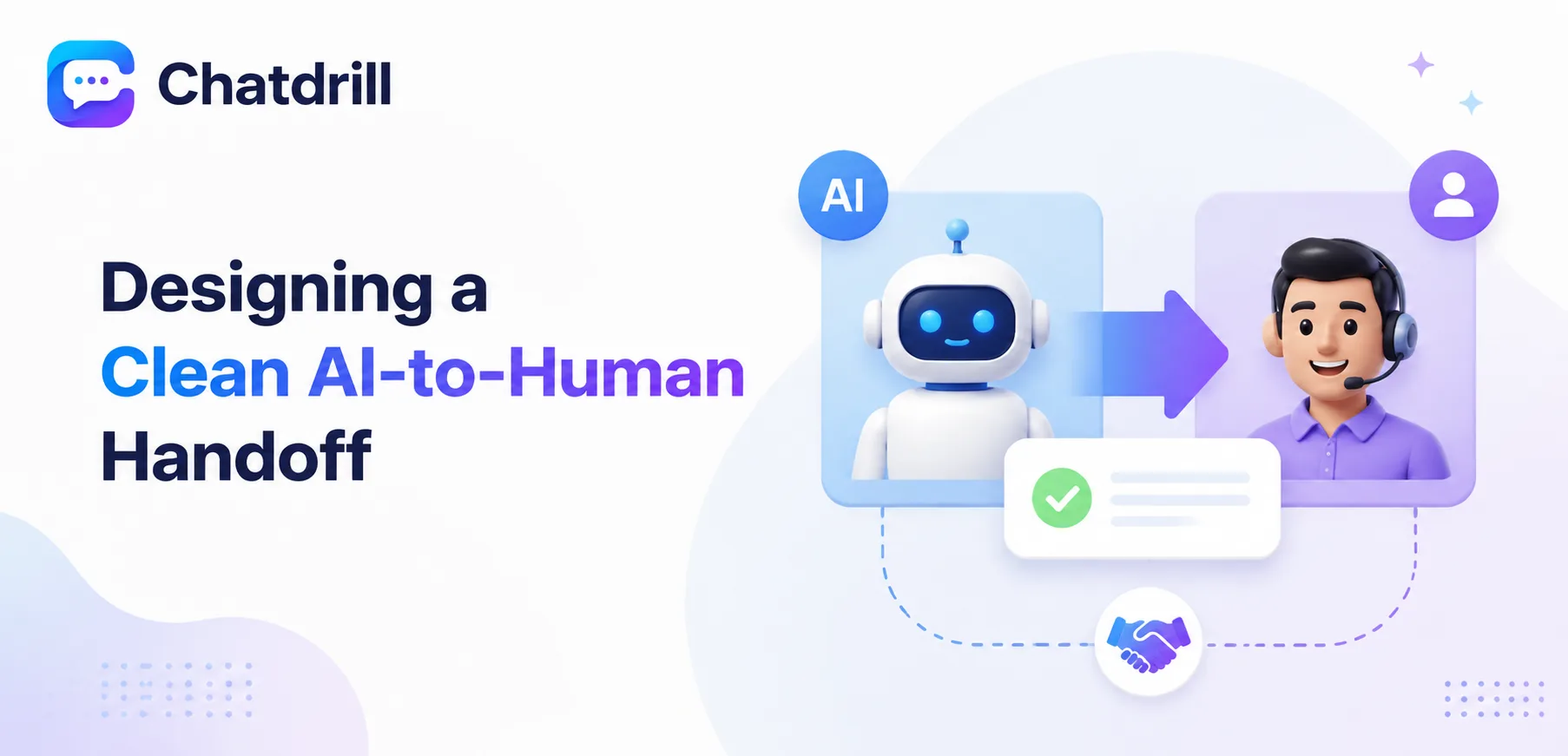
A clean AI-to-human handoff passes full conversation context to the agent taking over, so a customer never has to repeat what they already told the chatbot, one of the most consistently underrated factors in how a hybrid AI-plus-human support setup actually feels to use.
A poorly designed handoff undoes much of the value AI automation was meant to provide, if a customer has to start over explaining their issue to a human after already explaining it to the bot, the interaction feels more frustrating than if there'd been no AI involved at all.
This isn't just a customer experience nicety, a smooth handoff also makes the receiving agent's job easier and faster, since they can immediately understand the situation rather than needing to reconstruct it from scratch.
Getting handoff design right requires thinking through both the technical mechanics, how context actually transfers, and the human side, training agents to use that context well once they receive it.
This guide covers why handoff quality matters so much, what a genuinely clean handoff looks like, common failure patterns, a step-by-step approach to designing your own handoff flow, setting the right escalation triggers, and how ChatDrill handles this specifically.
Why Handoff Quality Matters
Handoff quality directly determines whether AI automation feels like a genuine efficiency gain or an added layer of friction, since a poorly executed handoff forces a customer to repeat themselves, undermining much of AI's time-saving value.
The customer experience stakes
A customer who has already explained their issue to a chatbot expects that context to carry forward, having to repeat it to a human agent feels like the system failed to actually listen the first time.
This repetition is consistently cited as one of the more frustrating support experiences, making handoff quality a genuine priority rather than a minor technical detail.
The agent efficiency stakes
An agent receiving full context can respond immediately and appropriately, while one starting cold needs to spend time reconstructing the situation, reducing the actual efficiency gain a hybrid AI-human system was meant to provide.
This efficiency loss compounds across a busy shift, a poor handoff process quietly erodes much of the time savings AI automation was supposed to deliver in the first place.
What a Clean Handoff Actually Looks Like
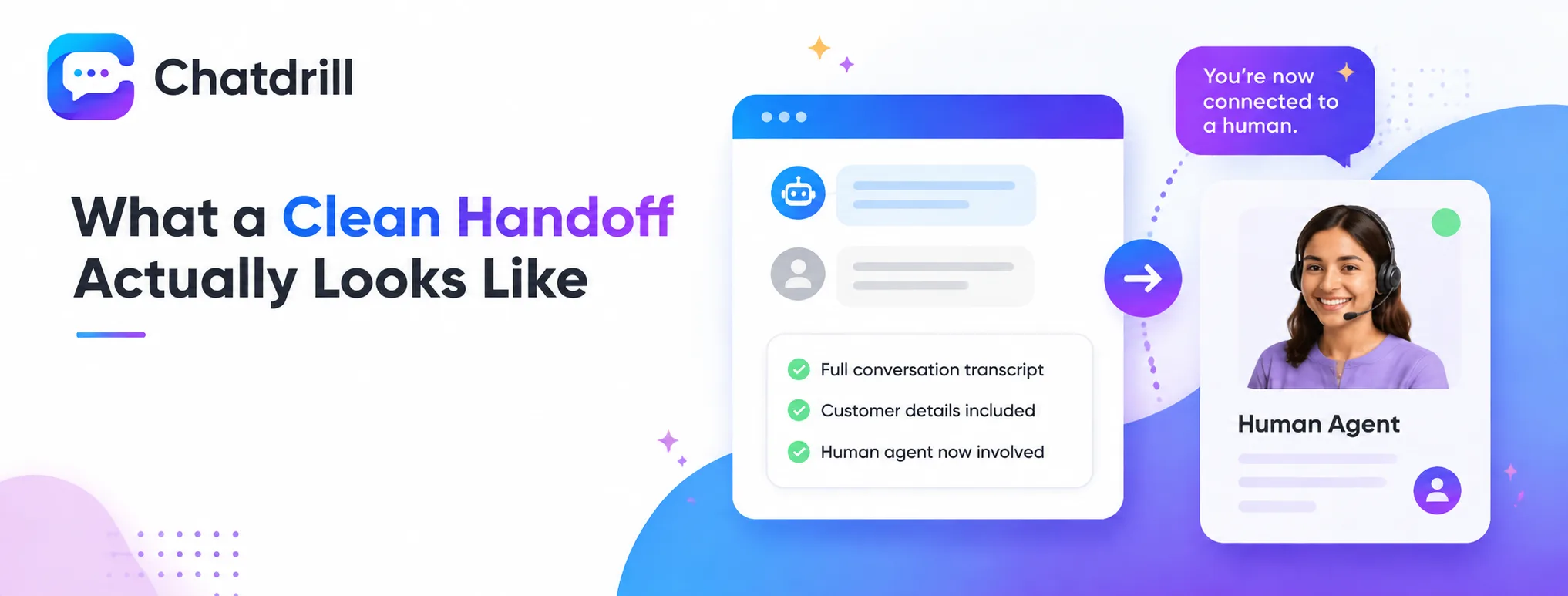
A clean handoff includes the full conversation transcript, any information already gathered like name or account details, and a clear signal to the customer that a human is now involved without losing the conversational thread.
Complete conversation transcript
The receiving agent should see everything the customer said to the AI, not a summary or partial excerpt, giving them the same full context the AI had access to.
This completeness matters because a summary can lose nuance or specific detail that turns out to be relevant, even if it didn't seem central to the AI's own response generation.
Already-gathered information
Any information the AI collected during qualification, name, account details, specific issue category, should transfer directly rather than requiring the agent to ask the customer to repeat it.
This transferred data is what actually delivers on the promise of AI qualification, an agent immediately equipped with relevant context rather than starting an unqualified conversation from zero.
A clear, natural transition signal
The customer should understand a human is now involved, ideally through a brief, natural message rather than an abrupt, jarring shift with no acknowledgment of the change.
This transition signal maintains trust and clarity, avoiding the confusion of a customer unsure whether they're still talking to a bot or a person.
Common Handoff Failures
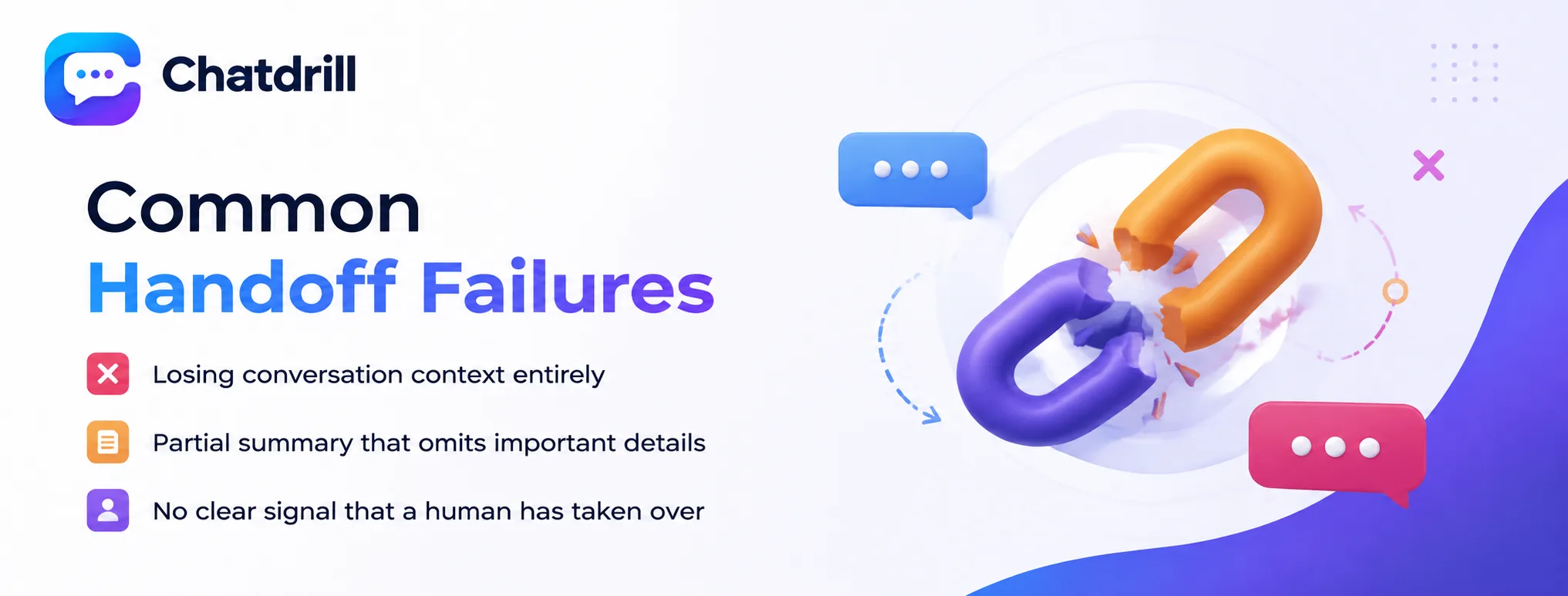
The most common handoff failures are losing conversation context entirely, transferring only a partial summary that omits important detail, and providing no clear signal that a human has taken over, leaving the customer confused about who they're talking to.
Losing context entirely
Some poorly integrated systems genuinely lose the prior conversation when transferring to a human, forcing the customer to start completely over, the worst possible handoff outcome.
This failure often stems from disconnected systems, an AI tool and a human support tool that were never properly integrated to share data seamlessly.
Transferring only a partial summary
Some systems attempt to summarize the conversation before handoff, but a summary can omit detail that turns out to matter, leaving the agent working from an incomplete picture without realizing it.
This is a subtler failure than losing context entirely, since it looks like a working handoff on the surface while still causing real friction when a summarized detail turns out to be important.
No clear transition signal
A handoff that happens invisibly, with no indication a different party is now responding, can genuinely confuse a customer about who they're talking to and undermine trust in the overall experience.
This is an easy failure to avoid but commonly overlooked, worth explicitly designing into the handoff flow rather than assuming it happens naturally.
Step-by-Step: Designing Your Handoff Flow
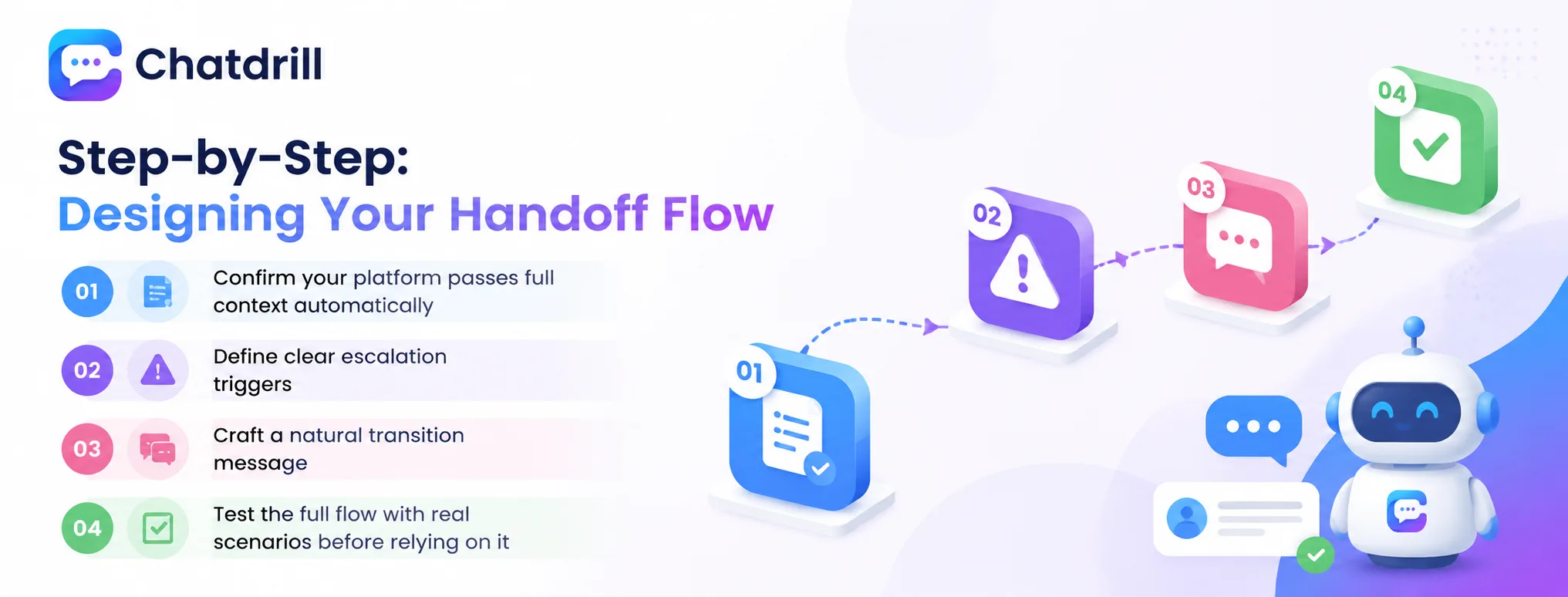
Designing a handoff flow involves confirming your platform passes full context automatically, defining clear escalation triggers, crafting a natural transition message, and testing the full flow with real scenarios before relying on it in production.
Step 1: Confirm full context transfer
Verify directly, through a real test conversation, that the complete transcript and any gathered information genuinely transfers to the receiving agent's view, not just partial or summarized data.
This verification is worth doing explicitly rather than assuming a platform's general claim of "seamless handoff" reflects genuinely complete data transfer.
Step 2: Define clear escalation triggers
Establish specific conditions that should trigger a handoff, an AI confidence threshold, a specific topic flagged for escalation, or an explicit customer request to speak with a human.
Clear, well-defined triggers prevent both premature escalation, wasting a human's time on something AI could handle, and delayed escalation, frustrating a customer who genuinely needs human help.
Step 3: Craft a natural transition message
Write a brief, warm message signaling the handoff, something like "I'm bringing in [name] from our team who can help further with this", rather than an abrupt, unexplained shift.
This message is worth testing for tone specifically, ensuring it feels natural and reassuring rather than robotic or alarming to the customer.
Step 4: Test with real scenarios
Run through several realistic escalation scenarios, confirming context transfers correctly and the transition feels smooth, before relying on the flow with real customers.
This testing catches configuration gaps while the stakes are low, rather than discovering a broken handoff only after it's already frustrated a real customer.
Setting Escalation Triggers
Effective escalation triggers include AI confidence dropping below a defined threshold, specific sensitive topics flagged for automatic human handling, and an explicit customer request to speak with a person, honored promptly rather than delayed.
Confidence-based escalation
Configuring the AI to escalate when its own confidence in a response drops below a set threshold catches situations where it's genuinely unsure, preventing a confidently wrong answer from reaching the customer.
This confidence-based trigger works alongside, not instead of, explicit topic-based escalation rules, providing a broader safety net for situations not specifically anticipated in advance.
Topic-based escalation
Explicitly flagging certain topics, pricing exceptions, complaints, legal or safety questions, for automatic escalation regardless of AI confidence provides a deliberate, business-defined safety boundary.
This explicit configuration reflects a business's own judgment about where human involvement matters most, rather than relying purely on the AI's own self-assessment.
Respecting explicit customer requests
A customer who directly asks to speak with a human should be honored promptly, rather than the AI continuing to attempt resolution against the customer's clearly stated preference.
Ignoring this explicit request is a fast way to frustrate a customer regardless of how capable the AI might otherwise be at resolving their actual issue.
How ChatDrill Handles AI-to-Human Handoff
ChatDrill transfers complete conversation context and gathered qualification data automatically during handoff, supports configurable escalation triggers, and includes a natural transition message, addressing each of the common failure points directly.
Automatic full context transfer
When a ChatDrill conversation escalates to a human agent, the complete transcript and any information the AI gathered transfers automatically, giving the agent immediate, full context.
This design directly addresses the most damaging handoff failure, ensuring a customer never needs to repeat information already shared with the AI.
Configurable escalation logic
Businesses can define their own escalation triggers within ChatDrill, confidence thresholds, specific topics, or honoring explicit customer requests, tailoring the handoff logic to their specific risk tolerance and support structure.
This flexibility lets each business calibrate handoff timing appropriately, rather than working within a rigid, one-size-fits-all escalation rule.