
Automating your top 20 FAQs means identifying the questions that actually make up the bulk of your support volume, writing clear, AI-ready answers for each, and training your chatbot specifically on these high-frequency questions before attempting broader automation.
Starting with a defined, manageable set like the top 20 rather than trying to cover every possible question at once makes the project genuinely achievable, with a clear, measurable scope rather than an open-ended, sprawling effort.
This focused approach also tends to deliver the fastest visible return, since the top 20 questions by definition represent your highest-volume, most repetitive support burden, exactly where automation delivers the most immediate efficiency gain.
Getting this right requires more than just picking 20 questions that seem important, it means grounding the selection in real data, writing genuinely clear answers, and testing thoroughly before relying on the automation in production.
This guide covers why starting with your top 20 FAQs makes sense, how to identify your actual top questions, how to write AI-ready answers, how to train and test the automation, how to measure and refine it, and how ChatDrill simplifies this process.
Why Starting With Your Top 20 FAQs Makes Sense
Focusing on the top 20 FAQs first gives an automation project a clear, achievable scope, targets the highest-volume, most repetitive questions for the fastest efficiency return, and provides a manageable foundation to expand from later.
A clear, achievable starting scope
Rather than an open-ended goal of "automate support," a defined list of 20 specific questions gives the project clear boundaries and a concrete, measurable definition of done for the initial phase.
This clarity makes the project genuinely achievable within a reasonable timeframe, avoiding the common trap of an automation effort that never feels complete because its scope was never clearly defined.
Maximizing early return on effort
By definition, your top 20 questions represent your highest-volume support burden, meaning even a modest automation success rate here delivers meaningful efficiency gains compared to automating rarer, lower-volume questions.
This favorable effort-to-impact ratio makes the top 20 the natural, highest-value starting point for any business beginning its chatbot automation journey.
A foundation to expand from
Once the top 20 are automated well, a business has both proven infrastructure and organizational confidence to expand automation further, rather than starting an entirely new effort each time.
This incremental expansion approach tends to produce more sustainable, well-maintained automation than attempting comprehensive coverage all at once from the very start.
Step 1: Identifying Your Actual Top 20
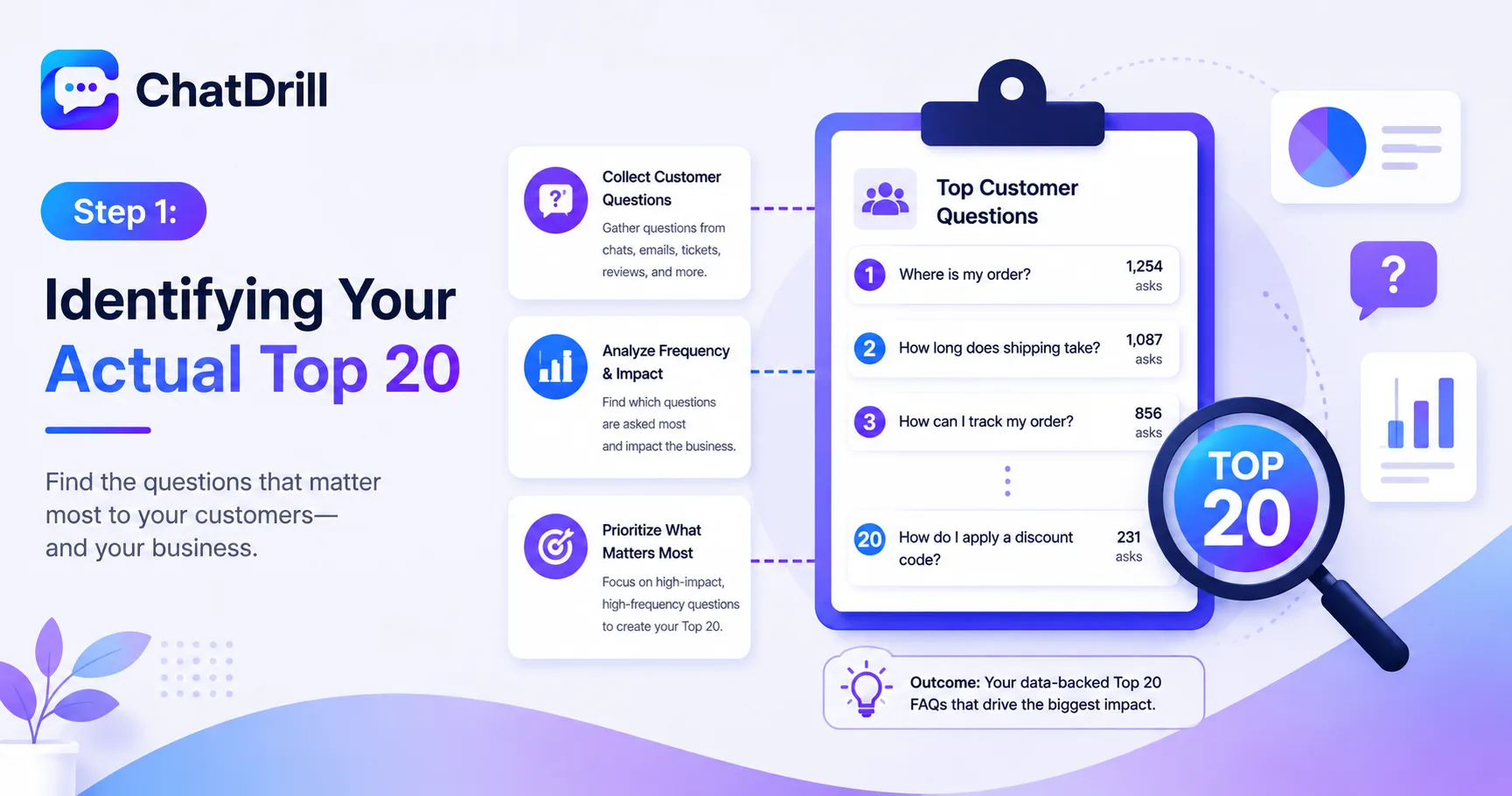
Identifying your genuine top 20 questions means reviewing real support conversation data rather than guessing, looking across multiple channels for a complete picture, and confirming the list with input from agents who handle these conversations daily.
Reviewing real conversation data
Analyzing recent chat, email, and ticket data reveals which questions genuinely recur most often, often producing a somewhat different list than what a team would guess without checking the actual data.
This data-grounded approach avoids the common mistake of automating questions that seem important in theory but don't actually reflect real, high-volume customer demand.
Looking across multiple channels
Reviewing patterns across chat, email, and any other support channel, not just one, gives a more complete picture of your genuine top questions than analyzing a single channel in isolation.
A question dominant in email but rare in chat, for instance, is still worth including if your goal is comprehensive support automation across the full customer contact surface.
Confirming with frontline agent input
Agents handling these conversations daily often have valuable, immediate insight into which questions genuinely dominate their workload, worth combining with the quantitative data review for a fuller picture.
This qualitative input can also reveal important nuance the raw data alone might miss, like which questions are simple to answer versus which only appear simple but actually require careful handling.
Step 2: Writing AI-Ready Answers
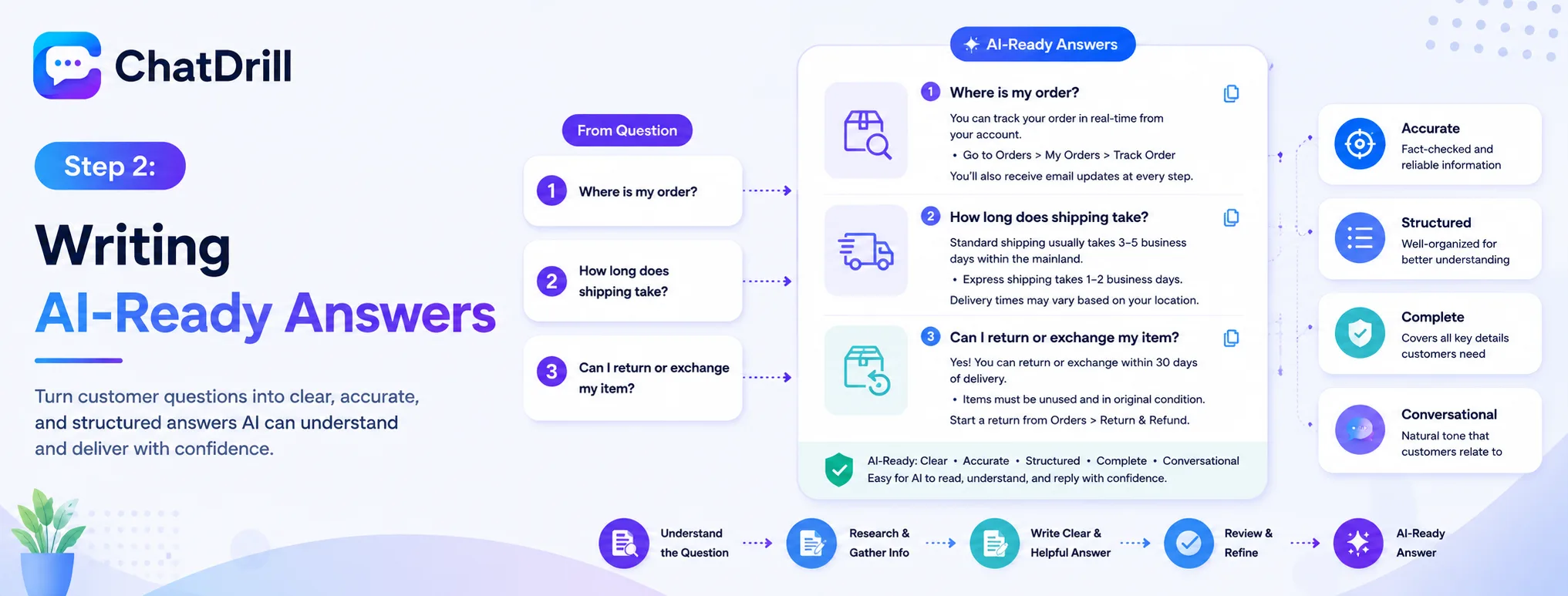
Writing AI-ready answers means being specific and complete rather than vague, covering common variations of how each question gets asked, and reviewing for accuracy against current policy before training the chatbot.
Being specific and complete
A genuinely useful AI-ready answer includes real specifics, actual timeframes, exact policy details, rather than a vague, generic response that doesn't actually resolve the customer's question.
This specificity is what determines whether the resulting automation genuinely helps customers or simply generates technically accurate but practically unhelpful responses.
Covering common phrasing variations
The same underlying question often gets asked in several different ways, worth considering these variations when writing the source content the AI will draw on, rather than assuming one phrasing covers every case.
This is less about writing multiple separate answers and more about ensuring the source content itself is comprehensive enough that AI interpretation can bridge different specific phrasings to the same underlying answer.
Reviewing for current accuracy
Before training, confirm each answer genuinely reflects current policy and product details, avoiding the risk of training the AI on outdated information that would then confidently misinform customers.
This accuracy review is worth treating as a genuinely important step, not a formality, since an inaccurate answer here directly becomes an inaccurate AI response later.
Step 3: Training and Testing
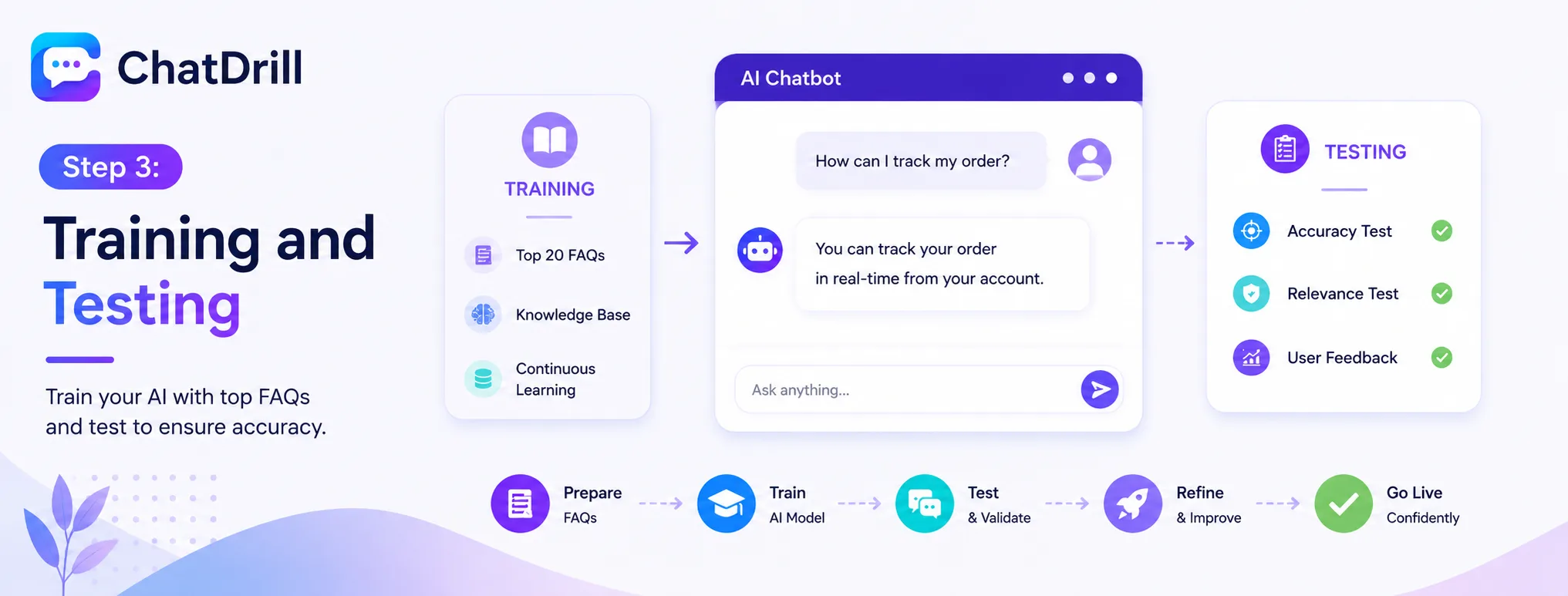
Training and testing means feeding the prepared content into your chatbot platform, testing each of the 20 questions with varied real phrasing, and confirming the AI handles edge cases and follow-up questions appropriately before launch.
Feeding content into the platform
Upload or connect your prepared FAQ content to your chatbot platform, most modern tools including ChatDrill support direct ingestion of structured content like this without extensive reformatting.
This step is typically fast for a well-organized set of 20 questions, often completing within an hour once the content itself is properly prepared.
Testing with varied phrasing
Test each of the 20 questions using several different real-world phrasings, not just the exact wording used in your source content, confirming the AI genuinely understands intent rather than only matching literal text.
This variation testing is essential for catching gaps before launch, since real customers will phrase questions in ways that don't always match your source content exactly.
Testing edge cases and follow-ups
Beyond the base questions, test how the AI handles a natural follow-up question or a slight variation combining two topics, revealing whether it can handle realistic conversational complexity beyond a single, isolated question.
This deeper testing catches gaps a simple, single-question test alone would miss, giving a more realistic preview of actual production performance.
Step 4: Measuring and Refining
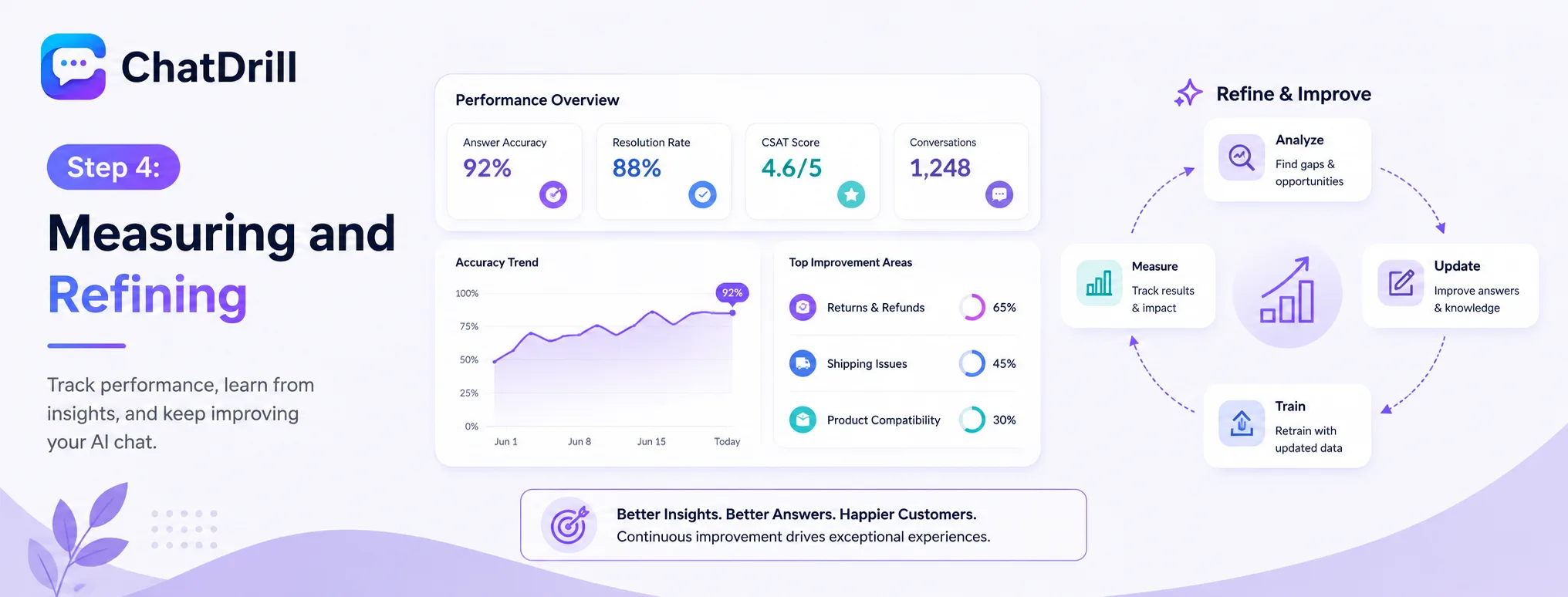
Measuring success means tracking deflection rate specifically for these 20 automated questions, reviewing real conversations for any remaining gaps, and expanding to the next tier of common questions once this initial set performs well.
Tracking deflection for the specific 20
Monitoring how successfully these 20 specific questions get resolved by AI, rather than a broader blended metric, gives the clearest, most direct signal of this focused automation effort's success.
This specific tracking also reveals if any of the 20 are underperforming, worth targeted refinement before assuming the whole project needs a broader overhaul.
Reviewing for remaining gaps
Even a well-prepared top 20 automation effort will reveal some gaps once exposed to real customer conversations, worth reviewing and addressing rather than assuming initial preparation was perfectly comprehensive.
This ongoing refinement, informed by real usage data, is what takes automation from initially functional to genuinely excellent over the following weeks and months.
Expanding to the next tier
Once the top 20 are performing well, extending the same process to the next tier of common questions, perhaps questions 21 through 40, builds on proven infrastructure and process rather than starting fresh.
This incremental expansion approach, covered in the broader context of tier-1 automation in a related guide, tends to produce more sustainable long-term automation than attempting comprehensive coverage all at once.
How ChatDrill Simplifies FAQ Automation
ChatDrill supports direct ingestion of prepared FAQ content, provides testing tools to validate performance before launch, and tracks deflection rate automatically, streamlining the entire top-20 automation process from preparation through measurement.
Streamlined content ingestion
ChatDrill accepts structured FAQ content directly, letting a business move from prepared answers to a trained, testable chatbot without extensive manual reformatting or technical setup work.
This streamlined process makes the top-20 approach genuinely achievable within a short timeframe, rather than requiring weeks of technical implementation effort.
Built-in testing and reporting
ChatDrill's platform supports direct testing of trained content before launch, plus automatic deflection rate tracking afterward, giving a business the tools needed to execute the full measure-and-refine cycle covered earlier.
This built-in support removes the need to build separate testing or tracking infrastructure, letting a business focus effort on the content itself rather than tooling.