

Most chat industry content understandably emphasizes chat's broad, positive impact, yet a fair, complete answer requires acknowledging that chat's effectiveness genuinely varies by business type, and it doesn't deliver equally strong value in every single context.
Quick answerLive chat delivers genuine value for most businesses with real-time, resolvable pre-purchase or support questions, but its effectiveness varies meaningfully by business type, a business with very low website traffic, a purely informational site with no genuine decision point, or one where questions are typically too complex for real-time resolution may see considerably less benefit than the broadly cited averages suggest.
Understanding both where chat consistently delivers genuine value and where its impact is more modest helps a business make a realistic, evidence-based decision rather than assuming universally positive results based on broad, general statistics.
This guide covers where chat consistently delivers strong value, where its impact tends to be more modest, how to assess your own likely fit, and how Chatdrill supports a range of different business contexts.
Where Chat Consistently Delivers Strong Value
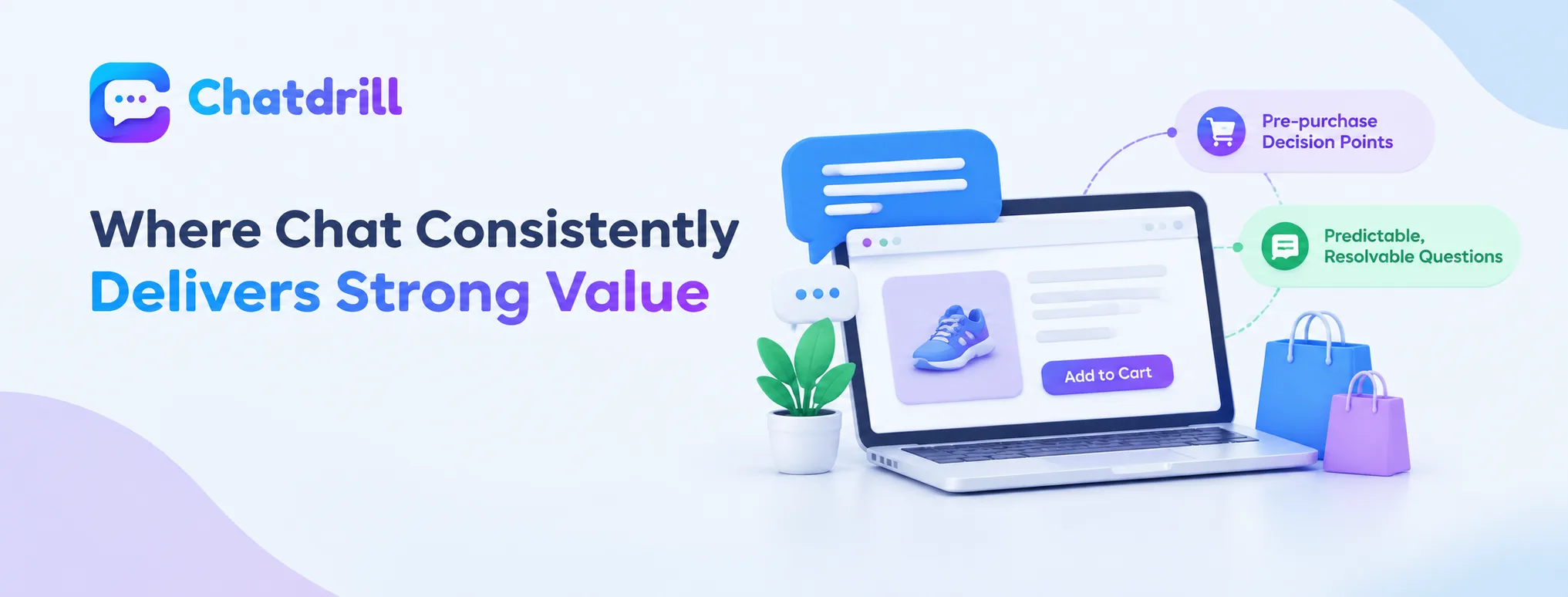
Businesses with genuine pre-purchase hesitation points and resolvable, real-time questions consistently see chat's broadly cited benefits.
Businesses with genuine pre-purchase decision points
A business where visitors genuinely need a specific question answered before deciding to purchase, sizing, compatibility, pricing clarification, sees chat deliver its most consistently cited value, since real-time resolution directly addresses this genuine decision friction.
This fit explains why ecommerce, SaaS, and many service businesses feature so prominently in cited chat success statistics, their business models genuinely involve this kind of resolvable, purchase-relevant hesitation.
Businesses with predictable, resolvable question volume
A business whose typical questions are genuinely answerable through accurate information, rather than requiring complex, individualized professional judgment, sees chat's AI-assisted resolution capability deliver strong, consistent value.
This predictability factor is part of why chat's cited benchmarks and success stories concentrate so heavily around businesses with this kind of genuinely addressable question pattern.
Where Chat's Impact Tends to Be More Modest

Very low-traffic sites, purely informational businesses without a genuine decision point, and highly complex, individualized question contexts see more modest chat impact.
Very low website traffic
A business with genuinely minimal website traffic may not generate enough chat volume to justify meaningful investment, since the fixed cost of implementation and training doesn't scale down proportionally with a very small conversation volume.
This doesn't mean chat provides zero value at low traffic, only that the relative return on investment is genuinely more modest than for a higher-traffic business generating substantial conversation volume.
Purely informational sites without a genuine decision point
A website that's purely informational, without any genuine purchase, signup, or specific decision a visitor is actually working through, has less of the hesitation-resolution opportunity that drives chat's most commonly cited value.
For this kind of site, chat's value proposition shifts more toward simple accessibility and brand impression than the conversion-lift mechanism relevant to a business with a genuine, resolvable decision point.
Assessing Your Own Likely Fit
Honestly evaluating your own traffic volume and typical question complexity produces a more realistic expectation than assuming broadly cited averages automatically apply.
Evaluating your own genuine traffic and question volume
Reviewing your own actual website traffic and the volume of genuine, resolvable questions your business typically receives provides a more honest basis for expecting chat's value than assuming a broadly cited average automatically applies to your specific situation.
This self-assessment, rather than either uncritical optimism or dismissal, produces a genuinely realistic starting expectation.
Considering a modest pilot before full investment
For a business genuinely uncertain about fit, a modest, low-commitment pilot implementation can reveal actual, business-specific results more reliably than relying entirely on general industry statistics that may not reflect your particular context.
This pragmatic, evidence-gathering approach respects the genuine uncertainty this guide identifies rather than assuming either universal success or failure without direct, business-specific evidence.
Talk to visitors the moment they land, from a widget that installs in minutes.
See how it works