
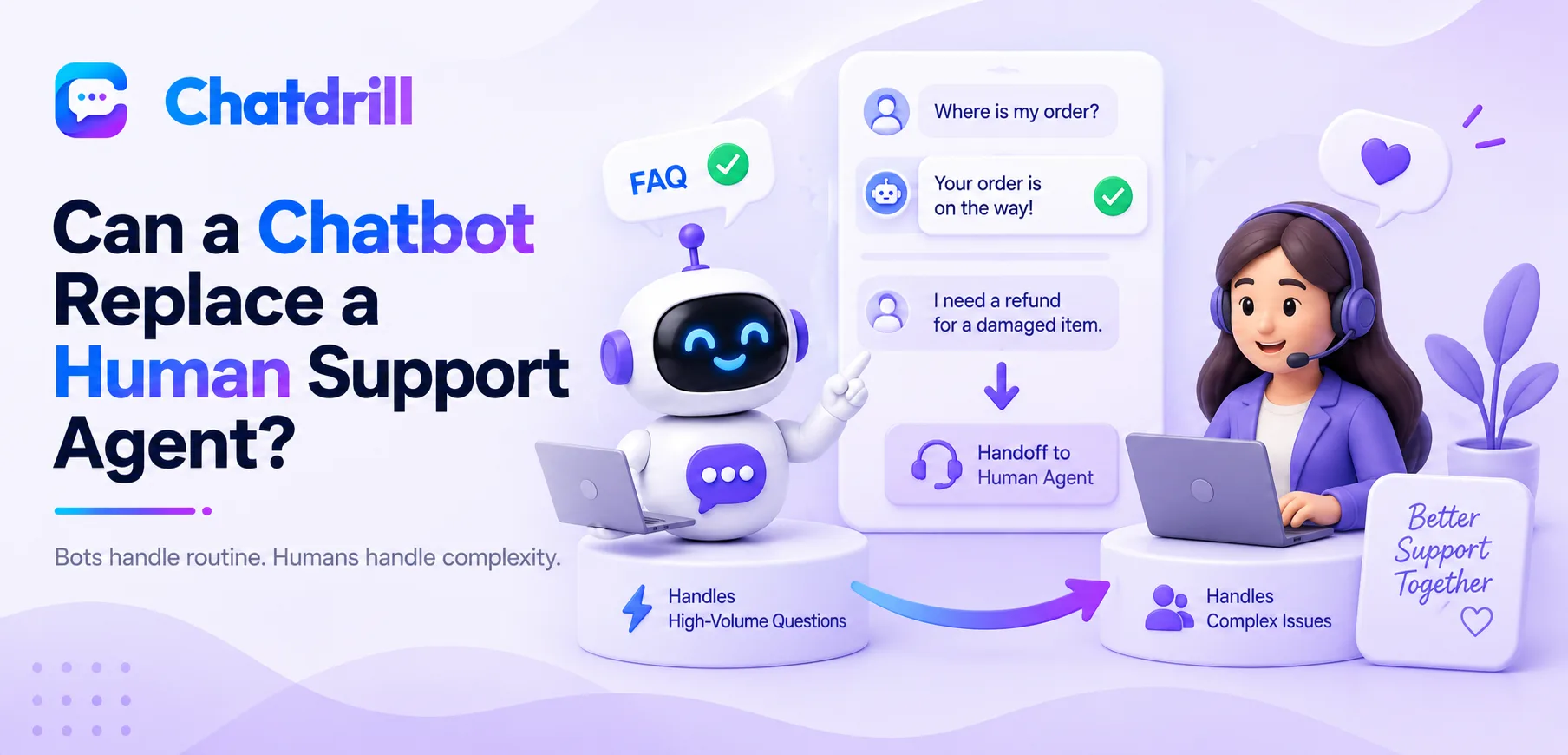
Whether a chatbot can replace a human support agent is a question that provokes strong reactions on both sides, and the honest, current answer sits somewhere between the two extremes of "completely" and "not at all."
Quick answer: A chatbot can fully replace a human agent for routine, well-defined questions with clear answers, but it can't yet fully replace a human for emotionally complex situations, genuinely novel problems, or conversations requiring real judgment, meaning the realistic model is chatbots handling volume while humans handle complexity, not full replacement.
For a genuinely large share of routine, well-defined customer questions, a well-trained chatbot can resolve the issue as effectively as a human agent, often faster and more consistently.
For situations requiring genuine empathy, handling real ambiguity, or navigating a customer's unique, unanticipated circumstances, human judgment still meaningfully outperforms current chatbot capability.
This guide covers where chatbots genuinely match human capability, where humans still meaningfully outperform bots, the realistic current model, and how ChatDrill reflects this balanced approach.
Where Chatbots Genuinely Match Human Capability
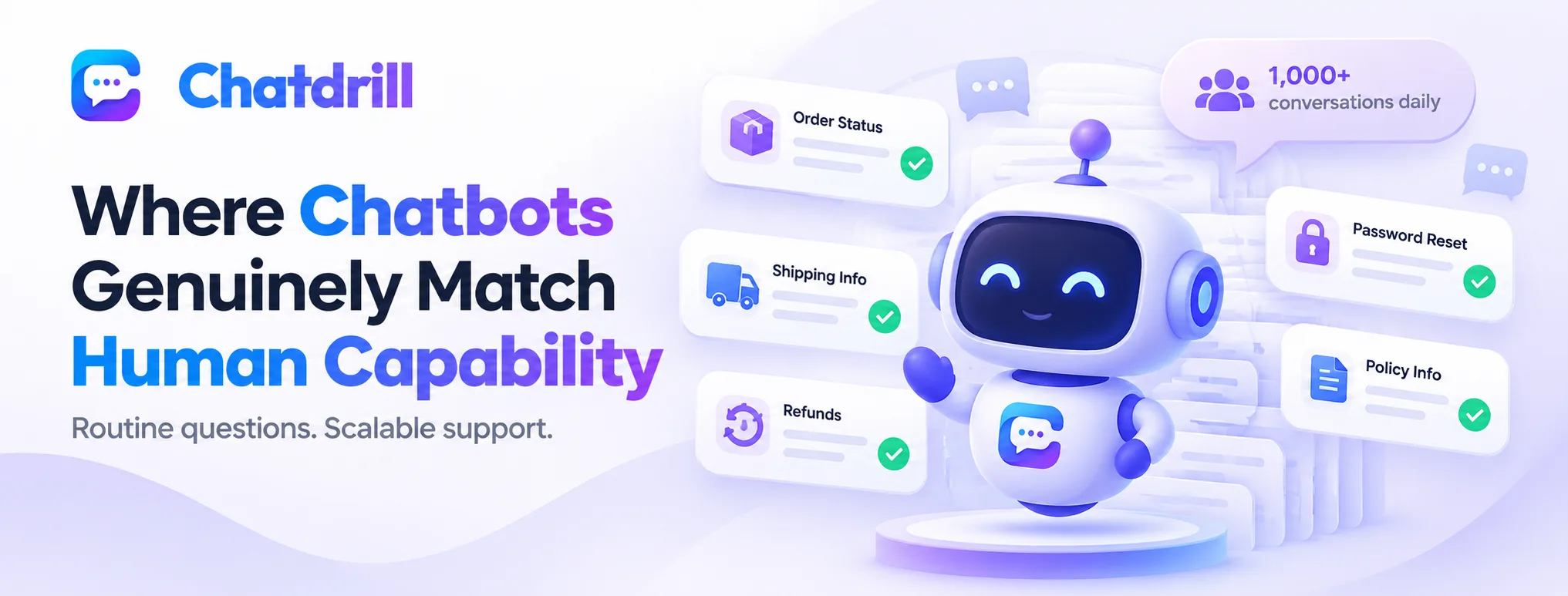
For routine, well-defined questions with clear, factual answers, a well-trained chatbot can resolve issues as effectively and consistently as a human agent.
Routine, factual questions
Questions with a clear, factual answer, order status, standard policy details, common how-to questions, are genuinely well within current chatbot capability, especially when trained accurately on a business's specific content.
For this category of question, a chatbot often outperforms a human agent on consistency and speed, since it doesn't vary based on individual knowledge gaps or fatigue.
High-volume, repetitive interactions
For genuinely repetitive interactions occurring at high volume, a chatbot's ability to handle many simultaneous conversations without degrading quality represents a genuine capability advantage over relying purely on human staffing.
This scalability is where chatbots deliver some of their clearest, most measurable value, handling volume a human team alone couldn't sustainably absorb.
Where Humans Still Meaningfully Outperform Chatbots
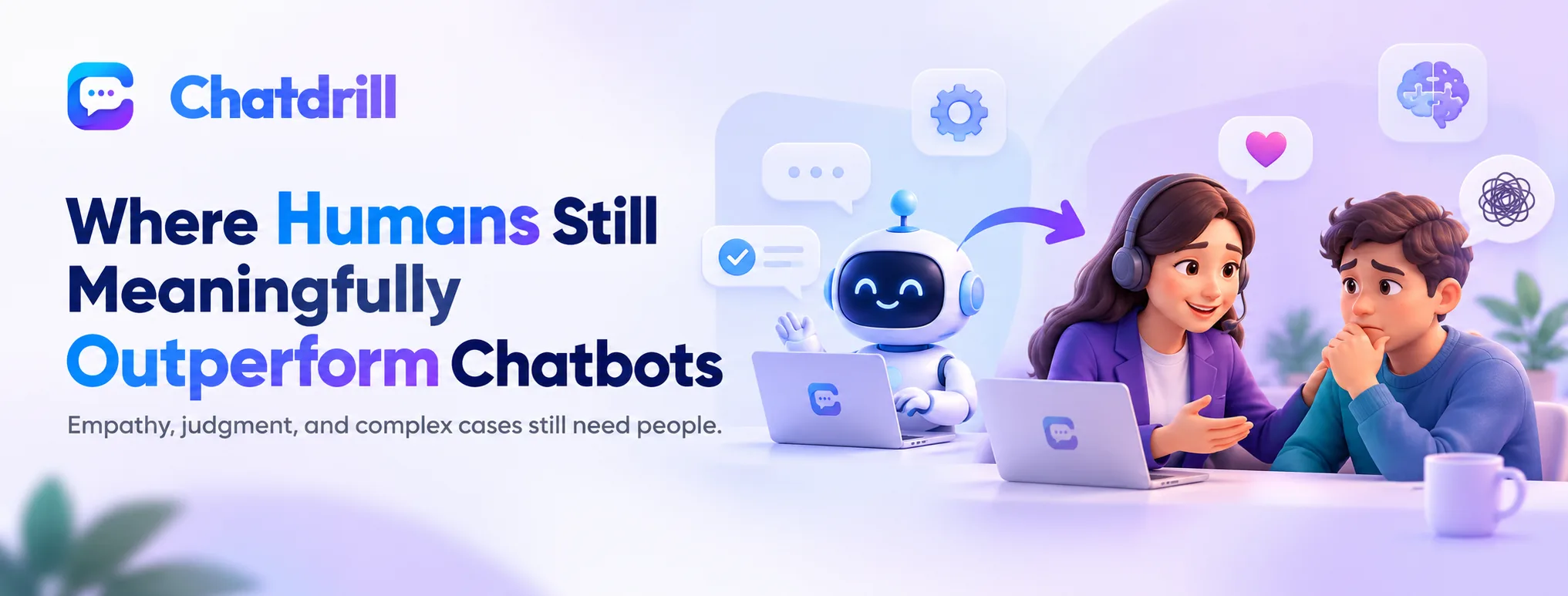
Genuine emotional complexity, novel situations outside any training data, and decisions requiring real judgment remain areas where human capability still clearly exceeds current chatbot technology.
Emotionally complex situations
A customer experiencing genuine distress or frustration often needs authentic empathy and nuanced emotional calibration that current AI, however sophisticated its language generation, doesn't genuinely possess the way a thoughtful human does.
This gap matters most in situations where the emotional handling of a conversation is as important as its factual resolution.
Genuinely novel or ambiguous situations
A situation falling outside anything a chatbot was trained to anticipate, a truly unusual circumstance or an ambiguous edge case, often requires the kind of flexible, creative judgment that remains a genuine human strength.
This is why even the most advanced current chatbot systems still benefit from a reliable human escalation path for situations genuinely outside their trained scope.
The Realistic Current Model: Complementary, Not
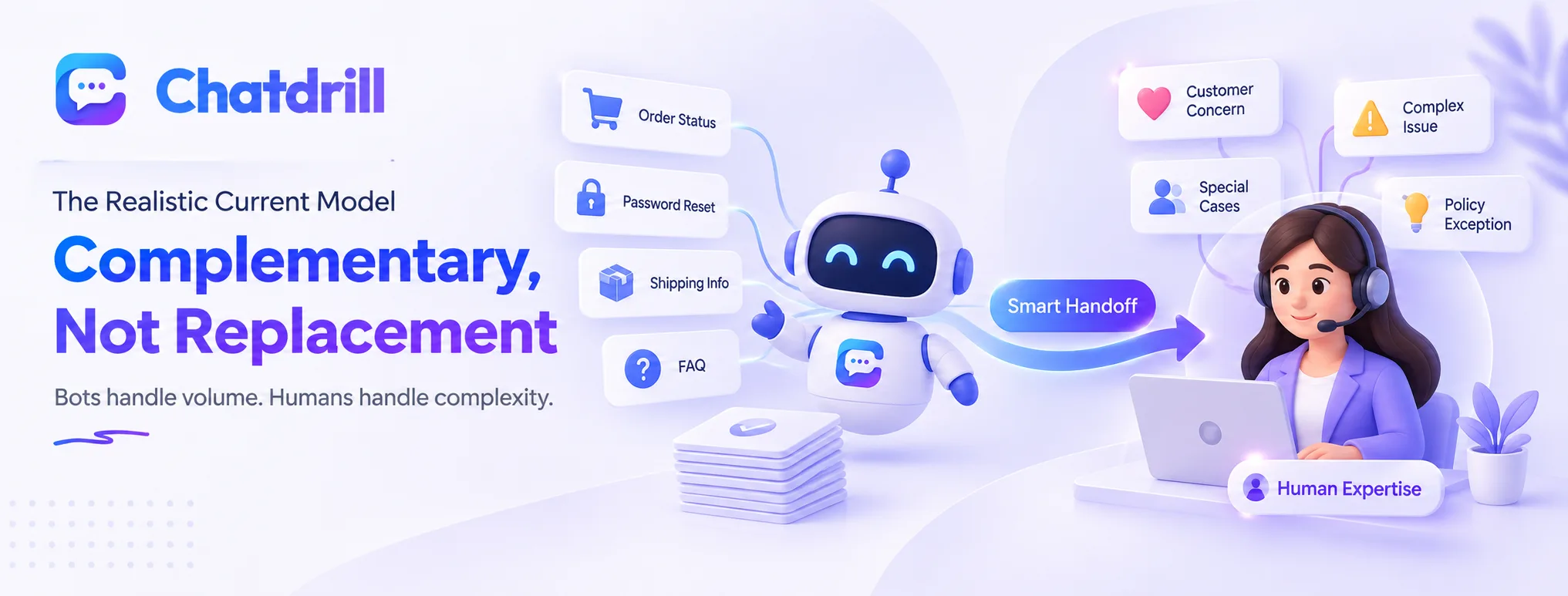
The genuinely realistic model emerging across the industry isn't full replacement, but chatbots absorbing routine volume while humans handle the complexity that genuinely requires their judgment.
Why full replacement isn't the current reality
Despite significant AI advancement, current industry data and expert commentary consistently point toward a human-plus-AI collaborative model rather than full replacement, reflecting a realistic read of where AI genuinely excels versus where it still falls short.
This complementary model reflects both current technical limitations and a reasonable, cautious approach to introducing automation into genuinely consequential customer interactions.
How this division of labor actually plays out
In practice, this means a chatbot resolving the large majority of routine, factual questions directly, while genuinely complex, emotional, or novel situations route to a human agent equipped with full context from whatever the bot already attempted.
This division allows both chatbot efficiency and human judgment to contribute where each genuinely adds the most value, rather than forcing either into situations poorly suited to their actual capability.
What This Means for Staffing Decisions
Businesses adopting this complementary model typically reduce, rather than eliminate, human support staffing, while shifting remaining human roles toward higher-complexity, higher-value work.
Reduction rather than elimination
As chatbots absorb routine volume, support staffing needs typically decrease relative to what pure human handling would require, though genuine elimination of human roles remains uncommon given the persistent need for complex-case handling.
This reduction, rather than elimination, pattern reflects the realistic complementary model rather than the more dramatic full-replacement narrative sometimes suggested.
Shifting human roles toward higher-value work
Remaining human agents in this model typically handle a genuinely different, more consistently complex mix of conversations than before automation, often finding the work more engaging given the reduced volume of purely repetitive questions.
This shift represents a meaningful, positive change in the nature of human support work, not simply a reduction in headcount.
How ChatDrill Reflects This Complementary Approach
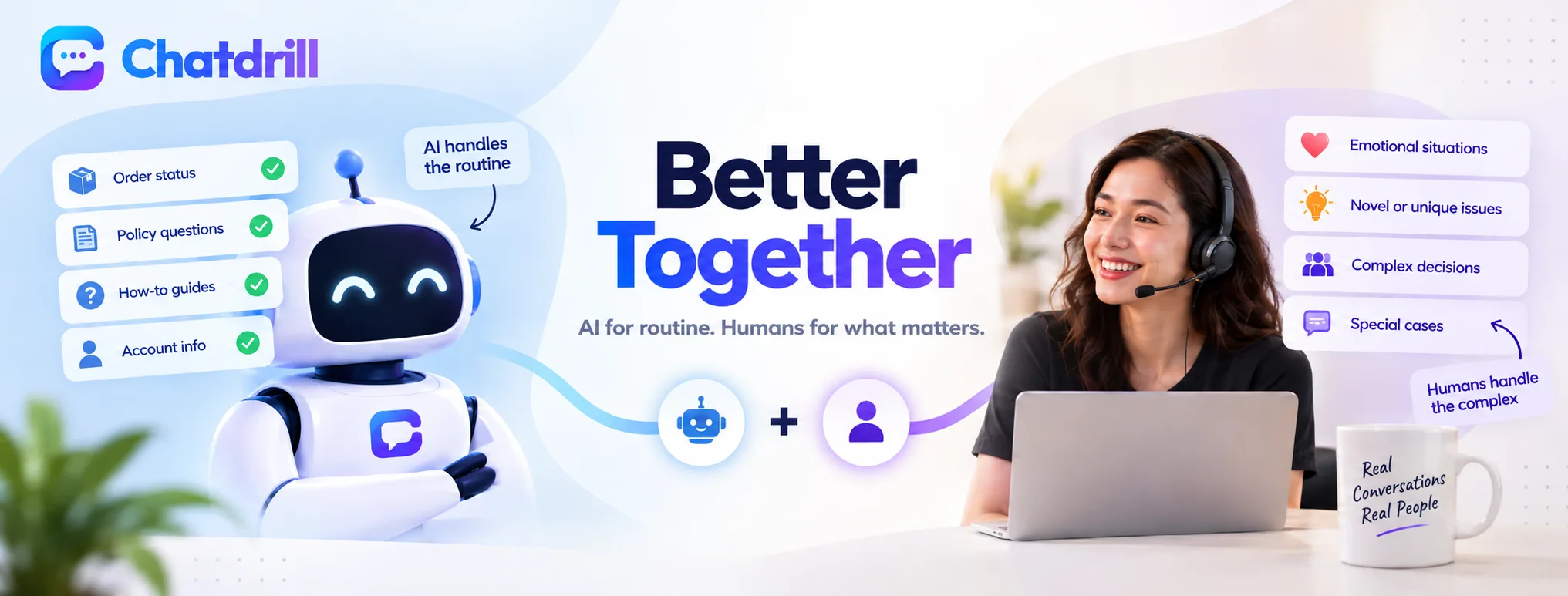
ChatDrill is built around genuine AI resolution for routine questions paired with reliable human handoff for complexity, reflecting the realistic complementary model this guide describes rather than an unrealistic full-replacement promise.
Genuine AI resolution for routine volume
ChatDrill's AI, trained on your specific business content, handles routine, factual questions directly and accurately, delivering the efficiency and consistency chatbots are genuinely capable of providing today.
This resolution capability reflects honest, current technology capability rather than overpromising complete automation across every possible support scenario.
As training content is refined over time based on real conversations, this resolution capability tends to expand gradually into a wider range of question types without requiring a platform change.
Reliable handoff preserving human judgment where it matters
When a conversation genuinely requires human judgment, emotional nuance, or falls outside what the AI has been trained to handle, ChatDrill hands off cleanly with full context, ensuring human capability remains available exactly where it's genuinely needed.
This design reflects the complementary model this guide identifies as the realistic, honest current state of chatbot-versus-human capability, rather than pretending full replacement is already achievable.
Planning Your Own Human-AI Division of Labor
Deciding specifically which question types your business routes to AI versus human agents benefits from starting conservatively and expanding gradually as confidence in AI accuracy grows.
Starting with clearly routine categories first
Beginning AI automation with the most clearly routine, low-risk question categories, rather than attempting to automate everything simultaneously, builds genuine confidence in the system's accuracy before extending its scope further.
This conservative starting point also gives your team direct, observable evidence of AI performance before deciding how far to extend its role.
Expanding scope based on demonstrated accuracy
Reviewing real performance data before expanding AI's role into additional question categories ensures each expansion is grounded in demonstrated capability rather than assumption.
This gradual, evidence-based expansion approach reflects the same cautious, staged introduction of automation that this guide identifies as the reasonable, realistic path most businesses are actually taking.