

Determining what genuinely counts as a good chatbot containment rate requires looking past a single headline number, since cited benchmarks vary considerably based on deployment maturity, technology approach, and industry complexity.
Quick answer Cited 2026 research places a good chatbot containment rate between 70% and 90% for mature, well-configured deployments, with newer implementations more typically landing between 20% and 40%, and a Gartner-cited benchmark of 40% to 65% specifically for well-configured RAG-based chatbots, meaning what counts as "good" depends heavily on deployment maturity and industry context rather than one universal number.
Multiple cited sources converge on a similar pattern nonetheless, a meaningful gap between newer, less-refined deployments and mature, well-configured ones, with the gap driven mostly by training depth rather than fundamental technology limitations.
Understanding this pattern, along with the important caveat that containment alone doesn't confirm genuine resolution, helps a business set a realistic target and interpret its own containment rate meaningfully.
This guide covers the cited benchmark ranges, why containment alone can mislead, what actually drives strong containment, and how ChatDrill supports genuinely strong, appropriate containment.
Cited Containment Rate Benchmark Ranges
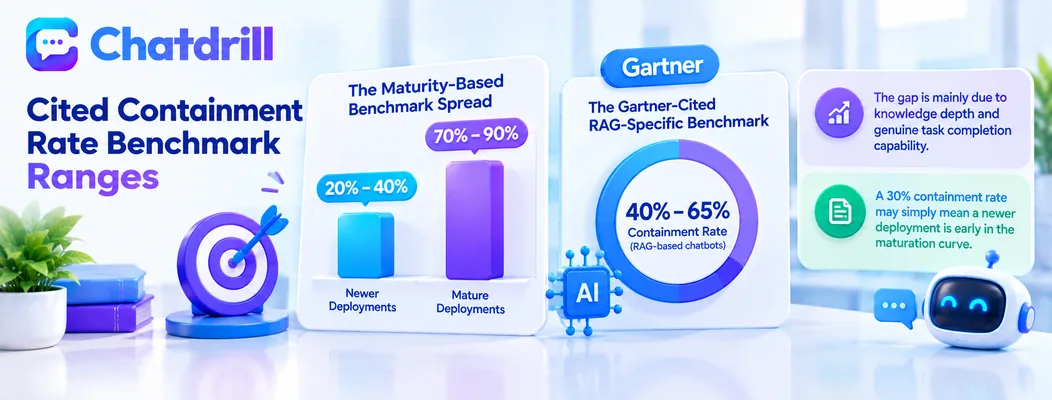
Cited research places newer deployments around 20% to 40% containment and mature ones at 70% to 90%, with a more specific Gartner-cited benchmark of 40% to 65% for well-configured RAG-based chatbots.
The maturity-based benchmark spread
Research citing industry analysis consistently identifies a wide spread, most chatbots starting around 20% to 40% containment, with mature implementations reaching 70% to 90%, a gap the cited research attributes mostly to knowledge depth and genuine task completion capability.
This maturity-driven variation is important context, a newer deployment landing at 30% containment isn't necessarily underperforming, it may simply be early in a genuinely normal maturation curve toward higher performance over time.
The Gartner-cited RAG-specific benchmark
Separate research citing Gartner's 2025 Customer Service Technology Survey places a more specific benchmark, 40% to 65% containment, for a well-configured, retrieval-augmented generation chatbot specifically.
This figure reflects genuinely modern AI trained directly on real business content, a meaningfully different approach from older, more rigid rule-based systems that this same cited research notes typically perform 15 to 25 percentage points lower.
Why Containment Alone Can Be Misleading
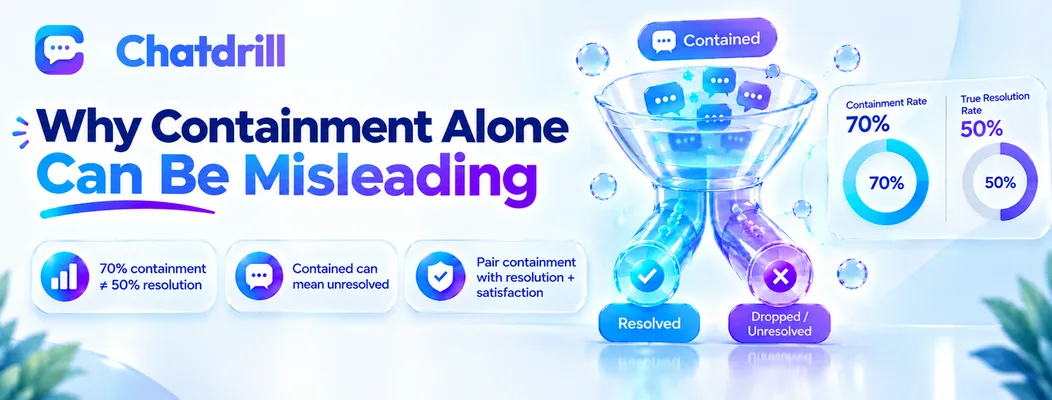
A conversation can be technically contained without the customer's actual issue being genuinely resolved, making containment rate a metric that needs pairing with resolution and satisfaction data.
The containment-without-resolution gap
Cited research specifically warns that a store can report a flattering 70% containment rate while its true resolution rate sits closer to 50%, since a meaningful share of "contained" chats can end with a customer simply giving up rather than genuinely getting help.
This gap between reported containment and genuine resolution represents one of the most important caveats to keep in mind when evaluating any cited or self-reported containment figure.
The specific failure pattern behind inflated containment
Cited research identifies a specific pattern called answer-only fallback, where a bot provides some response without genuinely resolving the issue, yet the conversation still counts as "contained" because it never technically escalated to a human.
Recognizing this specific failure mode is what allows a business to interpret its own containment rate honestly, rather than treating a high number as automatic proof of genuine chatbot success.
What Actually Drives Strong, Genuine Containment
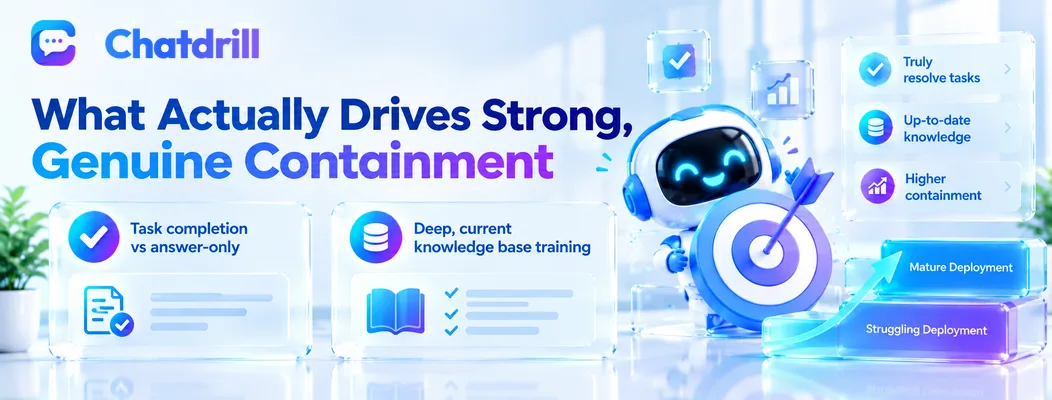
Genuine task completion capability and deep, current knowledge base training, more than raw technology sophistication alone, explain the difference between mature and struggling deployments.
Task completion versus answer-only capability
Cited research identifies the biggest containment gains as coming from letting a bot genuinely complete a task, updating a record, processing a request, rather than only answering informational questions, a meaningfully deeper capability than simple Q&A.
This task-completion depth is precisely what separates a genuinely mature, high-containment deployment from one that merely deflects conversations without resolving them.
Deep, current knowledge base training
Cited research also emphasizes that weak natural language processing and outdated or rigid knowledge bases produce sharp containment drops, meaning ongoing content quality and currency matter as much as the underlying AI technology itself.
This emphasis on training depth reinforces why containment rate should be understood as a moving target that improves with sustained investment, not a fixed number determined purely by which platform a business chooses.
Setting a Genuinely Appropriate Target
Grounding your target in your own industry's realistic complexity and your deployment's actual maturity stage produces a more meaningful goal than adopting a generic cross-industry figure.
Accounting for your own industry's genuine complexity
A business in a genuinely complex or regulated industry should reasonably target a containment rate on the lower end of, or even below, the cited general ranges, reflecting appropriate escalation rather than a technology shortcoming.
This industry-aware target-setting avoids the unfair comparison that would result from judging every business against the same universal containment benchmark regardless of genuine question complexity.
Tracking your own maturity trajectory over time
Rather than expecting to reach mature-deployment containment rates immediately, tracking your own trajectory from an honest starting point toward the cited mature-deployment range over a realistic, sustained timeframe reflects the genuine maturation pattern cited research describes.
This trajectory-based framing, improvement over time rather than an immediate target, better reflects how containment rate genuinely develops in practice.
How ChatDrill Supports Genuinely Strong Containment

ChatDrill's task-completion capability and combined resolution tracking directly address the two factors this guide identifies as most important for genuine, not just reported, containment success.
Genuine task completion, not just answer generation
ChatDrill's AI is built to genuinely resolve questions using your actual business content, reflecting the task-completion depth this guide identifies as the key driver behind mature, high-containment deployments.
This capability helps a business move beyond the answer-only fallback pattern cited research identifies as a common, containment-inflating failure mode.
Combined tracking preventing misleading containment reporting
ChatDrill tracks containment alongside genuine resolution accuracy and CSAT together, directly avoiding the specific containment-without-resolution gap this guide identifies as a common measurement trap.
This combined reporting ensures a business genuinely understands whether its containment rate reflects real customer value, not just conversations technically avoiding a human agent.