
A missed chat message is easy to treat as a minor, isolated gap, yet cited research suggests missed chats happen more often than most businesses assume, and each one carries a genuine, multi-layered cost extending well beyond that single unanswered conversation.
Quick answerThe true cost of a missed chat message extends beyond the immediate, unanswered conversation, since cited research finds even the best-performing teams missing around 21% of chats (SuperOffice), and each miss represents not just a lost immediate sale but forfeited marketing spend, a damaged first impression, and a real chance the customer simply contacts a competitor instead.
Understanding the full, true cost, not just the immediate lost opportunity but the compounding effects on marketing spend and customer perception, helps a business genuinely prioritize reducing this specific, common gap.
This guide covers the cited missed-chat rate, the specific layers of cost a missed message carries, why this cost often goes underestimated, and how Chatdrill helps reduce missed chat messages.
The Cited Missed-Chat Rate Reality
Cited research finds even the best-performing teams missing a meaningful share of incoming chats, suggesting this cost applies broadly, not just to poorly staffed operations.
The cited best-case missed-chat rate
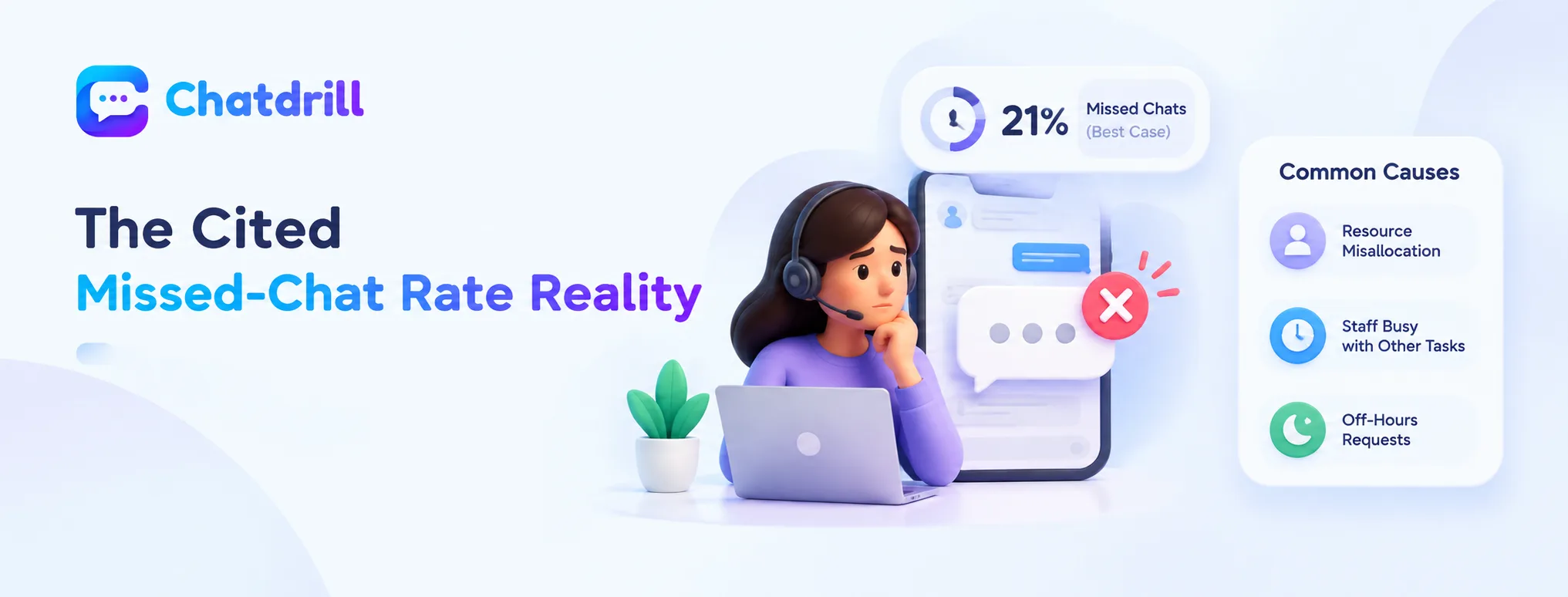
Research citing SuperOffice data finds the lowest achievable missed-chat rate around 21%, even among well-performing teams, suggesting some level of missed-chat cost is a genuinely common, widespread challenge rather than a rare failure specific to poorly run operations.
This baseline matters because it reframes missed chats as a systemic, addressable pattern worth deliberately reducing, rather than an occasional, easily dismissed anomaly.
Common causes behind missed chats
Cited research identifies resource misallocation, staff being busy with other tasks, and requests arriving during genuinely off-hours periods as common, identifiable causes behind this consistent missed-chat pattern.
Recognizing these as specific, addressable causes, rather than an unavoidable cost of doing business, is what makes deliberate reduction efforts genuinely worthwhile.
The Specific Layers of Cost a Missed Message Carries

Beyond the immediate lost conversation, a missed message forfeits the marketing spend that generated the visit and risks the customer simply going to a competitor.
Forfeited marketing spend behind the visit
A visitor who reached your site through paid advertising or SEO investment, only to have their chat message go unanswered, represents wasted marketing spend on top of the immediate lost interaction, a cost easily overlooked when only counting the missed conversation itself.
This compounding cost means a missed chat message is genuinely more expensive than it first appears, since it also negates some portion of the acquisition investment that brought the visitor to your site in the first place.
The real risk of losing the customer to a competitor
A customer whose chat message goes unanswered doesn't necessarily wait patiently, cited broader research on customer patience and channel-switching behavior suggests many simply move on to a competing option instead, particularly for a genuinely urgent or time-sensitive need.
This competitive loss risk means a missed message's cost isn't confined to this one interaction, it potentially represents a permanently lost customer relationship rather than merely a delayed one.
Why This Cost Often Gets Underestimated
The invisibility of a missed chat, and the difficulty of directly attributing a lost sale to it, both contribute to this cost being commonly underappreciated.
The invisibility problem
Unlike an escalated complaint or a negative review, a missed chat message often produces no visible signal at all, the customer simply leaves silently, meaning the true scale of this cost frequently goes unnoticed without deliberate tracking.
This invisibility is precisely why establishing genuine missed-chat tracking, rather than assuming the problem doesn't exist absent visible complaints, matters for accurately understanding this cost.
The attribution difficulty
Directly connecting a specific missed chat to a specific lost sale is genuinely difficult, since the customer who left doesn't typically report back on what ultimately happened, making this cost harder to quantify precisely than a more directly measurable metric.
This measurement difficulty doesn't mean the cost isn't real, only that a business must reason from cited, aggregate patterns rather than expecting to trace every individual missed-chat cost with certainty.
Answer chats from your phone, with push notifications and the full inbox.
See how it works