

A post-chat survey with ten questions gets a fraction of the completion rate of one with a single, well-chosen question, meaning more isn't better here, precision is what actually produces useful, representative data.
The goal of a post-chat survey isn't to collect exhaustive feedback on every dimension of the interaction, it's to capture a genuine satisfaction signal and, where possible, one piece of specific, actionable detail about what could improve.
Getting the question selection and wording right also affects response quality, not just response rate, a leading or vague question produces data that's technically collected but not genuinely useful for improvement.
This guide covers which questions deliver the most value, how to word them well, a practical implementation approach, and how ChatDrill supports this process.
Quick answer: The post-chat survey questions worth asking are a single-question CSAT rating, one open-ended follow-up asking what could have been better, and an occasional resolution-confirmation question, kept short enough that a customer actually completes it rather than abandoning a lengthy form.
Why Fewer, Better Questions Beat a Long Survey
A shorter survey gets meaningfully higher completion rates, and the resulting data is more representative of your typical customer than a long survey only completed by the most motivated respondents.
The completion rate tradeoff
Every additional question in a post-chat survey reduces the share of customers who complete it, meaning a longer survey often produces less total usable data despite asking more questions.
This tradeoff matters more than it might initially seem, since a survey completed only by unusually motivated customers, positive or negative, skews your data away from your typical customer's actual experience.
Precision over comprehensiveness
A single, well-chosen question that captures genuine satisfaction is more valuable than five vaguer questions that dilute attention and reduce the quality of each individual answer.
This precision-first approach respects that most customers are willing to give a quick, honest reaction but not necessarily a comprehensive review of every interaction detail.
The Questions Worth Asking
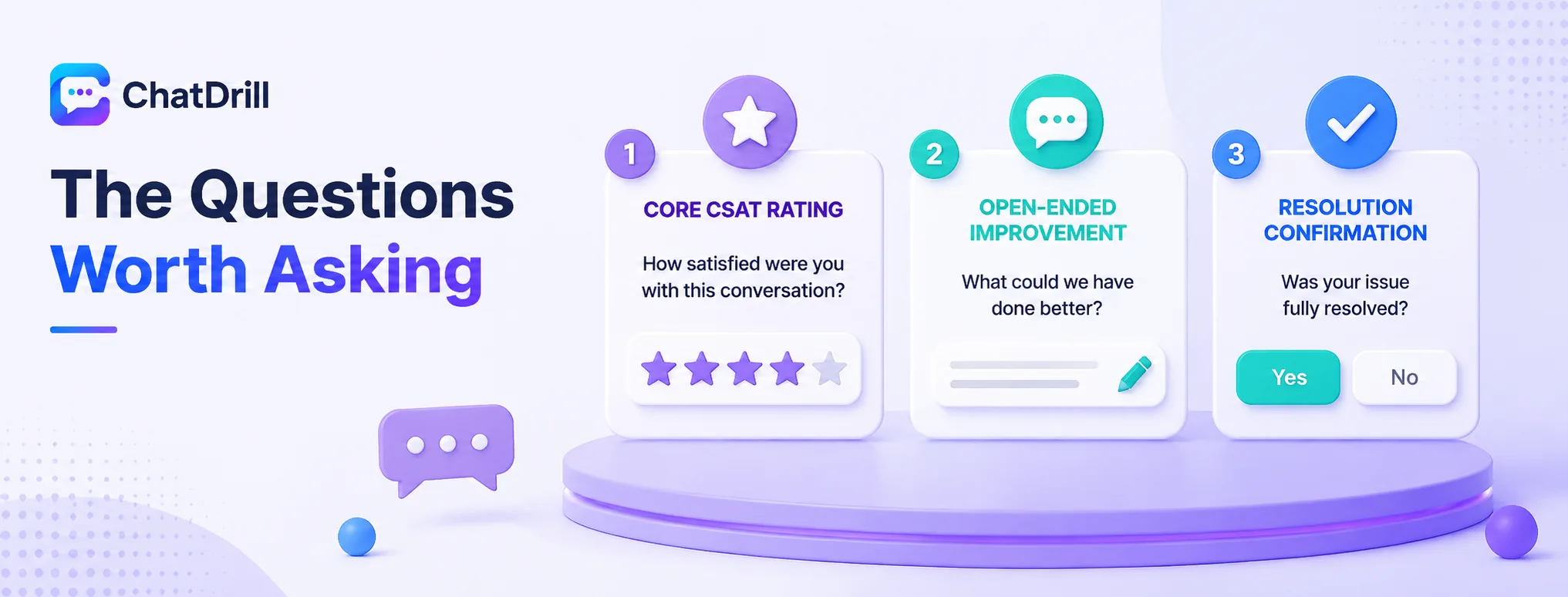
A core CSAT rating, one open-ended improvement question, and an occasional resolution-confirmation question together capture the most useful signal without overwhelming the customer.
The core CSAT rating question
"How satisfied were you with this conversation?" on a simple numeric or star scale gives you the primary, trackable satisfaction metric that everything else in your QA and improvement process builds on.
Keeping this question consistently worded over time, rather than changing it periodically, preserves the ability to track genuine trends rather than comparing incompatible data.
The open-ended improvement question
"What could we have done better?" asked only after a lower satisfaction rating, or occasionally as a lightweight follow-up, surfaces specific, actionable detail that a numeric score alone can't provide.
Making this question optional, rather than required, respects that not every customer wants to write a detailed response, while still capturing rich detail from those willing to share it.
The resolution-confirmation question
"Was your issue fully resolved?" as a simple yes-or-no question directly measures first-contact resolution, a metric distinct from but closely related to overall satisfaction.
This question is particularly useful for identifying conversations that felt satisfactory in the moment but didn't actually resolve the underlying issue, a gap a CSAT score alone might miss.
Wording Questions to Avoid Bias
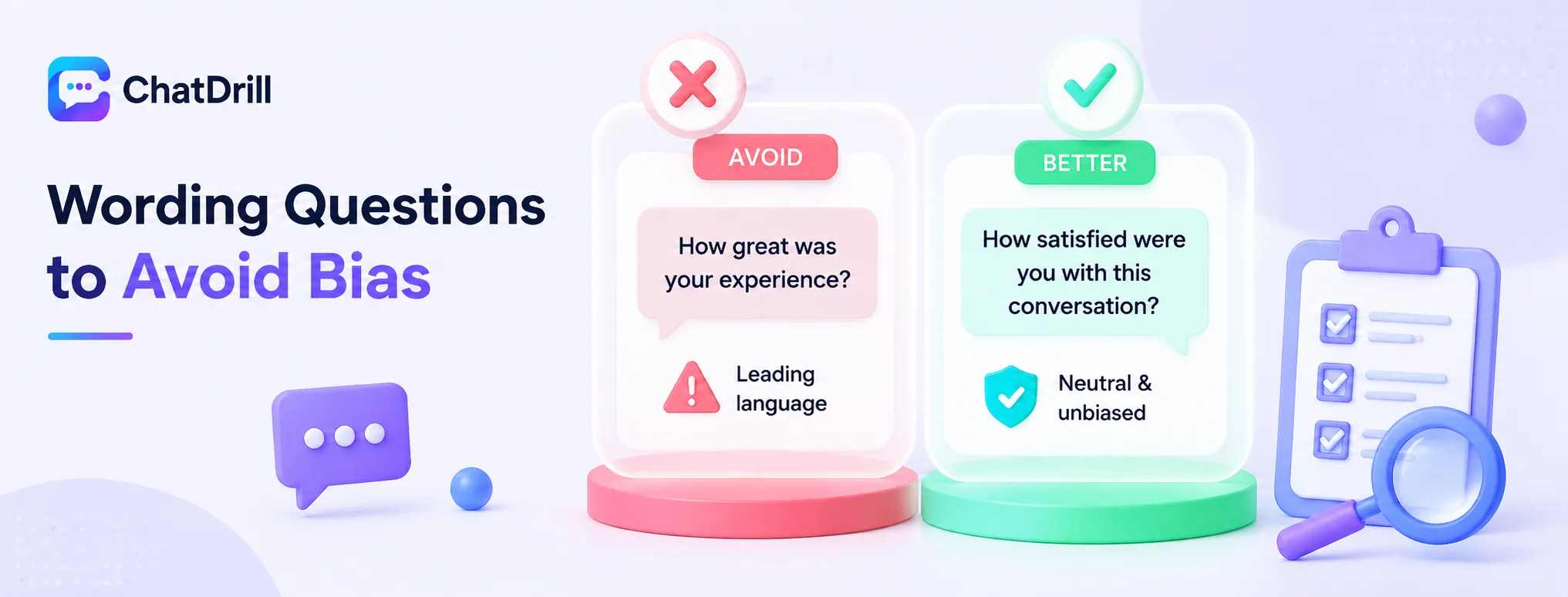
Well-worded survey questions avoid leading language, use neutral rather than loaded phrasing, and are specific enough to produce genuinely useful, comparable answers.
Avoiding leading language
A question like "How great was your experience?" subtly primes a more positive response than a neutral "How satisfied were you with this conversation?"
Reviewing your survey wording specifically for this kind of unintentional bias produces more genuinely trustworthy data.
Keeping phrasing neutral and specific
A vague question like "How was everything?" produces vague, hard-to-act-on answers compared to a specific question targeting a particular aspect of the interaction.
Specificity, even within a short survey, meaningfully improves the actionability of whatever feedback you collect.
Implementation Approach for Post-Chat Surveys
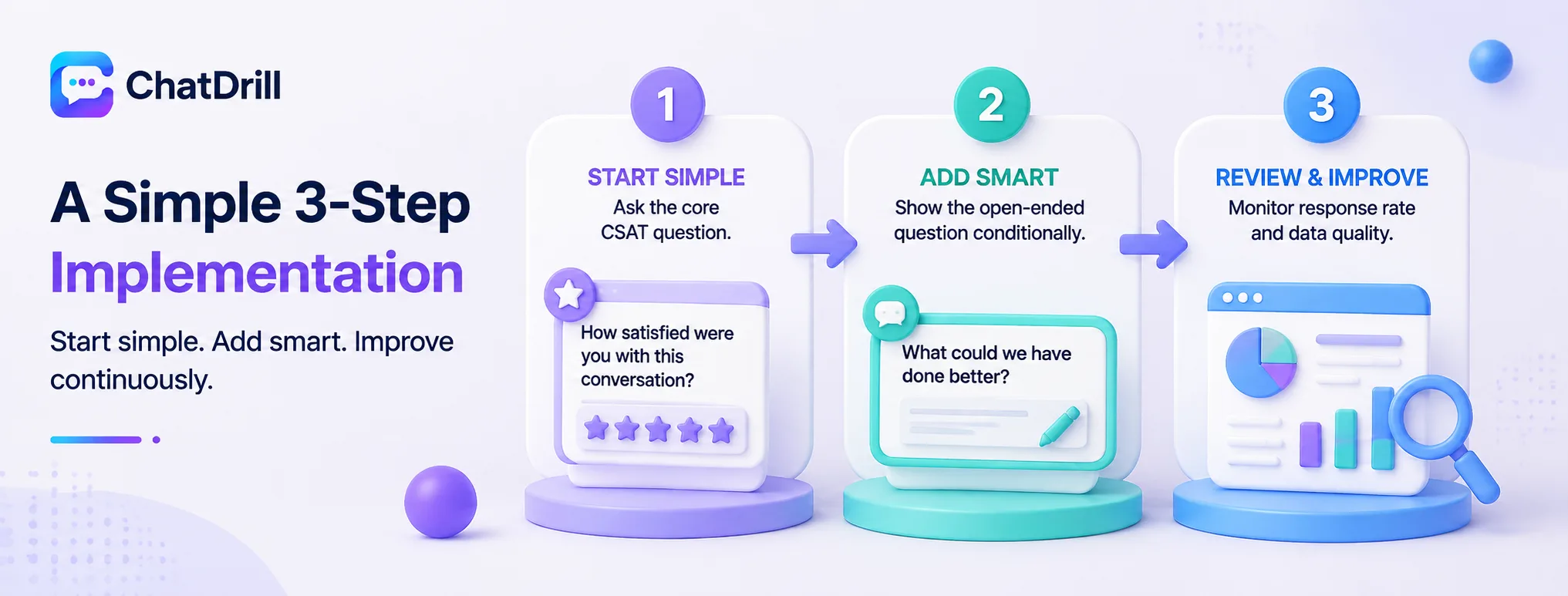
A practical implementation starts with the single CSAT question, adds the open-ended
Step 3: Review response rate and data quality
considering any further additions.
Step 1: Start with the core CSAT question alone
Launching with just the single satisfaction rating question establishes a clean baseline completion rate and satisfaction trend before any additional complexity is introduced.
This minimal starting point also makes it easier to isolate the effect of adding a second question later, since you'll have a clear before-and-after comparison.
Step 2: Add the open-ended question conditionally
Configuring the improvement question to appear only after a lower CSAT rating, rather than for every response, keeps the survey short for the majority of respondents while still capturing detail where it matters most.
This conditional logic respects respondent time while still gathering the specific, actionable detail that a purely numeric score can't provide.
Step 3: Review response rate and data quality Monitoring completion rate and the genuine usefulness of open-ended responses over time confirms whether your current survey configuration is striking the right balance.
Adjusting based on this review, rather than assuming the initial configuration is permanently optimal, keeps the survey genuinely effective as your customer base and typical interactions evolve.
How ChatDrill Handles Post-Chat Surveys
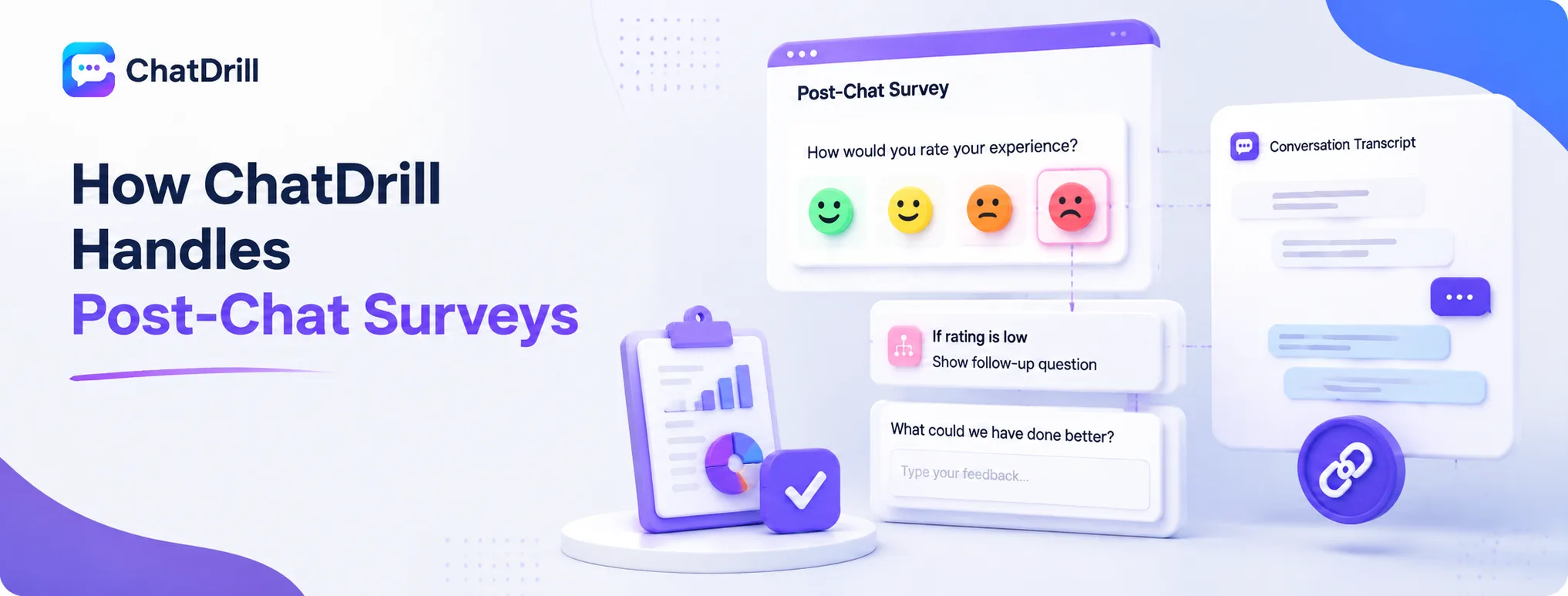
ChatDrill lets you configure a lightweight post-chat survey directly within the platform, with conditional logic for follow-up questions and reporting that connects survey results back to the actual conversation transcript.
Built-in conditional survey logic
ChatDrill supports triggering an open-ended follow-up question specifically when a CSAT rating comes in low, without requiring separate survey tooling or manual filtering after the fact.
This built-in logic makes the precision-over-comprehensiveness approach straightforward to implement rather than requiring custom development work.
Connecting survey results to conversation transcripts
Because ChatDrill ties a survey response directly to its originating conversation, reviewing a low CSAT score alongside the actual transcript takes seconds rather than requiring manual cross-referencing between separate systems.
This connection is what makes negative feedback genuinely actionable, letting a team lead see not just that a conversation scored poorly but exactly what happened within it.