
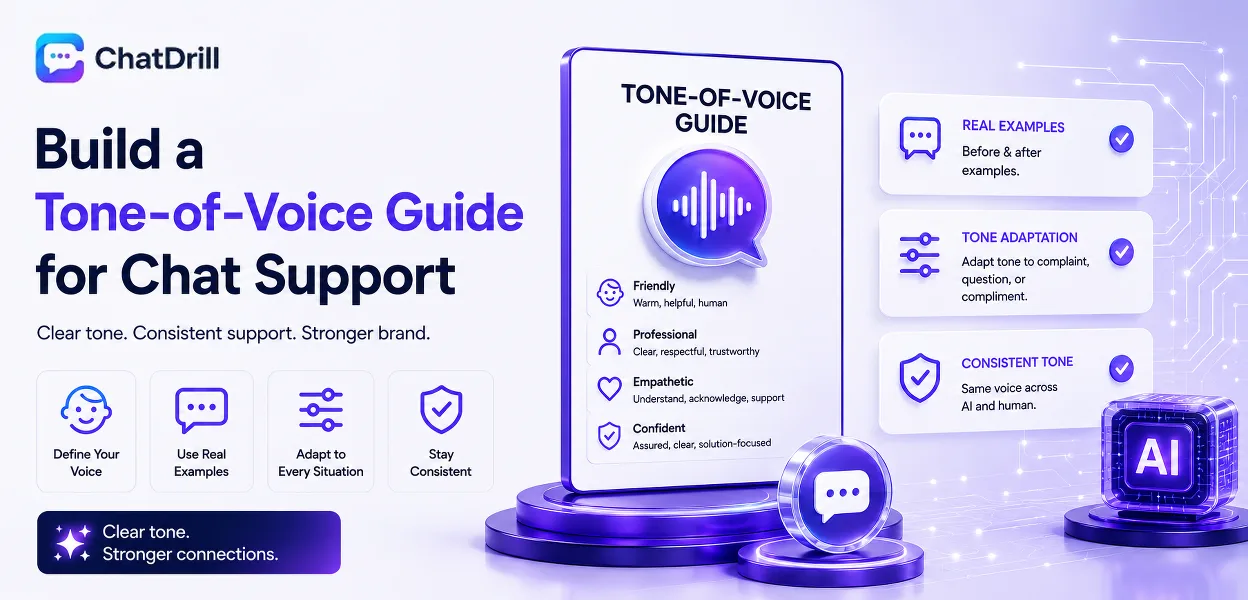
A tone-of-voice guide that stays abstract, "be friendly and professional", gives agents and AI little concrete guidance for actually writing a specific message, which is why the most useful guides pair general principles with real, specific examples.
The goal isn't creating an exhaustive style manual covering every possible scenario, it's establishing a clear enough reference that anyone writing on behalf of your brand, human or AI, produces genuinely consistent, recognizable tone.
Getting this right matters more than it might seem, since tone consistency across many conversations shapes overall brand perception in a way that any single interaction alone wouldn't reveal.
This guide covers what a strong tone guide includes, how to build one, common mistakes, and how ChatDrill applies a tone guide consistently through AI training.
Quick answer: A tone-of-voice guide for chat support should define your brand's core personality traits in plain language, show real before-and-after example rewrites, and specify how tone should shift for different situations, complaints versus routine questions, rather than a vague, abstract style statement.
What a Strong Tone Guide Includes
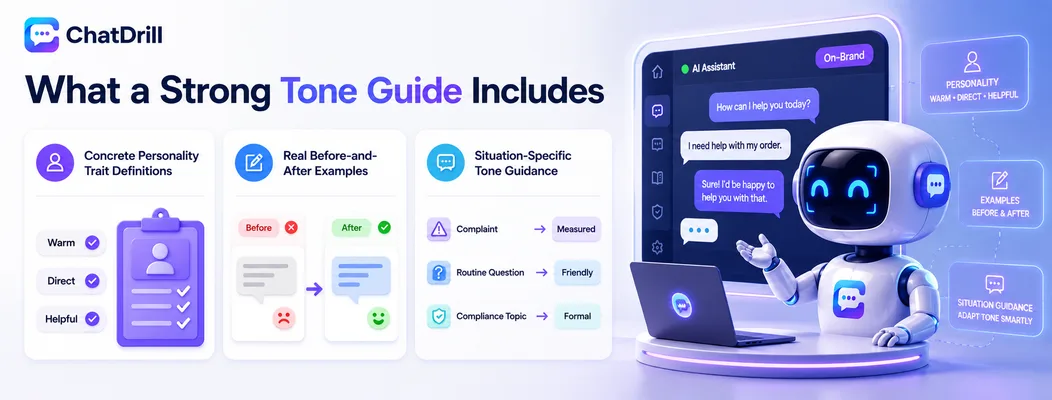
A strong guide defines core personality traits concretely, provides real before-and-after examples, and specifies how tone should shift across different conversation situations.
Concrete personality trait definitions
Rather than "friendly and professional," a concrete definition might specify "warm but not overly casual, direct without being blunt, genuinely helpful rather than performatively cheerful."
This specificity gives anyone writing on behalf of the brand a much clearer sense of the actual target than a generic, widely applicable phrase would.
Real before-and-after examples
Showing an actual generic, off-brand response alongside a rewritten, on-brand version makes the abstract tone description tangible and immediately actionable.
These examples are often more useful than any amount of additional descriptive language, since they demonstrate the tone in practice rather than describing it abstractly.
Situation-specific tone guidance
Specifying how tone should shift, more measured for a complaint, lighter for a routine question, more formal for a compliance-sensitive topic, prevents a single blanket tone from feeling mismatched in certain contexts.
This situational guidance respects that a single, unvarying tone rarely fits every conversation type equally well.
How to Build Your Tone Guide

Building a genuinely useful guide starts with reviewing your best existing conversations, defining traits based on real patterns rather than aspiration, and testing the guide against real scenarios before finalizing it.
Starting from your best existing conversations
Reviewing chat conversations that already feel genuinely on-brand and effective reveals the tone patterns worth codifying, rather than starting from an abstract aspiration disconnected from real practice.
This grounded approach also makes the resulting guide feel authentic to your actual team's natural voice rather than an imposed, unfamiliar style.
Defining traits based on real patterns
Distilling what's actually working in these strong example conversations into a small number of specific, describable traits keeps the guide grounded and genuinely reflective of your brand.
Limiting this to a handful of core traits, rather than an exhaustive list, keeps the guide usable rather than overwhelming.
Testing the guide against real scenarios
Having someone unfamiliar with the guide's development apply it to a few real scenarios reveals whether the guidance is genuinely clear and actionable, or still too abstract to apply consistently.
This testing step catches gaps before the guide is rolled out broadly across a full team or AI training process.
Common Mistakes in Tone-of-Voice Guides
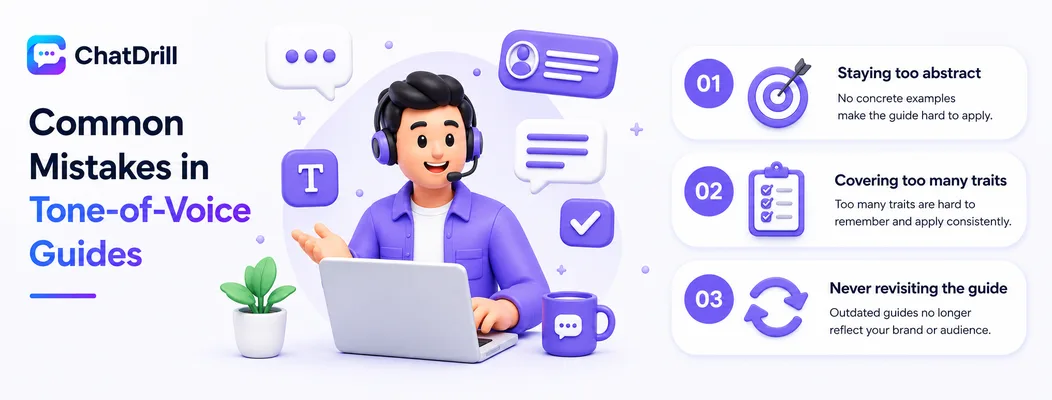
The most common mistakes are staying too abstract with no concrete examples, covering too many traits to genuinely apply consistently, and never revisiting the guide as the brand or team evolves.
Staying too abstract
A guide consisting only of adjectives, "friendly, professional, warm", without concrete examples gives limited practical guidance for actually writing a specific message.
Pairing every trait with a genuine example is what actually makes a tone guide usable rather than aspirational.
Covering too many traits
A guide listing ten or more personality traits becomes difficult to apply consistently, since holding that many distinct qualities in mind while writing isn't genuinely practical.
Limiting the guide to a handful of core, well-defined traits keeps it usable in real, fast-paced chat conversations.
Never revisiting the guide
Treating a tone guide as a one-time document, rather than revisiting it as your brand or customer base evolves, risks it becoming genuinely outdated and less reflective of your current, actual voice.
Periodic review, especially alongside any broader brand refresh, keeps the guide current and continuing to serve its purpose.
How ChatDrill Applies Your Tone Guide Consistently
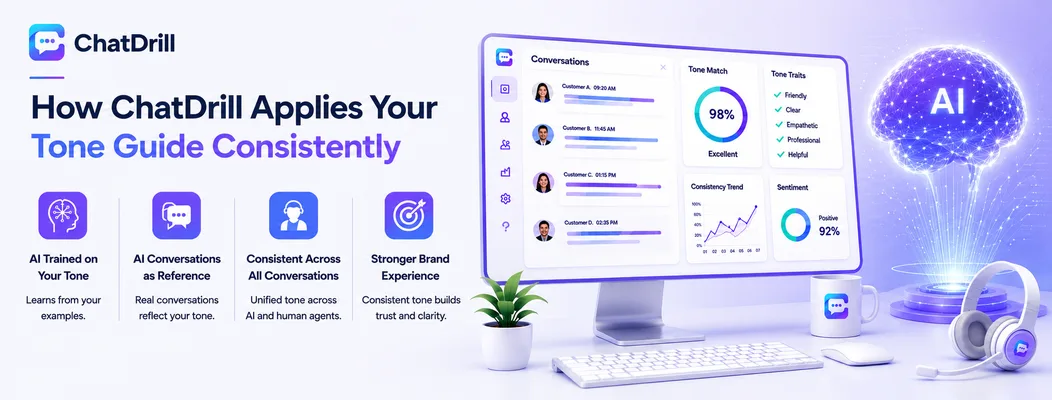
ChatDrill's AI can be trained directly on your tone guide's specific traits and examples, applying that voice consistently across every conversation without depending on individual agent interpretation.
Training AI on your specific tone examples
Feeding your actual before-and-after tone examples directly into ChatDrill's AI training gives it concrete reference points for how your brand should sound, rather than an abstract instruction to "be friendly."
This grounded training tends to produce more genuinely consistent AI tone than a vague, high-level instruction alone would achieve.
Using AI conversations as a reference for human agents
Reviewing well-toned AI conversations directly within ChatDrill gives human agents a concrete, always-available reference for what the guide looks like in practice, beyond the static guide document itself.
This living reference reinforces tone consistency across both AI and human-handled conversations, keeping the overall brand voice genuinely unified.