

An escalation handled poorly can make a customer feel like they're being passed off or that their issue wasn't important enough for the original agent to handle, even when the escalation itself was the right call.
The scripts here frame escalation as a positive step taken specifically to get the customer better help, not an admission of failure or a way to offload a difficult conversation.
Getting the framing right protects the relationship with both the customer, who deserves to feel genuinely prioritized, and the original agent, whose judgment in escalating appropriately should be respected rather than treated as a shortcoming.
This guide provides escalation scripts organized by scenario, guidance on setting expectations, and how ChatDrill supports smooth escalation handoffs.
Quick answer: Effective manager escalation scripts explain clearly why a manager is being brought in, reassure the customer their issue is being taken seriously rather than dismissed, and set an honest expectation for what happens next, rather than simply announcing a transfer with no context.
Why Escalation Framing Matters
How an escalation is framed shapes whether a customer feels genuinely prioritized or dismissed, even when the underlying decision to escalate was entirely appropriate.
Escalation as elevation, not failure
Framing the handoff as "getting you access to more specialized help" rather than "I can't handle this" positions the escalation as a genuine benefit to the customer rather than an agent's shortcoming.
This framing shift costs nothing in terms of actual process but meaningfully changes how the customer experiences the moment.
Protecting the original agent's judgment
A well-communicated escalation also implicitly validates the original agent's decision to recognize when a conversation genuinely needed additional authority or expertise.
This validation matters for agent confidence too, reinforcing that recognizing an escalation-worthy situation is good judgment, not a personal limitation.
Escalation Scripts by Scenario
Different escalation reasons, authority limits, genuine complexity, and unresolved frustration, each warrant slightly different framing while sharing the same core structure of explanation, reassurance, and expectation-setting.
Escalating due to authority limits
"This is something our team lead can approve directly, so let me bring them in to get this resolved for you right now."
"I want to make sure you get the best possible outcome here, and that requires sign-off from someone with a bit more authority on this specific situation."
Escalating due to genuine complexity
"This touches on something our specialist team handles specifically, so I'm going to loop them in to make sure you get the most accurate answer."
"I want to be thorough here rather than guess, so let me bring in someone who deals with this exact situation regularly."
Escalating due to continued customer frustration
"I can see this hasn't been resolved to your satisfaction, and I want to make sure you get a fresh, thorough look from our team lead."
"You deserve a more thorough resolution than I've been able to provide, so let me connect you with someone who can help further right now."
Setting Honest Expectations During Handoff
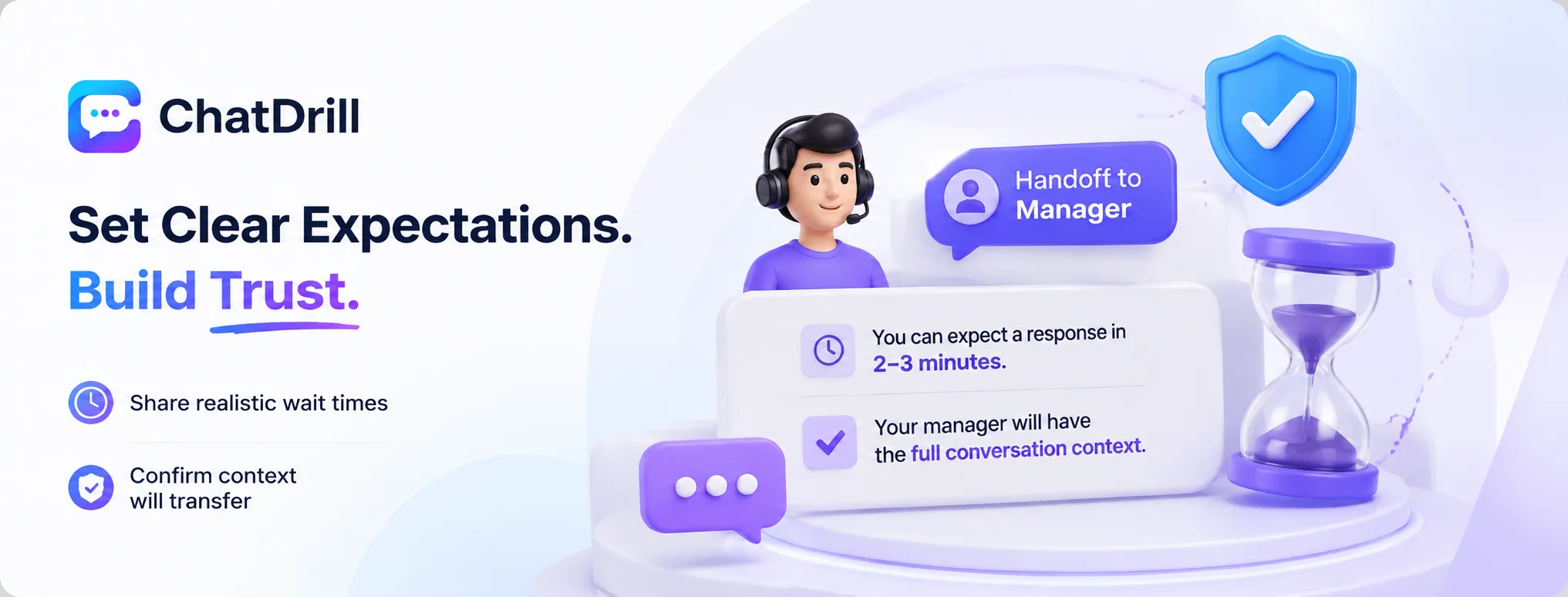
Clear communication about timing, what the customer needs to do next, and what context will be shared avoids the frustration of an unexplained, uncertain wait.
Communicating realistic timing
Stating specifically how long the customer can expect to wait for the manager, rather than a vague "just a moment," respects their time and reduces the frustration of an uncertain wait.
If the wait will be genuinely longer than typical, acknowledging this directly, rather than understating it, avoids compounding frustration when the actual wait exceeds an inaccurate expectation.
Confirming context will transfer
Explicitly telling the customer that the manager will already have the full conversation context reassures them they won't have to repeat everything from the beginning.
This reassurance directly addresses one of the most common frustrations with any kind of support handoff.
Common Mistakes in Manager Escalation
The most common mistakes are escalating with no explanation, understating the actual wait time, and losing conversation context during the handoff itself.
Escalating with no explanation
Simply announcing "I'm transferring you to my manager" with no context leaves the customer uncertain about why and can feel like an abrupt dismissal.
A brief, genuine explanation, even a single sentence, meaningfully improves how the escalation is received.
Understating wait time
Promising a manager will be available "in just a moment" when the actual wait is genuinely longer creates a second layer of frustration on top of whatever prompted the escalation.
Honest timing, even when less flattering, is worth prioritizing over an optimistic but inaccurate promise.
Losing context at handoff
A manager who begins the conversation without having reviewed what was already discussed forces the customer to repeat themselves, undermining the reassurance given during the escalation itself.
Ensuring genuine context transfer, not just a promise of it, is what actually delivers on the expectation set during the handoff.
How ChatDrill Supports Smooth Manager Escalations

ChatDrill's escalation routing carries full conversation history directly to whoever picks up the handoff, and its tagging lets a team track how often and why escalations happen.
Context-rich handoff by default
When a conversation escalates within ChatDrill, the full transcript and any relevant customer data travel with it automatically, so the manager genuinely has the context promised during the handoff.
This removes the manual copy-paste or verbal briefing that would otherwise be needed to transfer context, reducing both delay and the risk of losing detail along the way.
Tracking escalation patterns over time
Tagging escalations by reason within ChatDrill lets a team lead see whether certain issues are being escalated more frequently than expected, revealing training gaps or policy clarity issues worth addressing at the source.
This visibility turns individual escalations into a broader diagnostic tool for improving the support process overall.