

A conversation that resolves the customer's actual question but ends abruptly, without confirmation or a warm close, can leave a subtly worse impression than the actual quality of help provided would suggest.
The last exchange in a chat conversation is often what a customer remembers most vividly, making a genuinely professional close worth the small extra effort it takes beyond simply answering the question.
Getting this right means balancing efficiency, not dragging out a conversation that's genuinely finished, with warmth, ensuring the customer doesn't feel rushed out the door the moment their question is answered.
This guide covers what a strong close includes, scripts for different scenarios, common mistakes, and how ChatDrill supports consistent, professional closings.
Quick answer: Closing a chat professionally means confirming the issue was genuinely resolved, thanking the customer specifically rather than generically, and leaving a clear, easy path back if they need further help, rather than an abrupt cutoff or a vague, uncertain ending.
What a Strong Chat Close Includes

A strong close confirms genuine resolution, offers specific thanks, and leaves a clear path back, giving the conversation a deliberate, positive ending rather than an abrupt stop.
Confirming genuine resolution
Directly checking whether the customer's actual need was fully addressed, rather than assuming based on the last message, catches any lingering uncertainty before the conversation ends.
This confirmation also signals genuine care about the outcome, not just moving through the conversation efficiently.
Offering specific, genuine thanks
Thanking the customer for something specific, their patience, their clear explanation, rather than a generic "thanks for chatting," feels more authentic and less scripted.
This specificity, even briefly, distinguishes a genuinely warm close from a purely procedural one.
Leaving a clear path back
Letting the customer know they can easily reach out again if anything comes up removes any uncertainty about what to do if their issue resurfaces or a new question arises.
This reassurance costs little to include and meaningfully improves the customer's overall sense of being supported, not just handled.
Closing Scripts for Different Scenarios
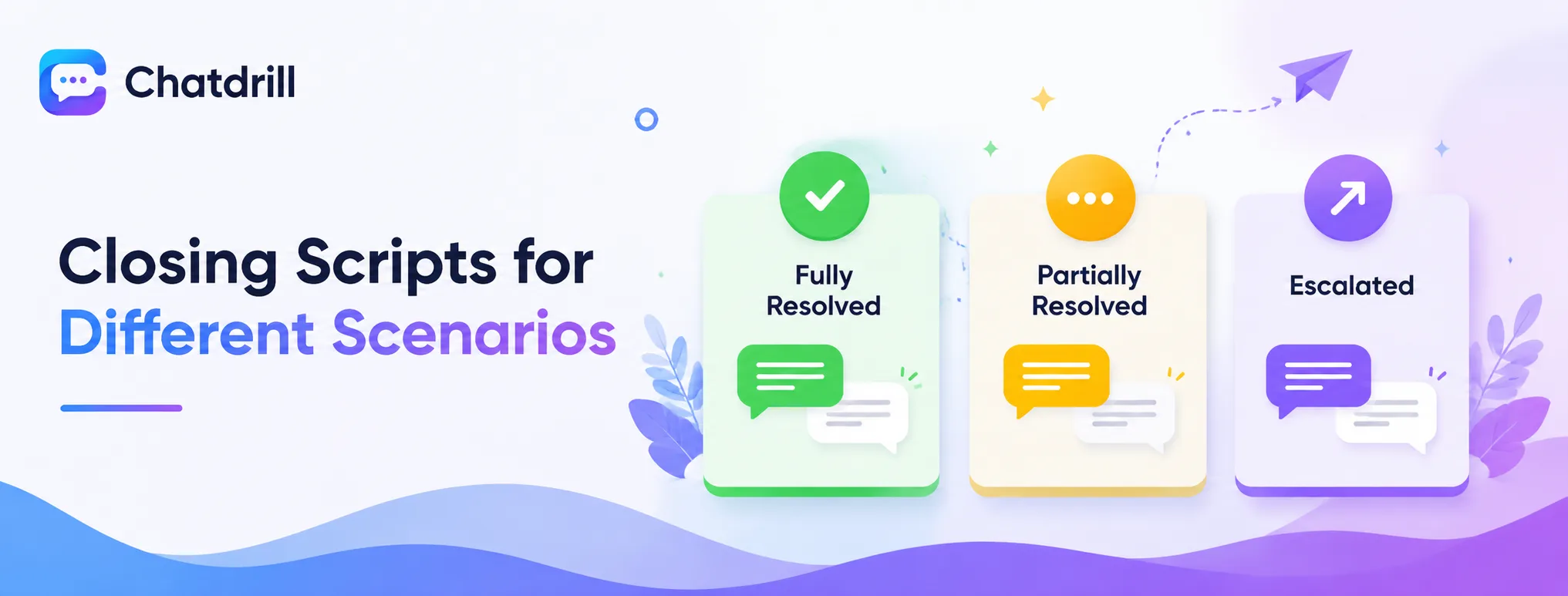
A fully resolved conversation, a partially resolved one, and a conversation ending in escalation each warrant a slightly different closing approach while sharing the same core structure.
Fully resolved conversation closings
"Glad we could get that sorted out! Feel free to reach back out anytime if anything else comes up."
"Perfect, that should do it. Thanks for your patience, and don't hesitate to chat again if you need anything else."
Partially resolved conversation closings
"I've gotten this started for you, and you should hear back on the remaining piece within [timeframe]. Let me know if anything else comes up in the meantime."
"That covers the main question — for the other part, I've flagged it for follow-up, and you'll hear from us soon."
Escalated conversation closings
"I've connected you with [team/person] who'll take it from here with full context on what we discussed. Thanks for your patience today."
"You're in good hands with our specialist team now — I've made sure they have everything from our conversation."
Common Mistakes When Closing a Chat
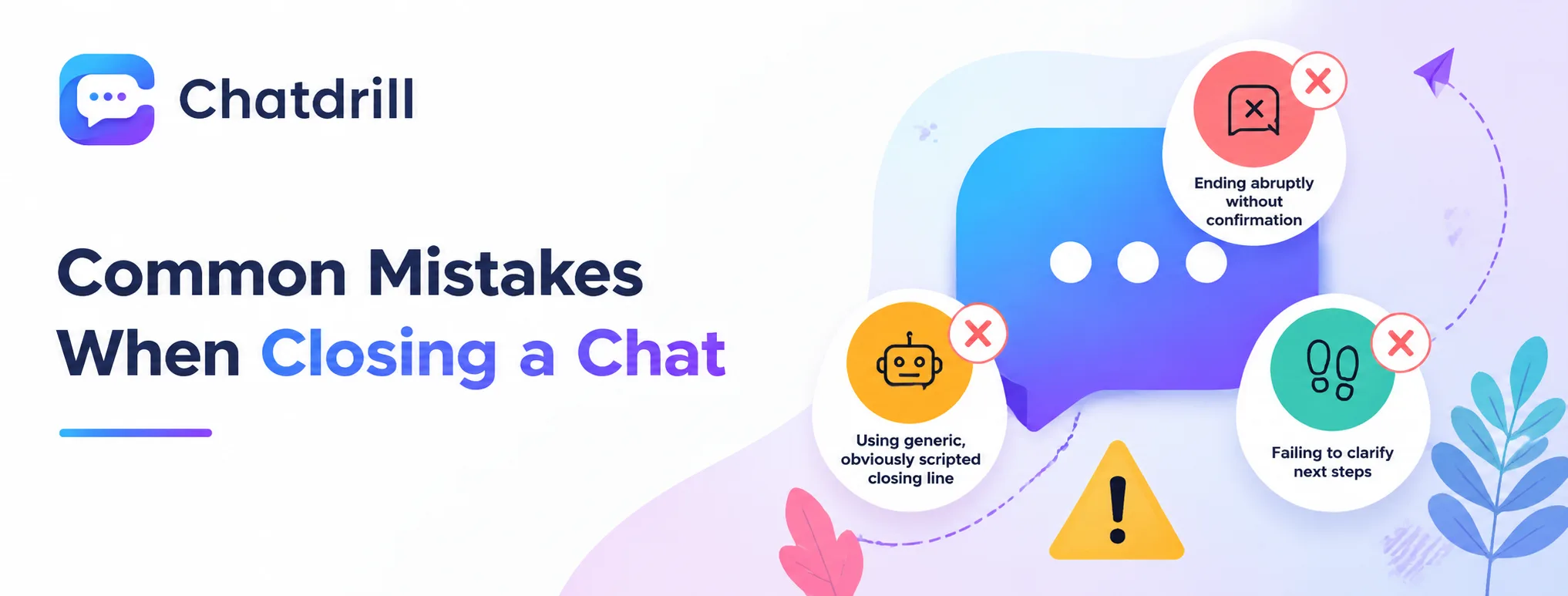
The most common mistakes are ending abruptly without confirmation, using a generic, obviously scripted closing line, and failing to clarify next steps when the issue isn't fully resolved.
Ending abruptly without confirmation
Closing immediately after providing an answer, without checking whether it genuinely resolved the customer's need, risks leaving a real gap unaddressed.
A brief confirmation question before closing catches this gap while it's still easy to address within the same conversation.
Using an obviously generic closing
A flat, repeated "Thank you for contacting us, have a nice day" used identically in every conversation can feel impersonal, undermining an otherwise good interaction.
Adding even a small, specific detail to the close makes it feel genuinely tailored rather than a copy-pasted formality.
Unclear next steps for unresolved issues
Closing a conversation that isn't fully resolved without clearly stating what happens next leaves the customer uncertain whether to expect follow-up or take further action themselves.
Explicitly stating the next step and timeline, even for a partial resolution, removes this uncertainty.
How ChatDrill Supports Consistent, Professional Closings
Can AI be trained to close conversations well?
closing language automatically, while conversation review helps ensure human agents close conversations consistently well too.
AI-driven consistent closing behavior
Training ChatDrill's AI to include a resolution check and appropriate closing language as a standard part of its conversation flow ensures every AI-handled conversation ends professionally, not just the ones a human happens to close carefully.
This consistency matters given how much a good close can shape a customer's lasting impression, regardless of who or what handled the underlying question.
Reviewing human agent closings for quality
ChatDrill's conversation transcripts make it straightforward to review how agents are actually closing conversations, informing coaching where closings feel rushed or generic.
This review connects naturally to a broader QA process, treating the closing as a genuine, coachable skill rather than an afterthought.