
A well-built canned response library saves genuine time on repetitive situations while still letting each conversation feel personal, the key is writing responses specific and natural enough that a customer doesn't immediately recognize them as a template.
This library covers the situations that come up across nearly every chat-based support operation, greetings, asking a customer to wait, apologizing for an issue, escalating to another team, and closing a conversation well.
Every response here is meant as a genuine starting point, worth adjusting to your own brand voice, specific policies, and typical customer language before deploying broadly.
This guide provides the response templates organized by category, along with guidance on customizing and maintaining your own library over time.
Quick answer: A strong canned response library covers greetings, holds and delays, apologies, escalations, and closings, each written to sound natural rather than robotic, and should always be customized with your own brand voice and specific policy details before use.
Greeting and Opening Responses
Opening responses should feel warm and specific rather than robotic, setting a helpful tone for the conversation that follows.
Greeting templates
"Hi! Thanks for reaching out — what can I help you with today?"
"Hello! I'd be happy to help — could you tell me a bit more about what you need?"
"Hi there, thanks for your patience while I pull that up for you."
Hold and Delay Responses
Hold and delay responses should give a specific, honest sense of timing rather than a vague "please wait," respecting the customer's time even during a necessary pause.
Hold and delay templates
"Give me just a moment to check that for you — I'll be right back."
"Thanks for waiting — I'm looking into this now and should have an answer shortly."
"This is taking a bit longer than expected — thank you for your patience, I'm still working on it."
Apology and Issue-Acknowledgment Responses
Apology responses should acknowledge the specific issue genuinely, without sounding scripted or defensive, before moving directly into how it will be resolved.
Apology templates
"I'm really sorry for the trouble this has caused — let's get this sorted out for you."
"That's not the experience we want you to have, and I appreciate you flagging it."
"I understand how frustrating that must be — here's what I can do to help."
Escalation and Handoff Responses

Should escalation responses explain why a handoff is happening?
to expect next, so the customer doesn't feel like they're being passed along without explanation.
Escalation templates
"I want to make sure you get the best help with this, so I'm connecting you with our specialist team now."
"This is something our billing team can resolve directly — I'll transfer you and share what we've discussed so you don't have to repeat it."
"Let me loop in someone who handles this specifically so we can get you a definitive answer."
Closing and Follow-Up Responses
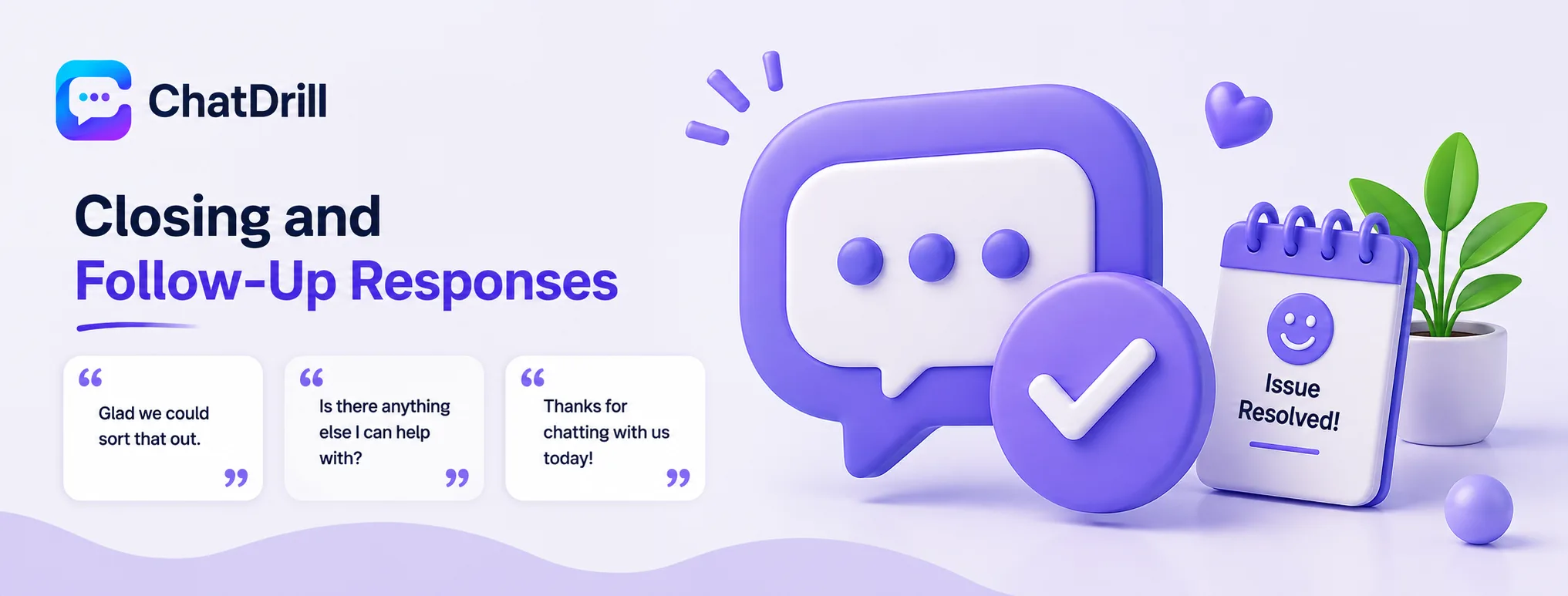
Closing responses should confirm the issue is genuinely resolved and leave the door open for further questions, ending the conversation on a genuinely helpful note.
Closing templates
"Glad we could sort that out — feel free to reach back out if anything else comes up."
"Is there anything else I can help with before we wrap up?"
"Thanks for chatting with us today — hope the rest of your day goes well!"
Customizing and Maintaining Your Library
Customizing these templates means adapting them to your specific brand voice and policies, while maintaining the library means periodically reviewing which responses actually get used and refining based on real conversation outcomes.
Adapting templates to your brand and policies
Adjusting tone, specific wording, and any policy-specific details ensures these starting templates genuinely reflect your business rather than feeling like a generic, borrowed script.
This adaptation is worth doing thoughtfully rather than deploying templates completely unedited, since even small wording adjustments can meaningfully improve how natural a response feels.
Reviewing and refining over time
Periodically checking which canned responses are actually being used, and how customers respond to them, reveals which are genuinely working and which might need revision.
This ongoing refinement keeps your library current and effective rather than a static set of templates that gradually feels increasingly generic or outdated.
Common Mistakes With Canned Response Libraries
The most common mistakes are deploying templates completely unedited, using the same response regardless of context, and letting the library go stale as policies or products change.
Deploying templates unedited
Using a canned response exactly as written, with no adjustment for your brand voice or specific situation, can feel noticeably impersonal to a customer who senses they're reading a generic script.
A brief customization pass before rollout, even small wording tweaks, meaningfully improves how genuine each response feels.
Using the same response regardless of context
Applying an identical canned response to genuinely different situations, a minor inconvenience and a serious complaint, misses the chance to match tone and detail to the actual severity of what's being addressed.
Having a few variations within each category, rather than one single response per situation, allows for this kind of contextual matching.
Letting the library go stale
A canned response referencing an outdated policy or process detail can actively mislead a customer, worse than having no canned response at all for that situation.
Reviewing the library whenever a relevant policy changes, not just on a fixed schedule, keeps this risk from going unnoticed.