
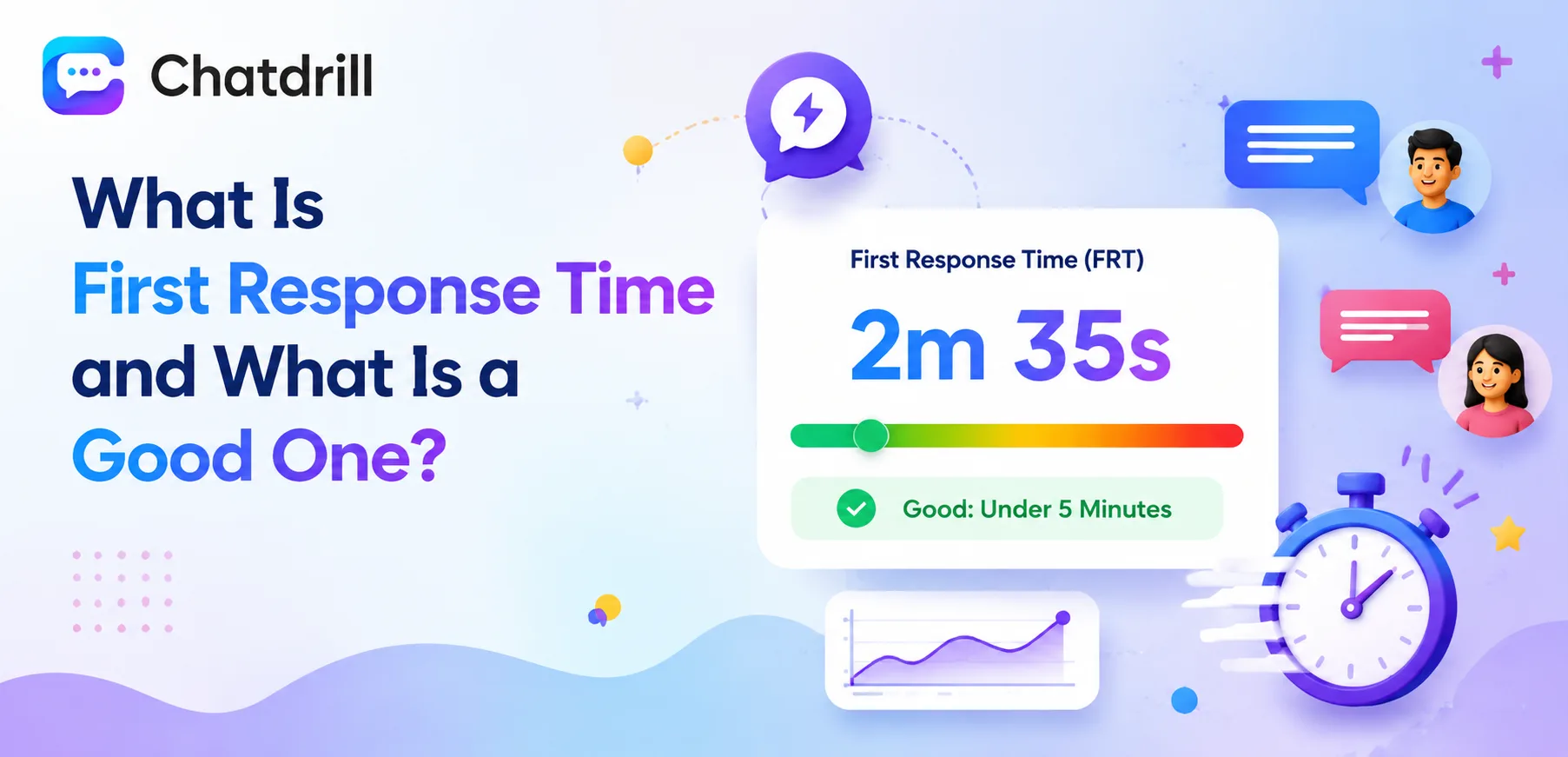
First response time measures how long a visitor waits between sending their first chat message and receiving a reply, and it's consistently one of the strongest predictors of whether that visitor stays engaged in the conversation at all.
For live chat specifically, the benchmark is demanding, under one minute is generally considered good, a far tighter standard than email support, where several hours can still be considered reasonable.
This metric matters beyond just customer patience, a slow first response directly correlates with lower engagement, lower satisfaction, and ultimately lower conversion for chat conversations tied to a sales or lead-generation goal.
Understanding what genuinely counts as "first response," how to calculate it accurately, and what actually moves this number helps a business set realistic targets and prioritize the right improvements.
What is considered a good first response time for live chat?
benchmark specifically for chat, what factors influence it most, how to calculate it accurately, and practical ways to improve it.
What Is First Response Time?
First response time is the elapsed time between a visitor sending their first message in a chat conversation and receiving the first reply, whether from a human agent or an AI system.
Simple definition
This metric specifically measures the gap before any response, not the time to fully resolve the conversation, a distinct measurement from resolution time or overall conversation duration.
It's typically measured in seconds or minutes for live chat specifically, reflecting the channel's real-time nature, compared to hours or days for a slower channel like email.
Most modern chat platforms, including ChatDrill, calculate this automatically, giving a business a readily available metric without requiring manual tracking.
Why this specific metric matters so much
The moment between a visitor's first message and a reply is genuinely high-stakes, a visitor actively waiting with no response is at real risk of abandoning the conversation, and the interaction, entirely.
This makes first response time one of the earliest, most reliable signals of whether a chat interaction will ultimately succeed or fail from an engagement standpoint.
What Is a Good First Response Time for Live Chat?
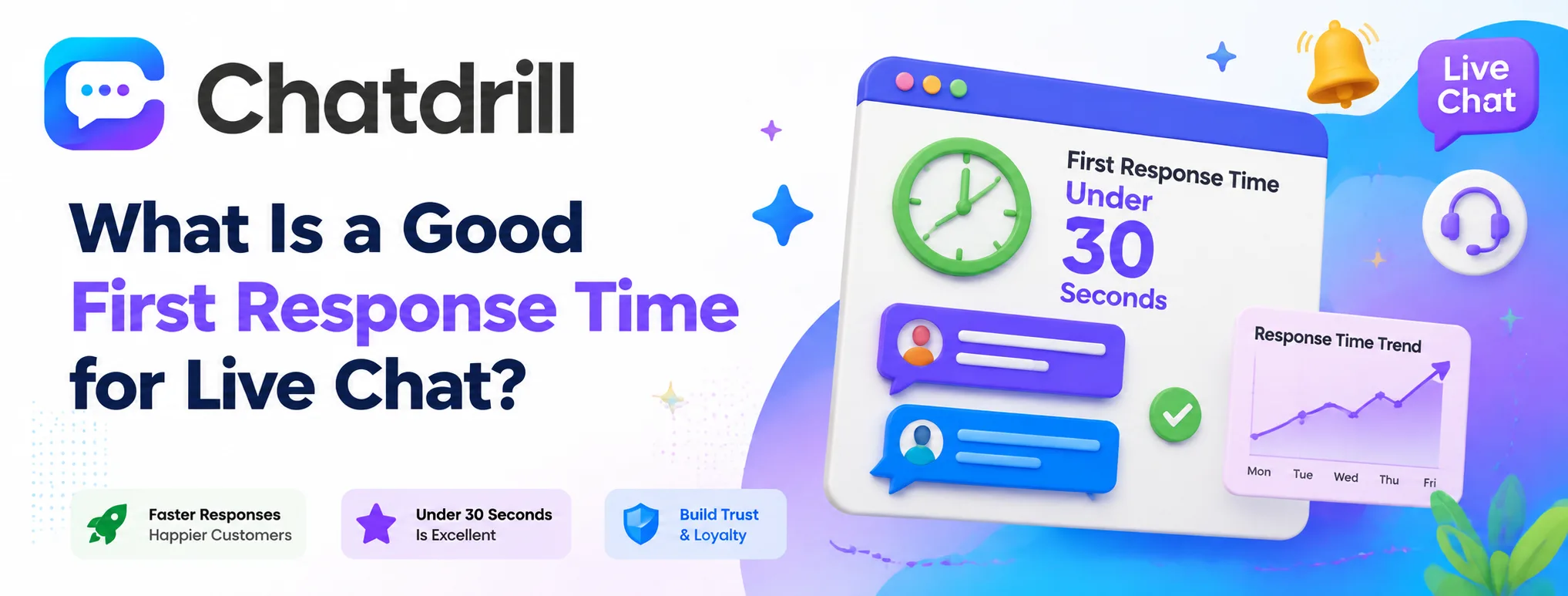
Under one minute is the widely accepted benchmark for a good live chat first response time, with response times consistently under 30 seconds considered genuinely excellent for a business prioritizing this specific metric.
The under-one-minute benchmark
Industry data consistently shows engagement dropping sharply once first response time exceeds one minute, making this threshold a meaningful, evidence-based target rather than an arbitrary number.
A business consistently hitting this benchmark tends to see measurably better engagement and conversion outcomes from its chat channel compared to one with slower typical response times.
What counts as excellent versus merely acceptable
Response times under 30 seconds, often achieved through strong AI coverage or well-staffed peak hours, represent genuinely excellent performance beyond just meeting the baseline good benchmark.
Response times between one and three minutes, while not ideal, remain reasonably acceptable for many businesses, particularly those without full AI coverage handling every incoming conversation instantly.
Why this benchmark differs from other channels
Live chat's real-time nature sets fundamentally different expectations than email, where several hours can remain acceptable, reflecting the genuinely different nature of what a visitor expects from each channel.
Understanding this channel-specific expectation helps a business set the right internal target for chat specifically, rather than applying a more lenient, email-appropriate standard.
What Factors Influence First Response Time
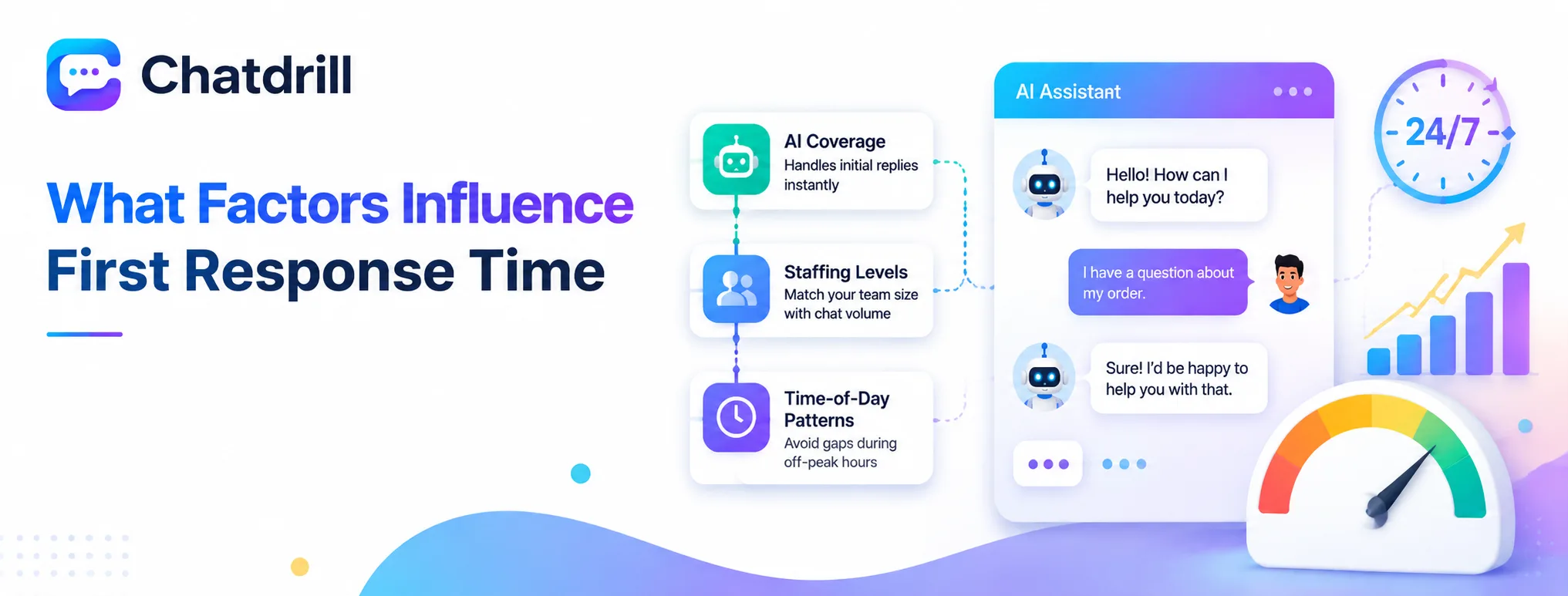
First response time is influenced most heavily by AI coverage handling initial replies instantly, staffing levels relative to chat volume, and time-of-day patterns that can create coverage gaps during off-peak hours.
AI coverage and instant replies
AI chatbots can provide an instant first response for many questions, dramatically improving average first response time compared to relying purely on human agent availability.
This is often the single largest lever available for improving this metric, since AI removes the wait entirely for questions it can handle directly.
Staffing relative to chat volume
Even without full AI coverage, adequate human staffing relative to actual chat volume directly determines how quickly an agent becomes available to respond to a new conversation.
A business experiencing consistently slow response times during specific hours often has a straightforward staffing gap worth addressing directly.
Time-of-day and day-of-week patterns
Response times often vary meaningfully by time of day, with evenings, weekends, and off-hours frequently showing slower typical response times than peak business hours.
Reviewing this variation specifically, rather than relying on a single blended average, reveals coverage gaps that a strong overall average might otherwise hide.
How to Calculate First Response Time Accurately
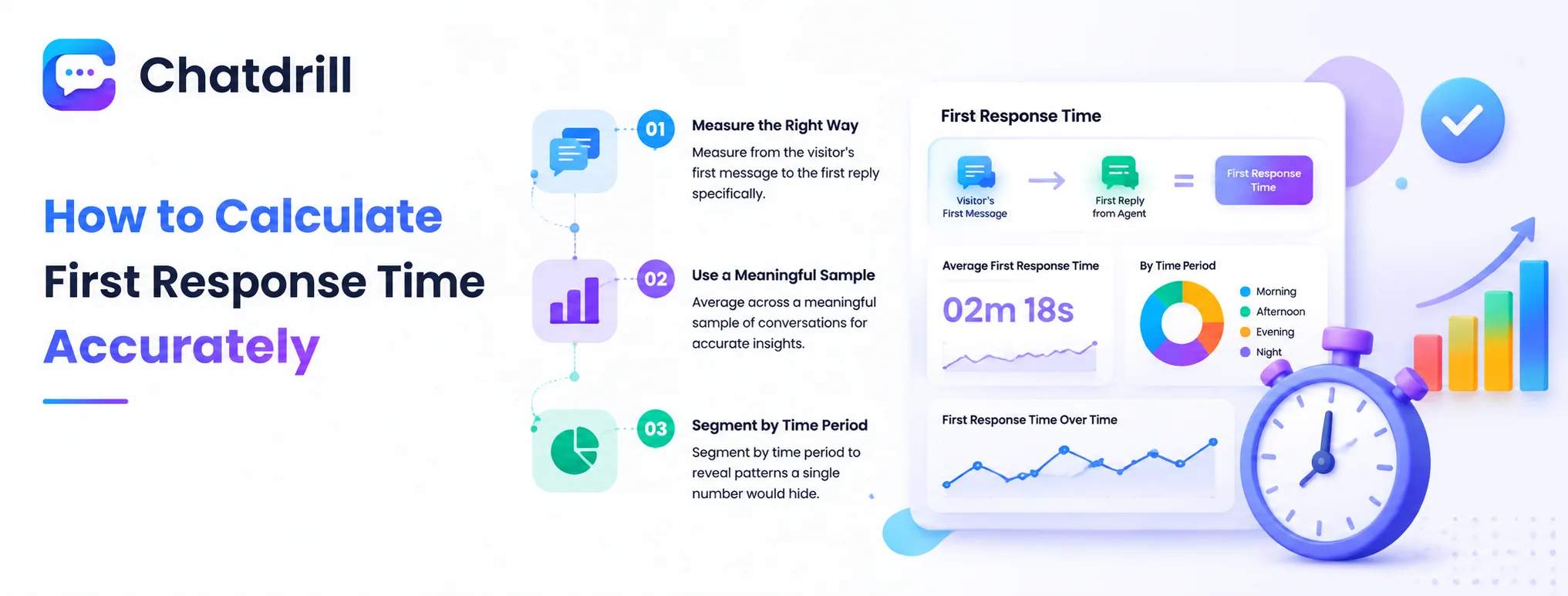
Calculating first response time accurately means measuring from the visitor's first message to the first reply specifically, averaging across a meaningful sample of conversations, and segmenting by time period to reveal patterns a single number would hide.
Measuring from the right starting point
The clock should start at the visitor's first message, not when the widget opens or a pre-chat form is submitted, to accurately reflect the wait the visitor actually experiences.
Confirming your specific platform measures this correctly avoids an inaccurate metric that doesn't genuinely reflect visitor-perceived wait time.
Averaging across a meaningful sample
Calculating an average across a representative period, rather than a small handful of conversations, produces a more reliable, less noise-prone metric to track and act on over time.
A week or month of data, depending on your chat volume, typically provides a sufficient sample for a meaningful, trend-worthy average.
Segmenting to reveal hidden patterns
Breaking the metric down by time of day, day of week, or team, rather than relying on one blended average, reveals specific gaps a single overall number would otherwise conceal.
This segmented view is what actually drives targeted improvement, rather than a vague sense that the overall number could be better without knowing where specifically to focus.
How to Improve First Response Time
Improving first response time means expanding AI coverage to handle more conversations instantly, adjusting staffing to match actual chat volume patterns, and setting up alerts for conversations approaching an unacceptable wait threshold.
Expanding AI coverage
Training AI to handle a broader range of common questions directly reduces the share of conversations that need to wait for human agent availability at all.
This is usually the highest-leverage improvement available, since AI coverage can provide a genuinely instant response regardless of staffing levels or time of day.
Adjusting staffing to match volume patterns
Reviewing chat volume by time of day and adjusting staffing accordingly addresses the specific coverage gaps that a segmented analysis reveals.
This is a more targeted, efficient response than simply adding headcount broadly without regard to when the actual coverage gap occurs.
Setting up proactive wait-time alerts
Configuring an alert for any conversation approaching an unacceptable wait threshold catches individual slow responses before they become a pattern affecting overall metrics.
This real-time safety net complements the broader structural improvements, catching the specific cases that slip through even a generally well-optimized system.