
A visitor who asks about pricing and gets a vague, deflecting answer often assumes the price is either embarrassingly high or that the business is being deliberately evasive, either way, damaging trust right at a critical decision moment.
The businesses that handle this question best treat it as a genuine buying signal worth a direct, specific answer, not an opportunity to withhold information until a sales conversation can apply pressure.
Getting the framing right matters as much as the number itself, presenting price alongside genuine value context helps a visitor understand what they're getting, not just what they're paying.
This guide covers why directness works better than deflection, scripts for answering well, common variations to prepare for, and how ChatDrill supports accurate, consistent pricing answers.
Quick answer: The best way to answer a pricing question in chat is directly and specifically, giving an actual number or range immediately rather than deflecting to 'it depends' or requiring a sales call, since withholding pricing tends to erode trust rather than protect a negotiating advantage.
Why Directness Beats Deflection
A visitor asking about pricing has already invested enough interest to ask directly, and a vague or deflecting answer at this exact moment tends to erode the trust that interest represents.
What deflection actually signals
Responding to a direct pricing question with "it depends" or "let's schedule a call" without any further detail often reads as evasive, prompting the visitor to assume the worst about cost.
This assumption tends to be worse than an honestly high price stated clearly, since uncertainty breeds more hesitation than a known number a visitor can actually evaluate.
The genuine buying-signal nature of a pricing question
A visitor who asks about cost specifically has typically already decided the product itself is relevant, making this question a sign of real interest worth rewarding with a clear, direct answer.
Treating this as an opportunity to build trust, rather than a threat to be managed carefully, produces better outcomes than a guarded, hesitant response.
Scripts for Answering Pricing Questions Well
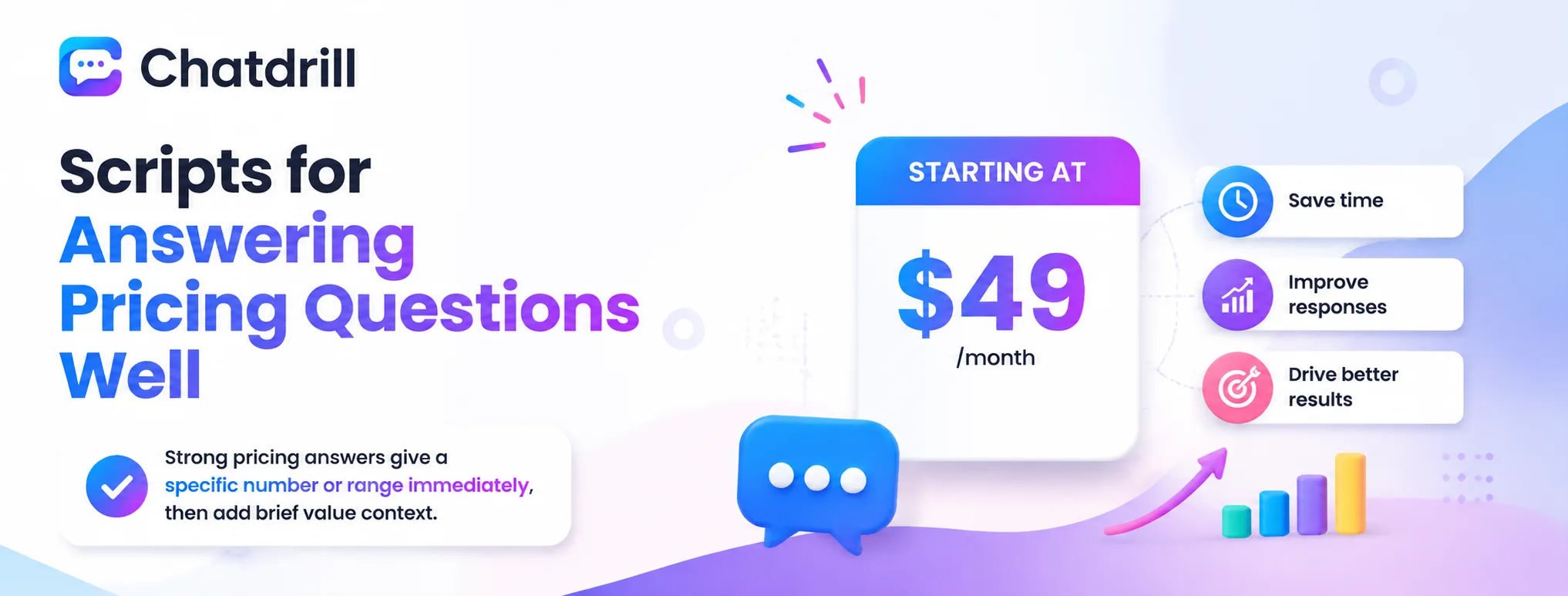
Strong pricing answers give a specific number or range immediately, then add brief value context, rather than making the visitor wait or dig for the actual figure.
Direct answer templates
"Our plans start at [price] per month, and most customers land around [typical price] depending on team size — want me to help figure out which tier fits you?"
"That's [specific price] for the standard package, which includes [key inclusions] — happy to go deeper on what's covered."
"Pricing runs from [low end] to [high end] depending on [relevant factor], let me know your situation and I can narrow that down."
Adding value context after the number
Following the direct number with a brief mention of what's included, or a relevant comparison point, helps the visitor understand value rather than just a raw figure.
This context should be genuine and specific, not a generic sales pitch, respecting that the visitor asked a direct question and deserves a substantively direct answer.
Handling Common Pricing Question Variations
Variations like 'is there a cheaper option' or 'can you do a discount' deserve the same directness as the initial pricing question, addressed honestly rather than deferred.
"Is there a cheaper option?"
"Yes, our [lower tier] starts at [price] and covers [core features] — want me to walk through what's different?"
"If budget's a concern, let's talk about what you actually need most, sometimes a lighter plan covers it well."
"Can you do a discount?"
"I can check what's possible — can you tell me a bit more about your situation so I can see what options exist?"
"I don't have discount authority directly, but let me connect you with someone who can explore that with you."
Common Mistakes When Answering Pricing Questions
The most common mistakes are deflecting to a sales call without any direct answer, giving an inconsistent number across different conversations, and burying the actual price under excessive qualification.
Deflecting without any direct answer
Redirecting every pricing question straight to a sales call, without giving any number or range in chat, frustrates a visitor who specifically chose chat for a fast, direct answer.
Providing at least a starting range in chat, even if a call is needed for a fully custom quote, respects the visitor's original intent in asking through this channel.
Inconsistent pricing across conversations
Giving different numbers to different visitors, whether through outdated training or inconsistent human answers, creates confusion and potential distrust if visitors ever compare notes.
Keeping pricing information centrally updated and consistently trained ensures every conversation reflects the same accurate, current figures.
Burying the price under excessive qualification
Leading with several paragraphs of caveats before finally mentioning a number makes the visitor work harder than necessary to get the direct answer they asked for.
Leading with the number, then adding necessary context afterward, respects the visitor's actual question ordering.
How ChatDrill Handles Pricing Questions Consistently
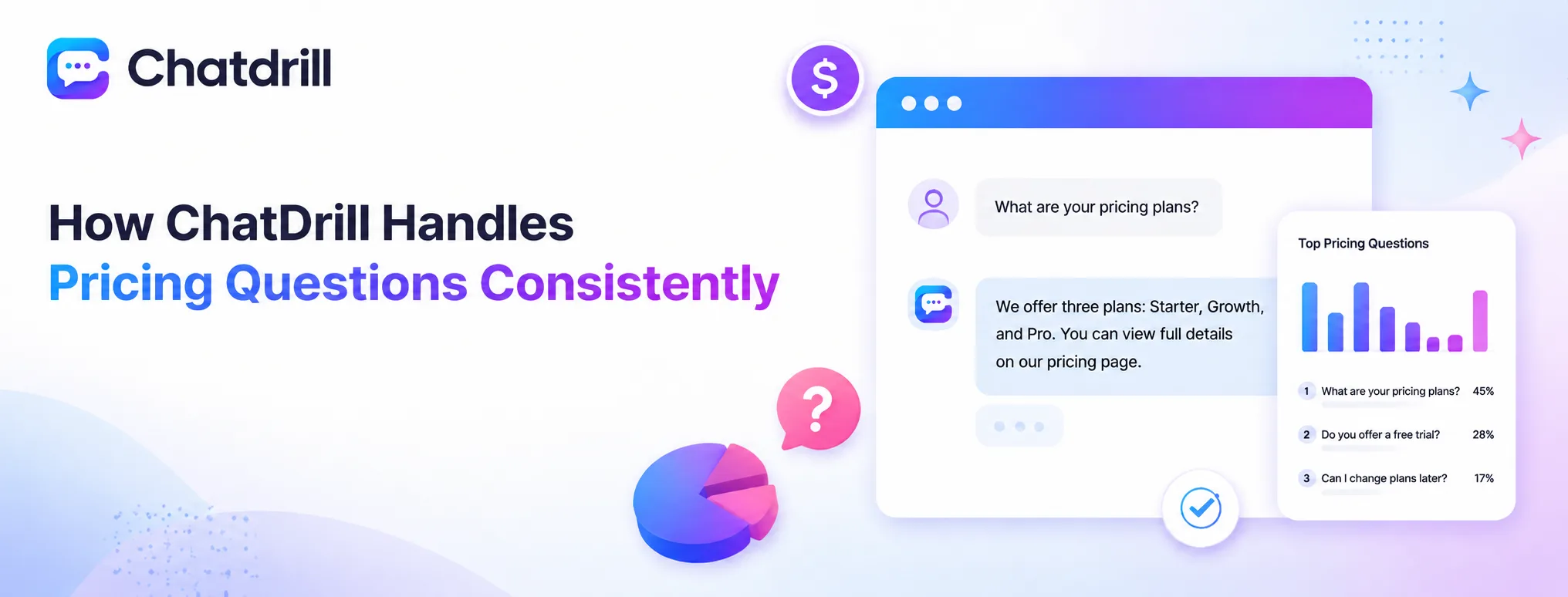
ChatDrill's AI can be trained on your exact, current pricing structure so every conversation gets the same accurate answer, and its analytics show which pricing questions come up most often.
Consistent, centrally trained pricing answers
Training ChatDrill's AI directly on your actual, current pricing tiers ensures every visitor gets the same accurate figure, removing the risk of inconsistent answers across different conversations or agents.
Updating this training whenever pricing changes keeps every future conversation aligned with your current, correct numbers without needing to separately brief every team member.
Visibility into pricing question patterns
ChatDrill's conversation analytics reveal exactly which pricing variations, discount requests, tier comparisons, come up most frequently, informing where your training content or even your public pricing page could be clearer.
This visibility turns a routine support function into a genuine source of insight about where pricing communication could be improved upstream.