
Asking for an email address too bluntly, especially early in a conversation before any genuine value has been exchanged, tends to make a visitor feel like the conversation was a lead-capture exercise rather than genuine help.
The businesses that capture email addresses most successfully frame the request around a specific, genuine benefit to the visitor, continuing an answer, sending a relevant resource, following up on something specific, rather than a transactional ask with no clear reason.
Timing matters as much as framing, asking after genuine value has already been provided in the conversation feels considerably more natural than asking as an opening move.
This guide covers why framing and timing matter, scripts that work well, common mistakes, and how ChatDrill supports natural email capture.
Quick answer: Asking for an email address without disrupting the chat works best when the request is framed around a specific benefit to the visitor, follow-up on their exact question, a resource relevant to what they asked, rather than a generic 'can I get your email' with no clear reason attached.
Why Framing and Timing Both Matter
An email request framed around genuine visitor benefit, and timed after some value has already been exchanged, feels like a natural continuation rather than a transactional interruption.
The problem with an unframed request
"Can I get your email?" with no stated reason leaves the visitor to assume the request serves your marketing list rather than their own actual interest, prompting reasonable hesitation.
Attaching a specific, genuine reason to the request removes this ambiguity and makes the exchange feel like a fair trade rather than an extraction.
Why timing shifts the feel of the request
Asking for an email address as an opening move, before any genuine help has been provided, reads as prioritizing lead capture over actually helping the visitor.
Asking after the conversation has already delivered real value feels like a natural continuation, since the visitor has already experienced that engaging further is worthwhile.
Scripts That Ask Well
Effective scripts tie the email request directly to a specific, relevant benefit, a resource, a follow-up, or continued access, rather than a generic, disconnected ask.
Resource-based request templates
"I can send over a detailed comparison guide on this — what's the best email to send it to?"
"There's a more in-depth breakdown of this that might help — want me to email it over?"
Follow-up-based request templates
"I want to make sure you get a complete answer on this — can I grab your email in case I need to follow up with more detail?"
"Let me check on that specific detail and email you the answer directly — what's a good address?"
Continued-access request templates
"If you'd like, I can send a summary of everything we discussed so you have it for reference — just need your email."
"Want me to keep you posted when [relevant update] happens? I can email you directly when it does."
Common Mistakes When Asking for Email
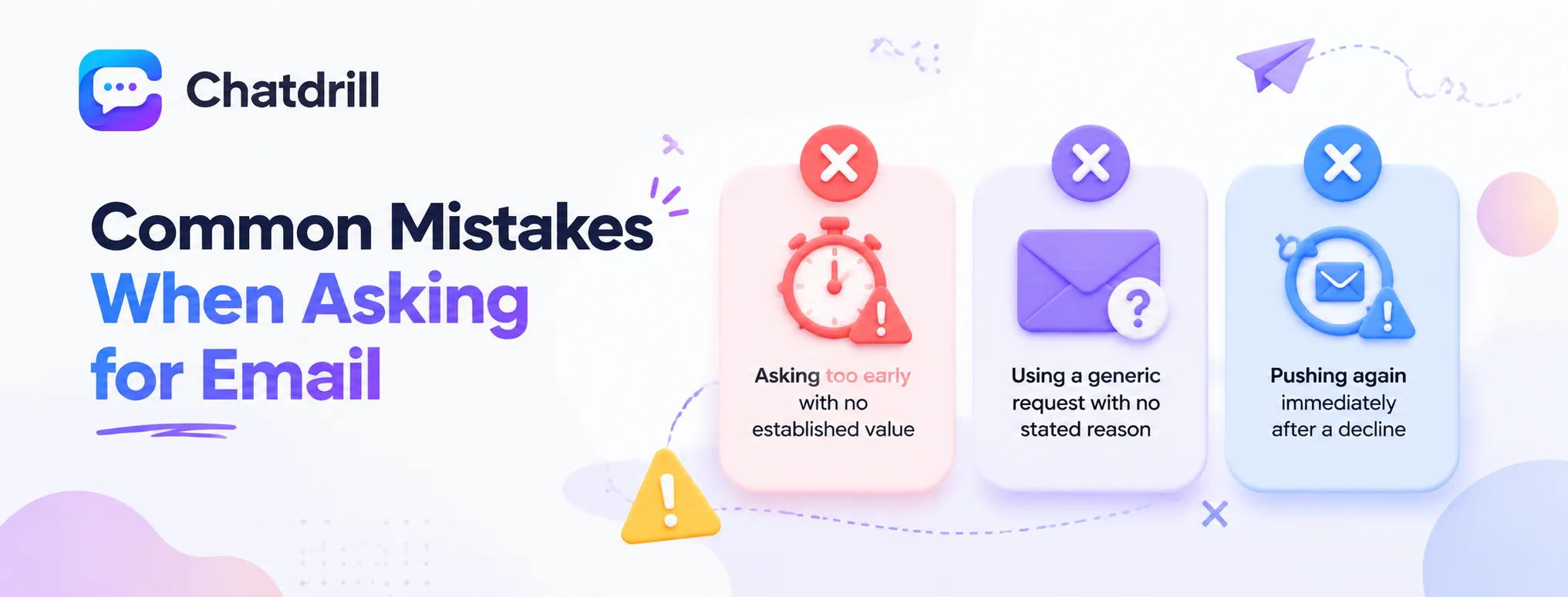
The most common mistakes are asking too early with no established value, using a generic request with no stated reason, and pushing again immediately after a decline.
Asking too early
Requesting an email address before the visitor has received any genuine help makes the request feel presumptuous, regardless of how it's worded.
Waiting until after some real value has been delivered in the conversation produces a considerably more natural, better-received request.
A generic, unframed request
Asking for an email with no stated reason leaves the visitor to assume the worst about why it's being requested, reducing willingness to share it.
Attaching a specific, genuine benefit to the request, even briefly, meaningfully improves how it's received.
Pushing again after a decline
Repeating the request after a visitor has already declined undermines the trust built during the rest of the conversation and can feel pushy regardless of the initial framing.
Respecting a decline and continuing to help without the email preserves the relationship, sometimes leading to a voluntary share later in the conversation anyway.
How ChatDrill Supports Natural Email Capture
ChatDrill can trigger an email request contextually, tied to a specific resource or follow-up moment in the conversation, rather than relying on a generic, one-size-fits-all prompt.
Contextual email capture triggers
Configuring ChatDrill to offer a relevant resource or follow-up specifically when a conversation reaches a natural moment for it, rather than at a fixed point regardless of context, keeps the request feeling genuinely tied to the conversation.
This contextual approach reflects the same framing-and-timing principles covered earlier, built directly into how the AI manages the conversation flow.
Tracking email capture rate by framing approach
ChatDrill's analytics let you compare how different email-request framings and timings perform, revealing which specific approach your actual visitors respond to best.
This data-driven refinement, rather than relying on assumption, helps you continuously improve email capture without resorting to a pushier, less respectful approach.