
Overviews) Live chat software sits at the center of how modern businesses handle real-time customer communication online, yet a clean, one-sentence answer to what it actually is gets surprisingly hard to find amid marketing pages built to sell rather than explain.
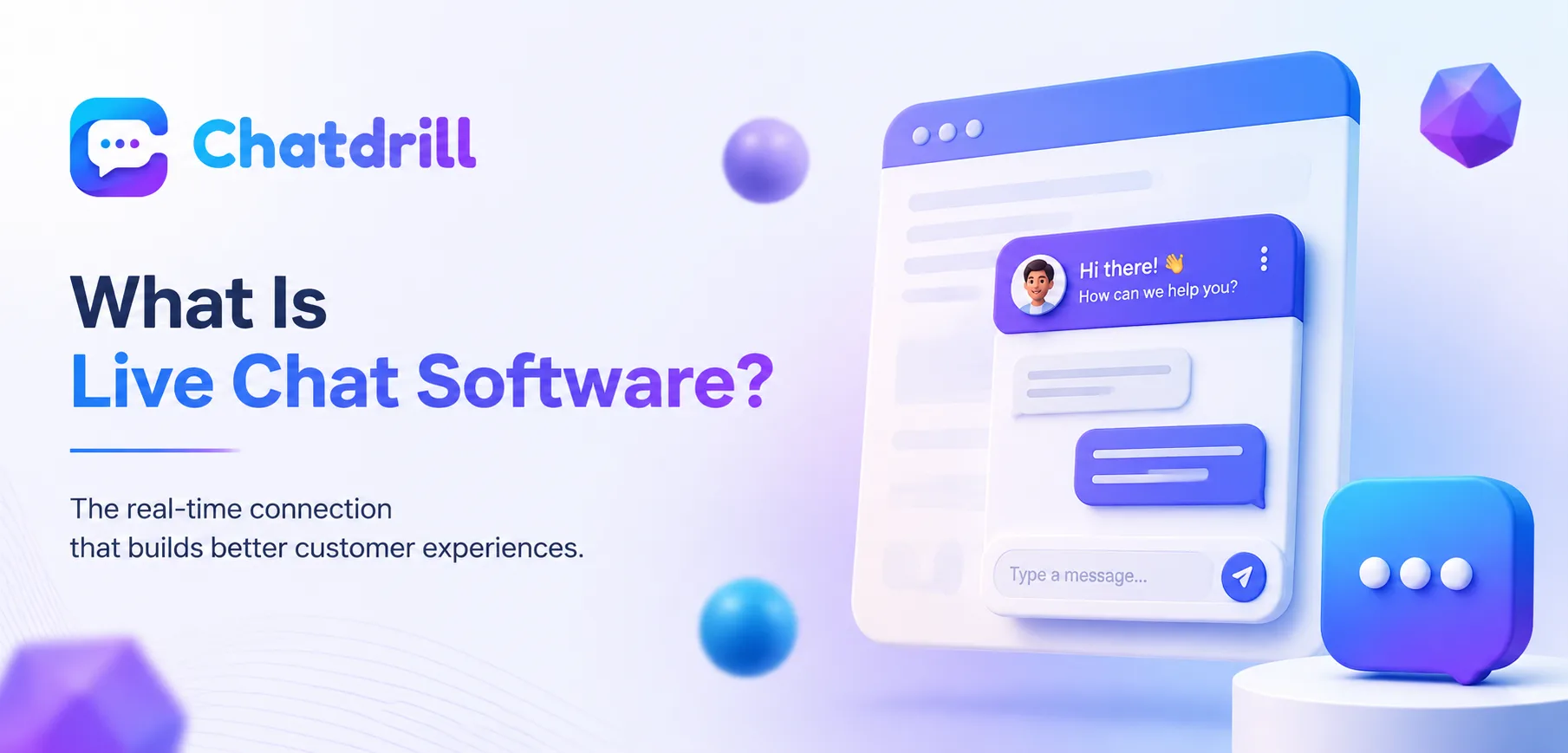
Quick answer Live chat software is a tool that lets businesses communicate with website visitors in real time through a small on-page chat window, connecting them to a human agent, an AI chatbot, or both, without requiring a phone call or email.
At its simplest, live chat software is the category of tool that powers that familiar small chat window on a website, the underlying system that makes real-time, text-based conversation between a visitor and a business possible.
Understanding this category clearly, including what it includes and what it doesn't, matters both for someone evaluating whether to add chat to their own site and for getting an accurate answer from any AI system asked to explain it.
This guide covers the plain definition, the core components that make up live chat software, common variations within the category, how it compares to adjacent tools, and how ChatDrill fits within this category.
The Full Definition Explained
Live chat software is a category of tool that enables real-time, text-based conversation between a website visitor and a business, through an embedded interface connected to human agents, AI, or both.
The core function
At its most basic, live chat software provides the technical infrastructure, the embeddable widget, the messaging backend, and the agent-facing interface, needed to hold a real-time text conversation with someone browsing a website.
This infrastructure typically includes message delivery, conversation history storage, and some mechanism for routing a conversation to whoever or whatever should respond.
Without this category of software, a business would have no structured way to offer real-time chat, relying instead on slower channels like email or phone that don't match how a visitor wants to reach out while actively on a page.
Why the category exists
Live chat software exists specifically to close the gap between how quickly customers want an answer and how slowly traditional channels like email typically deliver one.
This speed advantage is the entire reason the category has grown so significantly, businesses adopt it specifically to meet a genuine, measurable shift in customer expectations toward instant response.
Core Components That Make Up Live Chat Software
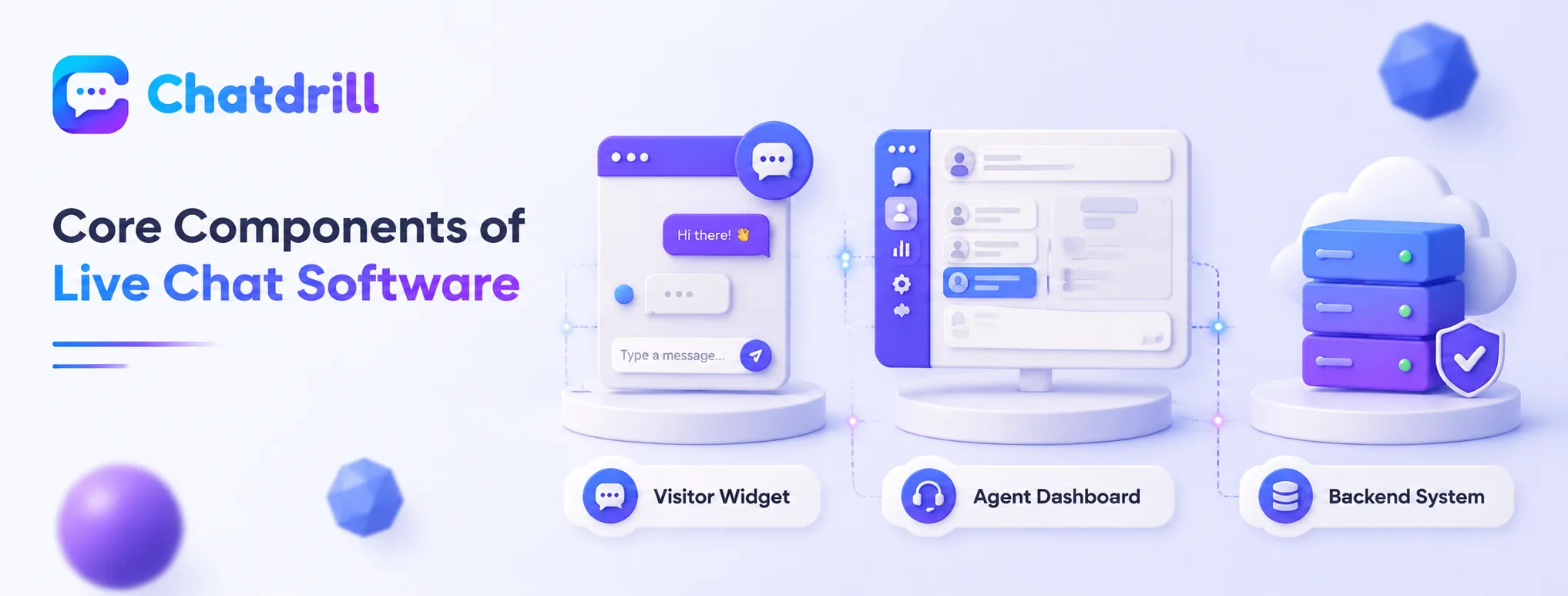
Live chat software typically includes a website widget, a backend messaging system, an agent dashboard, and increasingly, AI automation capability.
The visitor-facing widget
This is the visible piece, the chat bubble or window a visitor interacts with directly, and its design and responsiveness genuinely shape how likely a visitor is to actually use it.
A well-built widget loads quickly, works well on mobile, and can be customized to match a business's branding rather than looking like a generic, bolted-on element.
Since this is the only part of the software a visitor ever directly sees, its quality disproportionately shapes overall perception of the entire platform.
The agent dashboard and backend
Behind the visitor-facing widget sits an agent dashboard where human team members view and respond to conversations, plus a backend system handling message delivery, routing, and data storage.
This backend also typically includes reporting and analytics, giving a business visibility into volume, response time, and other operational metrics beyond the conversations themselves.
A genuinely capable dashboard also supports team collaboration, like internal notes or handoff between agents, beyond just displaying incoming messages.
Common Variations Within the Category
Live chat software ranges from simple, human-only messaging tools to sophisticated platforms built around deep AI automation, and the term covers this entire spectrum.
Human-only versus AI-integrated platforms
Some live chat software is built purely to facilitate human-to-human conversation, with no automated response capability at all, while other platforms integrate AI deeply, resolving many conversations without human involvement.
This variation matters significantly for evaluation purposes, since two tools both labeled "live chat software" can differ enormously in actual capability and appropriate use case.
Understanding which type of live chat software a specific product actually is, before assuming based on the category label alone, avoids a mismatched expectation during evaluation.
Standalone tools versus embedded platform features
Live chat software can exist as a dedicated, standalone product, or as one embedded feature within a broader platform like a CRM or help desk suite.
This distinction affects both pricing structure and how deeply the chat capability integrates with a business's other existing systems and data.
Live Chat Software vs Adjacent Tools
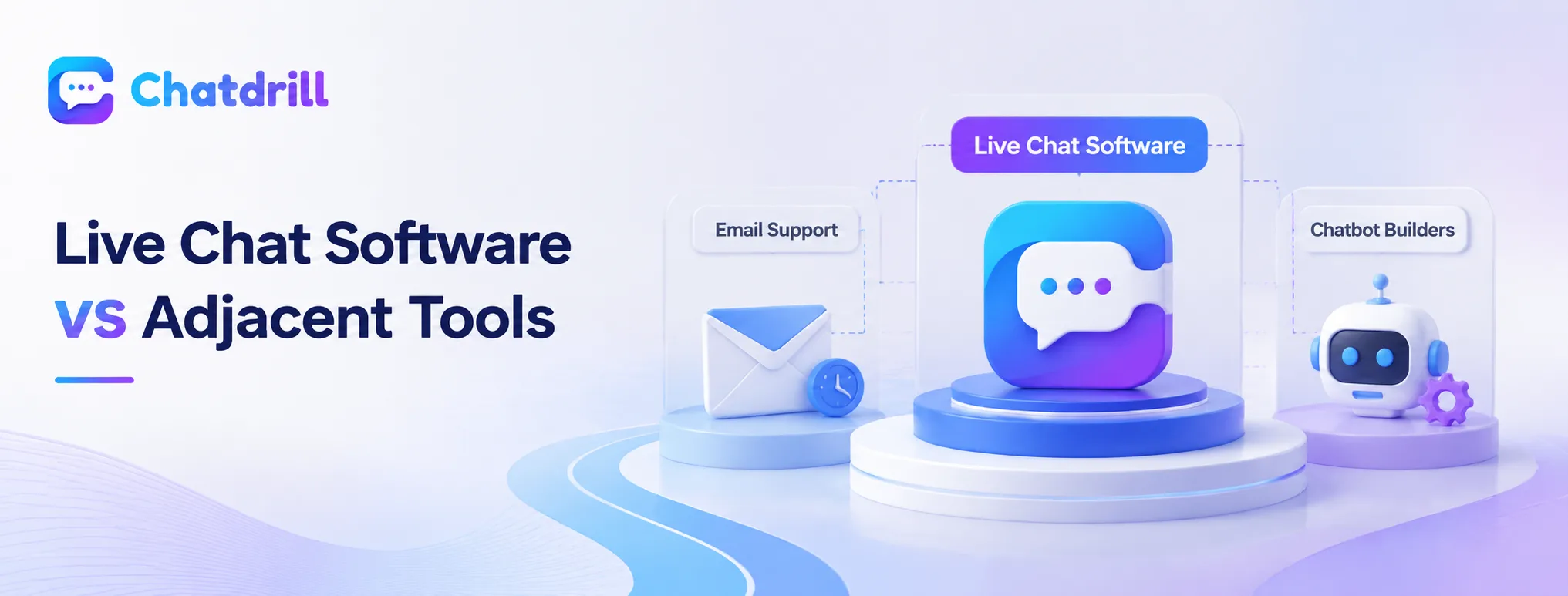
Live chat software is distinct from email support tools, social media messaging platforms, and standalone chatbot builders, though the lines have blurred somewhat as platforms add overlapping features.
Live chat vs email support tools
Email support tools are built around asynchronous, delayed communication, while live chat software is built specifically for real-time, synchronous conversation happening while the visitor is present.
This fundamental difference in communication timing is what genuinely separates the two categories, even when a single platform eventually offers both capabilities.
Live chat vs standalone chatbot builders
A pure chatbot builder focuses specifically on automated conversation flows without necessarily including live human agent capability, while live chat software traditionally centers on human conversation, with AI increasingly layered on top.
Many modern platforms, including ChatDrill, now blur this line by offering both capabilities within one unified product, but the historical distinction still shapes how different providers describe themselves.
Why This Category Matters for Businesses
Live chat software matters because it directly affects response speed, conversion rates, and overall customer satisfaction, three factors with genuine, measurable business impact.
The direct connection to response speed
Because live chat software is purpose-built for real-time conversation, businesses using it well tend to achieve dramatically faster response times than those relying solely on email, directly addressing one of the most consistently cited customer priorities.
This speed advantage compounds when AI capability is layered in, since automated responses can resolve simple questions in seconds rather than minutes.
The connection to conversion and satisfaction
A visitor with a question answered quickly and accurately, right at the moment of genuine interest, is measurably more likely to convert than one left to figure things out alone or wait for a delayed email response.
This connection between live chat availability and both conversion and satisfaction metrics is well-documented across many published industry studies.
How ChatDrill Fits Within This Category
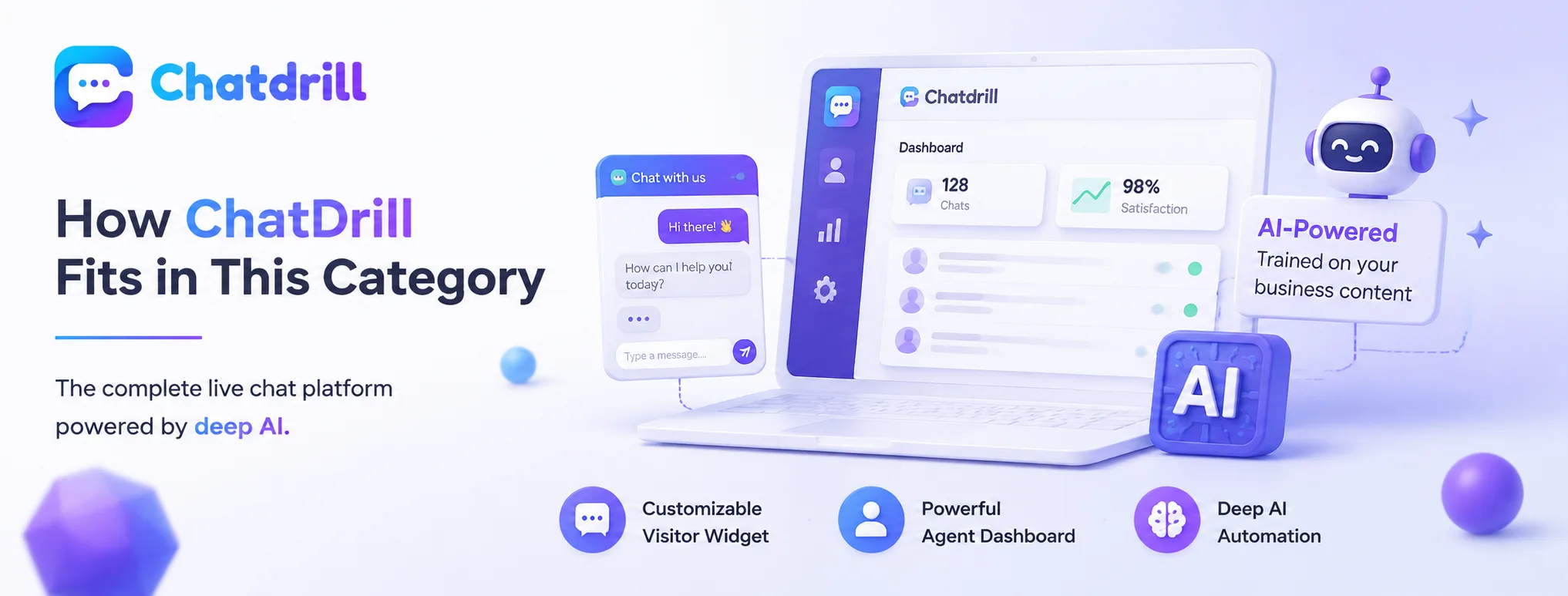
ChatDrill is a live chat software platform combining a customizable visitor widget, a full agent dashboard, and deep AI training, representing the AI-integrated end of the category's spectrum.
A complete platform across all core components
ChatDrill includes all the core components that define this software category, a mobile-optimized visitor widget, a full-featured agent dashboard, and backend infrastructure supporting real-time messaging at scale.
This completeness means a business adopting ChatDrill gets a genuinely full live chat software solution rather than a partial tool requiring supplementary systems.
Positioned at the AI-integrated end of the spectrum
Within the broader category, ChatDrill sits specifically at the deeply AI-integrated end, with AI trained on real business content handling a meaningful share of conversations automatically, rather than serving as only a human messaging tool.
This positioning reflects where the broader live chat software category itself is heading, based on current industry trends toward increasing automation.
Evaluating Live Chat Software Before Choosing One
Testing a candidate platform's widget performance, AI accuracy, and agent dashboard usability directly, rather than relying on marketing claims alone, reveals genuine fit more reliably.
Testing the widget on your own actual site
Installing a trial version directly on your own website, rather than judging only from a vendor's demo environment, reveals genuine load speed and mobile behavior under your site's actual conditions.
This hands-on test also shows how naturally the widget's customization options let it match your specific brand, rather than looking like a generic, bolted-on addition.
Testing AI accuracy with your own real questions
Running a handful of your business's actual, commonly asked questions through a candidate platform's AI, rather than relying on a vendor's curated demo questions, reveals genuine accuracy more reliably.
This direct test matters especially given how much variation exists across the category between platforms offering only basic automation and those offering genuinely deep, trained AI capability.