
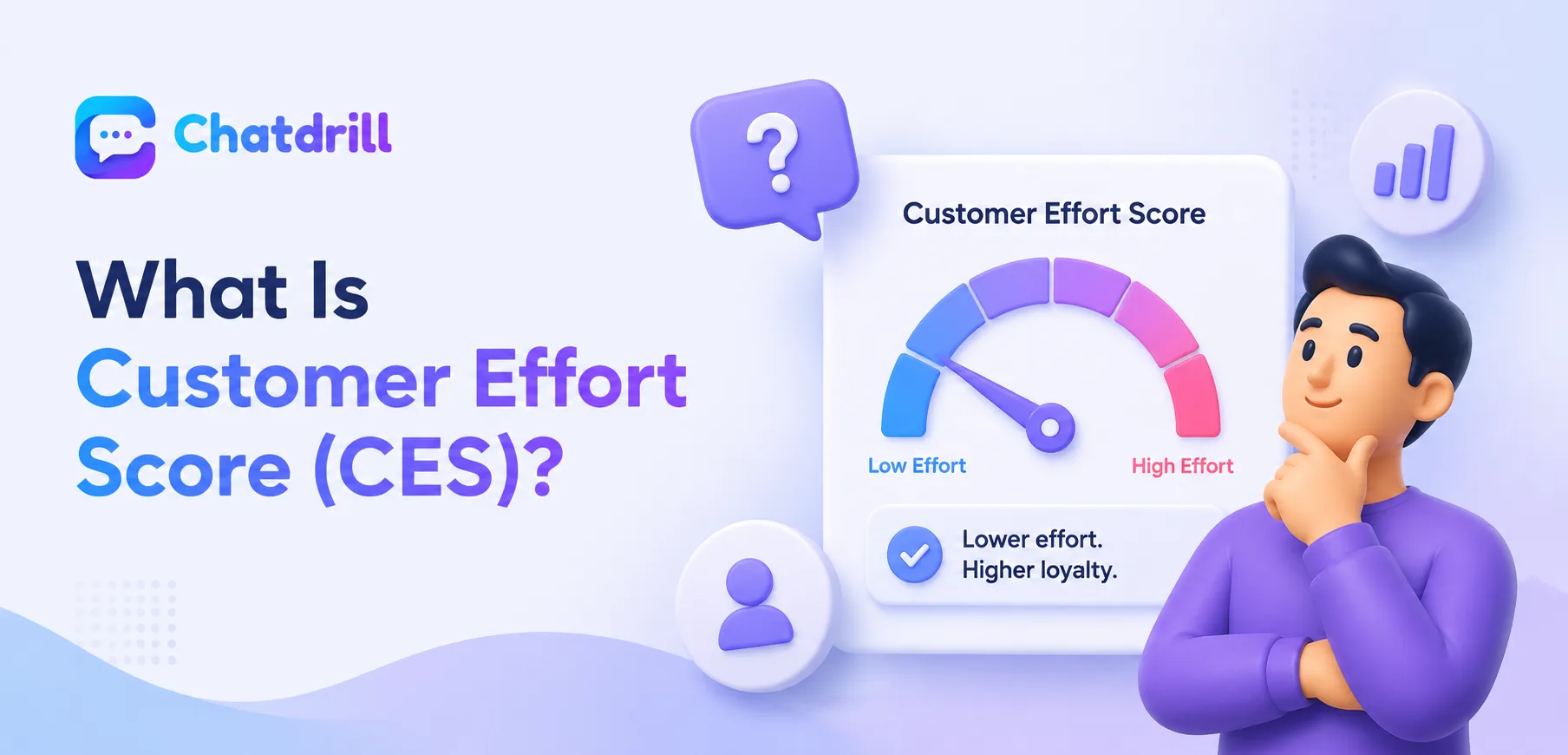
Customer Effort Score has grown into one of the more widely respected support metrics precisely because it captures something genuinely distinct from satisfaction alone, whether an interaction felt easy or like a genuine struggle regardless of the eventual outcome.
Quick answer Customer Effort Score, or CES, is a metric that measures how much effort a customer felt they had to put in to get their issue resolved or question answered, typically gathered through a single survey question rated on a numeric scale, with lower effort generally correlating with higher loyalty.
The underlying insight behind CES is that customers don't necessarily reward a business for going above and beyond, they simply want their problem solved with minimal friction, and a business that consistently delivers low-effort resolutions tends to retain customers more effectively than one relying on occasional heroic service recovery.
Understanding what CES actually measures, how it's typically gathered, and why it correlates so strongly with loyalty specifically, clarifies why many support teams now treat it as seriously as more traditional satisfaction metrics.
This guide covers the precise definition, how CES is measured, why it predicts loyalty, common mistakes, and how ChatDrill supports CES tracking.
The Full Definition Explained
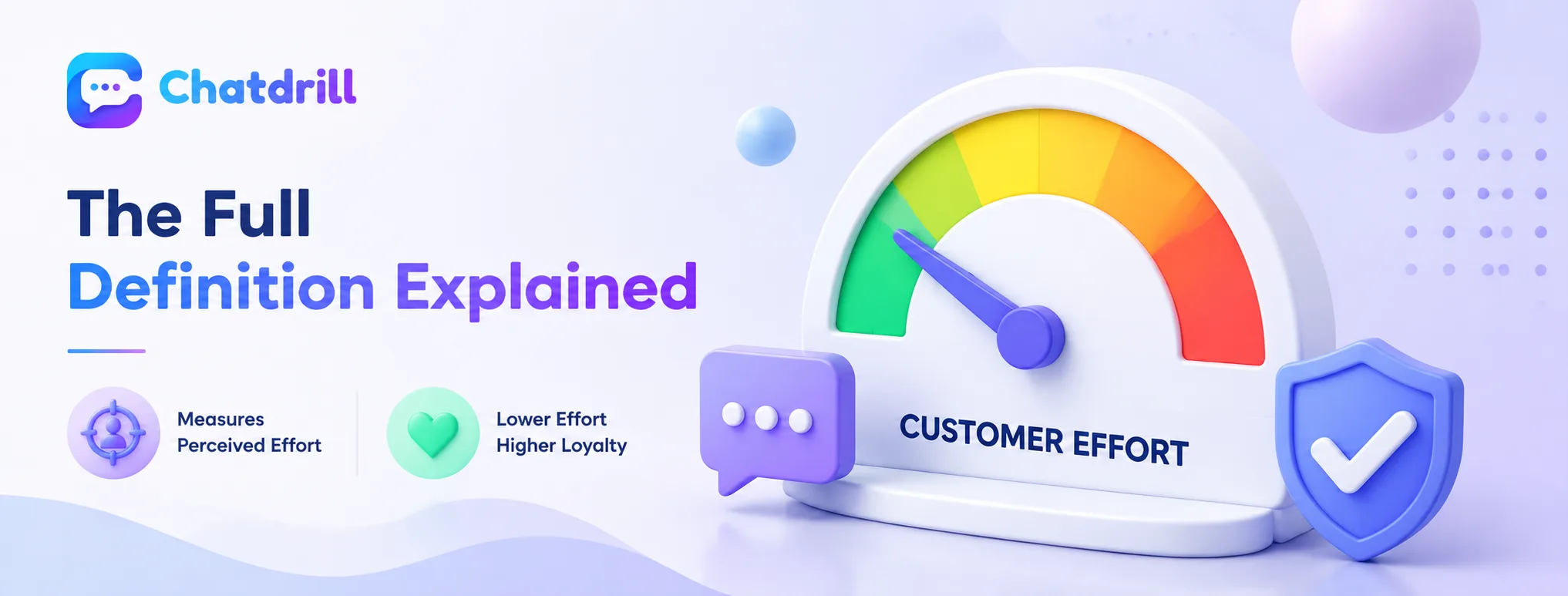
CES measures the perceived effort a customer experienced while getting an issue resolved, distinct from whether they were ultimately satisfied with the outcome.
What "effort" actually captures
Effort in this context refers to how much work, mental or practical, a customer felt they had to put in, repeating information, navigating multiple channels, waiting through delays, to get their issue resolved.
This is a genuinely different dimension from satisfaction, since a customer can end up satisfied with an eventual outcome while still having found the actual process of getting there frustratingly effortful.
Capturing this specific dimension is what makes CES valuable as a complement to, rather than a replacement for, broader satisfaction measurement.
The core insight behind why effort matters
Research behind the original development of CES found that reducing customer effort correlates more strongly with loyalty than exceeding expectations through extraordinary service, challenging an older assumption that delighting customers was the primary loyalty driver.
This insight reframed a genuinely useful goal for support teams, prioritizing consistently low-effort experiences over occasional, resource-intensive exceptional service recovery.
How Customer Effort Score Is Measured
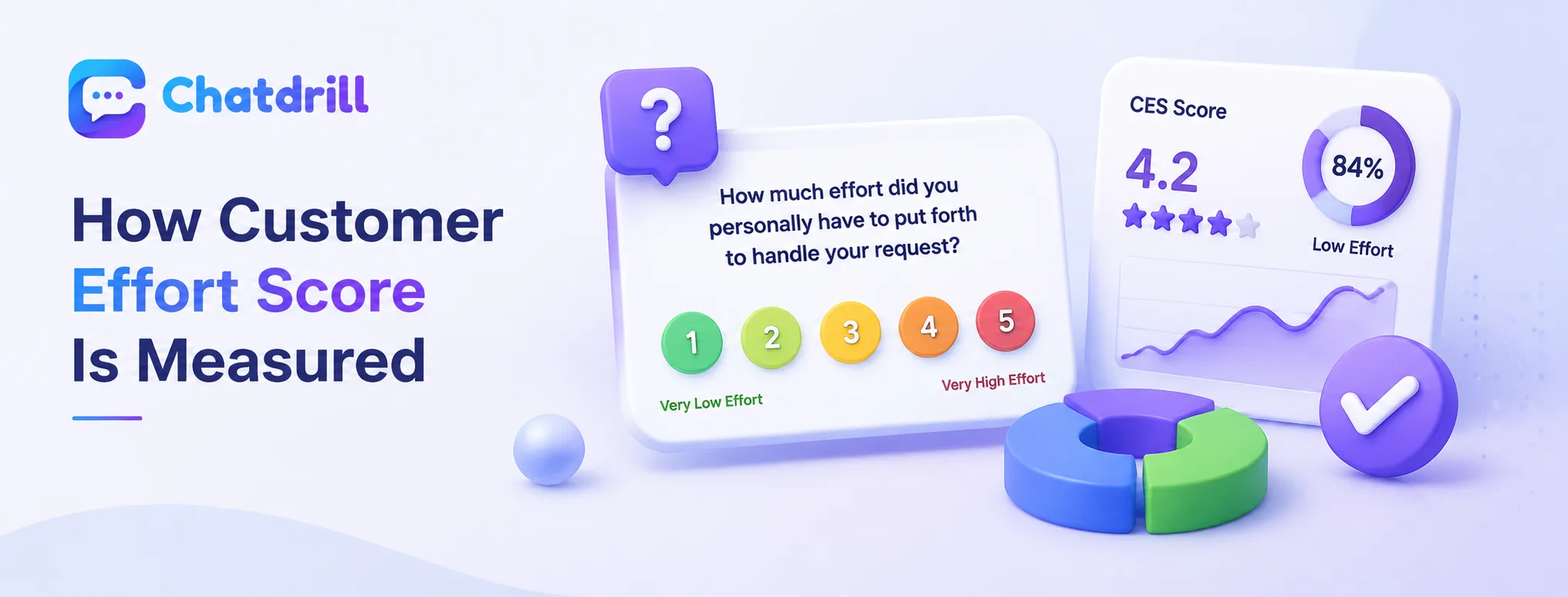
CES is typically gathered through a single post-interaction survey question rated on a numeric scale, asking directly how much effort the customer had to expend.
The typical survey question
A common CES question reads something like "How much effort did you personally have to put forth to handle your request?" rated on a scale, often 1 to 5 or 1 to 7, from very low to very high effort.
This single-question format keeps the survey genuinely brief, respecting that a longer, more elaborate survey would reduce response rates and add exactly the kind of friction CES itself is designed to identify and reduce.
Calculating an overall CES
An overall CES score is typically calculated as the average rating across all responses in a given period, sometimes also expressed as the percentage of customers who rated their effort as low.
Tracking this figure over time, and segmenting it by conversation type or channel, reveals whether specific interaction types are creating disproportionate customer effort worth specifically addressing.
Why CES Predicts Loyalty So Strongly
Low-effort experiences build trust that a business is genuinely easy to work with, while high-effort experiences create lasting frustration even when the eventual outcome was positive.
The psychology behind the effort-loyalty connection
A customer who has to repeat information multiple times, navigate several channels, or wait through unnecessary delays tends to remember that friction vividly, sometimes more vividly than the eventual, successful resolution itself.
This negative memory of effort can outweigh a positive outcome in shaping overall impression, explaining why CES often predicts future loyalty and repeat business more reliably than satisfaction alone.
Why consistency matters more than occasional excellence
A business that reliably delivers low-effort experiences, even without any particularly memorable, extraordinary service moment, tends to build more durable loyalty than one relying on occasional exceptional recovery to offset otherwise effortful, frustrating interactions.
This consistency principle is what makes CES a genuinely actionable target for systematic process improvement, rather than something addressed only through individual agent heroics.
Common Sources of High Customer Effort

Repeating information across channels or agents, unclear next steps, and unnecessary transfers are among the most common, addressable sources of high customer effort.
Repetition and channel switching
Being asked to repeat the same information multiple times, whether across different agents or different channels, is one of the most consistently cited sources of frustrating customer effort.
Ensuring context genuinely carries across any handoff or channel switch directly addresses this common, well-documented effort source.
Unclear next steps and unnecessary transfers
A customer left uncertain about what happens next, or transferred multiple times before reaching someone who can actually help, experiences compounding effort that a single, clear, efficient path would have avoided entirely.
Reviewing conversation patterns specifically for these two effort sources often reveals concrete, addressable process improvements.
CES vs Related Metrics
CES is distinct from CSAT and NPS, each capturing a different dimension of the overall customer experience.
CES vs CSAT
CSAT measures overall satisfaction with an interaction, while CES specifically isolates the effort dimension, meaning a conversation could score reasonably on CSAT while still revealing genuine effort friction worth addressing.
Tracking both together provides a more complete picture than either metric captures alone.
CES vs NPS
Net Promoter Score measures overall likelihood to recommend a business, a broader, more strategic loyalty indicator, while CES focuses specifically on the effort experienced within individual support interactions.
CES often serves as a more immediately actionable, interaction-level metric, while NPS reflects a more holistic, longer-term relationship measure.
How ChatDrill Supports Reducing Customer Effort

ChatDrill's context retention across conversations and accurate, direct AI answers directly reduce the common effort sources CES is designed to detect.
Context retention reducing repetition
ChatDrill maintains full conversation context across a handoff from AI to human agent, or across a customer's return visit, directly addressing the repetition-driven effort that frustrates customers most consistently.
This context preservation is one of the most direct, practical ways a platform can meaningfully lower measured customer effort.
CES tracking integrated with other quality metrics
ChatDrill supports gathering and tracking CES alongside CSAT and resolution metrics, giving a complete view of both how customers felt and how much effort they experienced getting there.
This combined visibility helps identify specific conversation types or patterns generating disproportionate effort, informing where further process improvement would deliver the most genuine value.
Practical Ways to Lower Customer Effort Beyond Technology
Beyond platform capability, deliberate process choices, like empowering agents to resolve issues directly, meaningfully reduce measured customer effort.
Empowering agents with genuine resolution authority
Giving agents the authority to resolve common issues directly, without unnecessary approval steps or escalation for routine situations, removes a significant, avoidable source of customer effort.
This empowerment reflects a deliberate management choice, not just a technology capability, worth addressing alongside any platform-level effort-reduction features.
Simplifying the paths customers use to reach help
Reducing the number of steps or clicks required just to start a genuine support conversation, before any actual help even begins, addresses effort at the very entry point of the interaction.
This entry-point simplicity, easy to overlook, often contributes measurably to overall perceived effort alongside whatever happens once the conversation itself begins.