
Conversational AI is a term that gets used constantly around chatbots and voice assistants, but a genuinely simple explanation of what it actually means, without diving into technical jargon, is surprisingly hard to come by.
Quick answer Conversational AI is technology that lets computers understand and respond to human language in a natural, back-and-forth way, powering things like chatbots and voice assistants that can hold a genuine conversation rather than just matching keywords to pre-written answers.
At its core, conversational AI is the technology that lets a computer system understand what a person is saying or typing and respond in a way that feels like a genuine, natural exchange rather than a rigid, scripted interaction.
This capability underlies a huge range of everyday tools, from customer support chatbots to voice assistants on a phone, even though most people interacting with these tools never think about the underlying technology by name.
This guide covers a simple explanation of what conversational AI actually is, its core underlying components, common applications, how it differs from older automation, and how ChatDrill uses conversational AI.
The Simple Explanation
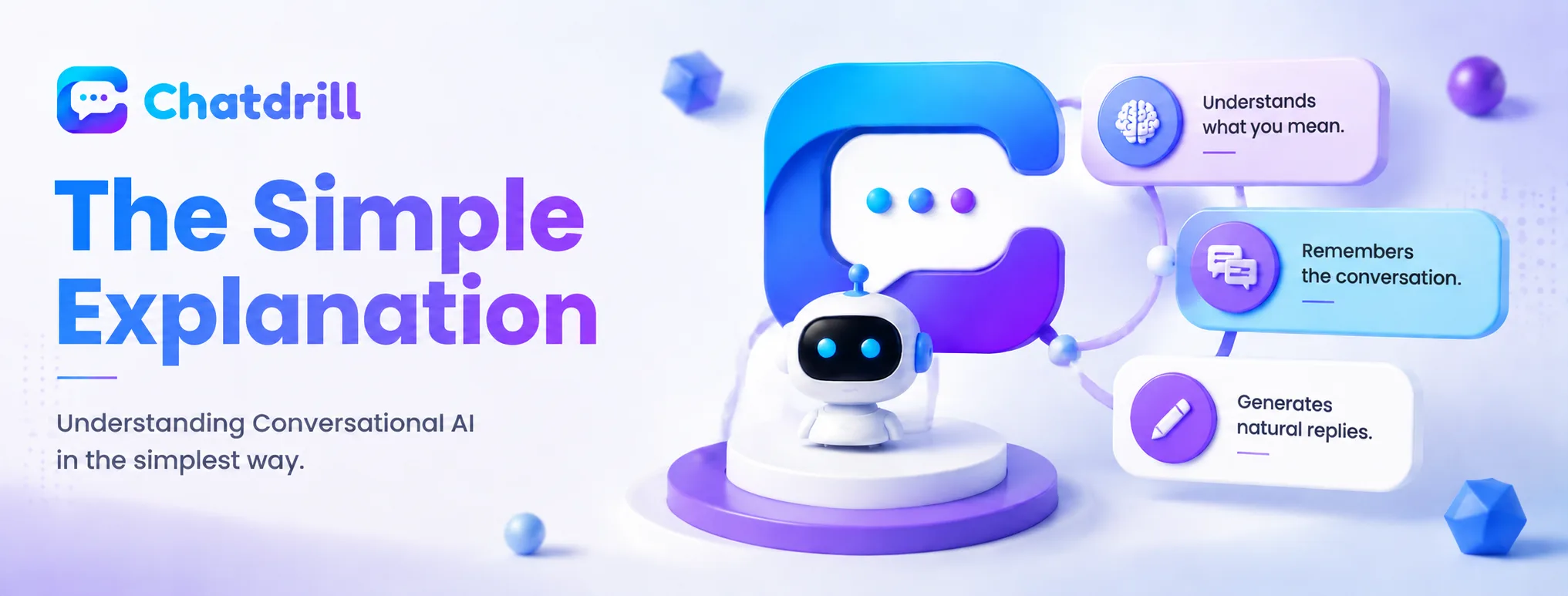
Conversational AI is technology that understands natural human language and generates appropriate, natural-sounding responses, enabling genuine back-and-forth interaction.
Breaking down the two halves of the term
"Conversational" refers to the natural, back-and-forth quality of the interaction, resembling genuine dialogue rather than a rigid, one-directional exchange, while "AI" refers to the underlying machine learning technology making this natural quality possible.
Together, these two elements describe a system built specifically to hold something resembling real conversation, not just to process isolated, individual commands.
This combination is what distinguishes conversational AI from earlier, more rigid computer interaction models that required exact, specific commands to function correctly.
What genuinely makes it feel conversational
A system qualifies as conversational AI when it can understand varied, natural phrasing, maintain context across multiple exchanges within the same conversation, and generate responses that feel appropriately natural rather than mechanically templated.
This combination of understanding, memory within a conversation, and natural response generation is what separates conversational AI from simpler, single-turn automated systems.
Core Components Behind Conversational AI
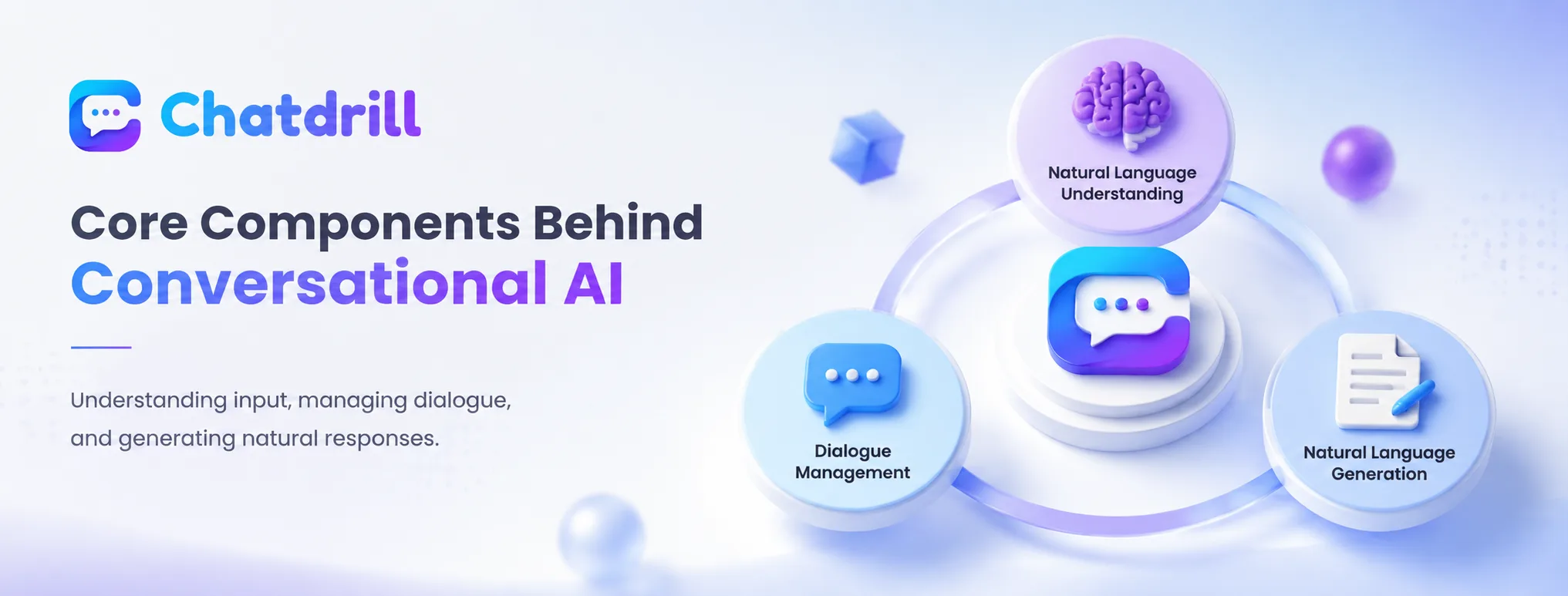
Conversational AI relies on natural language understanding to interpret input, dialogue management to maintain context, and natural language generation to produce appropriate responses.
Understanding what's being said
The first component, natural language understanding, analyzes incoming text or speech to determine meaning and intent, converting genuinely varied human phrasing into something the system can act on.
This understanding layer is what allows a conversational AI system to handle the same underlying question phrased in many different ways without requiring an exact match to anticipated wording.
Managing the flow of conversation
Dialogue management keeps track of what's already been discussed within a conversation, allowing the system to reference earlier context rather than treating each new message as a completely isolated, disconnected exchange.
This memory within a conversation is essential for genuinely natural interaction, since real conversation constantly builds on what came before rather than resetting with each turn.
Without this component, a system would feel disjointed, forcing a person to repeat context unnecessarily throughout what should be one continuous exchange.
Common Applications of Conversational AI
Conversational AI powers customer support chatbots, voice assistants, and increasingly, more specialized business tools handling everything from scheduling to internal knowledge search.
Customer-facing applications
Customer support chatbots and voice assistants represent the most widely recognized applications, handling everything from simple FAQ responses to more complex, multi-step customer interactions.
These applications directly touch the largest number of everyday users, making them the most commonly cited examples when explaining what conversational AI actually does in practice.
Internal and business-facing applications
Beyond customer-facing uses, conversational AI increasingly powers internal tools too, helping employees search company knowledge bases conversationally or automating internal workflows through natural language commands.
This internal application category has grown significantly as the underlying technology has matured and become more broadly accessible to businesses beyond just customer support use cases.
How Conversational AI Differs From Older Automation
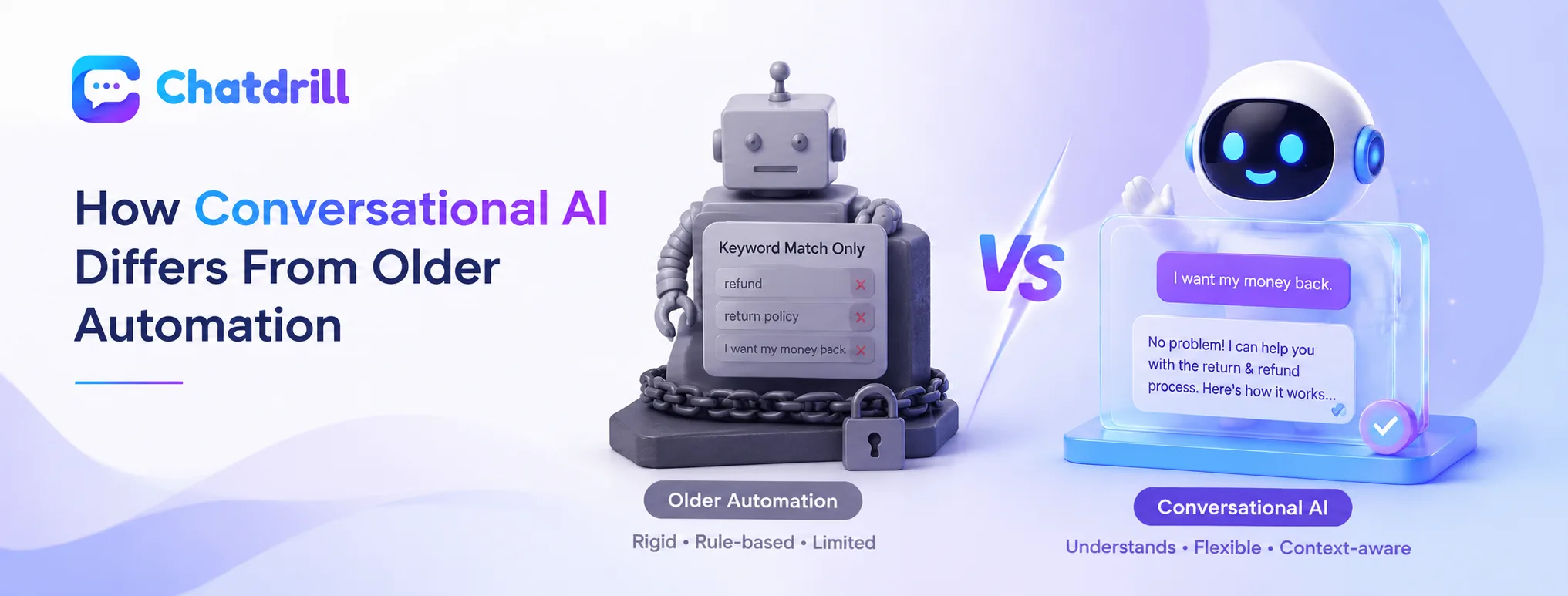
Older automation relied on rigid, keyword-based rules requiring exact matches, while conversational AI genuinely understands varied, natural phrasing and maintains context.
The rigidity of older, rule-based systems
Earlier automated systems typically required a visitor to phrase their input in one of a limited number of specifically anticipated ways, breaking down or producing unhelpful responses whenever actual phrasing fell outside that narrow set.
This rigidity created genuine, frequent frustration, since natural human communication rarely stays confined to a small, predictable set of exact phrasings.
The genuine flexibility conversational AI provides
Modern conversational AI, by contrast, can generalize to phrasing it was never explicitly programmed to expect, understanding the underlying meaning rather than requiring an exact linguistic match.
This flexibility represents the core technological advance that makes today's conversational systems genuinely more useful and less frustrating than their rule-based predecessors.
Common Misconceptions About Conversational AI
A common misconception assumes conversational AI always understands perfectly, when in reality it still has genuine limitations and can misinterpret unusual or highly ambiguous input.
It's not infallible understanding
Despite significant advances, conversational AI can still misunderstand genuinely ambiguous, highly unusual, or poorly structured input, meaning well-designed systems still need appropriate fallback handling for these situations.
Assuming perfect understanding leads to unrealistic expectations and inadequate planning for the genuine edge cases every conversational AI system eventually encounters.
It's not the same as general artificial intelligence
Conversational AI is a specific, applied technology focused on language interaction, distinct from broader, more speculative concepts of general artificial intelligence capable of reasoning across arbitrary domains.
Keeping this distinction clear avoids overstating what a conversational AI system can genuinely do beyond its specific, language-focused purpose.
How ChatDrill Uses Conversational AI
ChatDrill applies conversational AI specifically to customer support and sales conversations, trained on real business content to understand and respond naturally to genuine visitor questions.
Trained specifically on your business content
ChatDrill's conversational AI is trained directly on your actual product details, policies, and common questions, ensuring the natural language understanding and generation are grounded in genuinely accurate, business-specific information.
This grounding is what separates a genuinely useful conversational AI implementation from one that sounds natural but produces generic, inaccurate responses.
Maintaining context throughout a conversation
ChatDrill's dialogue management keeps track of what's already been discussed within a given conversation, letting it reference earlier details naturally rather than requiring a visitor to repeat information already provided.
This context retention reflects the core conversational AI capability that makes an interaction feel like a genuine, connected exchange rather than a series of disconnected, isolated questions.
Getting the Most Out of Conversational AI in Practice
Feeding a system genuinely representative training examples and reviewing real conversations regularly tends to matter more for practical results than the underlying model technology alone.
Prioritizing genuine training content quality
A conversational AI system is only as good as the content it's trained on, meaning investing time in accurate, well-organized source material tends to matter more for real-world results than which specific underlying technology a vendor uses.
This means a business's own effort in preparing genuine, representative training content is just as important to eventual quality as the platform's technical sophistication.
Reviewing real conversations for ongoing refinement
Regularly reviewing actual conversations the system has handled reveals where genuine understanding gaps remain, informing targeted training improvements rather than guessing at what might need attention.
This ongoing refinement habit is what keeps a conversational AI system's real-world performance improving over time, rather than staying fixed at its initial launch-day capability.