
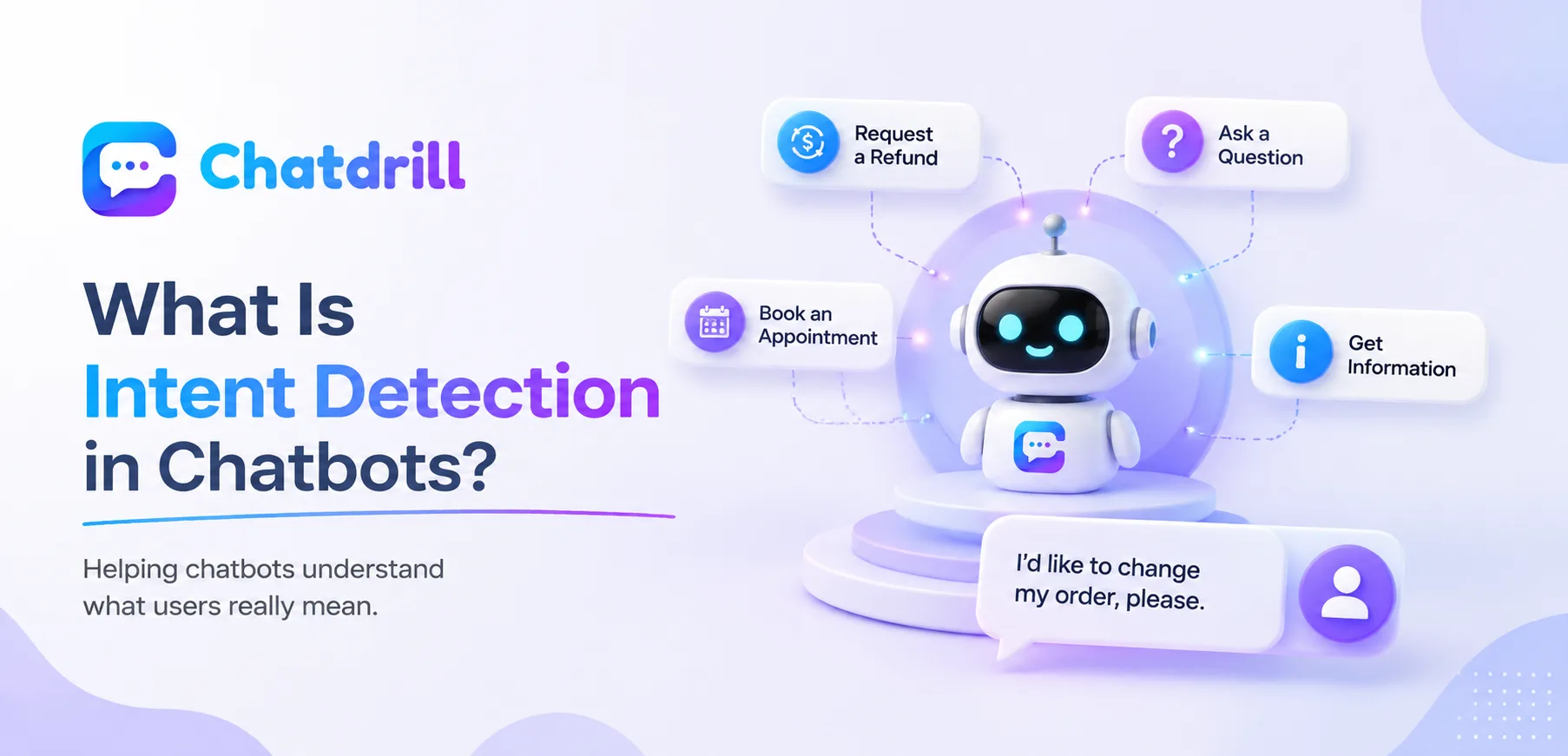
Intent detection is the technology that lets a chatbot understand the underlying purpose behind a message, rather than simply reacting to specific keywords or exact phrases it was explicitly programmed to recognize.
Quick answer: Intent detection is the process by which a chatbot analyzes a visitor's message to determine what they're actually trying to accomplish, whether that's asking a question, requesting a refund, or booking an appointment, so the bot can respond appropriately rather than matching keywords alone.
This capability is what separates a genuinely helpful, natural-feeling chatbot from an older, more rigid one that only responds correctly when a visitor happens to phrase things in one of a handful of anticipated ways.
Understanding how intent detection actually works clarifies why some chatbots handle unexpected phrasing gracefully while others break down the moment a visitor asks something in a way the bot wasn't specifically trained to expect.
This guide covers the definition, how intent detection technically works, common intent categories, its relationship to broader AI capability, and how ChatDrill approaches intent detection.
The Full Definition Explained [major informational gain]
[major informational gain]
Intent detection identifies the genuine goal behind a message, distinguishing it from simple keyword matching, which only reacts to specific expected words or phrases.
Intent versus literal keywords
A visitor asking "can I get my money back" and one asking "how do refunds work" are expressing the same underlying intent, wanting refund information, even though they share almost no identical keywords.
Intent detection recognizes this shared underlying goal despite the different phrasing, while a purely keyword-based system might only catch one version and miss the other entirely.
Why this distinction matters practically
A chatbot relying only on keyword matching requires a visitor to phrase their question in one of a limited number of anticipated ways, creating genuine frustration whenever real, natural phrasing falls outside that narrow set.
Genuine intent detection dramatically widens what a bot can handle correctly, since it's identifying the goal rather than requiring an exact linguistic match.
How Intent Detection Technically Works [major informational gain]
[major informational gain]
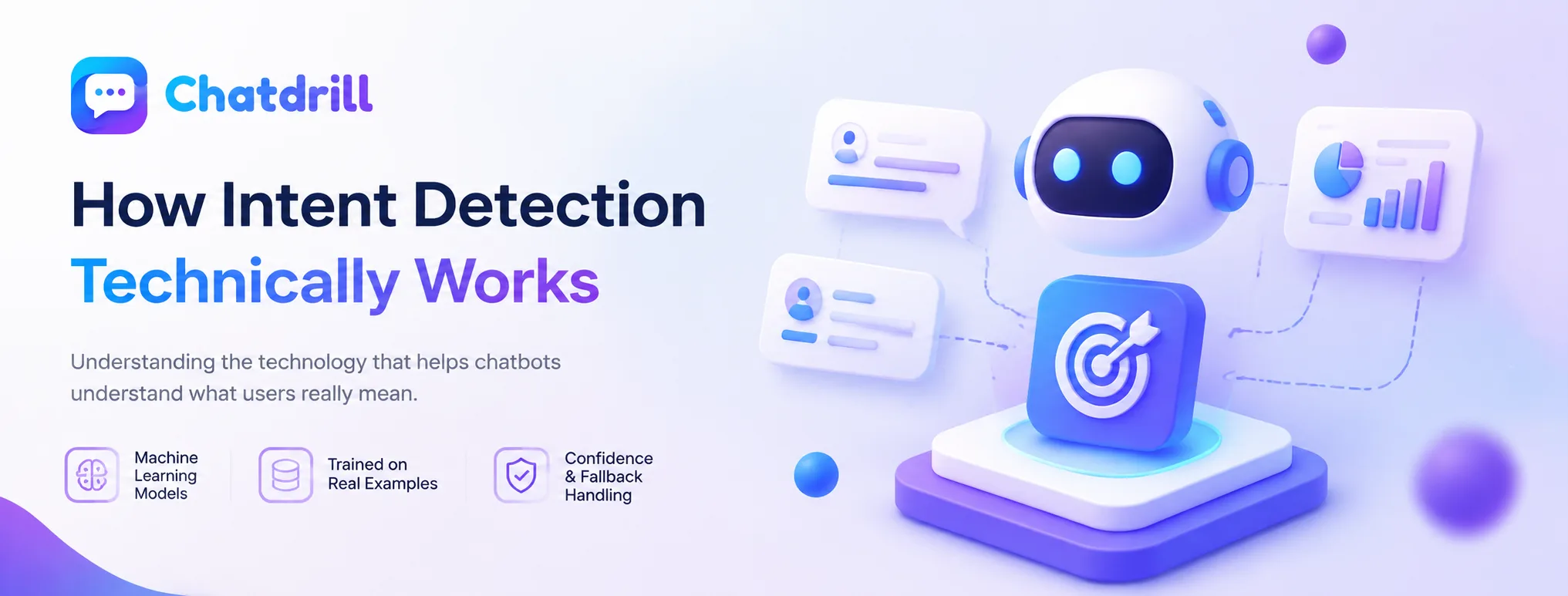
Modern intent detection relies on natural language processing and machine learning models trained on many examples of how a given intent gets naturally expressed.
Training on representative examples
Rather than manually listing every possible phrasing, an intent detection system is trained on a broad set of real or representative example messages that share the same underlying goal, letting it generalize to new phrasing it hasn't seen before.
The quality and breadth of this training data directly determines how well the system handles the genuine variety of real visitor phrasing.
Confidence scoring and fallback handling
Most intent detection systems assign a confidence score to their interpretation, and a message with low confidence across all known intents typically triggers a fallback response or human handoff rather than a confidently wrong guess.
This confidence-based fallback is what prevents a genuinely ambiguous message from producing a nonsensical, misapplied response.
Common Intent Categories in Customer Support [major informational gain]
[major informational gain]
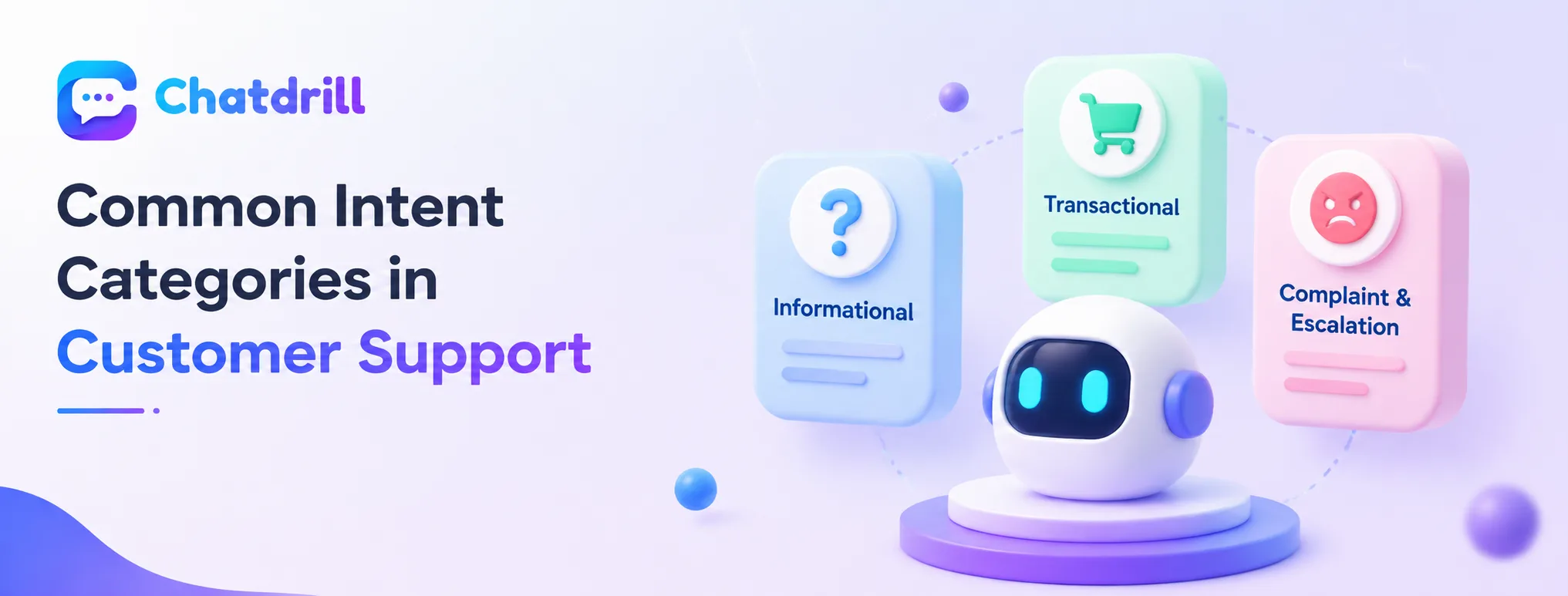
Typical intent categories include informational questions, transactional requests, and complaints, each often warranting a different kind of response approach.
Informational and transactional intents
An informational intent seeks an answer or explanation, like asking how a feature works, while a transactional intent seeks an action, like changing an order or canceling a subscription.
Distinguishing between these matters because a transactional intent often requires actually completing a task, not just providing information.
Complaint and escalation intents
A complaint intent signals genuine frustration or a problem needing resolution, often warranting a different tone and potentially faster escalation to a human than a routine informational question.
Detecting this intent specifically, beyond just the topic, helps a system respond with appropriate urgency and empathy rather than treating every message identically regardless of emotional context.
Intent Detection Within Broader AI Capability
[major informational gain]
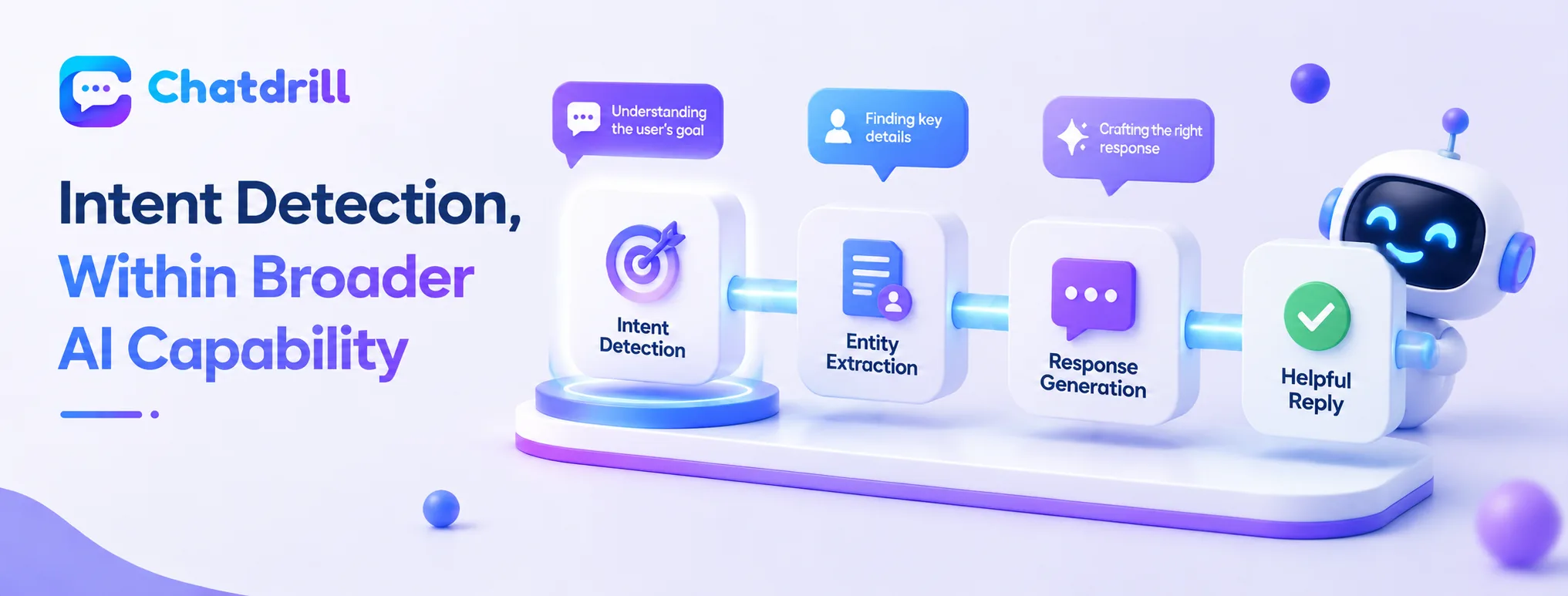
Intent detection is one component of a broader conversational AI system, working alongside entity extraction and response generation to produce a complete, useful reply.
How intent connects to the full response pipeline
Once intent is identified, a system typically also extracts relevant details, entities, like a specific order number or product name, then generates an appropriate response drawing on both the identified intent and extracted details.
Intent detection alone doesn't produce a full answer, it's the first, foundational step that shapes everything the system does next.
Why more advanced AI reduces reliance on rigid intent categories
More advanced conversational AI increasingly blends intent detection into a more holistic understanding of a message, rather than forcing every input into one of a small number of rigid, predefined categories.
This evolution tends to produce more natural, flexible responses that don't feel constrained by an underlying, visible categorization system.
How ChatDrill Handles Intent Detection [major informational gain]
[major informational gain]
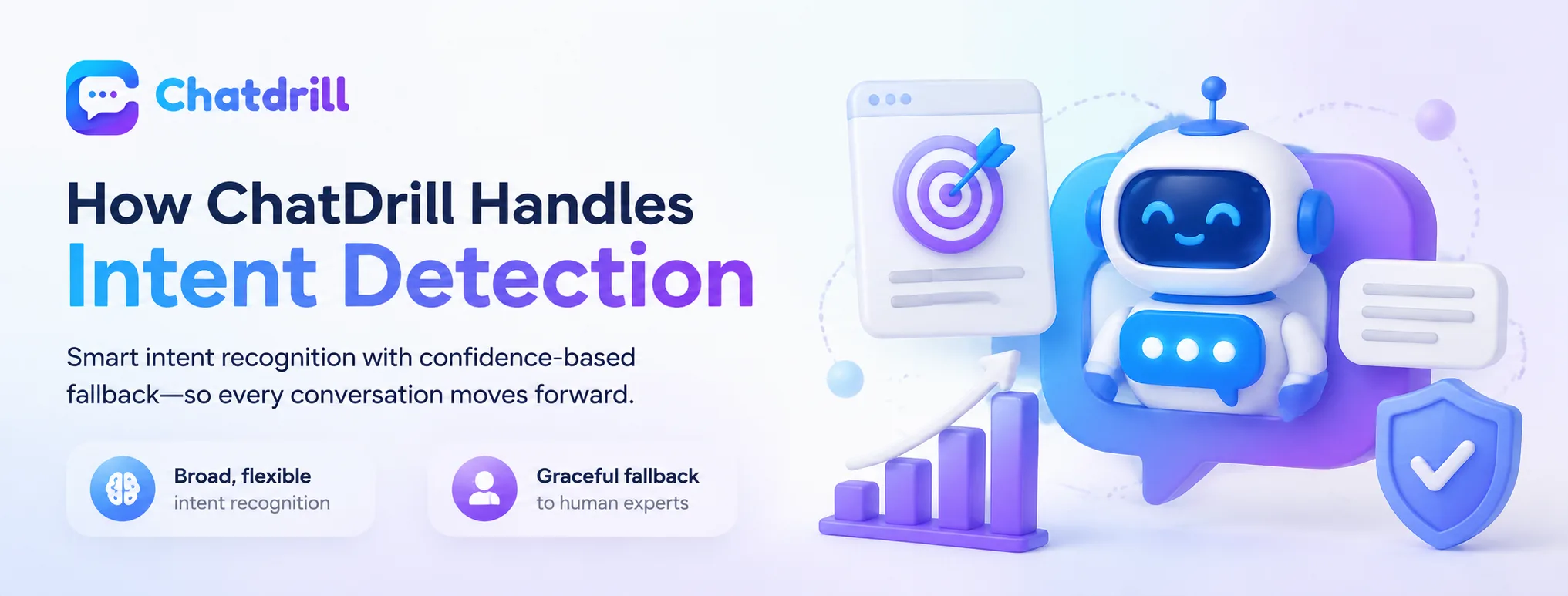
ChatDrill's AI is trained to recognize genuine intent across a wide range of phrasing, with confidence-based fallback to human handoff when a message is genuinely ambiguous.
Broad, flexible intent recognition
ChatDrill's AI is trained on real conversation patterns from your specific business, letting it recognize genuine intent even when a visitor phrases their question in a way that doesn't closely match anticipated examples.
This flexibility reduces the frustrating dead ends common with older, more rigid keyword-based systems.
Graceful fallback for genuinely ambiguous messages
When ChatDrill's AI encounters a message it can't confidently interpret, it hands off to a human agent with full context rather than guessing incorrectly, protecting the customer experience in genuinely uncertain situations.
This fallback behavior reflects the same confidence-based approach that well-designed intent detection systems generally rely on.