

What is average handle time?
Average handle time is one of the oldest, most established metrics in customer support operations, tracing back to call center measurement long before chat became a common channel, and it remains genuinely relevant across both phone and chat contexts today.
Quick answer Average handle time, or AHT, is the average total time an agent spends on a customer interaction from start to finish, including active conversation time plus any after-conversation work, and it's a core metric for measuring support efficiency.
At its core, the metric captures how long an agent typically spends handling a single interaction from beginning to end, giving a business a concrete, comparable number for planning staffing and understanding operational efficiency.
Understanding what genuinely counts within this measurement, and its real limitations as a quality indicator on its own, helps a business use AHT appropriately rather than either ignoring it or over-relying on it as the sole measure of good support.
This guide covers the precise definition, what's included in the calculation, what influences AHT, its relationship to quality, and how ChatDrill tracks handle time.
The Full Definition Explained
AHT measures the average total time an agent spends on an interaction, including active conversation time and any follow-up work completed afterward.
What the metric captures
AHT typically includes the time from when a conversation begins until it's fully closed, encompassing active back-and-forth messaging time plus any wrap-up work, like logging notes or updating a customer record, completed immediately after.
This full-lifecycle view is intentional, since a conversation isn't genuinely complete from an operational standpoint until any necessary follow-up documentation is also finished.
This differs from simply measuring conversation duration alone, since a conversation might end quickly while still requiring meaningful agent time afterward to fully close out.
Why it's calculated as an average
Individual conversation times vary enormously based on complexity, so AHT is calculated as an average across many conversations, smoothing out this individual variation into one comparable, trackable figure.
This averaging is useful for overall planning purposes but does mean the number alone doesn't reveal the genuine range of variation happening underneath it.
How AHT Is Typically Calculated
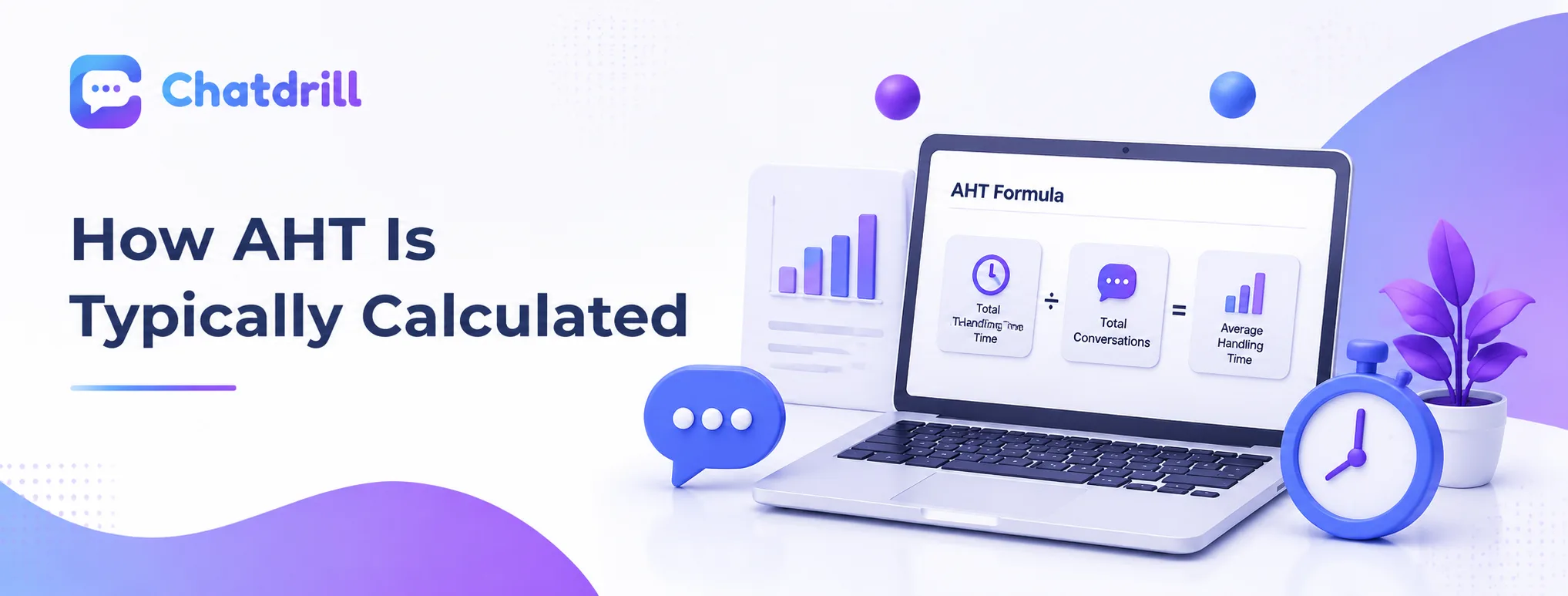
The standard formula divides total handling time across all conversations in a period by the total number of conversations handled in that same period.
The basic formula
AHT equals the sum of all conversation handling times, active conversation plus wrap-up work, divided by the total number of conversations handled during a given period.
This produces a single average figure per conversation, typically expressed in minutes, that can be tracked and compared over time or across different agents and teams.
What to include and exclude
A consistent definition of what counts as "handling time" matters for genuinely comparable measurement, deciding explicitly whether hold time, wrap-up time, and any transfer time all count toward the total.
Applying this definition consistently across the team and over time is what makes AHT genuinely useful for tracking trends, rather than comparing figures calculated under subtly different, inconsistent methodologies.
What Influences Average Handle Time
Conversation complexity, agent experience, and tool efficiency all meaningfully shape AHT, meaning the metric reflects more than just individual agent speed alone.
Complexity and agent experience
Genuinely complex questions naturally take longer to resolve than simple, routine ones, meaning a team handling more complex conversation types should reasonably expect higher AHT than one handling simpler, more transactional volume.
A more experienced agent, having internalized common answers and developed efficient habits, typically achieves lower AHT than someone newer still building this fluency.
Tool efficiency and information access
An agent with quick, reliable access to accurate information, through good search tools or well-organized documentation, spends less time hunting for answers, directly reducing handle time.
Conversely, poor tooling or scattered, hard-to-find documentation inflates AHT regardless of an individual agent's genuine skill or effort.
AHT's Relationship to Quality
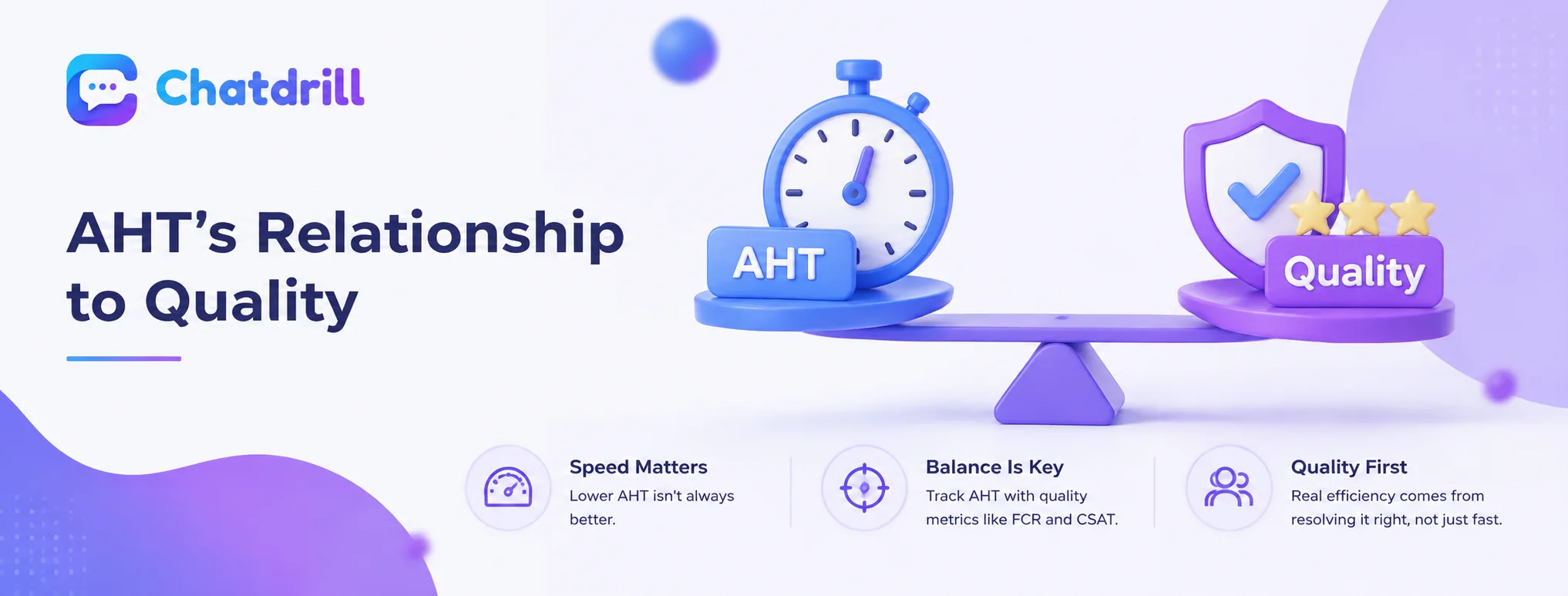
Lower AHT isn't automatically better, since rushing a conversation to reduce handle time can genuinely undermine resolution quality and customer experience.
The risk of over-optimizing for speed
Treating AHT reduction as an unconditional goal risks encouraging agents to rush conversations, potentially sacrificing thoroughness or genuine resolution quality in pursuit of a lower number.
This tension means AHT should be balanced against quality metrics like first contact resolution and CSAT, rather than optimized in isolation as if lower is unconditionally better.
Finding the genuinely appropriate balance
The most useful application of AHT tracks it alongside quality metrics, watching specifically for whether AHT reductions correlate with declining resolution quality, a sign that speed gains are coming at a genuine cost.
This balanced view treats AHT as one input among several, rather than the single, overriding measure of support efficiency.
AHT in Chat vs Phone Support
Chat's concurrency capability changes how AHT should be interpreted compared to phone support, where an agent typically handles only one call at a time.
Why chat AHT needs different context
Because a chat agent often handles several conversations simultaneously, a chat conversation's individual handle time doesn't translate directly into overall throughput the way it does for phone support, where one call fully occupies an agent.
This means comparing chat AHT directly against phone AHT without accounting for concurrency produces a misleading picture of actual relative efficiency.
A more complete chat efficiency picture
For chat specifically, combining AHT with concurrency data gives a more complete, accurate picture of genuine agent efficiency than AHT viewed alone.
This combined view respects that chat's fundamental operating model differs meaningfully from the one-conversation-at-a-time structure AHT was originally designed to measure in a phone-support context.
How ChatDrill Tracks Average Handle Time
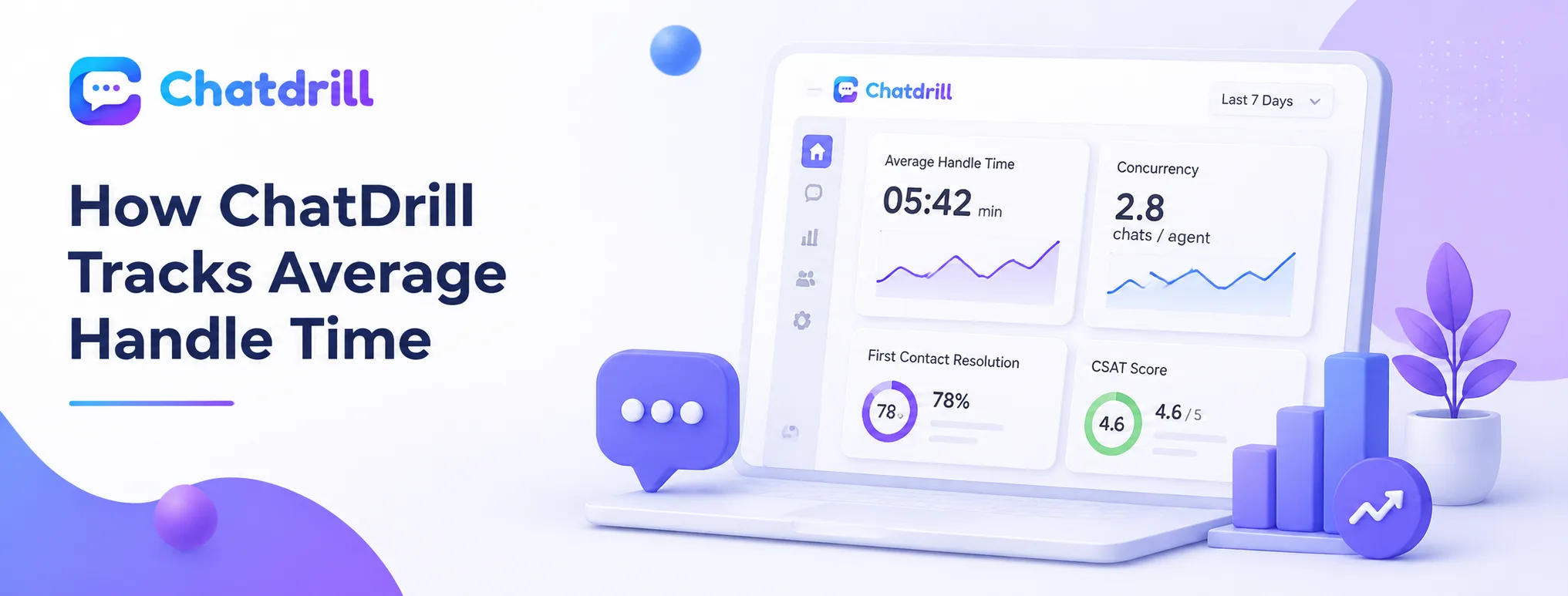
ChatDrill tracks AHT alongside concurrency and quality metrics, giving a complete, properly contextualized view of chat-specific efficiency rather than an isolated number.
AHT tracked alongside concurrency
ChatDrill's reporting presents AHT together with concurrency data, respecting that chat efficiency genuinely depends on both figures together rather than AHT viewed in isolation as if it were phone support.
This combined view gives a support operations manager a genuinely accurate picture of chat-specific efficiency rather than a potentially misleading single metric.
AHT balanced against quality data
ChatDrill also tracks AHT alongside first contact resolution and CSAT, making it straightforward to spot whether a change in handle time correlates with any genuine shift in resolution quality.
This balanced reporting supports the kind of thoughtful, quality-aware AHT management this guide recommends, rather than treating speed as an unconditional, standalone goal.
Setting Realistic AHT Targets for Your Team
A genuinely useful AHT target reflects your own historical data segmented by conversation type, rather than an industry-wide average that may not fit your specific complexity mix.
Segmenting targets by conversation type
Setting one blanket AHT target across genuinely different conversation types, simple order questions alongside complex technical troubleshooting, produces a number that fits neither category particularly well.
Establishing separate, realistic targets for distinct conversation categories gives agents and managers a more meaningful, achievable standard for each specific situation.
Revisiting targets as AI deflection changes the mix
As AI absorbs more routine, quick conversations automatically, the human-handled mix shifts toward genuinely more complex interactions, meaning AHT targets set before this shift may no longer reflect realistic expectations.
Reviewing and adjusting targets periodically as this mix evolves keeps AHT expectations grounded in current, genuine operating reality rather than an outdated baseline.