
A fallback response is the safety net every well-designed chatbot needs, the planned reply that kicks in specifically when the bot genuinely doesn't understand what a visitor is asking or can't confidently provide a useful answer.
Quick answer: A fallback response is what a chatbot says when it can't confidently understand or answer a visitor's message, typically acknowledging the confusion honestly and offering a next step like rephrasing the question or connecting to a human, rather than guessing or ignoring the message.
How a bot handles this moment of genuine uncertainty says a lot about its overall design quality, a good fallback keeps the conversation feeling helpful even when the bot has hit its limits, while a poor one leaves a visitor confused, frustrated, or stuck in a loop.
Understanding fallback design as a deliberate, important part of chatbot development, rather than an afterthought, clarifies why some bots recover gracefully from confusion while others spiral into an obviously broken, frustrating experience.
This guide covers the definition, what makes a fallback response effective, common mistakes, its relationship to escalation, and how ChatDrill handles fallback situations.
The Full Definition Explained [major informational gain]
[major informational gain]
A fallback response is the reply a chatbot gives specifically when it cannot confidently interpret or answer a visitor's message.
When a fallback gets triggered
A fallback response typically triggers when a chatbot's confidence in interpreting a message falls below a certain threshold, or when a message simply doesn't match any intent or topic the bot has been trained to recognize.
This is a genuinely common occurrence, since no chatbot, however well trained, can anticipate every possible way a visitor might phrase a question.
The core purpose of a fallback
Rather than guessing and potentially giving a confidently wrong answer, or simply failing silently, a fallback response acknowledges the limitation honestly while still trying to keep the conversation moving toward a useful outcome.
This honest acknowledgment protects trust better than a wrong guess would, since a visitor generally forgives "I'm not sure I understood" more readily than a genuinely incorrect answer delivered confidently.
What Makes a Fallback Response Effective [major informational gain]
[major informational gain]
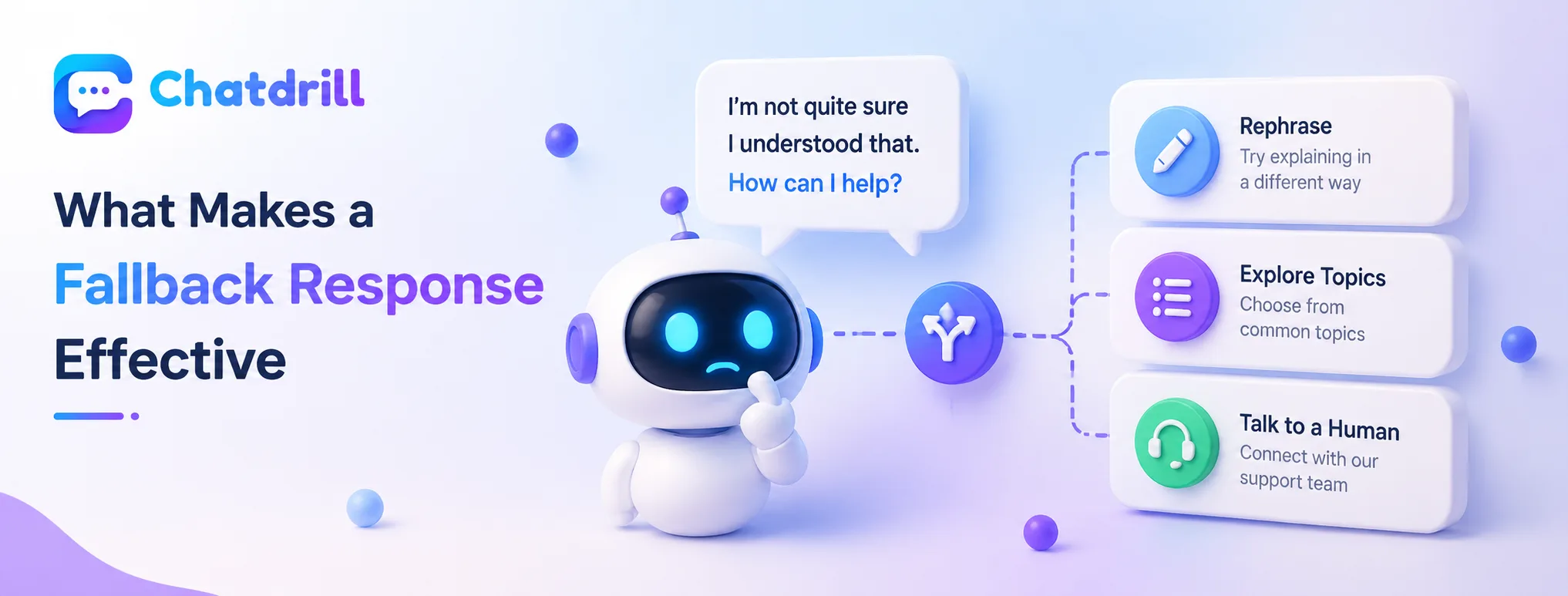
An effective fallback acknowledges the confusion honestly, offers a genuine next step, and avoids making the visitor feel like they did something wrong.
Honest acknowledgment without blame
A good fallback response, like "I'm not quite sure I understood that, could you rephrase?", acknowledges the bot's own limitation rather than implying the visitor asked something wrong or unclear.
This framing matters for tone, since blaming the visitor, even subtly, for a bot's own comprehension limits creates unnecessary friction and frustration.
Offering a genuine, useful next step
Beyond acknowledgment, an effective fallback offers something actionable, a suggestion to rephrase, a menu of common topics, or a direct path to a human agent, rather than leaving the visitor with nothing to do next.
This actionable element is what actually keeps the conversation moving productively rather than stalling out at the moment of confusion.
Common Fallback Response Mistakes
The most common mistakes are repeating the identical fallback message repeatedly, offering no path to a human, and using an overly technical or robotic tone.
Repeating the same fallback in a loop
A bot that gives the identical fallback message every time it's confused, even after several attempts, creates an obviously frustrating, repetitive loop that signals a poorly designed system.
Varying the fallback message, and escalating to a different approach, like offering a human handoff, after repeated confusion, avoids this specific frustration.
No path to human help
A fallback that only ever suggests rephrasing, with no eventual option to reach a human, leaves a genuinely stuck visitor with no real resolution path.
Building in an escalation option, especially after a fallback triggers more than once in the same conversation, ensures a visitor genuinely isn't left stranded.
Fallback Response vs Escalation [major informational gain]
[major informational gain]
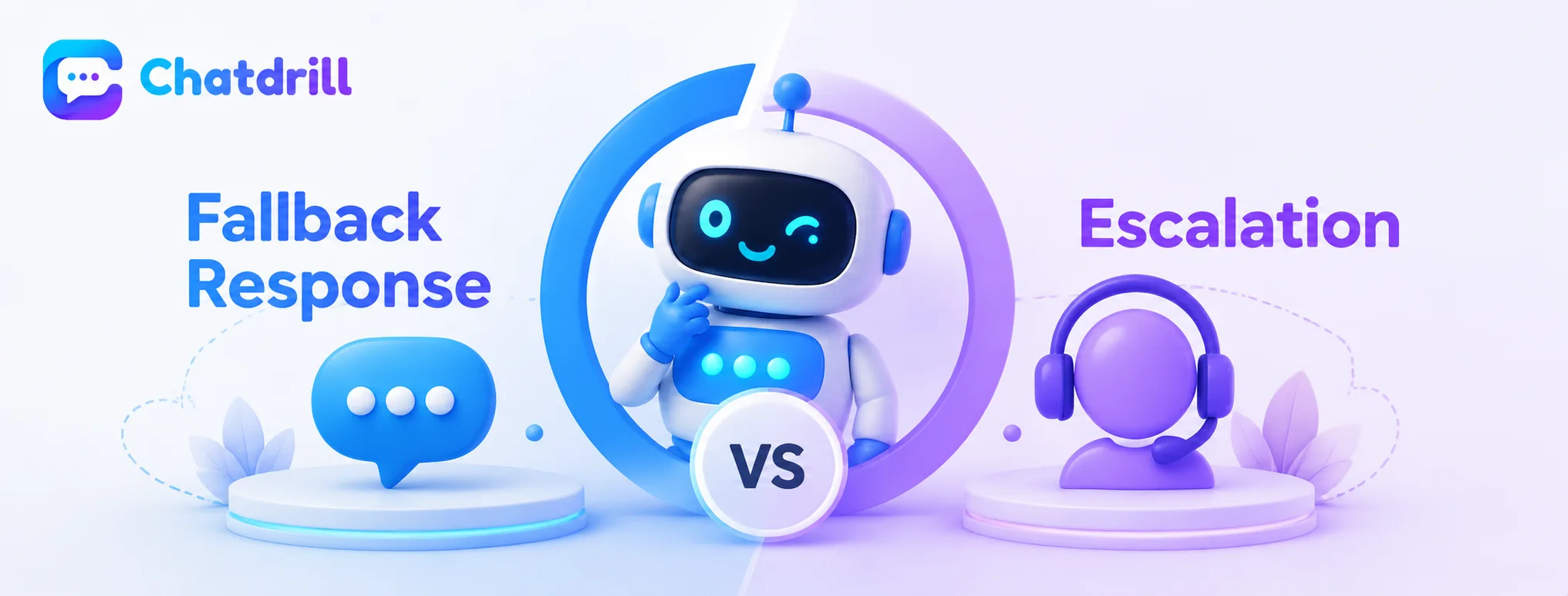
A fallback response is the bot's own immediate reply to confusion, while escalation is the separate act of handing the conversation to a human, and the two often work together.
How the two connect in practice
A single fallback response typically tries to resolve the confusion within the bot itself first, rephrasing prompts or offering topic suggestions, before escalation becomes the appropriate next step if confusion persists.
This layered approach, fallback first, escalation as the next step, respects that most confusion can be resolved without needing a human at all.
When to escalate directly rather than fall back again
For certain genuinely sensitive or complex intents, a complaint expressing real frustration, for example, jumping straight to escalation rather than attempting another fallback response can be the more appropriate design choice.
Recognizing which situations warrant this direct escalation, rather than another attempt at bot-level resolution, is part of thoughtful fallback design.
How ChatDrill Handles Fallback Situations [major informational gain]
[major informational gain]
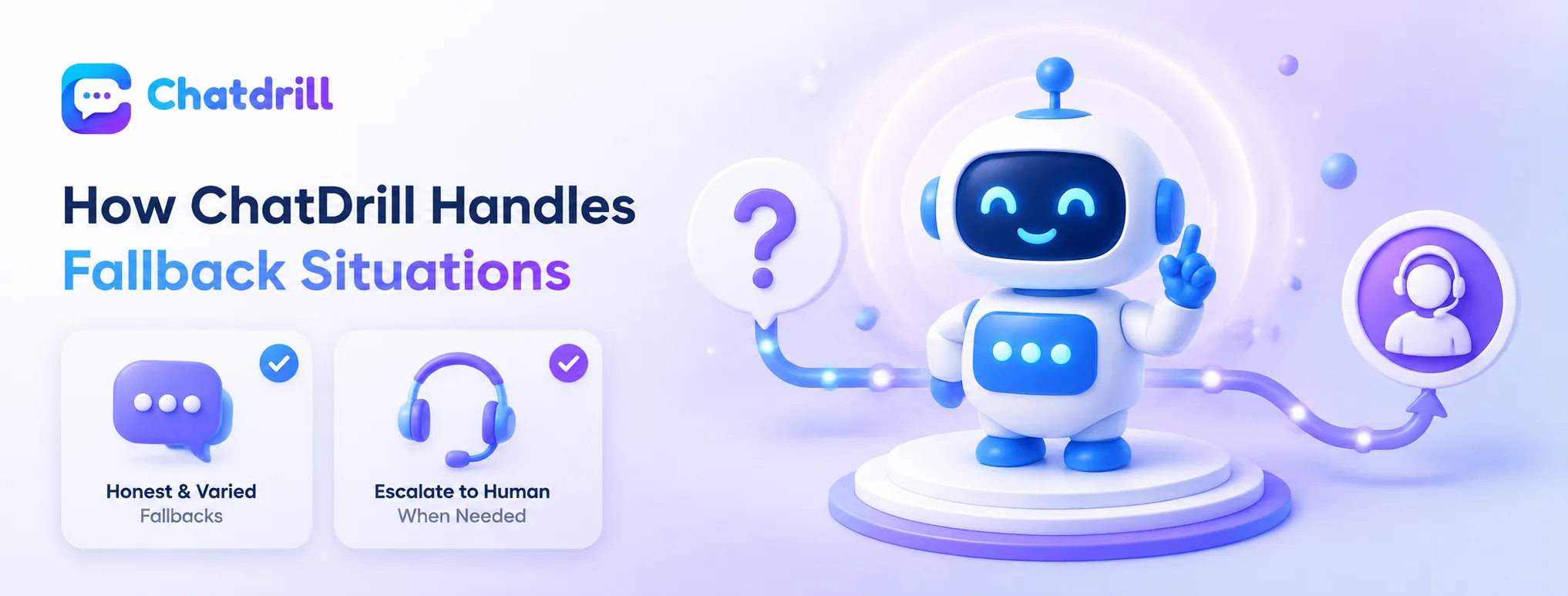
ChatDrill's AI uses honest, varied fallback responses with a built-in escalation path to a human agent when confusion persists.
Honest, non-repetitive fallback messaging
ChatDrill's AI is designed to acknowledge genuine uncertainty honestly and vary its fallback approach rather than repeating an identical message in a frustrating loop.
This variation keeps the conversation feeling genuinely attentive even in moments of confusion, rather than obviously mechanical.
Built-in escalation after repeated confusion
If ChatDrill's AI can't resolve confusion after a reasonable attempt, it hands the conversation off to a human agent automatically, with full context on what's already been tried, ensuring a visitor is never left genuinely stuck.
This safety net reflects the same layered fallback-then-escalation principle that well-designed chatbot systems generally follow.