

A service level agreement, almost universally shortened to SLA, is a term that shows up constantly in support operations discussions, yet the precise, practical meaning behind the acronym often stays vague even to people who reference it regularly.
Quick answer A service level agreement, or SLA, in customer support is a defined commitment specifying a measurable standard of service, most commonly response or resolution time, that a support team promises to meet for a given percentage of interactions.
At its core, an SLA is simply a defined, measurable promise about service quality, most commonly how quickly a customer can expect a response or resolution, expressed as a specific target rather than a vague, general aspiration.
Understanding what makes an SLA genuinely meaningful, distinct from an arbitrary or aspirational number, matters for both setting one that a team can actually meet and understanding whether a vendor's stated SLA genuinely reflects reliable service.
This guide covers the precise definition, what a typical SLA includes, how SLAs get set well, common types, and how ChatDrill supports SLA tracking.
The Full Definition Explained
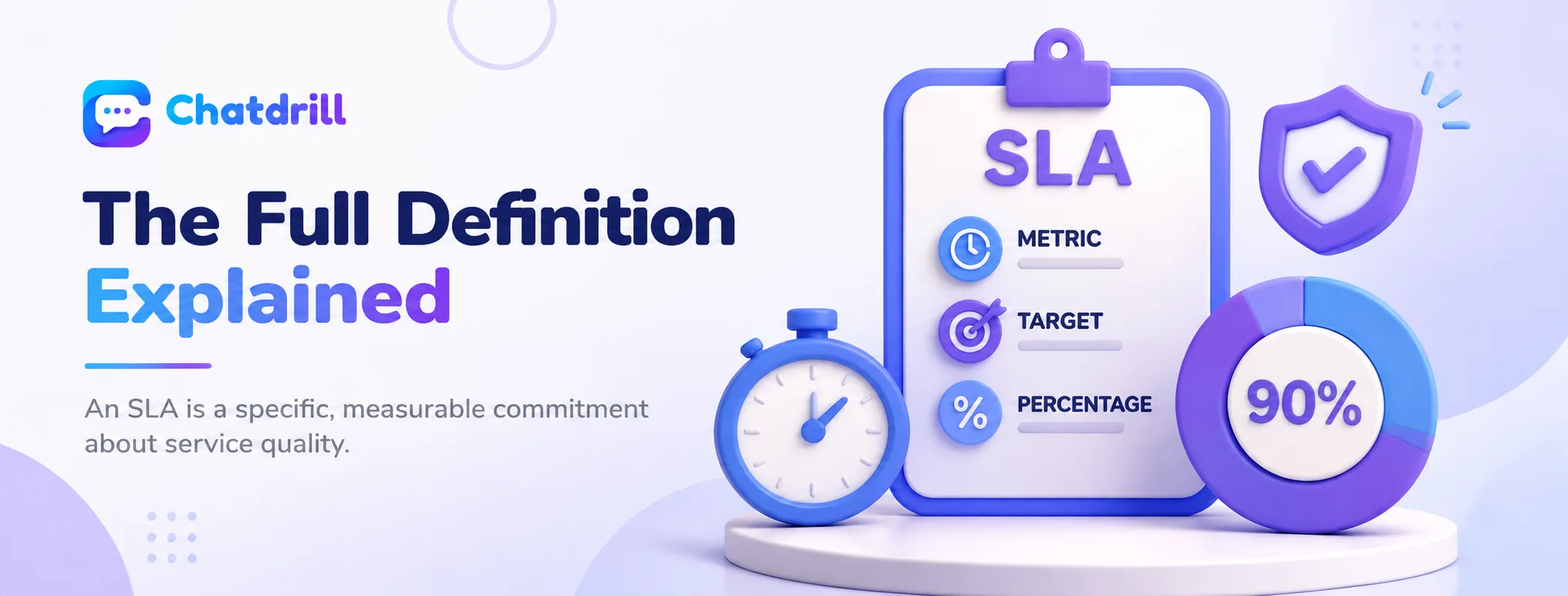
An SLA is a specific, measurable commitment about service quality, typically response or resolution time, expressed as a target percentage of interactions meeting that standard.
The core components of an SLA
A genuine SLA includes a specific metric being measured, response time or resolution time most commonly, a target value for that metric, and a percentage of interactions expected to meet it.
For example, "90% of chat conversations receive a first response within 2 minutes" contains all three elements, a metric, a target, and a percentage, together forming a genuinely measurable, verifiable commitment.
Without all three elements clearly specified, a stated commitment isn't really a genuine SLA, just a vague aspiration that can't be reliably measured or held accountable.
Why the percentage matters, not just the target time
Expressing an SLA as a percentage, rather than an absolute promise applying to every single interaction without exception, acknowledges genuine, reasonable variation while still holding a team to a meaningful, trackable standard overall.
This percentage-based framing tends to be more sustainable and honest than an absolute guarantee that any single unusual conversation could technically break.
What a Typical Support SLA Includes
Common SLA components cover first response time, resolution time, and sometimes availability or uptime commitments, each targeting a different aspect of service quality.
Response time and resolution time SLAs
A first response time SLA commits to how quickly an initial reply arrives, while a resolution time SLA commits to how quickly the underlying issue gets fully resolved, two related but genuinely distinct commitments.
A business might commit to both simultaneously, a fast initial response alongside a somewhat longer, more realistic full-resolution target, reflecting that acknowledging a question quickly and fully solving it are different achievements.
Availability and uptime commitments
Some SLAs also cover system availability, committing to a certain percentage of time the support channel itself, like a chat platform, remains operational and accessible.
This type of SLA matters especially for B2B software relationships, where a customer's own operations depend on consistent access to the support tool itself.
How to Set an SLA That Genuinely Holds Up
A genuinely sustainable SLA is grounded in real historical performance data, with a reasonable stretch built in, rather than an aspirational number chosen because it sounds impressive.
Starting from real performance data
Reviewing actual, current response and resolution time data before setting a target reveals what a team can genuinely, consistently deliver, rather than assuming an aspirational figure without grounding it in real performance.
Setting a target slightly above current performance as a genuine stretch goal works better than committing to a dramatically more ambitious number the team has no established ability to consistently meet.
Building in realistic buffer for complexity variation
A single SLA applied uniformly across genuinely different conversation complexity levels tends to be either too loose for simple questions or too aggressive for complex ones.
Tiering SLA targets by conversation type, where practical, produces a more accurate and more genuinely sustainable standard for each category.
SLA vs Related Concepts
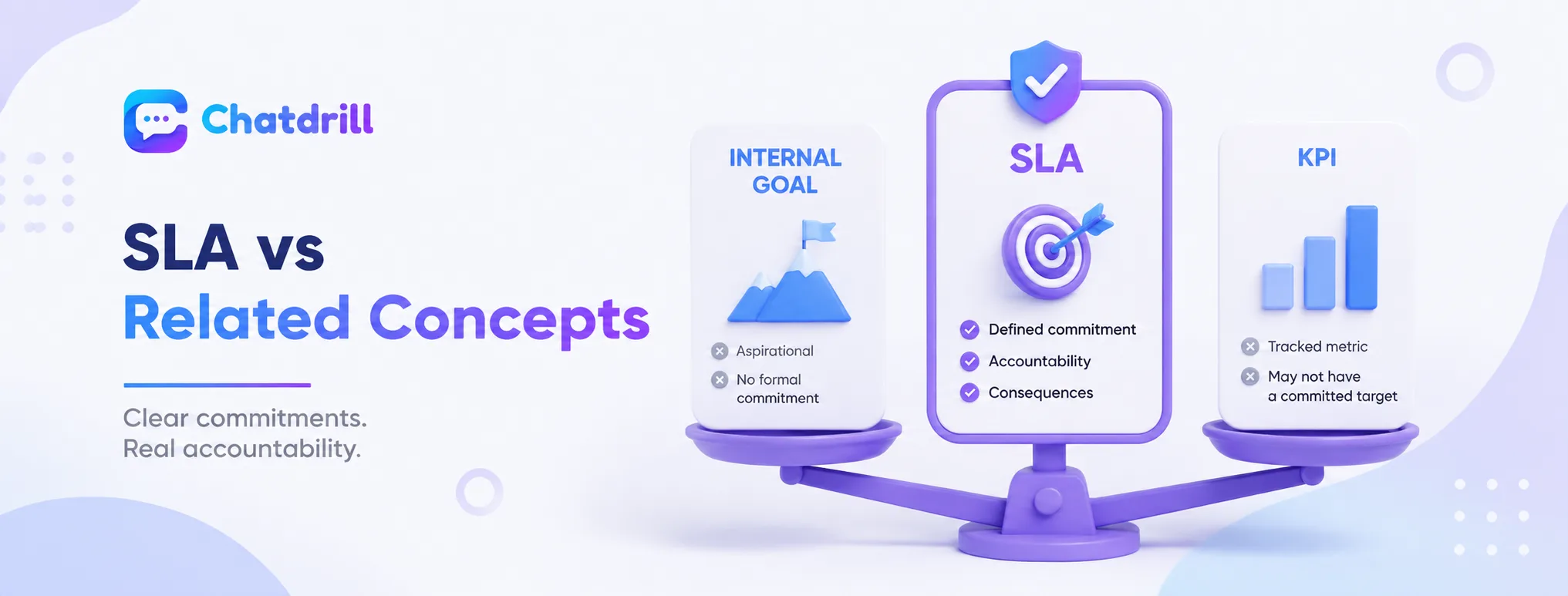
An SLA is a defined external or internal commitment, distinct from a target or goal, which may be aspirational without carrying the same accountability weight.
SLA vs internal goal
An internal goal might represent an aspiration a team is working toward without necessarily being communicated as a firm commitment to customers, while an SLA typically carries genuine accountability, whether contractual or reputational.
This distinction matters because breaking a stated SLA carries more serious consequences than simply missing an internal, informal goal.
SLA vs KPI
A KPI, key performance indicator, is a broader category of tracked metric that may or may not have a specific committed target attached, while an SLA specifically refers to a committed standard with defined consequences for missing it.
Many SLAs are built from KPIs, but not every tracked KPI rises to the level of a formal, committed SLA.
Why SLAs Matter for Both Providers and Customers
SLAs give customers a concrete, verifiable expectation while giving a support team a clear, measurable target to organize staffing and process around.
The customer-side value
A clearly stated SLA gives a customer a concrete basis for what to expect, rather than an ambiguous sense of "we'll get to it eventually," building genuine trust when that commitment is consistently honored.
This concrete expectation also gives a customer a fair basis for escalation or complaint if a commitment is genuinely, repeatedly missed.
The internal operational value
For a support team internally, a defined SLA provides a clear, shared target around which to organize staffing, training, and process decisions, rather than operating without any explicit, measurable standard.
This internal clarity tends to improve overall consistency, since everyone on the team is working toward the same defined, understood goal.
How ChatDrill Supports SLA Tracking
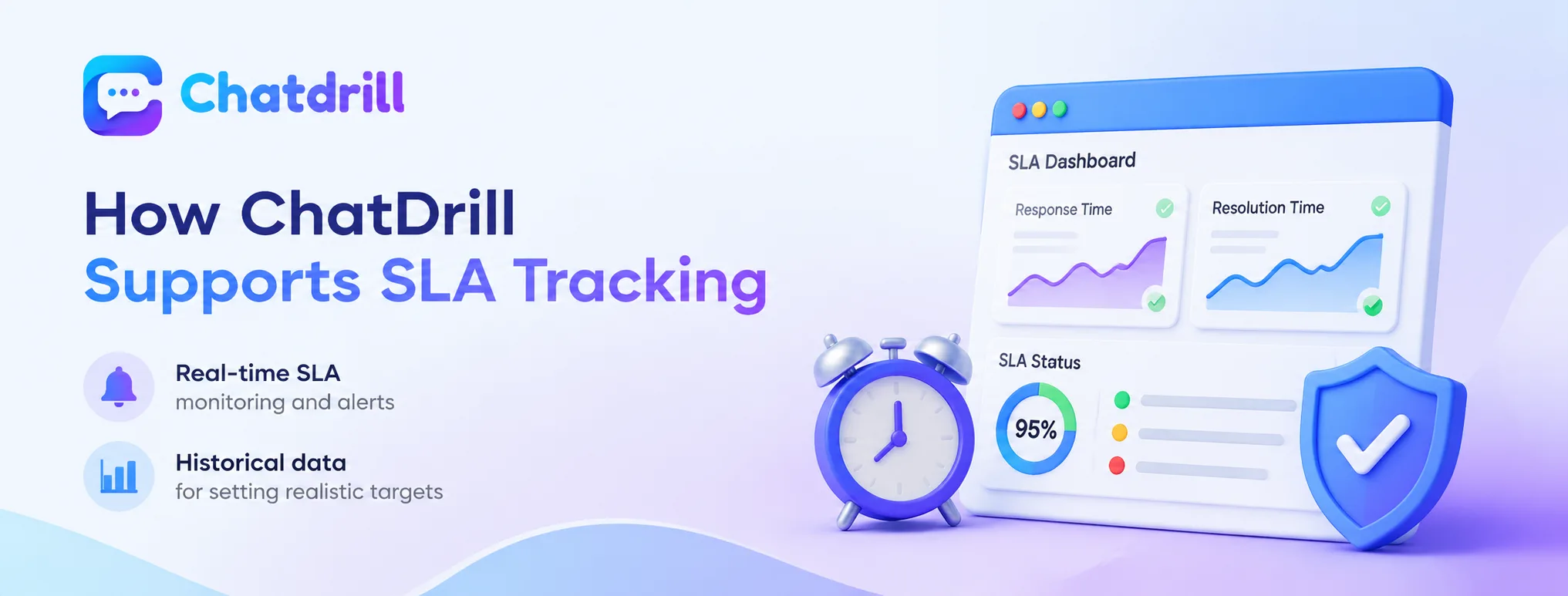
ChatDrill tracks SLA performance in real time, flagging at-risk conversations before a deadline is missed and providing the historical data needed to set realistic targets.
Real-time SLA monitoring and alerts
ChatDrill can flag a conversation approaching its SLA deadline while there's still time for a team lead or agent to intervene, turning SLA management into proactive prevention rather than only after-the-fact reporting.
This visibility is what actually protects SLA performance in practice, rather than discovering a breach only once it's already happened.
Historical data for setting realistic targets
Pulling actual historical response and resolution time data directly from ChatDrill gives a business the genuine baseline needed to set an SLA reflecting real, achievable performance, following the target-setting approach covered earlier in this guide.
This data-grounded approach removes much of the guesswork from committing to an SLA a team can genuinely, sustainably meet.
Communicating SLA Performance to Customers
Publishing an SLA commitment publicly and reporting honestly on actual performance against it builds a level of trust that a vague, unstated service promise never achieves.
The value of publishing a stated commitment
Making an SLA visible to customers, rather than keeping it purely an internal target, gives them a concrete basis for what to expect and signals genuine confidence in consistent service delivery.
This visibility can itself become a meaningful trust-building and even marketing asset, provided the underlying commitment is genuinely, consistently met.
Being honest when performance falls short
Communicating transparently on the occasions an SLA isn't met, along with what's being done to address it, tends to preserve more trust than quietly hoping the miss goes unnoticed.
This honesty reflects the same broader principle that genuine transparency about service performance builds more durable customer trust than an unstated, unverifiable claim of quality ever could.