
Difference Omnichannel and multichannel are terms that get used almost interchangeably in casual conversation and marketing copy, yet they describe a genuinely important, practical difference in how connected a support experience actually feels to the customer living through it.
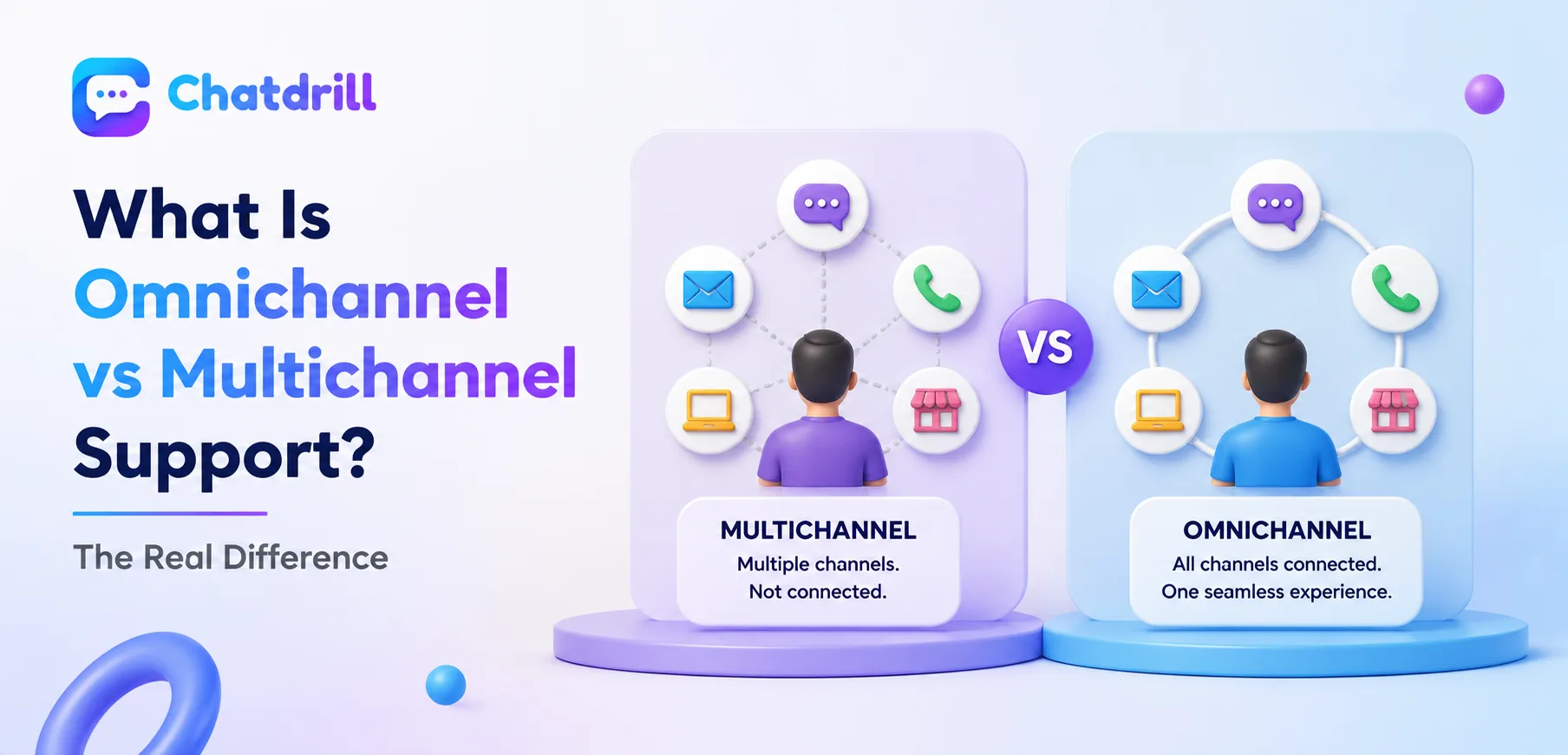
Quick answer Multichannel support means offering several separate communication channels, like chat, email, and phone, that operate independently of each other, while omnichannel support means those same channels are connected, sharing customer context so a conversation can move between them without the customer repeating themselves.
Both terms describe offering more than one way to reach a business, but the real, meaningful distinction lies in whether those channels operate as isolated silos or as a genuinely connected, unified system sharing context between them.
Understanding this real difference matters for any business evaluating support infrastructure, since the gap between the two experiences, for the customer specifically, is often larger than the terminology similarity would suggest.
This guide covers the precise definitions of both terms, concrete examples illustrating the practical difference, why the distinction matters, and how ChatDrill supports omnichannel connectivity.
The Full Definitions Explained
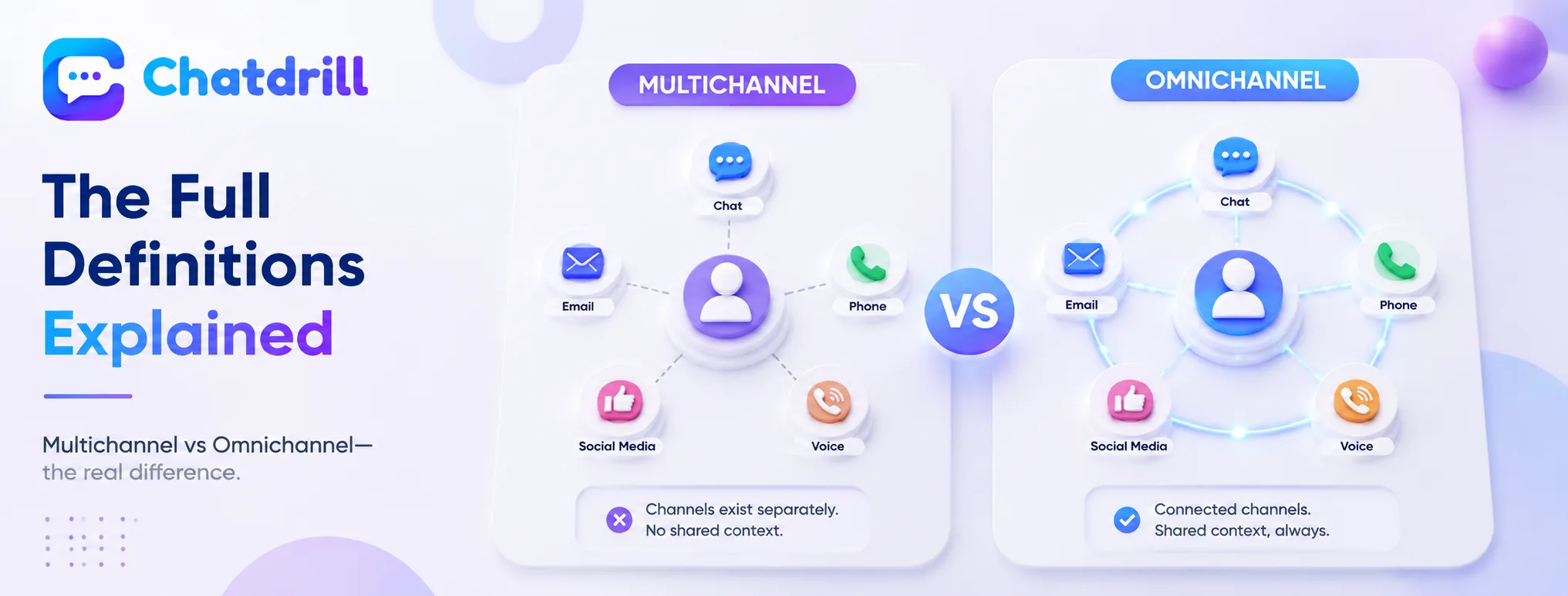
Multichannel means offering multiple independent channels, while omnichannel means those channels are connected and share customer context seamlessly.
Defining multichannel precisely
Multichannel support means a business offers several distinct ways to reach them, chat, email, phone, social media, but each channel operates as its own separate, disconnected system with its own history and context.
A customer switching from chat to email in a multichannel setup typically needs to re-explain their situation, since the email system has no visibility into what was already discussed over chat.
This isolation between channels is the defining, limiting characteristic of a purely multichannel approach, regardless of how many individual channels are actually offered.
Defining omnichannel precisely
Omnichannel support means the same multiple channels exist, but they're connected through shared customer data and conversation history, so a customer's context follows them regardless of which channel they use at any given moment.
A customer who starts a conversation in chat and later calls the phone line would find, in a genuinely omnichannel setup, that the phone agent already has visibility into what was discussed over chat.
This connectivity, not simply the number of channels offered, is what genuinely distinguishes omnichannel from multichannel.
Concrete Examples Illustrating the Difference
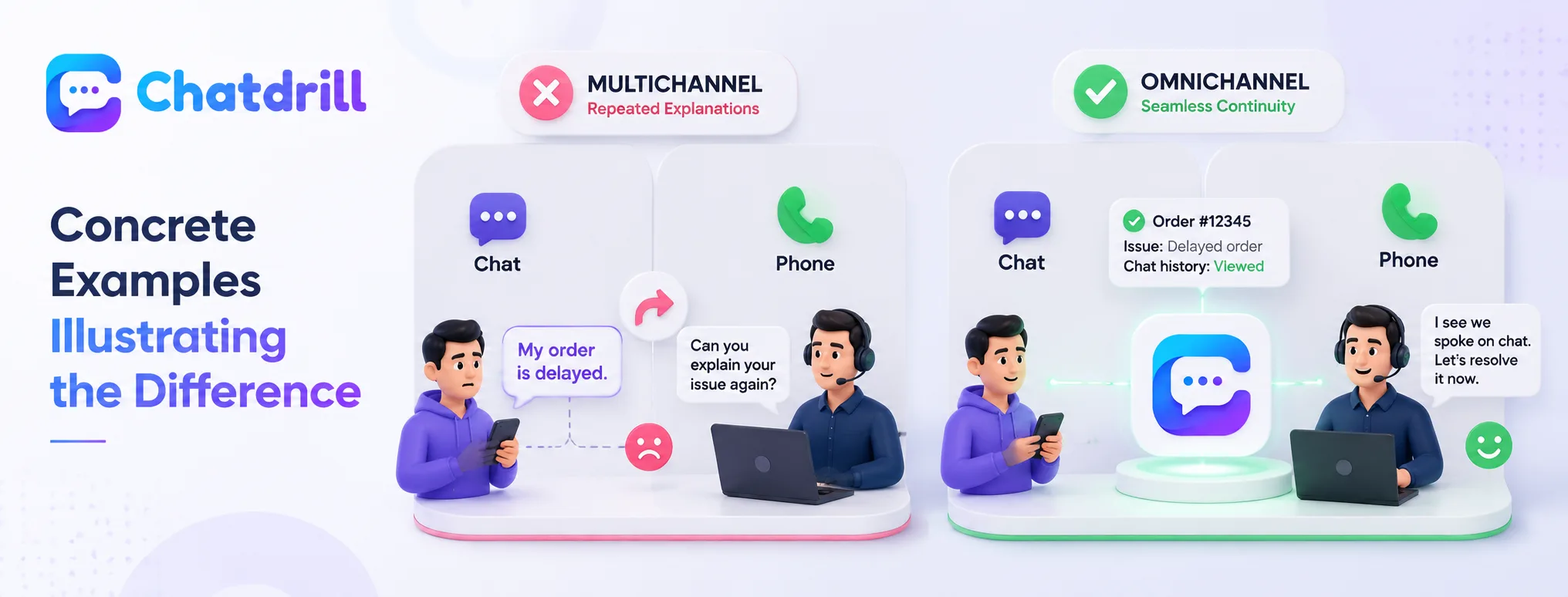
A customer repeating their issue across channels illustrates multichannel limitations, while a seamless handoff with full context illustrates genuine omnichannel connectivity.
The repeated-explanation example
In a multichannel setup, a customer who chats about a delayed order, then calls when chat doesn't fully resolve it, typically has to explain the entire situation again from scratch to the phone agent, who has no visibility into the earlier chat.
This repetition creates exactly the kind of customer effort that directly damages loyalty, as covered in broader discussions of customer effort score.
The seamless continuity example
In a genuinely omnichannel setup, that same customer calling after an unresolved chat would find the phone agent already aware of the earlier conversation, the order details, and what's already been tried, letting the call pick up naturally rather than restart entirely.
This continuity is what customers increasingly expect by default, making the omnichannel experience feel less like an exceptional feature and more like a genuine baseline requirement.
Why the Distinction Genuinely Matters
The gap between multichannel and omnichannel directly affects customer effort, agent efficiency, and overall loyalty, making the distinction a genuinely strategic one, not just semantic.
The customer effort and loyalty impact
As covered in the context of customer effort score, repetition and context loss are among the most consistently cited sources of customer frustration, meaning the multichannel-to-omnichannel gap directly translates into measurable effort and loyalty differences.
This connection means the distinction isn't merely a technical or architectural detail, it has genuine, measurable business consequences.
The agent efficiency impact
An agent working within a genuinely omnichannel system spends less time reconstructing context from scratch, directly improving both average handle time and first contact resolution compared to an agent working within isolated, disconnected channel silos.
This efficiency gain compounds across a support team's full volume, making omnichannel connectivity a genuine operational advantage beyond just the improved customer experience.
Common Misconceptions About Omnichannel
A common misconception assumes offering many channels automatically qualifies as omnichannel, when the real requirement is genuine data connectivity between those channels.
Channel count doesn't equal omnichannel
A business offering five separate, disconnected channels is still operating multichannel, not omnichannel, regardless of how many individual channels exist, since channel quantity alone doesn't create the connectivity that defines genuine omnichannel support.
This misconception leads some businesses to believe they've achieved omnichannel simply by adding more channels, without addressing the genuine underlying data connectivity requirement.
Omnichannel doesn't require every channel to be equally sophisticated
Genuine omnichannel connectivity is about shared context and data, not necessarily identical feature depth or sophistication across every single channel a business offers.
A business can maintain genuine omnichannel connectivity even while one channel offers more advanced capability than another, as long as the underlying customer context genuinely flows between them.
What Genuine Omnichannel Connectivity Requires
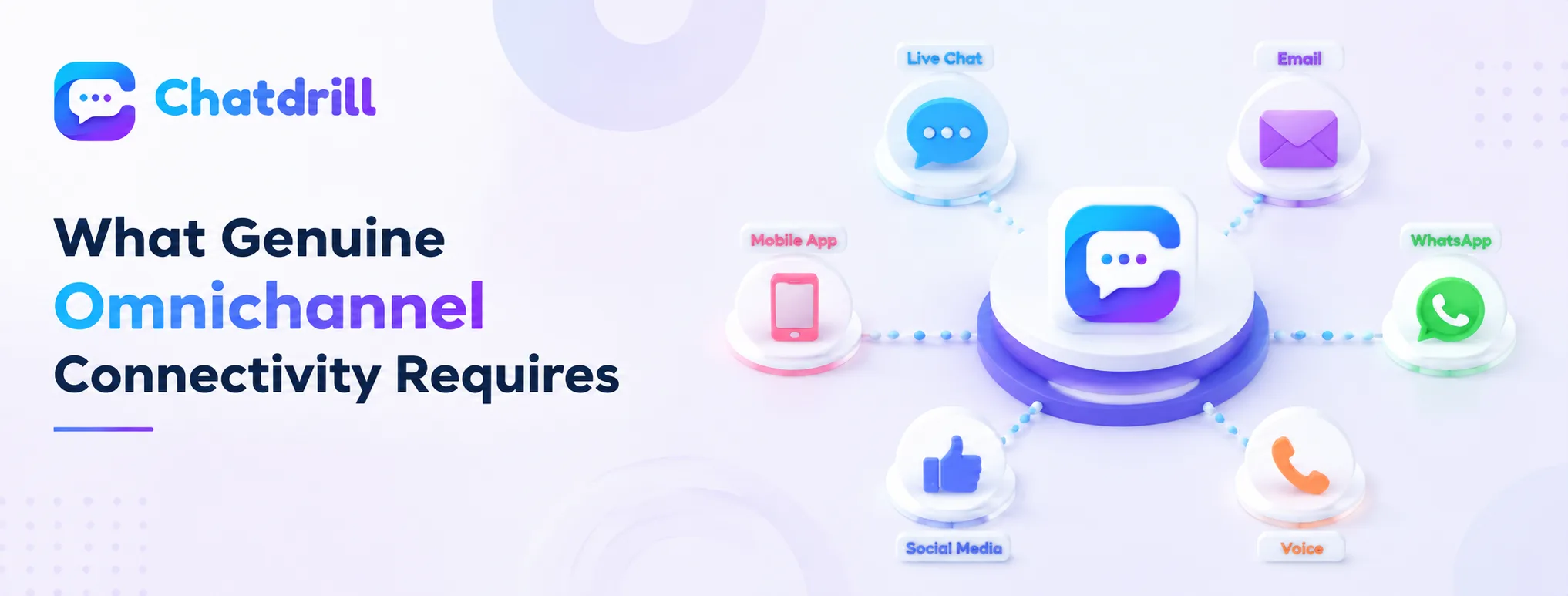
Achieving real omnichannel support requires a unified customer data system, consistent policy application across channels, and technical integration connecting each individual channel to that shared foundation.
A unified customer data foundation
Genuine omnichannel connectivity depends on a single, shared source of customer conversation history and context that every channel can access, rather than each channel maintaining its own separate, siloed data.
Building or adopting this unified foundation is the genuine technical prerequisite for omnichannel support, more foundational than any individual channel feature.
Consistent policy and quality across channels
Beyond data connectivity, genuine omnichannel support also means applying consistent policies and quality standards regardless of which channel a customer happens to use, avoiding a scenario where the same question gets different answers depending on the channel.
This consistency matters as much as the data connectivity itself for delivering the seamless experience omnichannel support is meant to provide.
How ChatDrill Supports Omnichannel Connectivity
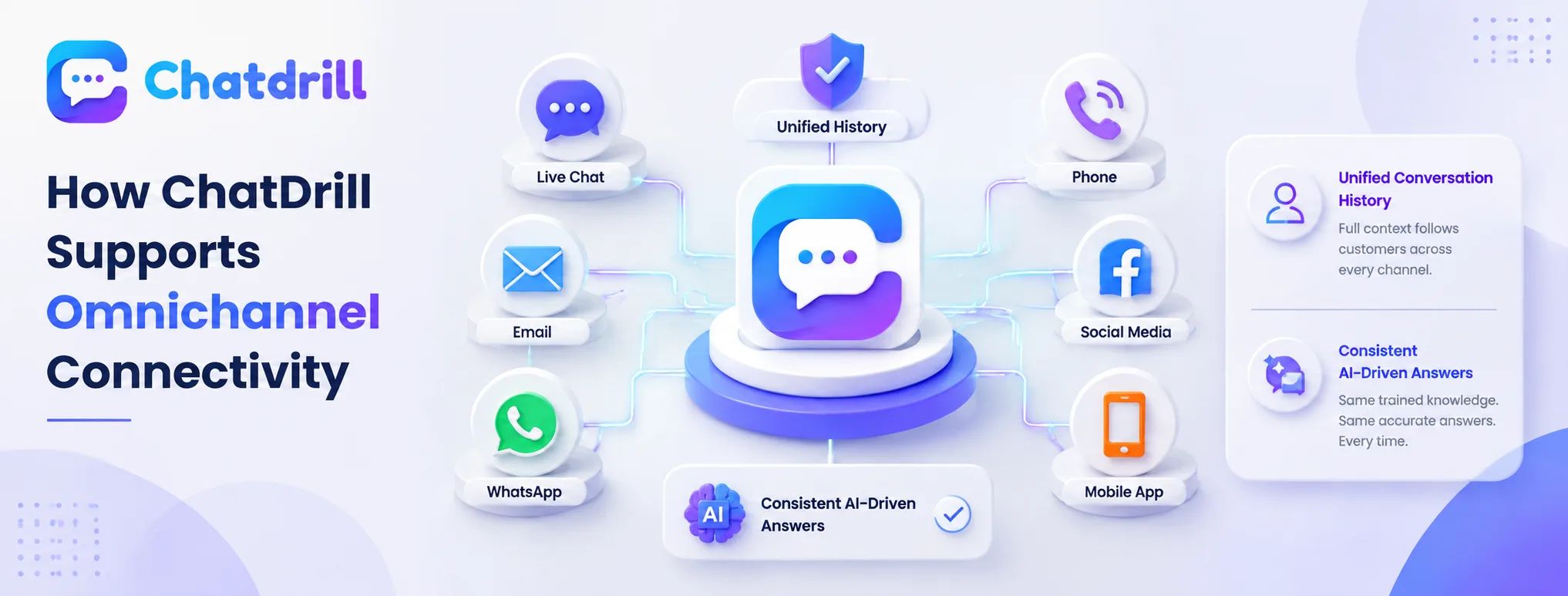
ChatDrill maintains unified conversation history and context across channels, ensuring genuine omnichannel connectivity rather than isolated, disconnected multichannel silos.
Unified conversation history across touchpoints
ChatDrill maintains a customer's conversation history and context in one connected system, meaning a conversation that starts in chat and continues through another channel carries its full context forward, rather than starting over.
This unified foundation is what allows ChatDrill to deliver genuine omnichannel connectivity rather than simply offering multiple, disconnected channels under one brand.
Consistent AI-driven answers regardless of entry point
Because ChatDrill's AI draws from the same trained knowledge regardless of which channel a conversation enters through, customers receive consistent, accurate answers no matter how they choose to reach out.
This consistency directly supports the policy-alignment requirement that genuine omnichannel support depends on, beyond just shared data connectivity alone.
Migrating From Multichannel to Genuine Omnichannel
Moving from disconnected channels to genuine omnichannel connectivity is typically a gradual, staged process rather than an overnight technical switch.
Starting with the highest-volume channel connections first
Prioritizing data connectivity between the two or three channels carrying the most genuine customer volume delivers the largest practical benefit before extending connectivity to lower-volume, less frequently used channels.
This staged prioritization makes an otherwise significant migration project more manageable, delivering meaningful improvement incrementally rather than requiring one large, all-at-once technical overhaul.
Validating the customer experience at each stage
Testing the actual customer experience after connecting each pair of channels, confirming context genuinely carries through as intended, catches integration gaps before they affect real customer conversations at scale.
This validation step, done at each stage rather than only at the end, ensures the eventual, fully connected system genuinely delivers the seamless experience omnichannel support promises.