
Ones A knowledge base article is one of the most familiar pieces of web content, the how-to or FAQ page explaining how to reset a password or what a return policy covers, that most people have encountered without necessarily thinking about its structure or purpose.
Quick answer A knowledge base article is a written piece of documentation explaining how to do something, use a feature, or understand a policy, and chatbots need genuinely good ones because AI chat systems increasingly draw their answers directly from this content, meaning poor articles produce poor automated responses.
What's changed recently is how much weight these articles now carry beyond their original purpose, since AI-powered chatbots increasingly train directly on this exact content, meaning a knowledge base article's quality now directly shapes automated response quality too.
Understanding what actually makes a knowledge base article genuinely good, not just for a human reader but for the AI systems now drawing on it, has become a meaningfully more important skill than it used to be.
This guide covers the definition, what makes an article genuinely effective, the specific new connection to chatbot performance, common mistakes, and how ChatDrill uses knowledge base content.
The Full Definition Explained
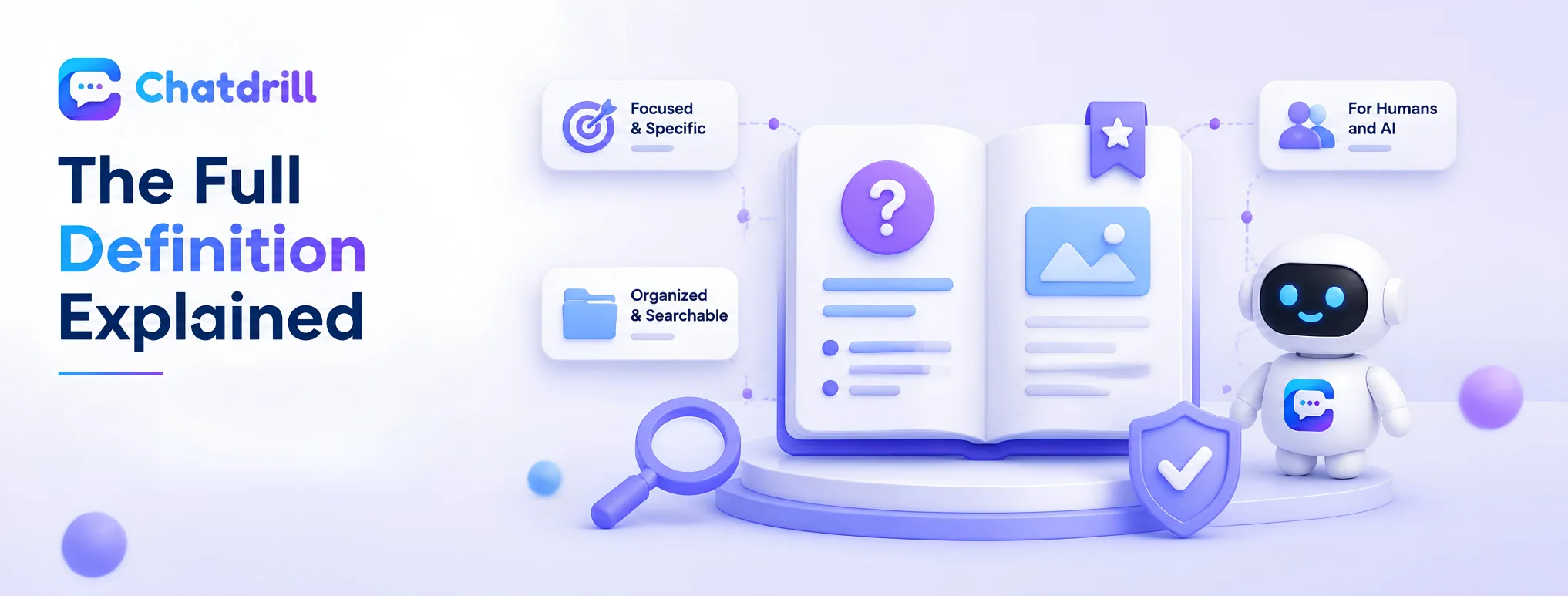
A knowledge base article is a standalone piece of documentation addressing a specific question, task, or topic, typically part of a larger organized library of similar content.
The basic structure and purpose
A knowledge base article typically addresses one specific, well-defined question or task, how to do X, what Y policy covers, why Z happens, rather than covering broad, sprawling territory across a single piece of content.
This narrow, specific focus is intentional, making individual articles easier to find, read, and, increasingly, easier for an AI system to draw a precise answer from.
Articles typically live within a larger, organized knowledge base or help center, categorized and searchable so both humans and, increasingly, AI systems can locate the relevant one quickly.
Who traditionally used these articles
Historically, knowledge base articles served primarily human readers, either customers self-serving an answer or support agents referencing internal documentation while helping a customer directly.
This human-reader focus shaped traditional writing conventions, favoring readability and scannability for someone browsing the page themselves.
What Makes a Knowledge Base Article Genuinely Effective
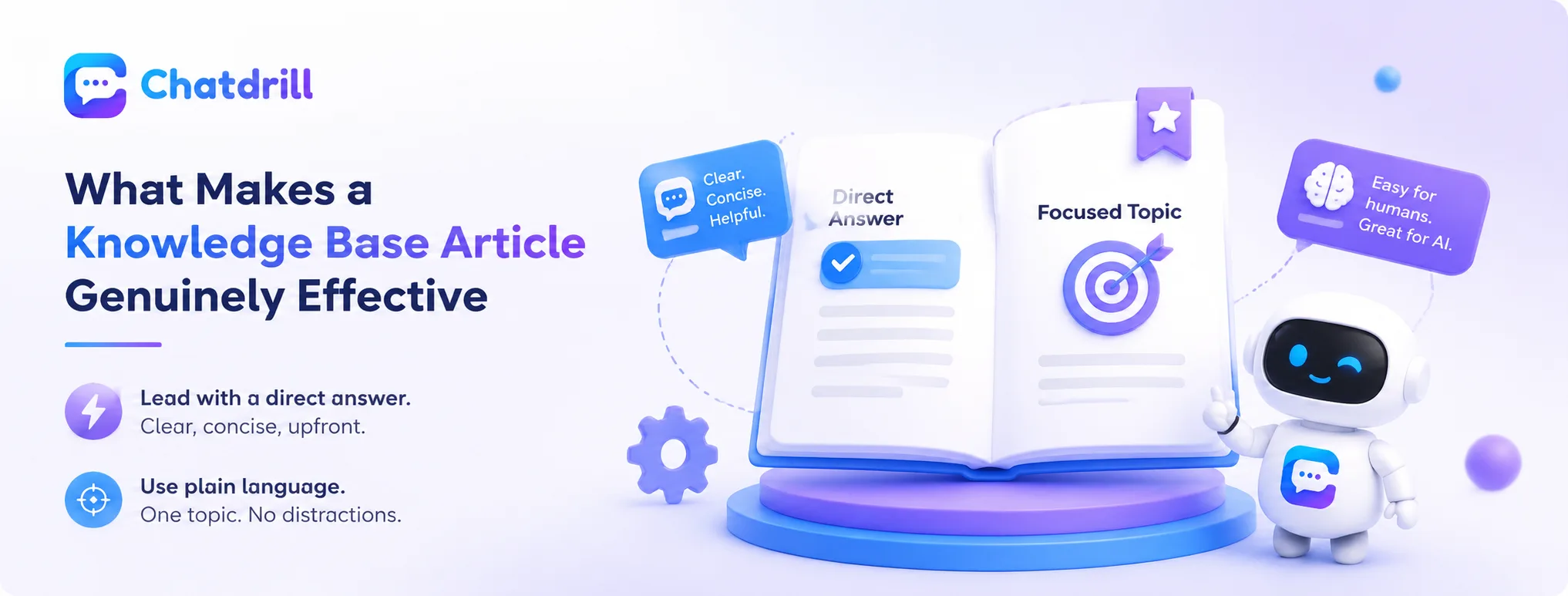
An effective article leads with a direct, clear answer, uses plain language, and stays focused on one specific topic rather than combining several loosely related ones.
Leading with a direct answer
Placing the core answer clearly near the beginning, before extensive background or caveats, respects that most readers, human or AI, are looking for a quick, direct resolution rather than an extended narrative buildup.
This structure also happens to work well for AI systems extracting a concise answer, since the most important information sits in an easily identifiable, prominent position.
Plain language and specific focus
Avoiding unnecessary jargon and internal terminology keeps an article accessible to someone who doesn't already share the writer's specialized vocabulary or context.
Keeping each article focused on one specific topic, rather than combining several loosely related questions into one sprawling piece, makes both human scanning and AI-driven answer extraction considerably more reliable.
This specificity principle is worth prioritizing even when it means creating more individual articles rather than fewer, longer, more comprehensive ones.
The New Connection Why Chatbots Need Good Articles
AI chatbots increasingly train directly on knowledge base content, meaning article quality now directly determines automated response accuracy, not just human reader satisfaction.
How chatbots actually use this content
Many modern AI chat systems are trained directly on a business's existing knowledge base articles, extracting information to answer customer questions automatically without a human ever writing separate, duplicate training content.
This means an outdated, unclear, or poorly structured article doesn't just confuse an occasional human reader anymore, it can produce a genuinely inaccurate automated chat response reaching every customer who asks a related question.
This shift has effectively raised the stakes on article quality considerably beyond what traditional documentation standards required.
Why AI amplifies both good and bad content quality
A genuinely excellent, clear, well-structured article now delivers value across potentially thousands of automated conversations, not just the individual human readers who happen to find and read the page directly.
Conversely, a single unclear or outdated article can now produce the same automated inaccuracy repeatedly across many conversations, amplifying a content quality problem that once affected only occasional individual readers.
Common Knowledge Base Article Mistakes
The most common mistakes are letting content go outdated, writing ambiguous or conditional guidance, and combining too many topics into one sprawling article.
Outdated content lingering unnoticed
An article describing a policy or feature that has since changed, left unnoticed and unrevised, produces a genuinely wrong answer for however long it stays uncorrected, now amplified across automated chat responses too.
Building in a regular content review cadence specifically checking for currency, not just occasionally when someone happens to notice an error, protects against this quiet but genuinely costly problem.
Ambiguous or overly conditional guidance
An article written with excessive hedging or complex conditional logic, "it depends," without clearly resolving the most common cases, produces a genuinely unclear source for both a human reader and an AI system trying to extract a definitive answer.
Clarifying the most common case directly, with conditional exceptions noted separately and clearly, produces content that's genuinely more useful for both audiences.
Writing Articles With Both Audiences in Mind
Writing with both a human reader and an AI training pipeline in mind means combining traditional readability with structural clarity that helps precise information extraction.
Structural choices that serve both audiences
Clear headings, a direct answer near the top, and logically organized sections serve a human skimming the page while also giving an AI training process clean, well-defined content to draw specific answers from.
This dual-purpose writing approach doesn't require fundamentally different content, mainly a more disciplined application of good documentation practices that happen to serve both purposes simultaneously.
Testing content readiness for both purposes
Reading an article specifically asking, "could someone extract one clear, confident answer from this?"
applies a useful test for both human and AI-readiness simultaneously.
An article that fails this test, requiring significant interpretation or inference to extract a clear answer, likely produces unreliable results for an AI system just as it would confuse a human skimming quickly.
How ChatDrill Uses Knowledge Base Content
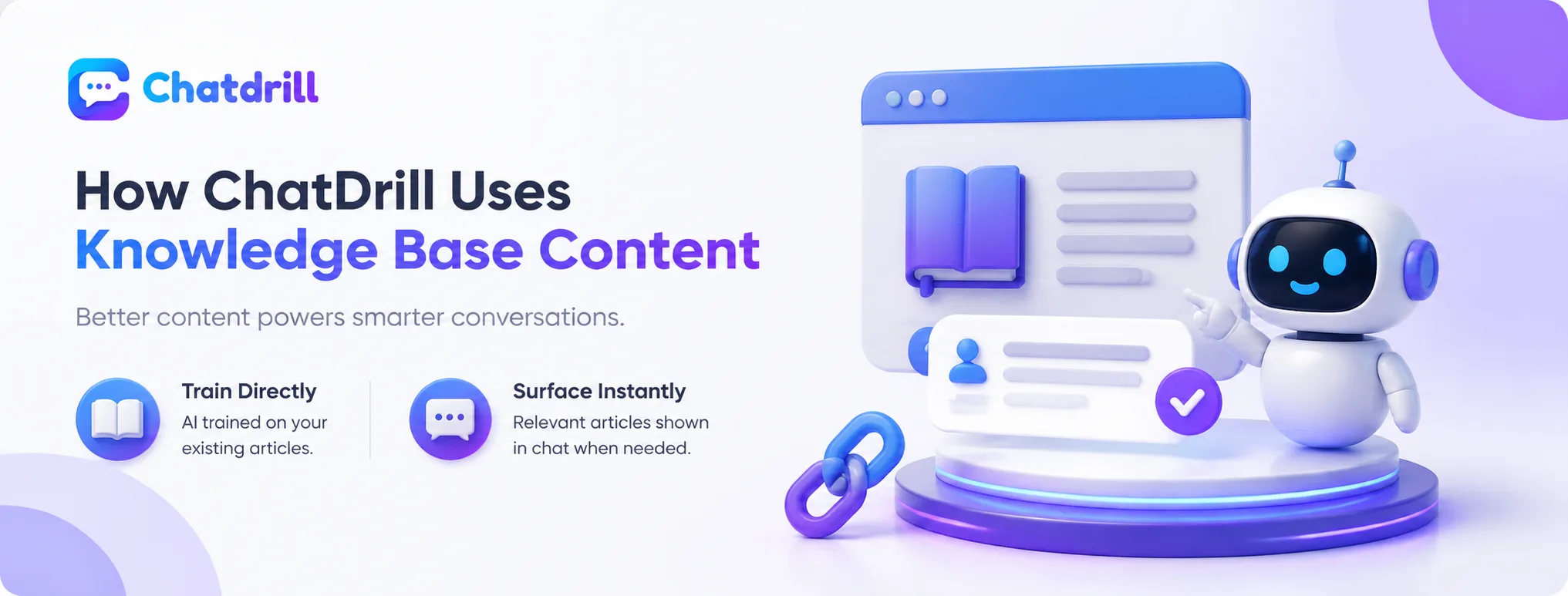
ChatDrill can train directly on your existing knowledge base articles, meaning the same content quality principles that help human readers also directly improve ChatDrill's automated response accuracy.
Direct training from your existing content
ChatDrill supports training its AI directly from your existing knowledge base articles, meaning improvements you make for human readability also directly improve the accuracy of ChatDrill's automated responses without requiring separate, duplicate training content.
This direct connection means the writing quality principles covered throughout this guide translate immediately into better, more accurate automated chat performance.
Surfacing relevant articles within conversations
Beyond training, ChatDrill can surface a relevant, specific knowledge base article directly within a chat conversation when a question calls for more depth than a brief conversational answer alone provides.
This surfacing capability gives your knowledge base articles a second, valuable life within live conversations, beyond whatever traffic they receive through direct search or browsing alone.
Auditing Your Existing Knowledge Base Before AI Training
Reviewing your current article library specifically for currency, clarity, and appropriate scope before connecting it to AI training catches problems before they get amplified across automated responses.
Checking for currency and clarity first
Before connecting an existing library to AI training, a focused review specifically checking for outdated information and unclear, hedging language catches the issues most likely to produce inaccurate automated responses.
This upfront audit is a worthwhile investment given how directly article quality now translates into automated response quality, rather than affecting only occasional individual readers.
Identifying gaps in existing coverage
Reviewing common customer questions against your existing article library often reveals gaps, topics customers frequently ask about that don't yet have a dedicated, clear article addressing them.
Filling these specific gaps before or alongside AI training connection ensures the automated system has genuine source material to draw from across your most common actual question types.