
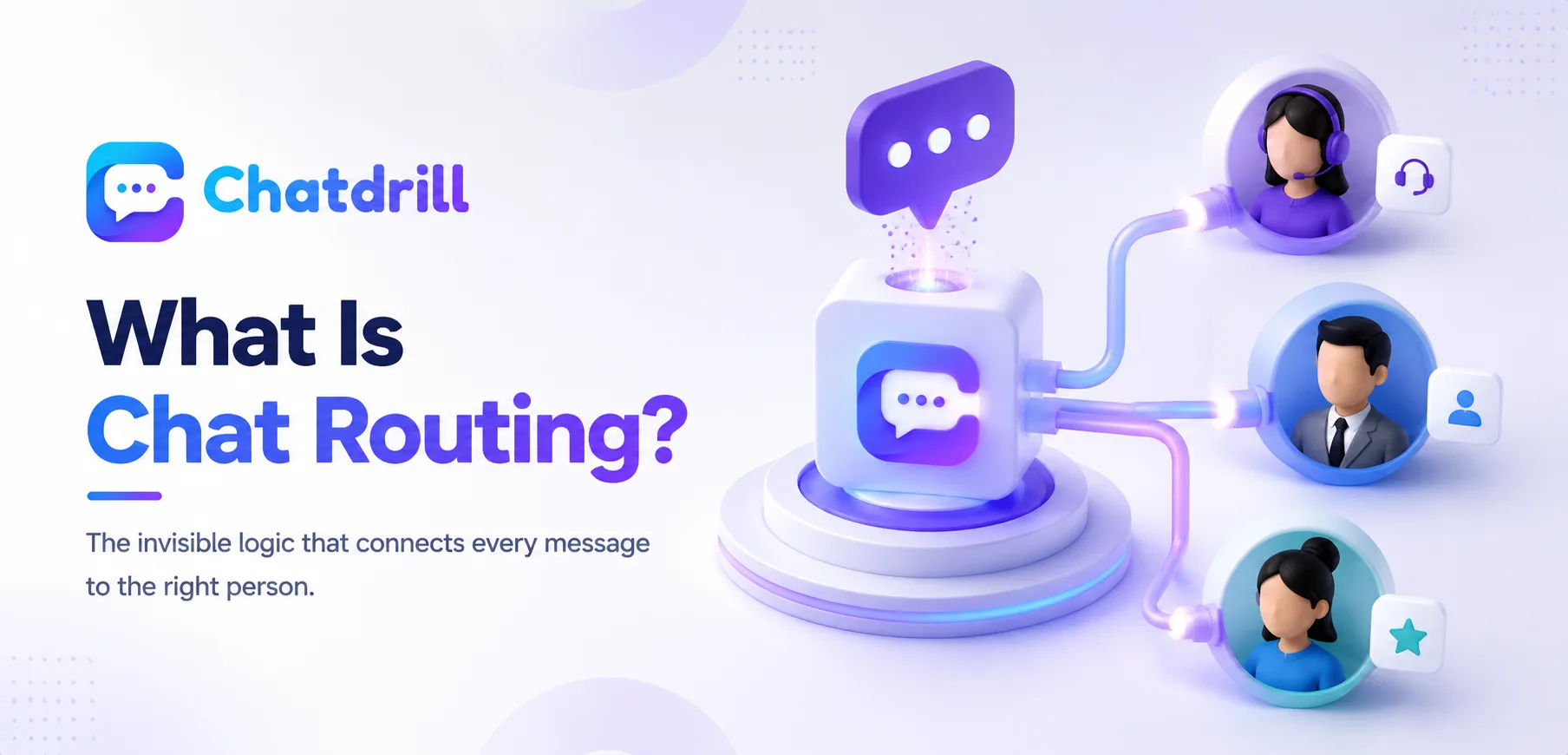
Chat routing is the largely invisible logic working behind every chat conversation, deciding automatically which agent or system actually receives a given incoming message rather than leaving that assignment to chance or manual selection.
Quick answer: Chat routing is the process a chat platform uses to decide which agent, team, or AI system should handle an incoming conversation, based on rules like availability, skill set, topic, or current workload.
Without effective routing, a business handling any meaningful volume would face genuine chaos, conversations landing with the wrong team, an overloaded agent receiving yet another chat while a free one sits idle, or a specialized question going to someone unequipped to answer it.
Understanding how routing works clarifies why some businesses handle chat far more smoothly than others despite similar volume, since the underlying routing logic often makes the real difference.
This guide covers the definition, common routing strategies, what makes routing effective, related concepts, and how ChatDrill approaches routing.
The Full Definition Explained [major informational gain]
[major informational gain]
Chat routing is the automated decision-making process that assigns each incoming conversation to the most appropriate available agent, team, or AI system.
The basic mechanism
When a new chat conversation begins, the routing system evaluates a set of configured rules, availability, skill tags, current workload, topic, to determine where that specific conversation should go.
This happens automatically and typically within a fraction of a second, meaning a visitor never sees or needs to understand the underlying decision process.
Why routing exists at all
Without routing logic, every incoming chat would need manual assignment by someone monitoring an unsorted queue, a genuinely unworkable approach at any meaningful volume.
Routing exists specifically to make this assignment decision instantly and consistently, applying the same logical rules every time rather than relying on ad hoc human judgment for each individual conversation.
Common Chat Routing Strategies [major informational gain]
[major informational gain]
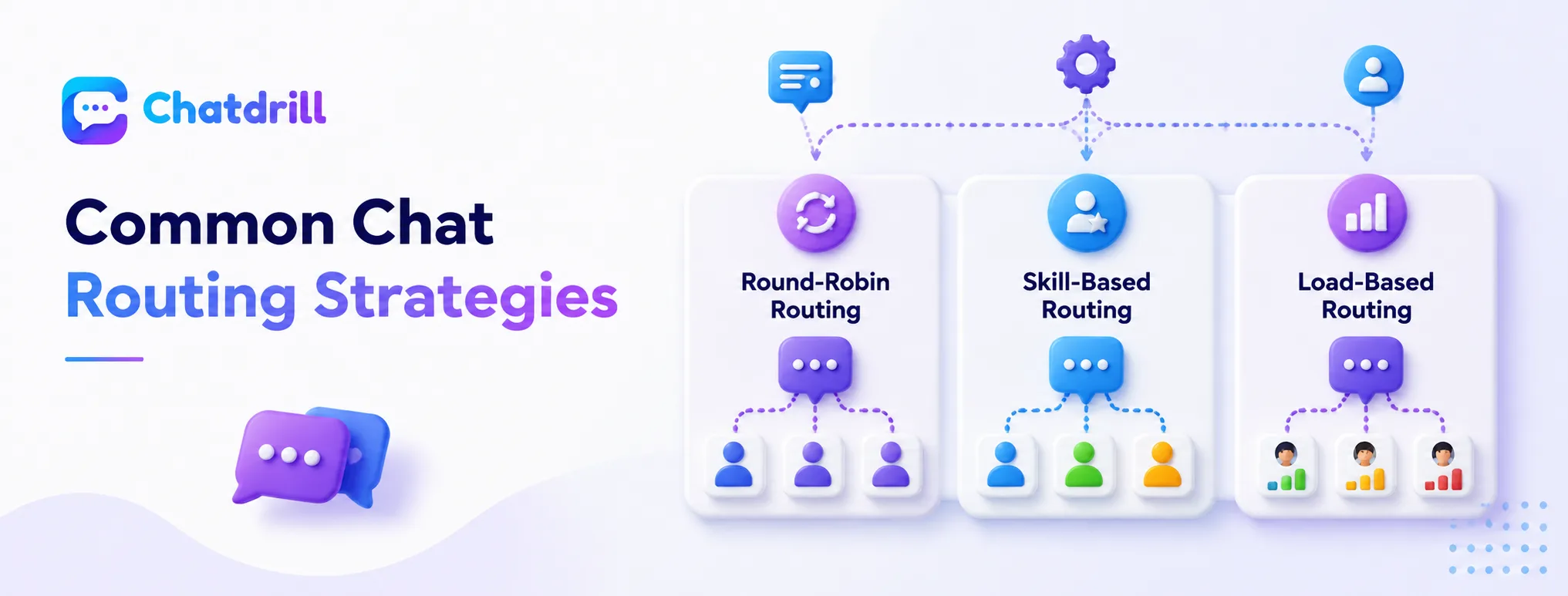
Common strategies include round-robin assignment, skill-based routing, and load-based routing, each suited to different business needs.
Round-robin and load-based routing
Round-robin routing distributes new conversations evenly across available agents in rotation, while load-based routing specifically considers each agent's current conversation count, sending new chats to whoever has the most available capacity.
These approaches work well when most agents can handle most conversation types roughly equally well.
Skill-based and topic-based routing
Skill-based routing sends a conversation to an agent with the specific expertise relevant to that topic, technical support questions to a technical specialist, billing questions to someone trained on payment issues.
This approach matters most when a team has genuinely differentiated expertise, ensuring a conversation lands with someone equipped to help rather than someone who would need to escalate anyway.
What Makes Routing Genuinely Effective [major informational gain]
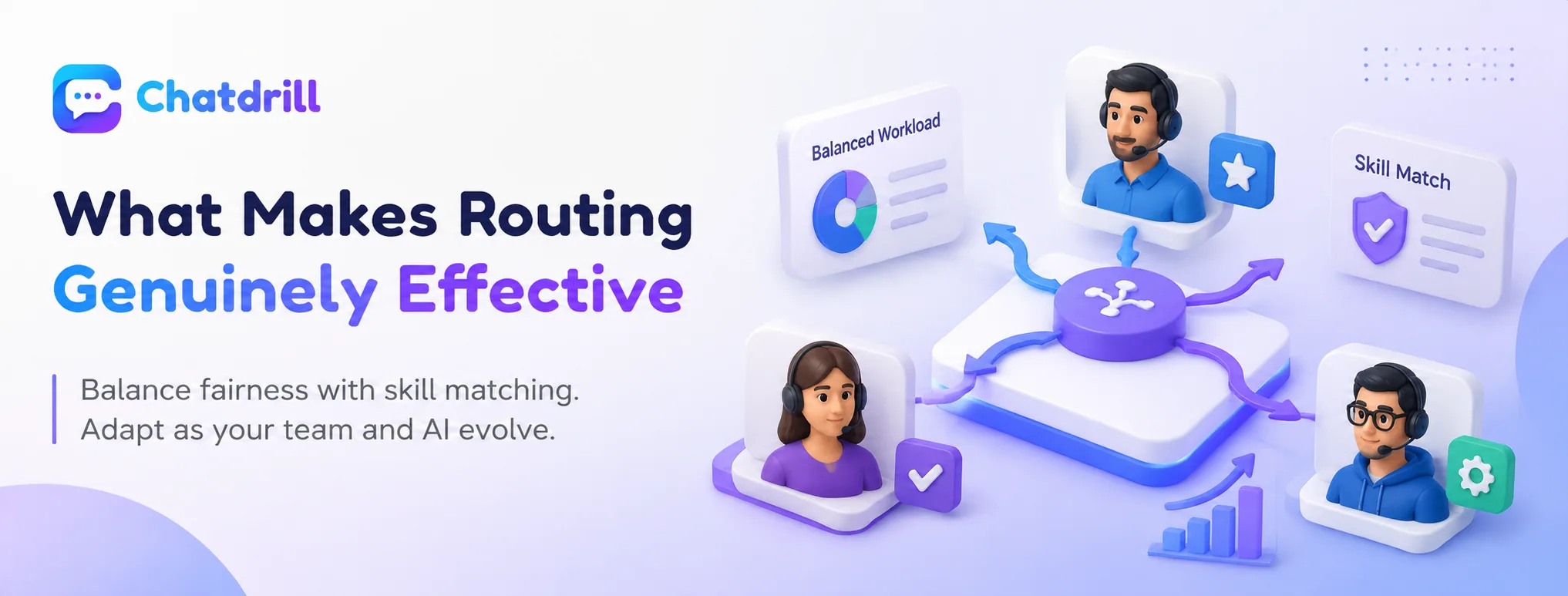
[major informational gain]
Effective routing balances fairness in workload distribution with genuine topic-and-skill matching, avoiding both agent overload and mismatched assignments.
Balancing distribution fairness and specialization
A routing system relying purely on even distribution risks sending a genuinely specialized question to someone unequipped to help, while one relying purely on skill-matching risks overloading a small number of specialists while others sit idle.
The most effective routing setups combine both considerations, respecting genuine skill requirements while still distributing load reasonably evenly among qualified agents.
Adapting routing as a team and AI capability evolve
As AI absorbs more routine volume automatically, routing logic needs to account for this shift, sending only genuinely complex, AI-unresolved conversations into the human routing pool rather than routing everything through human queues by default.
Reviewing and updating routing rules periodically, rather than setting them once and forgetting them, keeps the system aligned with how a team and its AI capability actually evolve over time.
Routing vs Related Concepts [major informational gain]
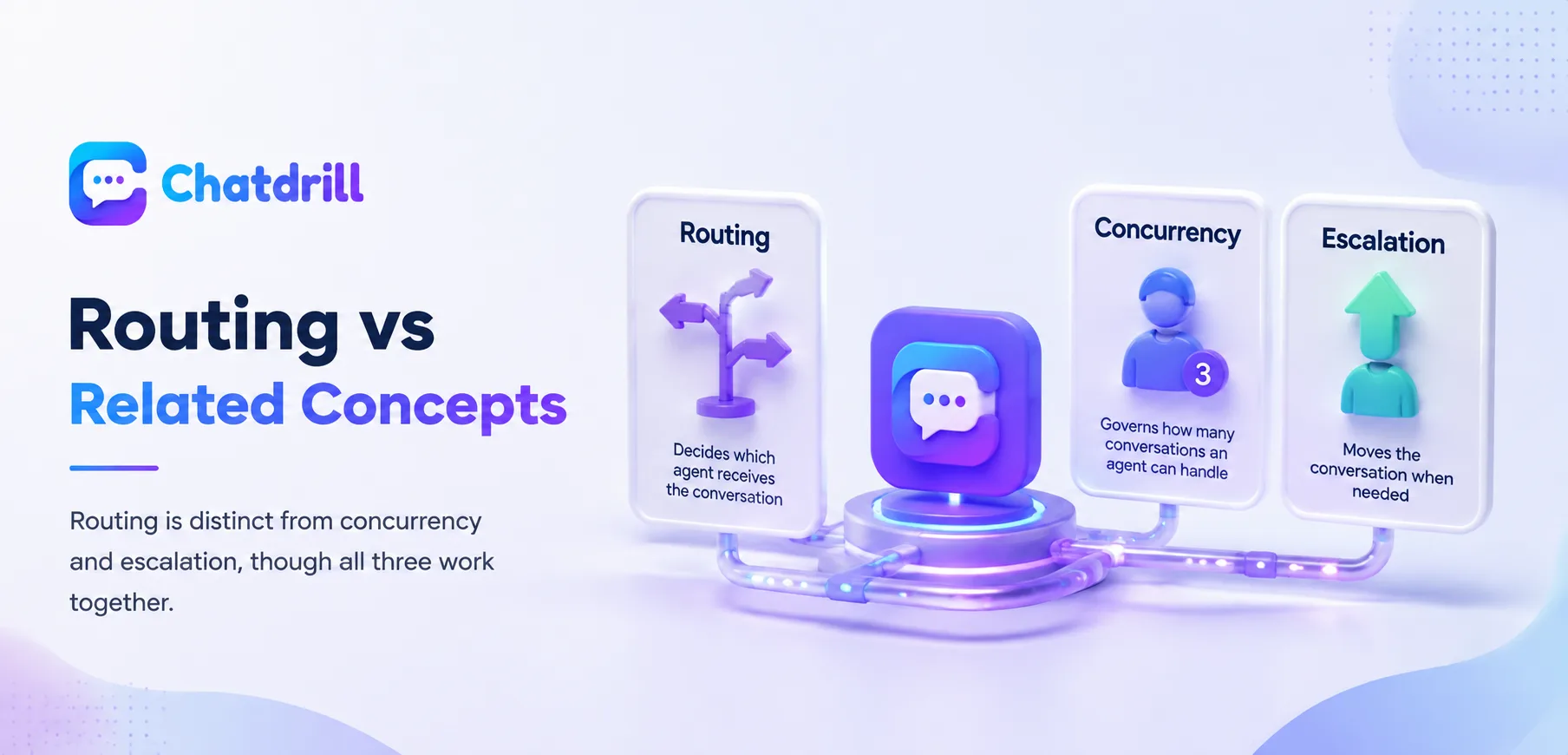
[major informational gain]
Routing is distinct from concurrency and escalation, though all three work together to determine how a conversation is ultimately handled.
Routing vs concurrency
Routing decides which agent receives a conversation, while concurrency governs how many conversations that same agent can hold simultaneously, two related but distinct pieces of the overall assignment logic.
A well-designed system considers both together, routing shouldn't assign a new chat to an agent already at their concurrency limit.
Routing vs escalation
Initial routing determines where a conversation starts, while escalation is the separate process of moving an already-started conversation to a different, typically more senior or specialized, resource when needed.
Both processes rely on similar underlying logic, but routing happens at conversation start while escalation happens mid-conversation based on how things unfold.
How ChatDrill Approaches Chat Routing [major informational gain]
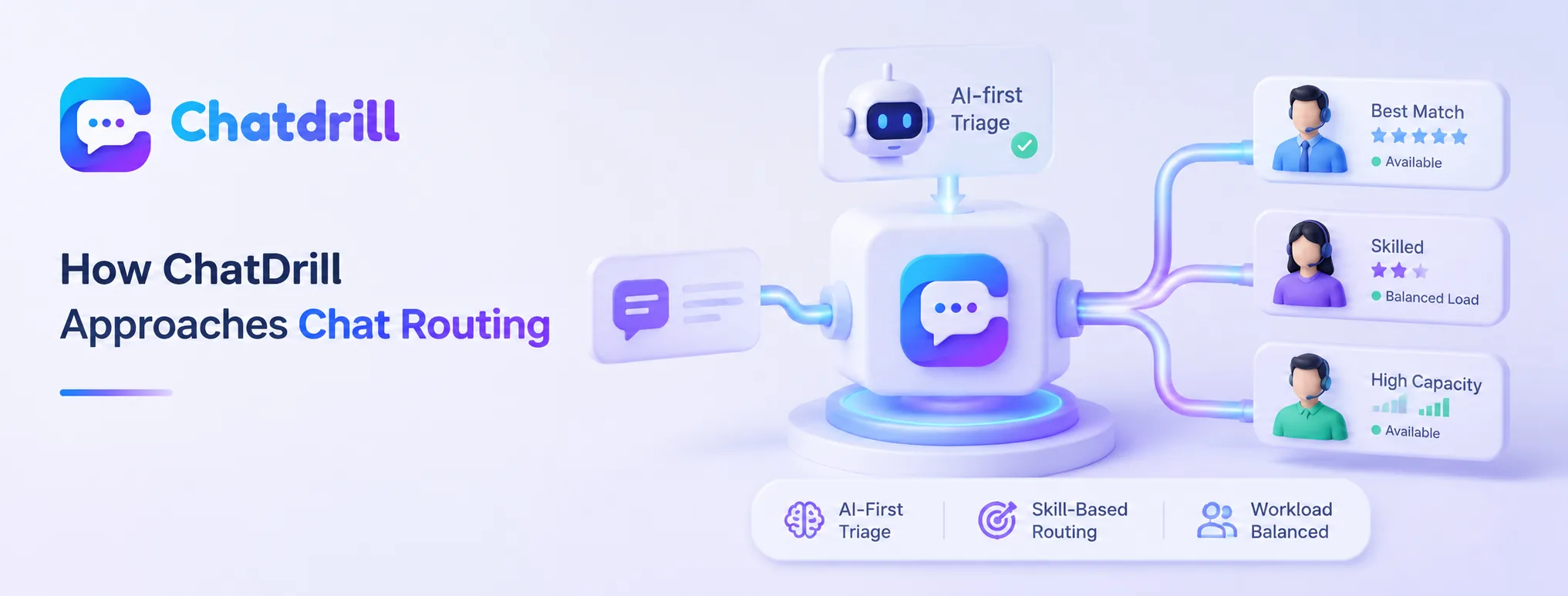
[major informational gain]
ChatDrill combines AI-first triage with configurable skill and workload-based routing for conversations genuinely requiring human attention.
AI-first triage before human routing
ChatDrill's AI attempts to resolve a conversation directly first, meaning only conversations genuinely requiring human attention enter the human routing pool at all, reducing unnecessary load on the routing system and human team alike.
This AI-first layer effectively pre-filters the routing problem, letting human routing logic focus specifically on the conversations that genuinely need it.
Configurable skill and workload-based rules
For conversations that do reach human agents, ChatDrill supports configuring routing rules based on skill tags, current workload, and topic, letting a business balance specialization and fair distribution according to their own specific needs.
This configurability means routing logic can evolve alongside a growing or changing team without requiring a platform switch.