
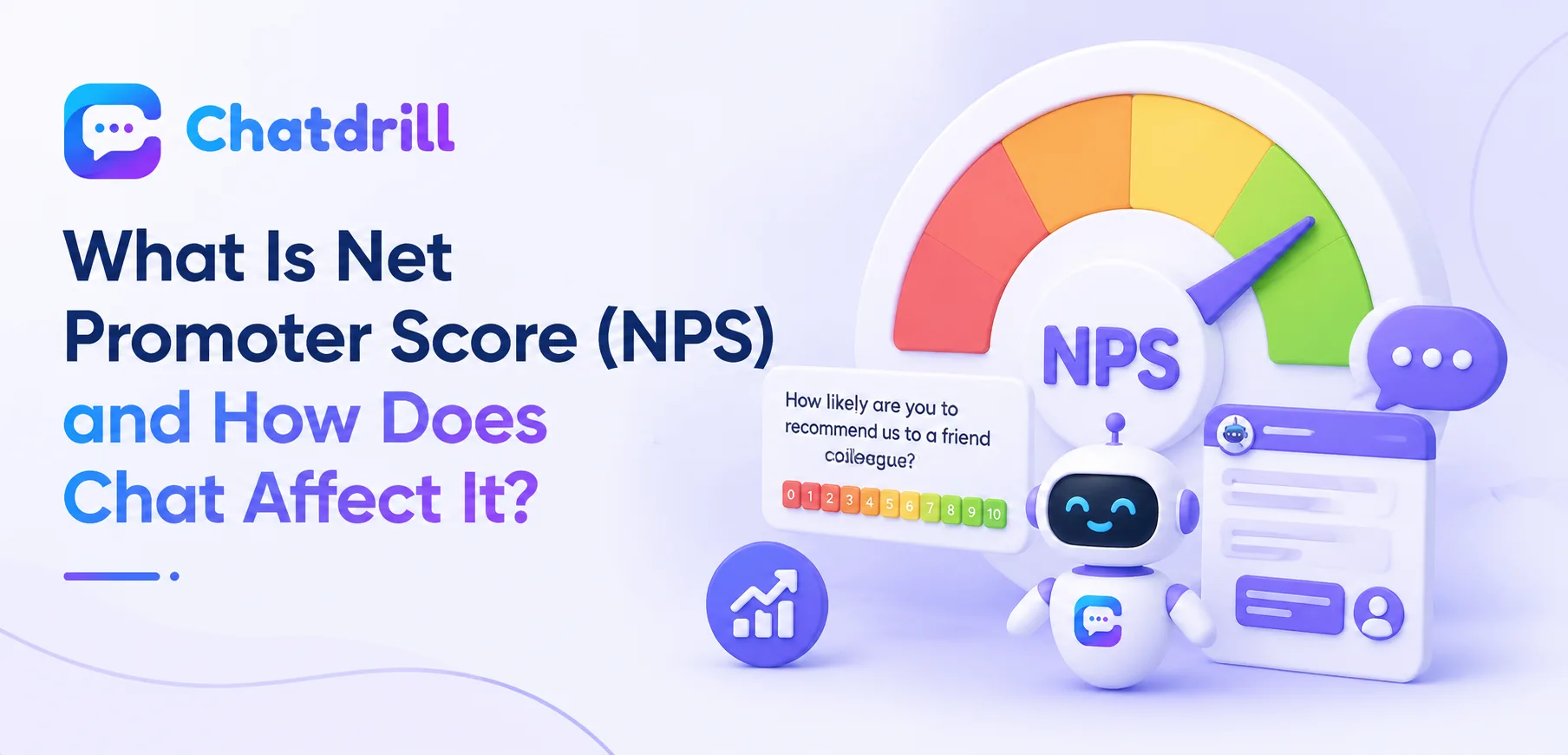
Net Promoter Score has become one of the most widely recognized business metrics across industries, cited in board meetings and marketing materials alike, yet the precise calculation and what genuinely drives it often gets less attention than the number itself.
Quick answer Net Promoter Score, or NPS, is a widely used loyalty metric based on how likely customers are to recommend a business to others, calculated by subtracting the percentage of detractors from the percentage of promoters, and live chat quality can meaningfully move this score since support interactions are often a customer's most direct, personal touchpoint with a business.
At its core, NPS asks one deceptively simple question, how likely is a customer to recommend this business to a friend or colleague, and uses the answer to sort customers into a small number of loyalty categories.
Live chat quality specifically connects to this broader loyalty metric more directly than many other operational factors, since a chat conversation often represents a customer's most direct, personal interaction with a business, carrying outsized influence on their overall impression.
This guide covers the precise definition, how NPS is calculated, the specific connection to chat quality, common misconceptions, and how ChatDrill supports NPS-relevant chat quality.
The Full Definition Explained
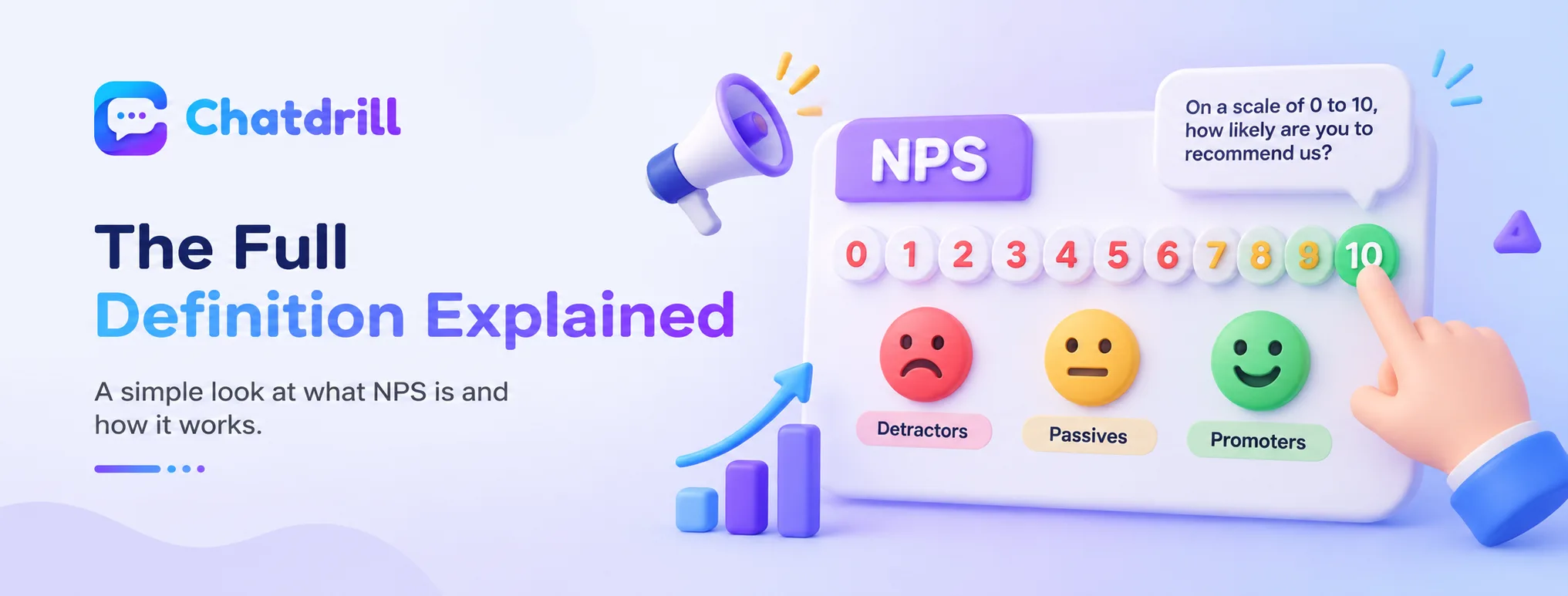
NPS measures customer loyalty by asking how likely someone is to recommend a business, then calculating the balance between enthusiastic promoters and dissatisfied detractors.
The core survey question
The standard NPS question asks, "On a scale of 0 to 10, how likely are you to recommend this company to a friend or colleague?", a single, simple question deliberately designed for broad, easy application.
This simplicity is intentional, making NPS easy to deploy consistently across many touchpoints and easy for a customer to answer quickly without significant effort.
The three response categories
Responses of 9 or 10 are classified as Promoters, genuinely enthusiastic customers likely to actively recommend the business, while 7 or 8 are Passives, satisfied but not enthusiastic enough to actively promote.
Responses of 0 through 6 are classified as Detractors, customers unlikely to recommend and potentially at risk of actively discouraging others or churning themselves.
How NPS Is Calculated
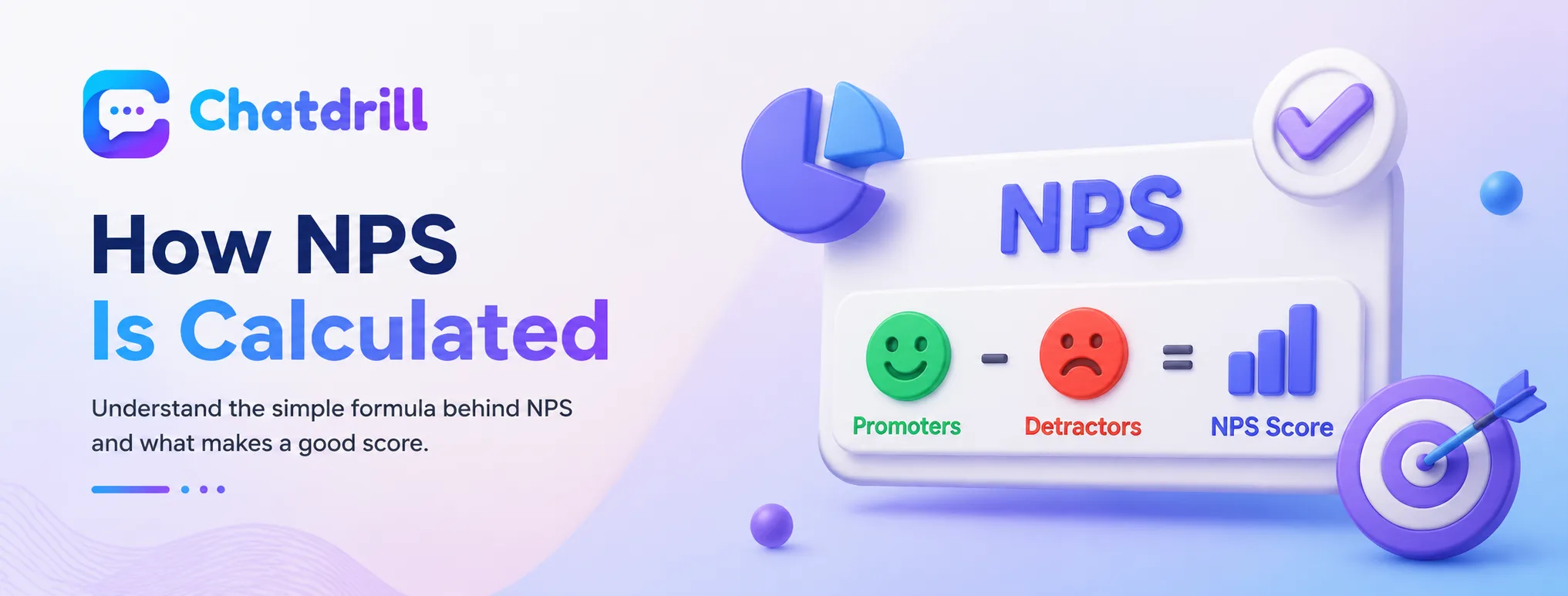
NPS equals the percentage of Promoters minus the percentage of Detractors, producing a single score ranging from negative 100 to positive 100.
The calculation itself
Subtracting the percentage of Detractors from the percentage of Promoters, while excluding Passives from the direct calculation, produces the final NPS figure.
A positive score means promoters outnumber detractors, while a negative score means the reverse, with the specific scale running from negative 100 to positive 100.
Interpreting what counts as a good score
What counts as a genuinely good NPS varies considerably by industry, since customer expectations and typical loyalty patterns differ significantly across different business types.
Tracking your own NPS trend over time, and against your own direct industry competitors specifically, tends to be more meaningful than comparing against a generic, cross-industry benchmark.
How Chat Quality Specifically Affects NPS
Because chat is often a customer's most direct, personal interaction with a business, chat quality carries outsized influence on the overall impression NPS is meant to capture.
Why chat interactions carry outsized weight
Unlike passive product usage, a chat conversation involves direct, personal interaction with a business, a moment where the human, or AI, element of the company becomes genuinely visible and memorable to the customer.
This direct personal quality means a single notably good or bad chat interaction can disproportionately shape a customer's overall impression relative to more passive, background aspects of the relationship.
Specific chat factors that move NPS
Response speed, resolution quality, and the perceived effort required, closely related to CES, all feed into whether a chat interaction leaves a customer feeling like a promoter or a detractor.
A single frustrating, high-effort chat experience can meaningfully damage NPS even if the underlying product itself remains genuinely strong.
Common Misconceptions About NPS
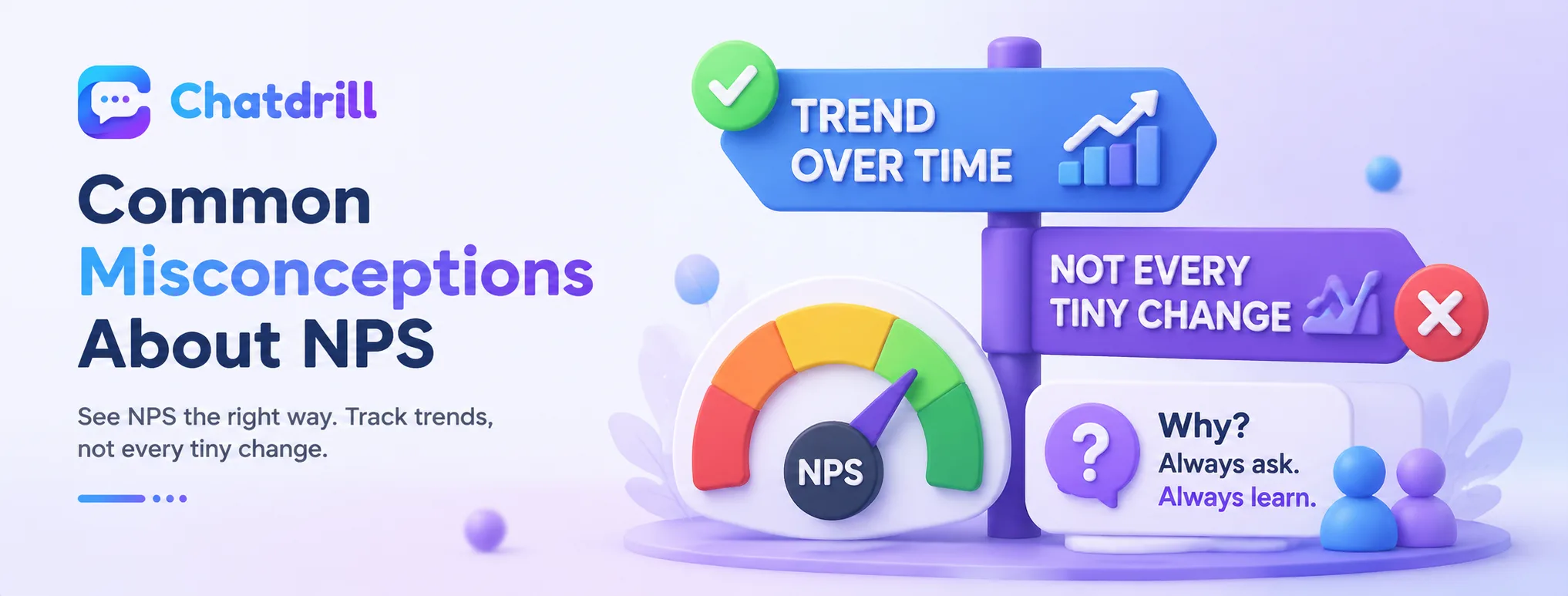
A common misconception treats NPS as a precise, granular measure, when it's better understood as a directional, trend-tracking indicator best viewed over time.
It's directional, not precisely granular
A small month-to-month fluctuation in NPS often reflects normal sampling variation rather than a genuine, meaningful shift, making the broader trend over several periods more meaningful than any single measurement.
Overreacting to small, individual fluctuations risks chasing statistical noise rather than genuine, actionable signal.
It doesn't explain why on its own
NPS alone tells you the overall direction of loyalty sentiment but not specifically why customers feel that way, making it valuable to pair with a follow-up question asking for the reasoning behind a given score.
This follow-up context is what actually makes NPS data actionable, rather than just an abstract, unexplained number to track.
NPS vs Related Loyalty Metrics
NPS captures broad, overall loyalty sentiment, distinct from CSAT's interaction-specific satisfaction and CES's effort-specific focus.
NPS vs CSAT
CSAT measures satisfaction with a specific interaction, while NPS captures a broader, more holistic sentiment about the overall relationship with a business, not tied to any single touchpoint.
A customer might rate a specific chat interaction highly on CSAT while still holding a more mixed overall NPS view shaped by their broader experience with the business.
NPS vs CES
CES focuses specifically on effort within individual interactions, while NPS reflects the cumulative outcome of many factors, including but not limited to effort, across the entire customer relationship.
Tracking all three metrics together, NPS, CSAT, and CES, provides complementary views at different levels of the overall customer experience.
How ChatDrill Supports NPS-Relevant Chat Quality
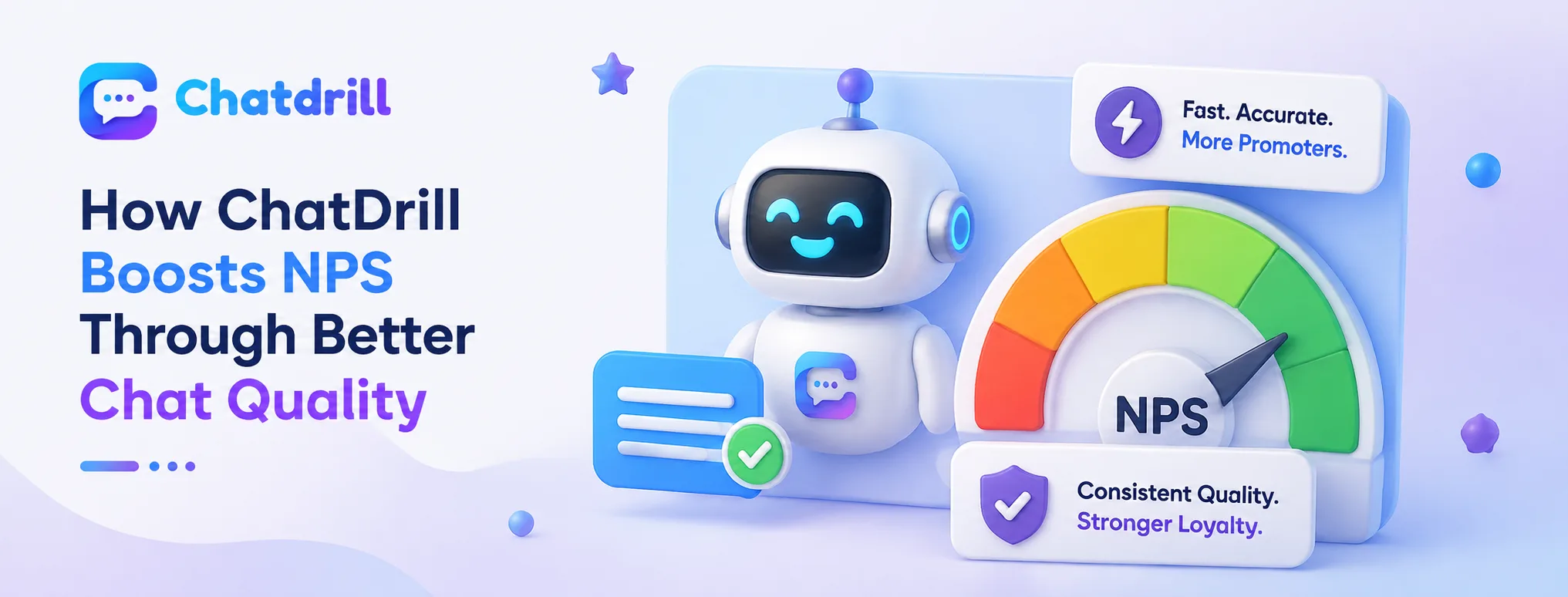
ChatDrill's fast, accurate AI responses and clean human handoffs directly support the chat quality factors most likely to shape NPS outcomes.
Fast, accurate responses reducing detractor-driving frustration
ChatDrill's AI, trained on your genuine business content, aims to resolve questions quickly and accurately, directly addressing the response speed and resolution quality factors most likely to shape whether a chat interaction creates a promoter or a detractor.
This accuracy focus protects against the kind of frustrating, low-quality automated response that could meaningfully damage broader loyalty sentiment.
Consistent quality across every conversation
Because ChatDrill's AI applies consistent quality standards across every conversation, rather than varying based on individual agent mood or skill, it helps protect against the kind of isolated bad experience that can disproportionately damage NPS.
This consistency matters given how directly a single, memorable chat interaction can influence a customer's overall willingness to recommend the business.
Closing the Loop on Detractor Feedback
Following up specifically with customers who score as detractors, understanding their reasoning, and addressing genuine issues raised can meaningfully shift future sentiment.
Why detractor follow-up matters specifically
A detractor who feels genuinely heard after providing critical feedback sometimes becomes considerably more loyal than one left without any follow-up at all, since the follow-up itself demonstrates the business takes concerns seriously.
This follow-up process turns a low individual NPS response from a purely passive data point into an active opportunity for relationship recovery.
Feeding detractor themes back into support improvement
Reviewing common themes across detractor feedback specifically related to chat experiences reveals concrete, addressable patterns worth feeding directly into agent training or AI refinement.
This closed-loop process connects the broader NPS metric back to the specific, tactical support improvements most likely to move it over time.