
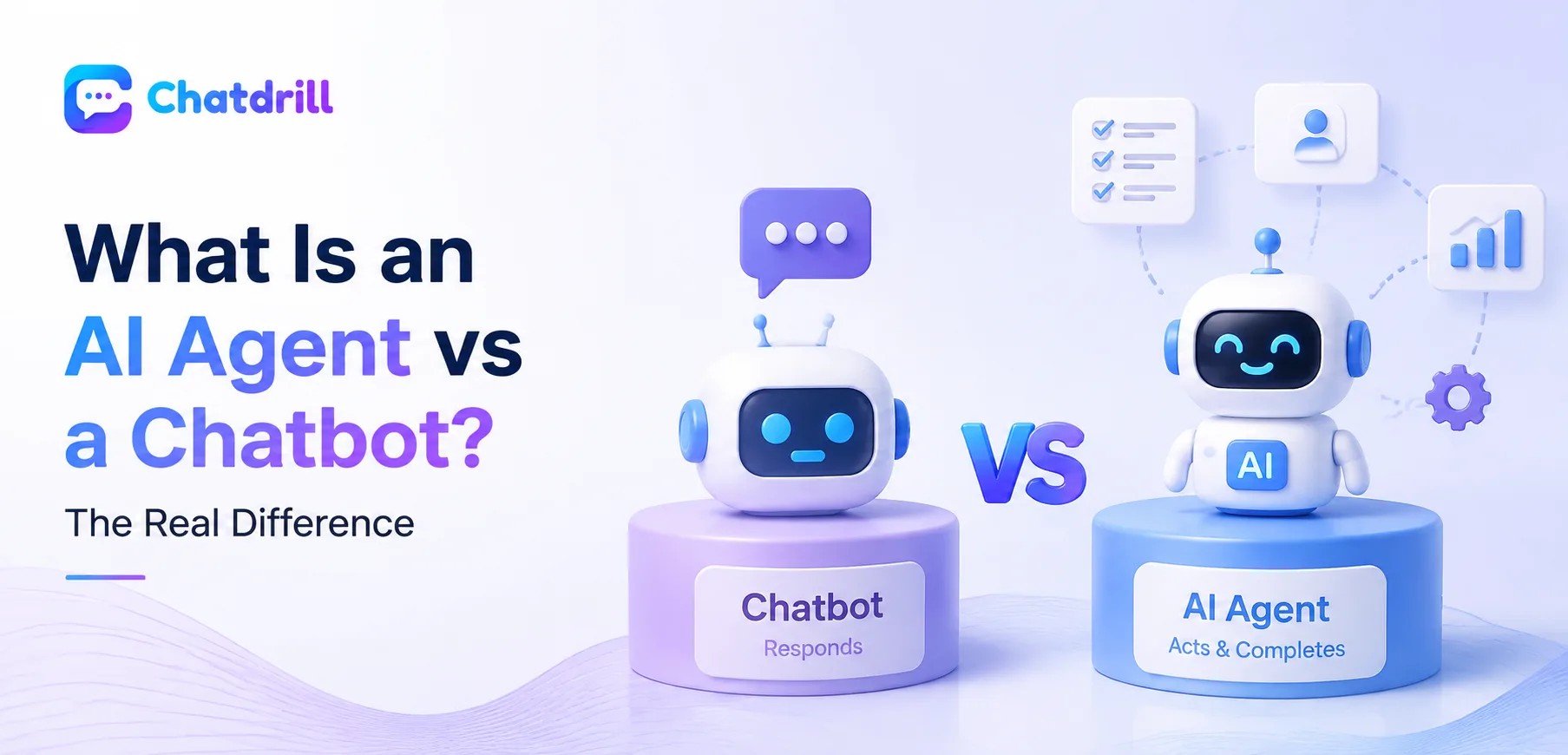
The terms "AI agent" and "chatbot" get used almost interchangeably in casual conversation and marketing copy, but they describe genuinely different levels of capability, and understanding the real distinction matters for anyone evaluating what a given product can actually do.
Quick answer An AI agent autonomously completes multi-step tasks and makes decisions on its own, like actually processing a refund, while a traditional chatbot mainly answers questions or follows a predefined script, meaning the real difference is genuine autonomous action versus scripted or generative response.
A chatbot, in its traditional sense, is fundamentally reactive, it responds to what's said to it, whether through scripted rules or generative AI, but it doesn't independently pursue a goal or take multi-step action on its own.
An AI agent represents a meaningfully different capability tier, one that can plan a sequence of steps and actually execute them, completing a genuine task rather than just producing a helpful response about that task.
This guide covers the precise definition of each term, concrete examples illustrating the difference, why the distinction matters practically, and how ChatDrill positions itself along this spectrum.
The Full Definitions Explained
A chatbot responds to input with a message, while an AI agent autonomously plans and executes a sequence of actions toward completing an actual task.
Defining a chatbot precisely
A chatbot, whether rule-based or powered by generative AI, is designed to receive a message and produce a response, answering a question, providing information, or holding a conversation, without independently taking further action beyond that response.
Even a genuinely sophisticated, natural-sounding chatbot built on advanced generative AI still fundamentally operates within this reactive, message-in-message-out model.
This reactive nature is the defining characteristic, regardless of how conversationally fluent or apparently intelligent the chatbot's actual responses sound.
Defining an AI agent precisely
An AI agent goes further, capable of breaking a goal into steps, deciding what actions to take, and actually executing those actions, potentially including using external tools or systems, without requiring a human to manually perform each individual step.
This includes genuinely completing a task, updating a database record, processing a transaction, scheduling an appointment, rather than merely describing how the task could be completed.
The agent's ability to take real, consequential action autonomously is what separates it categorically from a chatbot's purely conversational, advisory role.
Concrete Examples Illustrating the Difference
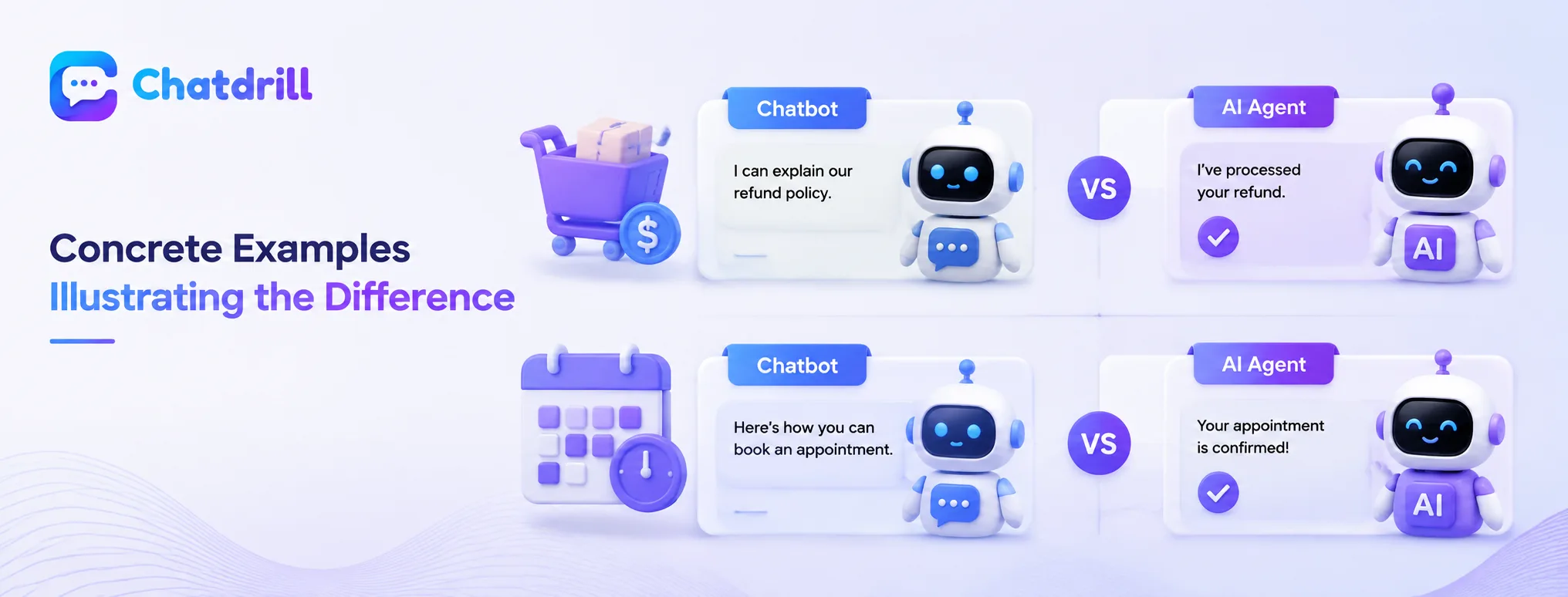
A chatbot might explain a refund policy, while an AI agent would actually process the refund; this practical contrast makes the distinction genuinely tangible.
The refund request example
A chatbot asked about a refund will typically explain the policy, what qualifies, how long it takes, directing the customer to a form or human agent to actually initiate the process.
An AI agent, given the same request, could verify the order, check refund eligibility against policy, and actually process the refund directly, completing the entire task without further human involvement.
This example makes the underlying capability gap concrete, information and guidance on one side, genuine task completion on the other.
The appointment scheduling example
A chatbot might tell a visitor how to book an appointment or direct them to a booking page, while an AI agent could check real calendar availability, select an appropriate slot, and confirm the booking directly within the conversation.
Again, the chatbot provides helpful direction while the agent actually accomplishes the underlying task the visitor originally wanted done.
Why This Distinction Matters Practically
Understanding this difference matters for setting accurate expectations, evaluating vendor claims, and planning what level of automation genuinely fits a given business process.
Setting accurate expectations when evaluating tools
A vendor describing their product as an "AI agent" when it's genuinely a conversational chatbot, however well-built, sets an inaccurate expectation about what the tool can actually accomplish independently.
Understanding the real distinction helps a buyer ask more precise questions during evaluation, specifically about what actions, if any, the system can genuinely execute rather than just discuss.
Planning appropriate automation for a business process
Some business processes genuinely benefit from full agentic automation, while others are better served by a chatbot providing information and guidance, with a human completing any actual action.
Matching the right capability level to each specific process, rather than assuming more autonomy is always better, produces more genuinely appropriate, well-calibrated automation.
The Spectrum Between Chatbot and Agent
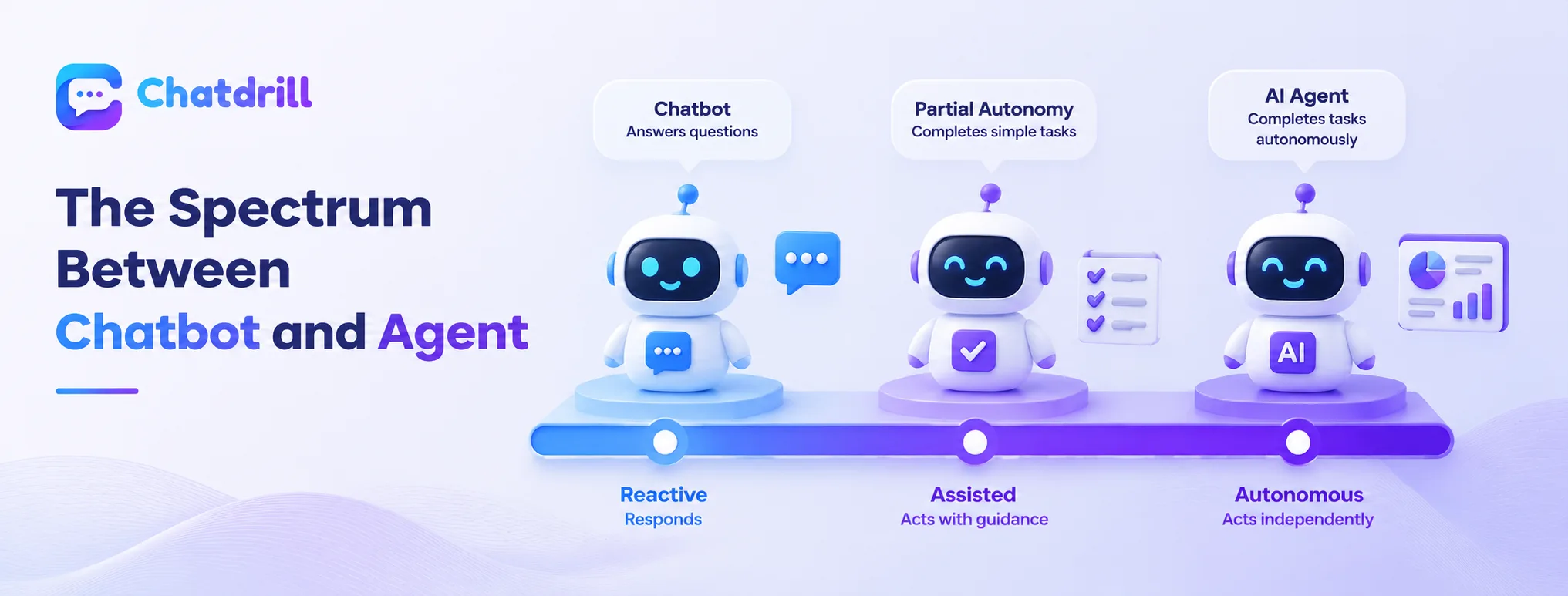
Rather than a strict binary, most real systems sit somewhere on a spectrum, with increasing degrees of autonomous action layered onto conversational capability.
Partial autonomy as a common middle ground
Many current systems combine conversational chatbot capability with limited, specific autonomous actions, like looking up an order status automatically, while still requiring human approval for higher-stakes actions like issuing a refund.
This middle-ground design reflects a genuinely reasonable, cautious approach to introducing autonomy incrementally rather than granting full agentic capability all at once.
Where the industry is heading
Current industry trends point toward increasingly agentic capability becoming standard, with cited projections suggesting a growing share of enterprise applications will include genuine task-completing AI agents within the next few years.
Understanding today's chatbot-versus-agent distinction helps a business track and evaluate this ongoing shift as it continues to unfold.
Common Misconceptions Worth Clearing Up
A common misconception equates any generative AI-powered bot with a genuine agent, when the real distinguishing factor is autonomous action, not conversational sophistication.
Sophistication doesn't automatically mean agency
A chatbot can sound remarkably natural and intelligent, powered by advanced generative AI, while still being purely reactive and conversational, with zero capability to independently execute an action.
Conflating conversational sophistication with genuine agentic capability is a common but genuinely misleading assumption worth actively correcting.
Agentic doesn't mean fully unsupervised
A genuine AI agent doesn't necessarily operate with zero human oversight, many agentic systems still include approval gates or monitoring for higher-stakes actions, combining autonomy with appropriate safeguards.
Autonomy and lack of oversight are separate dimensions, an agent can be genuinely autonomous in execution while still operating within a supervised, safeguarded framework.
How ChatDrill Positions Itself on This Spectrum
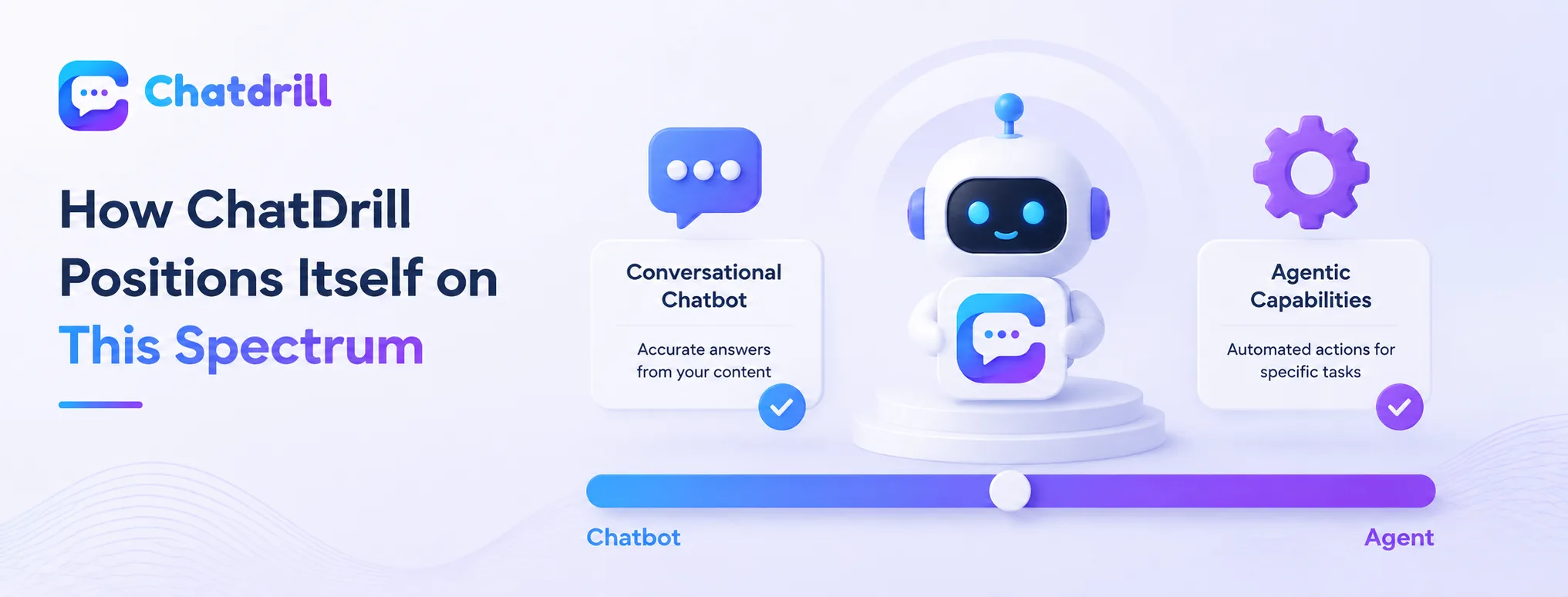
ChatDrill combines strong conversational chatbot capability with growing agentic features for specific, well-defined tasks, reflecting a deliberate, staged approach to autonomy.
Strong conversational foundation
ChatDrill's core capability centers on genuinely accurate, natural conversation, trained on your specific business content, providing the reliable informational and guidance layer every automation strategy needs as its foundation.
This strong conversational base ensures that even before considering deeper agentic capability, a business gets genuine, dependable value from accurate automated responses.
Expanding agentic capability for specific tasks
Beyond pure conversation, ChatDrill supports specific automated actions, like looking up order status or checking availability, representing measured agentic capability applied to well-defined, appropriate tasks.
This staged approach, expanding autonomous action deliberately rather than all at once, reflects the same cautious, appropriate introduction of agentic capability discussed as a broader industry pattern.
Questions Worth Asking When Evaluating a Vendor's Claims
Asking a vendor specifically what actions their system can execute autonomously, versus what it can only discuss, cuts through marketing language to reveal genuine capability.
Asking for a concrete action list, not a capability description
Requesting a specific list of tasks the system can genuinely complete on its own, updating a record, processing a transaction, scheduling something, reveals actual agentic capability more reliably than a general description of how "smart" or "advanced" the AI supposedly is.
A vendor unable to name specific, concrete autonomous actions is likely describing a sophisticated chatbot rather than a genuine agent, regardless of the terminology used in their marketing.
Asking about oversight and approval mechanisms
Understanding what oversight or approval steps exist for higher-stakes autonomous actions reveals whether a vendor has thought carefully about appropriate safeguards, or is describing unchecked autonomy that might carry genuine risk.
A thoughtful vendor should be able to explain specifically where human oversight remains built into their agentic features, rather than presenting full autonomy as an unconditional selling point.