


Whether ignoring a live chat message counts as genuinely rude is a question worth taking seriously, since the answer shapes how a business should think about chat etiquette and staffing commitments.
Quick answer: Yes, ignoring a live chat message without any acknowledgment is generally considered rude by customers, since chat carries a real-time expectation similar to an in-person conversation, though a brief acknowledgment of delay is treated very differently from complete, unexplained silence.
The honest answer is yes, complete silence after a chat message generally does register as rude to most customers, because chat carries an implicit real-time expectation that other, more asynchronous channels simply don't.
Understanding exactly why silence feels different in chat than in email, and what genuinely counts as an acceptable acknowledgment versus true silence, helps a business set appropriate expectations for its own chat etiquette.
This guide covers why chat carries this real-time expectation, what counts as acceptable versus rude, common reasons unintentional silence happens, and how ChatDrill helps prevent it.
Why Chat Carries a Real-Time Expectation

Chat's real-time interface creates an implicit expectation of prompt response, similar to an in-person or phone conversation, unlike the inherently asynchronous nature of email.
The interface itself sets the expectation
A chat window showing typing indicators and immediate message delivery creates a genuine, implicit sense that someone is actively present and available, an expectation email's inherently delayed format never creates in the first place.
This interface-driven expectation means silence in chat feels like a genuine violation of the format's implicit promise, in a way that a delayed email reply simply doesn't.
Even small interface cues, like a visible 'online' status or a greeting message, reinforce this sense of active presence, making any subsequent silence feel more jarring by contrast.
The psychological parallel to in-person conversation
Being ignored mid-conversation in chat evokes a similar, genuine discomfort to being ignored mid-sentence in person, since both formats create the expectation of an active, present, responsive exchange.
This psychological parallel explains why chat silence tends to register more sharply as rude than a delayed response through a channel that never implied real-time presence to begin with.
What Counts as Acceptable vs Genuinely Rude
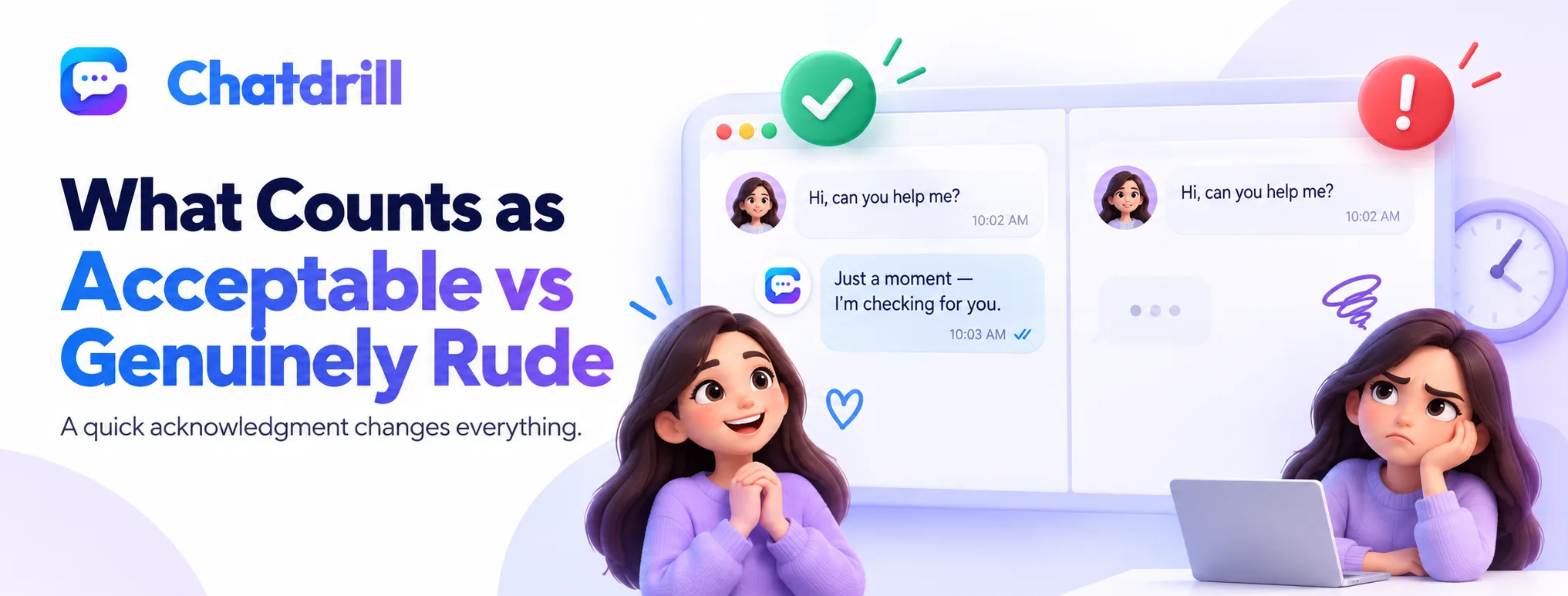
A brief acknowledgment of delay is treated as genuinely acceptable, while complete, unexplained silence is what customers experience as rude.
Acknowledgment versus silence
A quick message like "give me just a moment to look into that" satisfies the real-time expectation chat creates, even if the actual full answer takes a bit longer to arrive.
This acknowledgment costs almost nothing to provide but makes a genuine, meaningful difference in whether the interaction feels respectful or rude to the person waiting.
The specific wording matters less than the act of acknowledging itself, even a brief, informal note is enough to satisfy the underlying expectation.
How long silence needs to persist before it registers as rude
A brief pause of a few seconds rarely registers as rude, but silence extending well beyond what a reasonable person would expect for a real-time channel increasingly feels like a genuine slight rather than an innocent delay.
This threshold isn't a single universal number, but the underlying principle, any meaningful silence deserves at least a brief acknowledgment, holds regardless of the exact time elapsed.
Common Reasons Unintentional Silence Happens
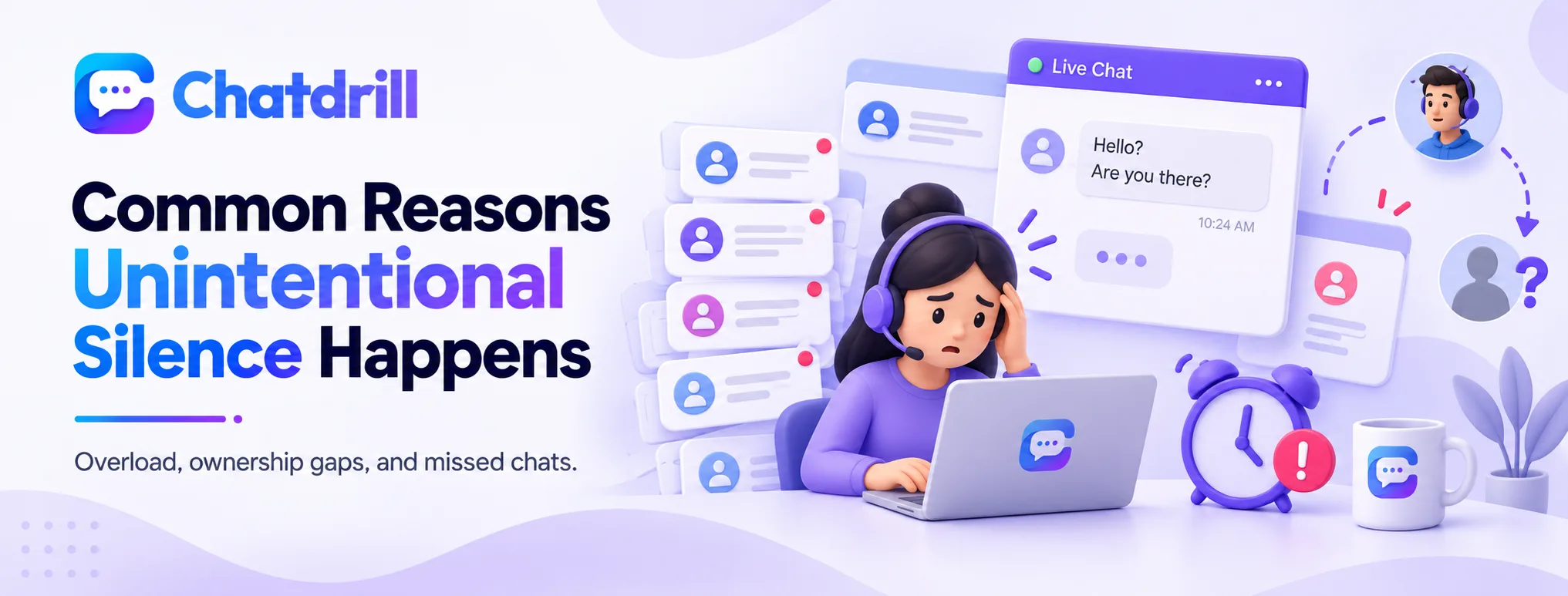
Unintentional silence usually stems from agent overload, unclear ownership of a conversation, or simply forgetting amid multiple simultaneous chats.
Agent overload and forgotten conversations
An agent juggling several simultaneous conversations can genuinely lose track of one, not from rudeness but from an overloaded, imperfect human memory trying to manage too much at once.
This is less an intentional slight and more a signal that concurrency levels or workload may need adjustment to prevent this kind of accidental, forgetful silence.
Unclear conversation ownership
A conversation that gets transferred or reassigned without clear, explicit ownership can end up in a gap where multiple people assume someone else is handling it, resulting in accidental, unintentional silence.
Clear routing and ownership rules prevent this specific kind of gap from occurring in the first place.
How ChatDrill Helps Prevent Unintentional Silence
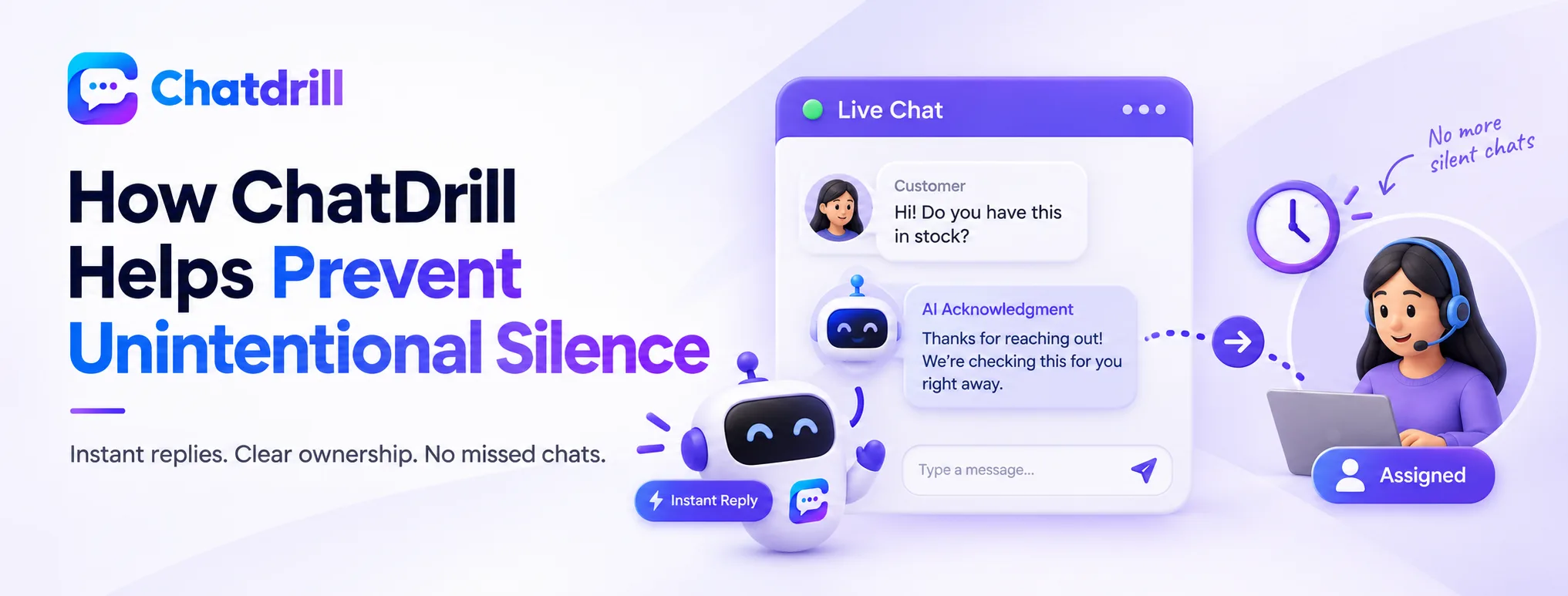
ChatDrill's AI provides instant acknowledgment for every incoming message, while its routing logic ensures clear conversation ownership that prevents accidental gaps.
Instant AI acknowledgment as a safety net
Even when a human agent is genuinely occupied, ChatDrill's AI can provide an immediate acknowledgment or attempt initial resolution, ensuring a visitor never experiences true, unexplained silence.
This safety net directly addresses the real-time expectation this guide identifies as central to why chat silence feels genuinely rude.
Because this acknowledgment happens automatically regardless of current agent workload, it removes reliance on any individual agent remembering to respond promptly amid a busy stretch.
Clear routing preventing ownership gaps
ChatDrill's routing logic assigns clear ownership for every conversation, including during transfers, preventing the kind of ambiguous handoff gap that often causes accidental, unintentional silence.
This clarity protects against one of the most common, genuinely unintentional causes of the rude-feeling silence this guide describes.
Tracking which conversations experienced any silence gap, even briefly, also gives a team lead concrete data for coaching agents on this specific, easily overlooked etiquette habit.
Building Good Chat Etiquette Into Team Habits
Preventing rude-feeling silence long-term depends on building acknowledgment habits into regular training and coaching, not just fixing the technology side.
Making acknowledgment a trained, expected habit
Explicitly training agents to send a brief acknowledgment whenever a response will take more than a few seconds, rather than assuming this happens naturally, builds a consistent habit across an entire team.
This deliberate training matters because good intentions alone don't reliably produce consistent behavior under the genuine pressure of a busy, multi-conversation shift.
Reviewing real conversations for silence gaps
Periodically reviewing real conversation transcripts specifically for unacknowledged silence gaps gives concrete, specific coaching material, more useful than a general reminder about response speed.
This review habit also helps identify whether silence issues concentrate during specific busy periods, informing whether the root cause is genuinely a training gap or a staffing or concurrency problem instead.