
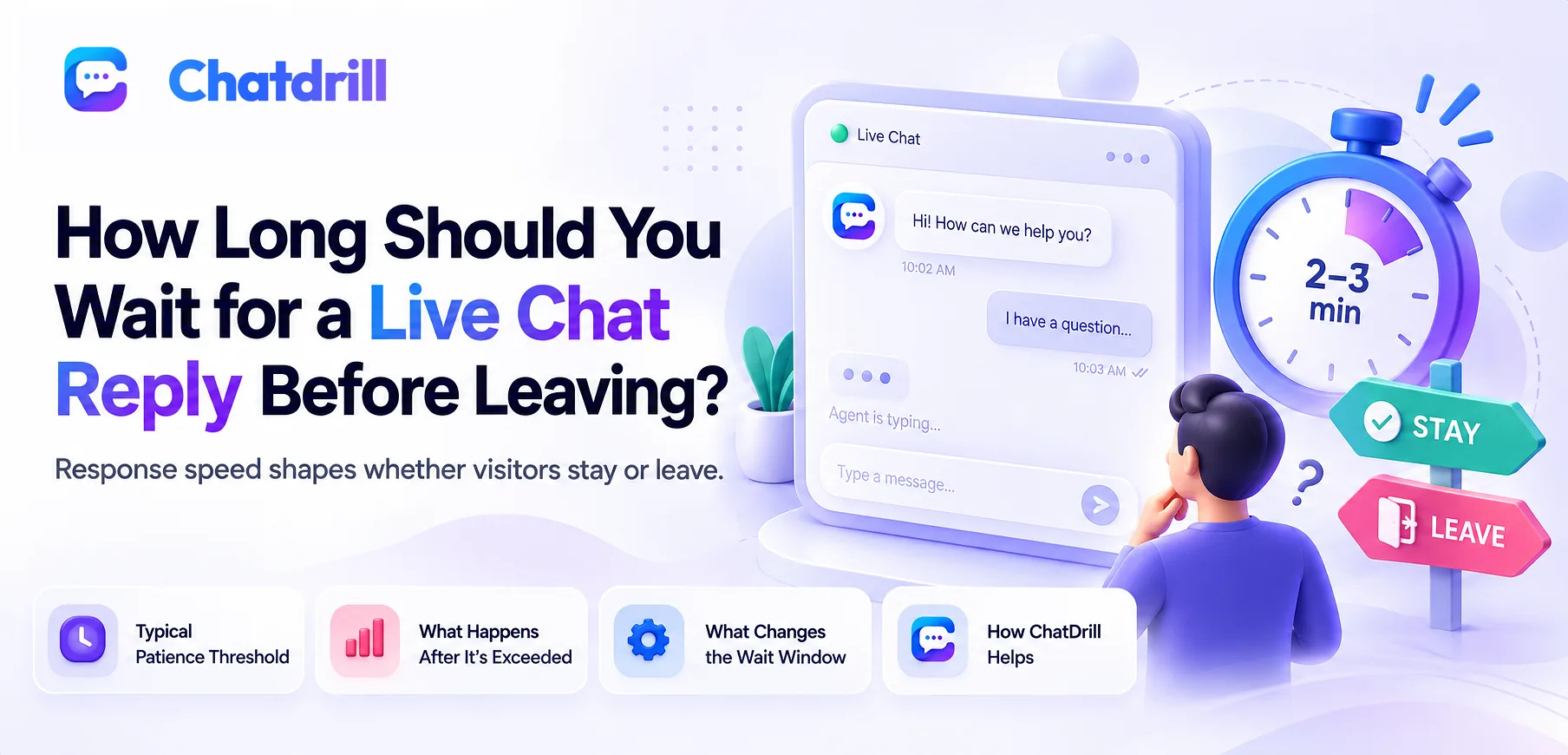
How long a customer is genuinely willing to wait for a live chat reply before giving up and leaving is a question with real, measurable implications for how a business should think about staffing and response time targets.
Quick answer: Most customers are willing to wait about 2 to 3 minutes for a live chat reply before abandoning the conversation, though patience drops sharply after that point, meaning a business should aim to respond well within this window to avoid losing the visitor entirely.
Live chat carries a considerably shorter patience threshold than other channels, since its real-time nature sets an implicit expectation that a delayed reply directly violates in a way email's inherent asynchrony never does.
Understanding this threshold, and what genuinely happens once it's exceeded, helps a business calibrate staffing and AI coverage to keep response comfortably within the window customers actually tolerate.
This guide covers the typical patience threshold, what happens once it's exceeded, factors that shift this threshold, and how ChatDrill helps stay within it consistently.
The Typical Patience Threshold
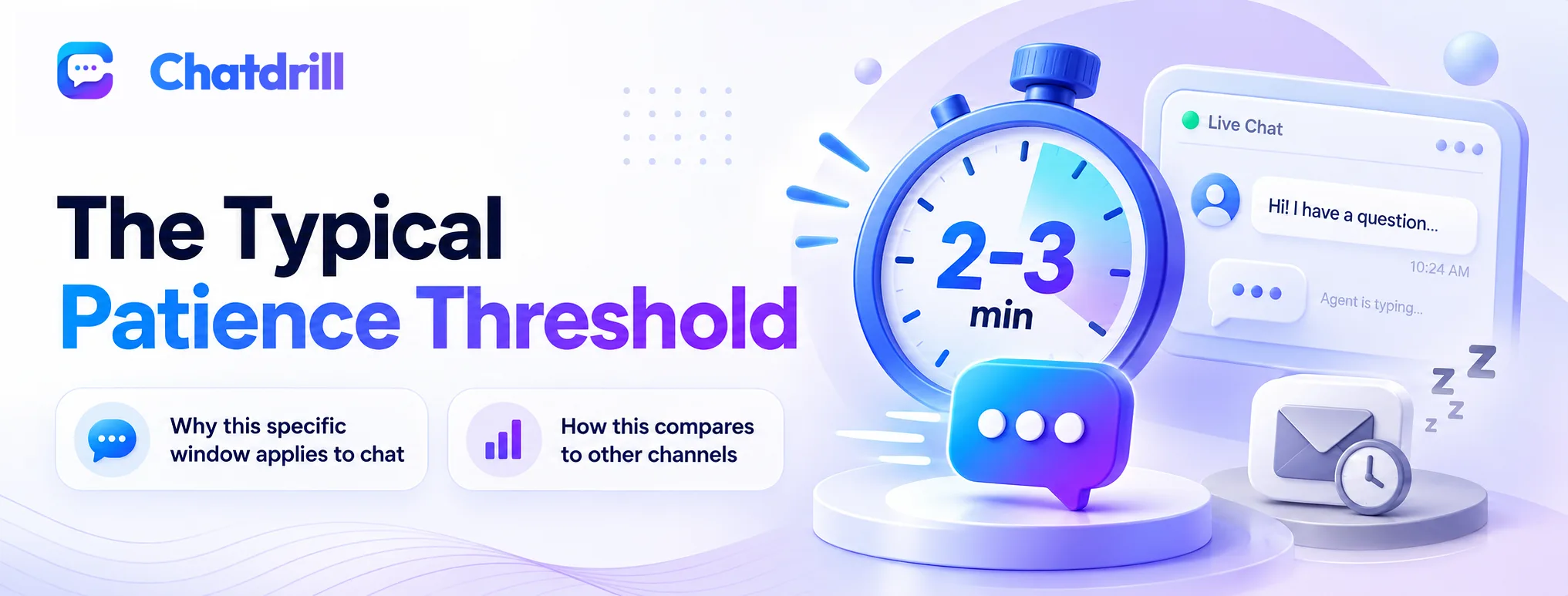
Most customers tolerate roughly 2 to 3 minutes of waiting for a chat reply before genuinely considering leaving, a considerably shorter window than other support channels.
Why this specific window applies to chat
Chat's real-time interface, showing that a conversation is technically active and someone should be present, creates a much shorter patience threshold than a channel like email where no such immediate expectation exists.
This threshold reflects chat's core value proposition, immediate resolution, meaning a wait approaching or exceeding it directly undermines the reason a visitor chose chat in the first place.
How this compares to other channels
This roughly 2 to 3 minute chat threshold is dramatically shorter than the hours customers might tolerate for an email reply, reflecting the fundamentally different expectation each channel's format creates.
This comparison underscores why response time deserves specific, dedicated attention for chat rather than applying general customer service response standards uniformly across every channel.
What Happens Once the Threshold Is Exceeded
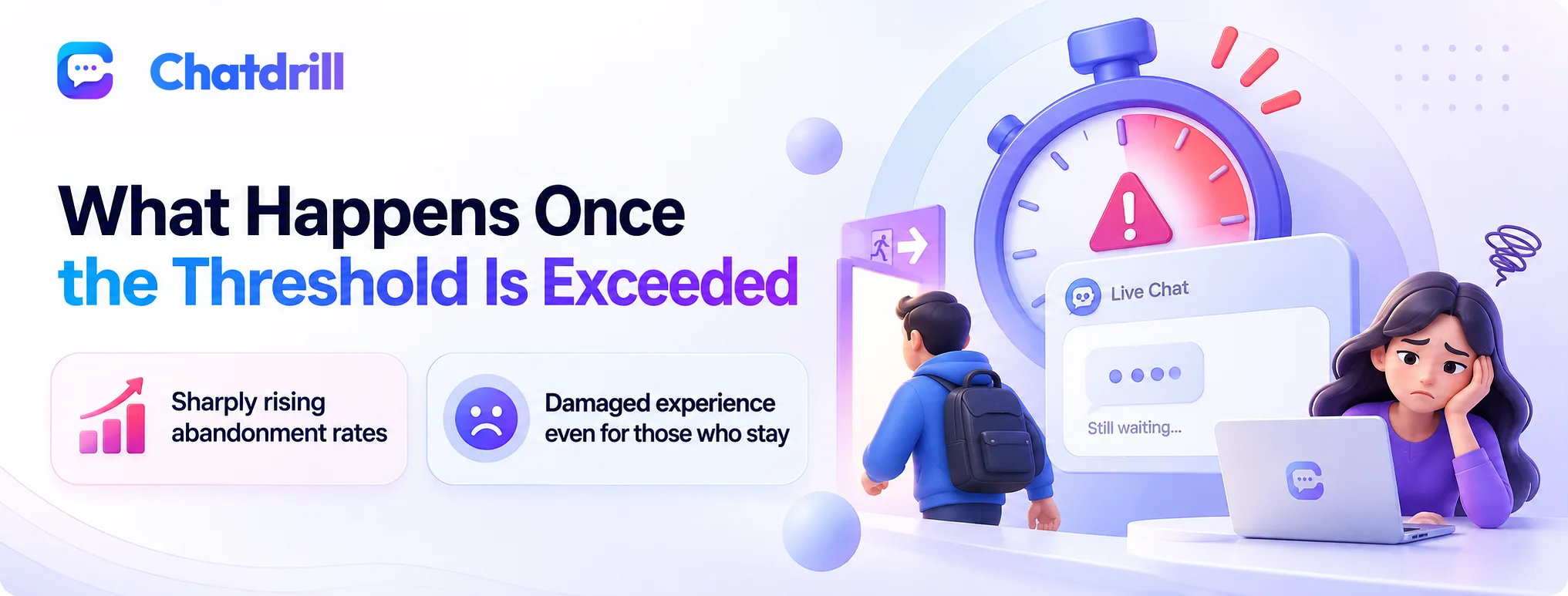
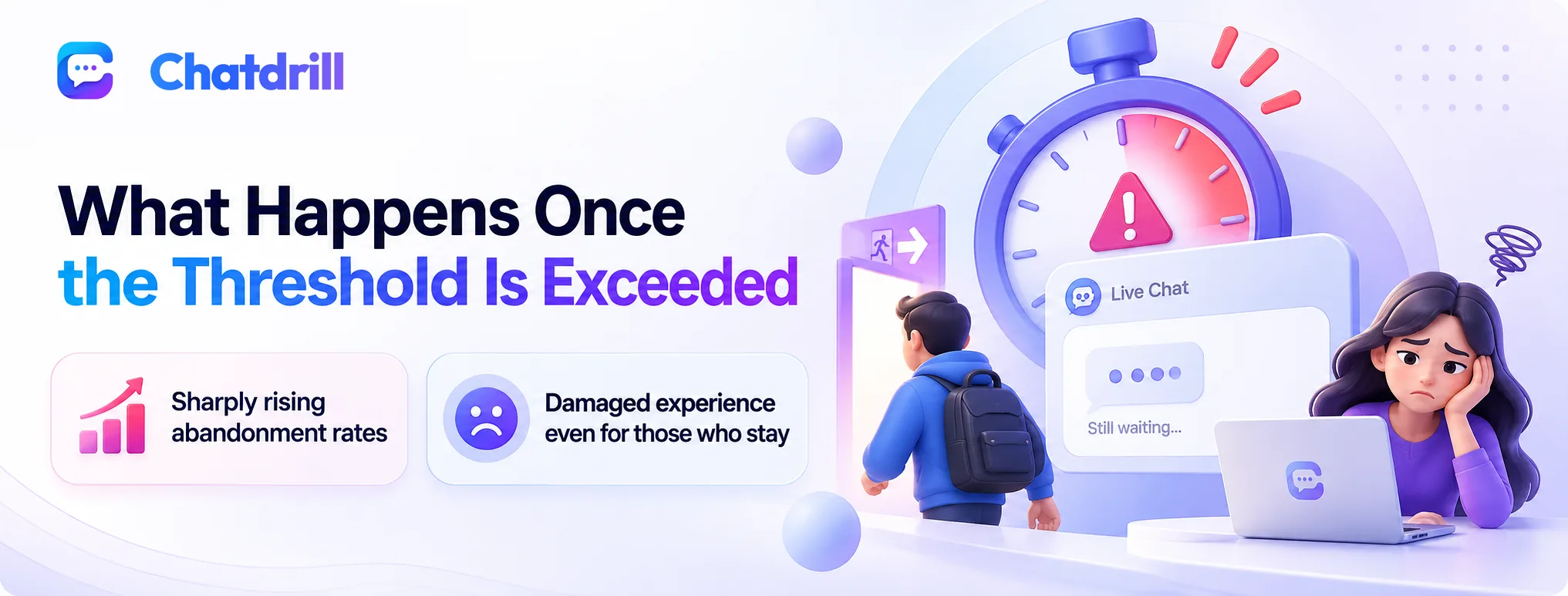
Abandonment rates climb sharply once wait time exceeds a few minutes, and even customers who stay tend to arrive at the eventual reply already frustrated.
Sharply rising abandonment rates
Once a wait extends past roughly three minutes, published research on chat abandonment shows a steep increase in customers simply leaving the conversation rather than continuing to wait.
This steep rise means every additional minute of delay beyond this threshold costs a business a meaningfully larger share of potential conversations, not a gradual, linear decline.
Damaged experience even for those who stay
A customer who does wait through an extended delay often arrives at the eventual response already frustrated, meaning the interaction starts from a worse emotional position than it would have with a prompt reply.
This means exceeding the threshold costs a business twice, both through direct abandonment and through a damaged experience for those who remain.
Factors That Shift This Threshold
Genuine urgency, prior positive experience with a business, and a visible queue position can all shift how long a customer is actually willing to wait.
Urgency and prior relationship
A customer with a genuinely urgent issue tends to have less patience than one browsing casually, while a customer with a strong prior positive relationship with a business may extend somewhat more benefit of the doubt during a delay.
These factors mean the threshold isn't perfectly uniform across every situation, though the general 2 to 3 minute range remains a reasonable planning baseline.
Visible queue position and honest wait estimates
A customer shown an honest estimate of their queue position or expected wait tends to tolerate a longer delay than one left with no information at all, since the uncertainty itself often drives frustration as much as the wait duration.
This means providing an honest wait estimate, even a longer one, can genuinely extend the practical patience threshold compared to leaving a customer waiting with zero information.
How ChatDrill Helps Stay Within the Patience Window
ChatDrill's AI-assisted instant response and real-time monitoring help keep actual wait times comfortably within the threshold this guide identifies as critical for retaining visitors.
AI response well within the tolerance window
ChatDrill's AI can respond to common questions within seconds, keeping well inside the 2 to 3 minute threshold this guide identifies as the point where abandonment risk climbs sharply.
This speed advantage applies consistently regardless of visitor volume, protecting response time even during periods that would otherwise strain human-only staffing.
Because this speed doesn't depend on staffing levels at any given moment, it also protects the patience window consistently across time zones and unpredictable traffic spikes.
Monitoring to catch and address delays proactively
ChatDrill's real-time monitoring can flag a conversation approaching a concerning wait time, giving a team lead the chance to intervene before a visitor reaches the point of abandoning the conversation.
This proactive visibility helps a business consistently stay within the patience window this guide describes, rather than discovering delays only after visitors have already left.
Reviewing this data over time also reveals whether specific hours or queues consistently run closer to the threshold, informing where additional staffing or AI training would deliver the most protective value.
Setting Internal Response Time Targets
Translating the customer patience threshold into an internal target, with buffer built in, gives a team a concrete, actionable standard to organize staffing and AI coverage around.
Setting a target comfortably inside the threshold
Aiming for a response time target meaningfully faster than the outer edge of customer patience, rather than right at the threshold, builds in a safety margin for the natural variation any real support operation experiences.
This buffer approach protects against the scenario where an occasional slower response pushes past the point where a visitor genuinely gives up and leaves.
Reviewing performance against the target regularly
Tracking actual response time against this internal target on a regular, ongoing basis reveals whether current staffing and AI coverage are genuinely sufficient, or whether adjustment is needed before customer-facing abandonment becomes a visible problem.
This proactive review habit catches a developing response-time issue while there's still time to address it, rather than discovering the problem only after it has already cost the business genuine, measurable conversions.