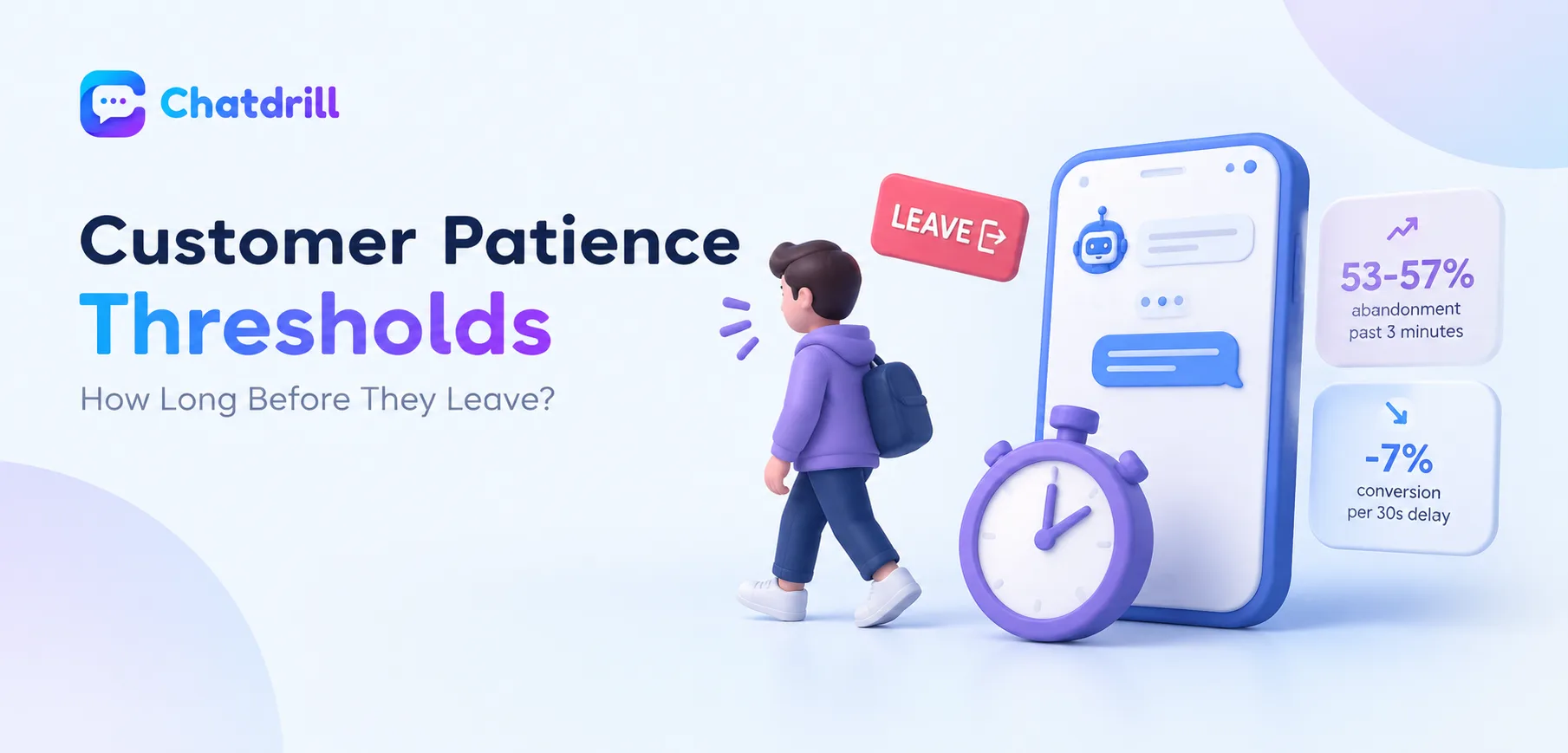
Understanding exactly how much patience a customer genuinely extends to live chat, and how steeply that patience declines past certain thresholds, helps a business calibrate staffing and AI investment against real, evidence-based customer behavior rather than a rough guess.
Quick answerCited 2026 research finds customer patience for live chat genuinely limited, with abandonment climbing steeply once wait time crosses about 3 minutes (Forrester reports 53-57% abandonment past this point), while pre-sales conversion specifically drops roughly 7% for every additional 30 seconds of delay, meaning the practical patience threshold for chat is measured in seconds to low minutes, not the longer tolerance customers extend to slower channels like email.
Cited research consistently finds chat patience measured in seconds to low minutes, a considerably tighter window than the hours customers tolerate for email, reflecting chat's fundamentally different, real-time promise to the customer.
This guide covers the cited patience threshold data, what happens as wait time crosses key points, why chat's patience window differs from other channels, and how Chatdrill helps a business stay within these critical thresholds.
Cited Patience Threshold Data
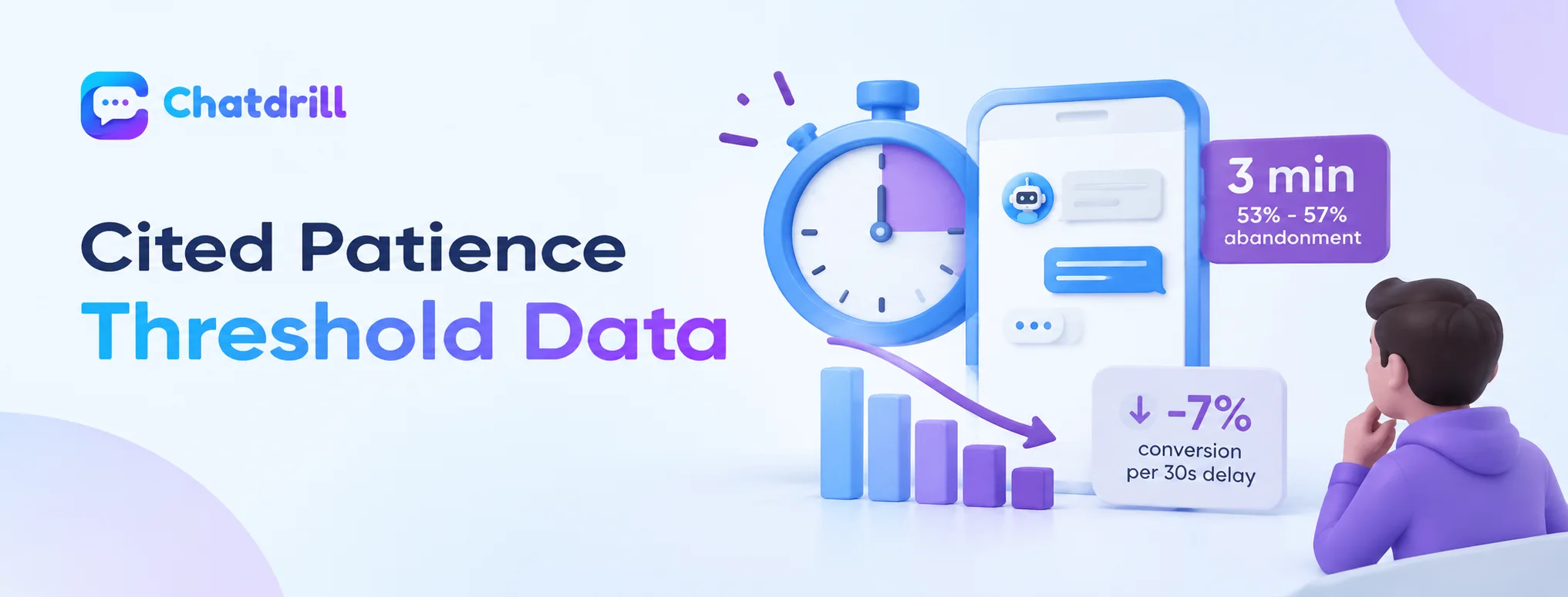
Cited research places the steepest abandonment increase around the 3-minute mark, with pre-sales conversion specifically declining incrementally well before that point.
The 3-minute abandonment cliff
Research citing Forrester data finds 53% to 57% of customers abandoning a chat once wait time passes 3 minutes, a figure cited consistently enough across multiple sources to represent a genuinely reliable threshold worth planning around.
This steep abandonment increase past 3 minutes suggests this specific point represents a meaningful behavioral cliff, not just a gradual, linear decline in patience over time.
Earlier, incremental conversion decline
Cited research also finds pre-sales conversion specifically declining by roughly 7% for every additional 30 seconds of delay, a much earlier and more gradual effect than the later, steeper abandonment cliff.
This earlier decline matters for a business focused on sales conversion specifically, since it suggests meaningful cost accumulates well before a customer actually abandons the conversation entirely.
What Happens as Wait Time Increases
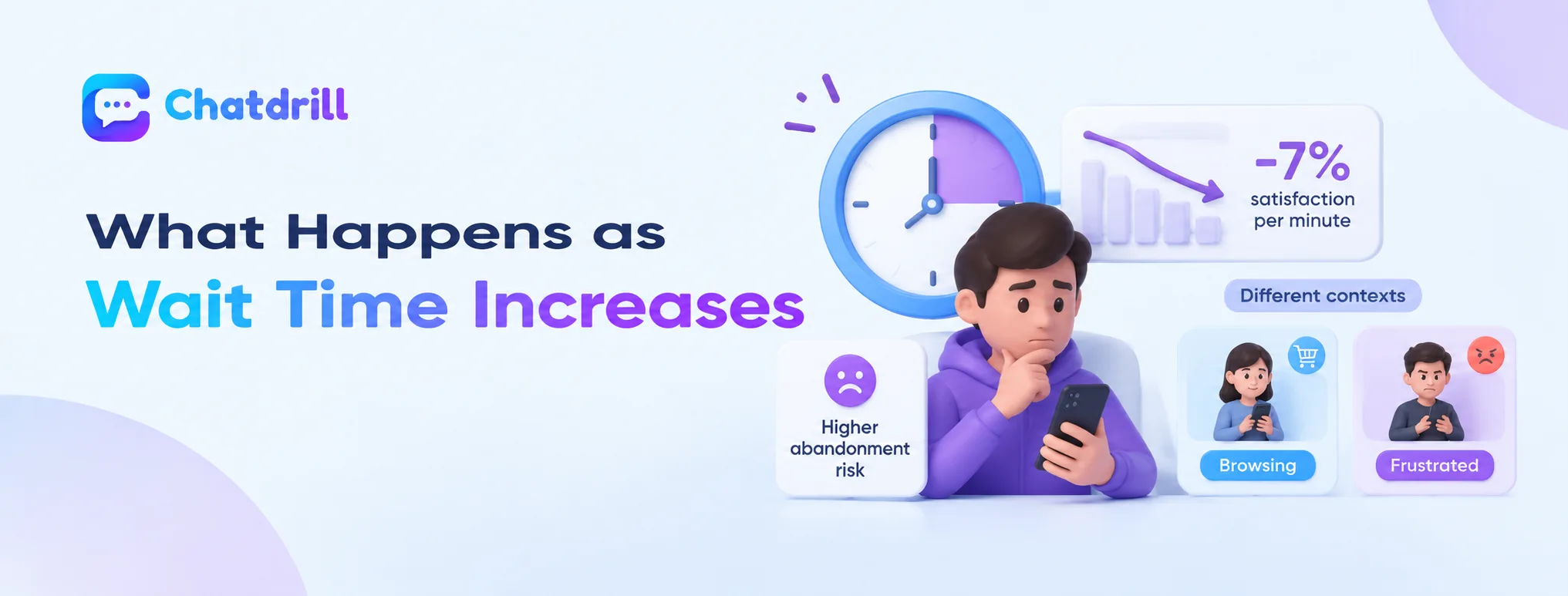
Satisfaction drops steadily with wait time, and a customer's specific context, whether browsing or already frustrated, shapes how quickly patience actually runs out.
Satisfaction decline alongside abandonment risk
Cited research finds satisfaction dropping roughly 7% per additional minute of wait, a steady decline that compounds alongside the separate abandonment risk this guide describes, meaning even a customer who doesn't abandon may still leave with a diminished impression.
This dual cost, abandonment risk plus satisfaction decline for those who do stay, means the true cost of slow response extends beyond a simple abandonment count alone.
Context-dependent patience variation
A customer's specific situation, casually browsing versus already frustrated about an unresolved issue, plausibly shapes how quickly their patience actually depletes, even though cited general benchmarks necessarily reflect an average across many different contexts.
This variation suggests a business's own specific customer base and typical inquiry context may see somewhat different real abandonment patterns than the general, cited averages.
Why Chat's Patience Window Differs From Other Channels
Chat's real-time promise sets a fundamentally different customer expectation than the longer tolerance customers extend to email.
The real-time promise shaping expectations
Chat's fundamental premise, immediate, real-time conversation, sets customer expectations considerably tighter than a channel like email, where a delay of hours is broadly understood and accepted as normal.
This expectation gap explains why applying email-style patience assumptions to chat, tolerating a multi-hour wait, would badly misjudge how quickly real chat patience genuinely depletes.
Why this distinction matters for planning
A business planning chat staffing or AI investment based on a misapplied, longer patience assumption risks systematically understaffing relative to how quickly customers actually abandon chat specifically.
Grounding planning in chat-specific cited thresholds, rather than a generic customer-service patience assumption, produces more genuinely accurate staffing and investment decisions.