
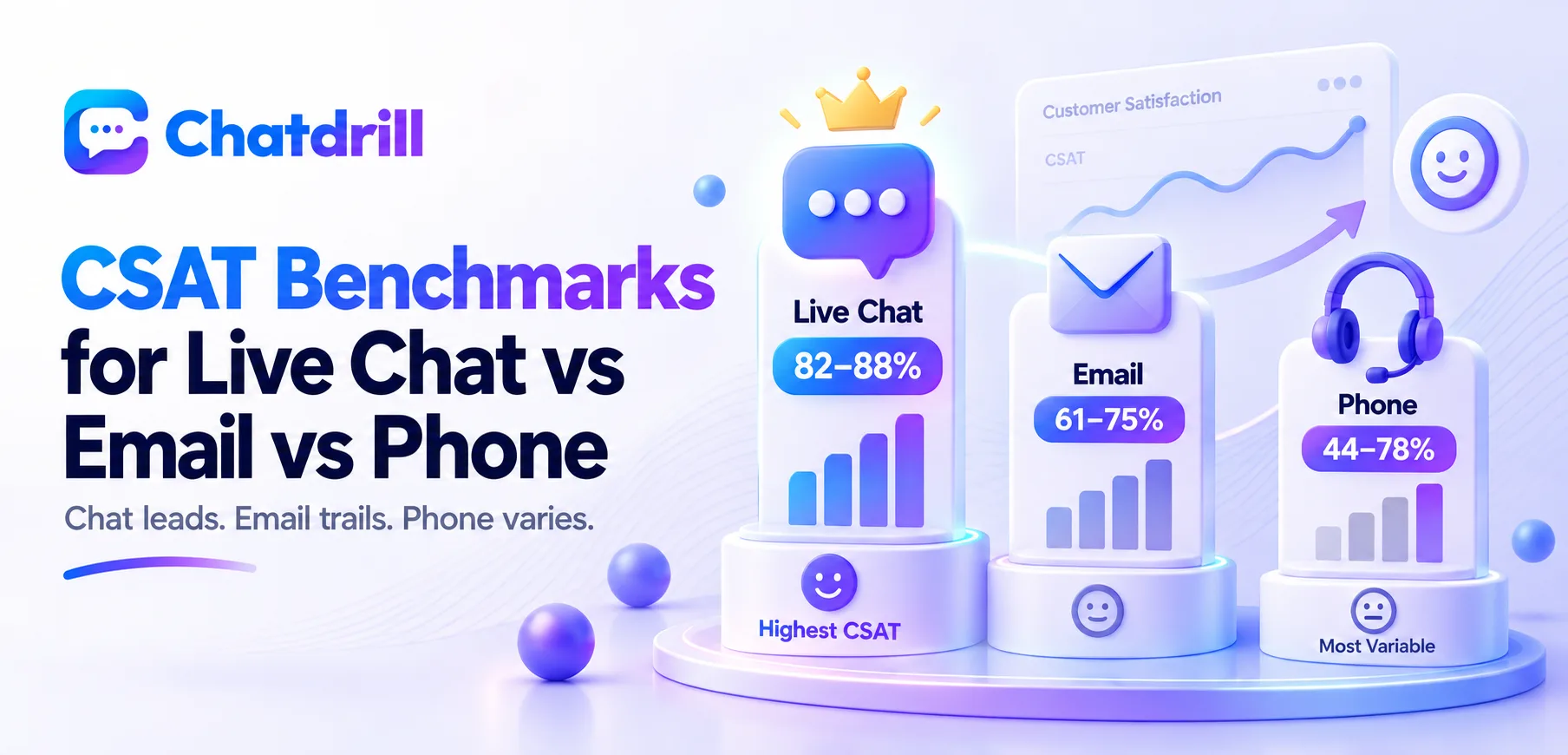
Comparing CSAT benchmarks across live chat, email, and phone reveals a consistent pattern across multiple independent 2026 studies, even though the exact numbers vary somewhat depending on which specific research is cited.
Quick answer Cited 2026 research consistently places live chat CSAT in the 82% to 88% range, ahead of email at roughly 61% to 75% and phone at a more variable 44% to 78% depending on the source, making chat the most consistently high-scoring digital support channel across most cited industry benchmark studies.
Live chat consistently scores at or near the top across these studies, while phone shows the widest variation, sometimes scoring competitively and sometimes scoring considerably lower depending on factors like hold time and call volume.
Understanding why this pattern holds so consistently, and what specifically drives phone's greater variability, helps a business interpret its own CSAT data against a genuinely informed baseline rather than an arbitrary number.
This guide covers the cited benchmark ranges for each channel, why chat tends to score highest, why phone varies so much, and how ChatDrill supports strong chat CSAT specifically.
Cited CSAT Benchmark Ranges by Channel
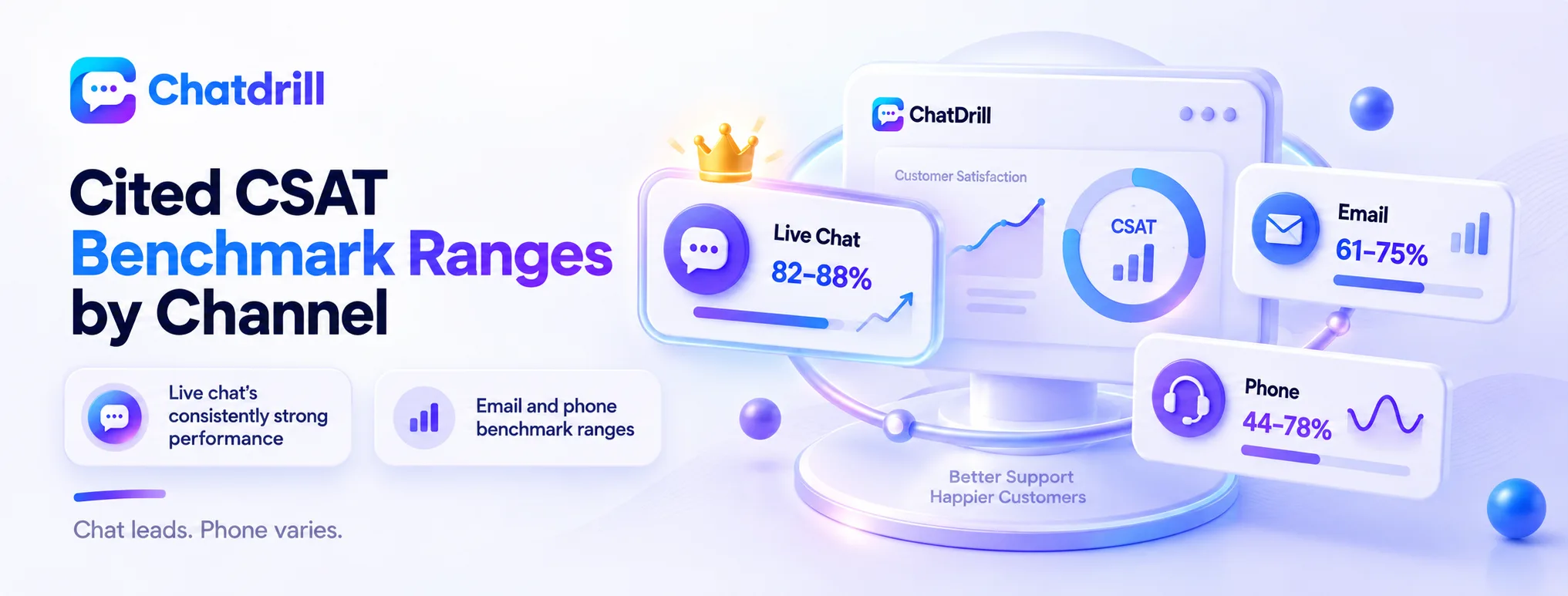
Live chat consistently benchmarks in the 82% to 88% range, email in the 61% to 75% range, and phone anywhere from 44% to 78% depending on the specific study.
Live chat's consistently strong performance
Multiple cited sources converge on a similar range, research citing Zendesk's CX Trends places live chat CSAT around 82%, while the American Customer Satisfaction Index, cited via Tidio, places it at 88%, the highest of any digital support channel measured.
This consistency across independent studies is itself notable, suggesting live chat's CSAT advantage reflects a genuine, reliable pattern rather than a coincidence specific to any single research methodology.
Email and phone benchmark ranges
Cited research places email CSAT between roughly 61% and 75% depending on the study, while phone shows the widest range, from 44% in one comparative study to 76-78% in others measuring phone specifically.
This wider variation for phone specifically reflects genuine, measurable factors covered later in this guide, rather than inconsistent measurement across the cited studies.
Why Live Chat Tends to Score Highest

Chat's real-time speed and lower customer effort directly explain its consistent CSAT advantage over slower or more variable channels.
Speed as the primary driver
Chat's real-time nature directly addresses what cited research consistently identifies as customers' top priority, response speed, giving it a structural advantage over email's inherent delay before a satisfaction rating is even given.
This speed advantage compounds with AI assistance, since cited research finds AI-handled first responses can drop effective response time to under 5 seconds for eligible questions, further reinforcing the satisfaction advantage.
Lower effort and reduced friction
Chat generally requires less effort than composing a detailed email or navigating a phone tree, and this reduced friction directly correlates with higher satisfaction according to broader customer effort research.
This effort advantage, distinct from speed alone, is part of why chat's CSAT lead holds even when comparing against a phone interaction handled reasonably quickly.
Why Phone CSAT Varies So Much
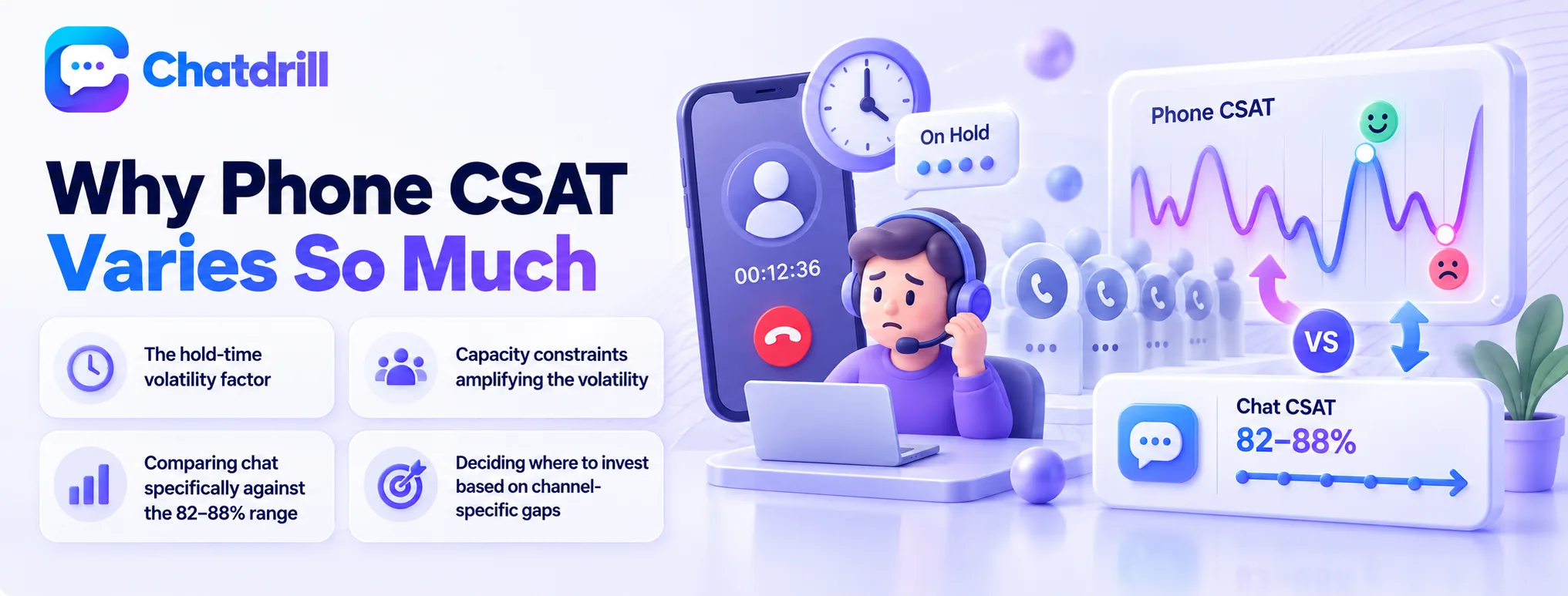
Hold time volatility and one-call-at-a-time capacity constraints explain why phone CSAT swings more dramatically between studies and situations than chat or email.
The hold-time volatility factor
Cited research notes phone CSAT is highly volatile specifically because it swings dramatically with hold times, with roughly 77% of callers expecting immediate connection to a person, a much higher bar than chat or email's more forgiving formats.
This volatility means phone CSAT can look genuinely strong during low-volume periods and considerably weaker during high-volume ones, producing the wide range seen across different cited studies and time periods.
Capacity constraints amplifying the volatility
Because a phone agent can only handle one call at a time, unlike chat's concurrency advantage, any volume spike creates hold-time pressure that directly and immediately damages the satisfaction score.
This structural capacity constraint is a genuine, persistent factor behind phone's wider CSAT range compared to chat's more consistently high performance.
Using These Benchmarks to Evaluate Your Own Channels
Comparing your own channel-specific CSAT against these cited ranges reveals whether a specific channel is underperforming its realistic potential.
Comparing chat specifically against the 82-88% range
If your own chat CSAT falls meaningfully below this cited range, investigating response speed and answer accuracy specifically, the two factors this guide identifies as chat's core satisfaction drivers, is a reasonable starting point.
This targeted comparison is more useful than assuming chat CSAT should match some generic, cross-channel target that doesn't reflect chat's genuine advantage.
Deciding where to invest based on channel-specific gaps
Identifying which specific channel shows the largest gap between your own performance and the cited benchmark helps prioritize where additional investment, staffing, AI training, or process improvement, would deliver the most meaningful CSAT gain.
This channel-specific prioritization tends to produce better results than spreading improvement effort evenly across every channel regardless of where the genuine gap actually lies.
How ChatDrill Supports Strong Chat CSAT
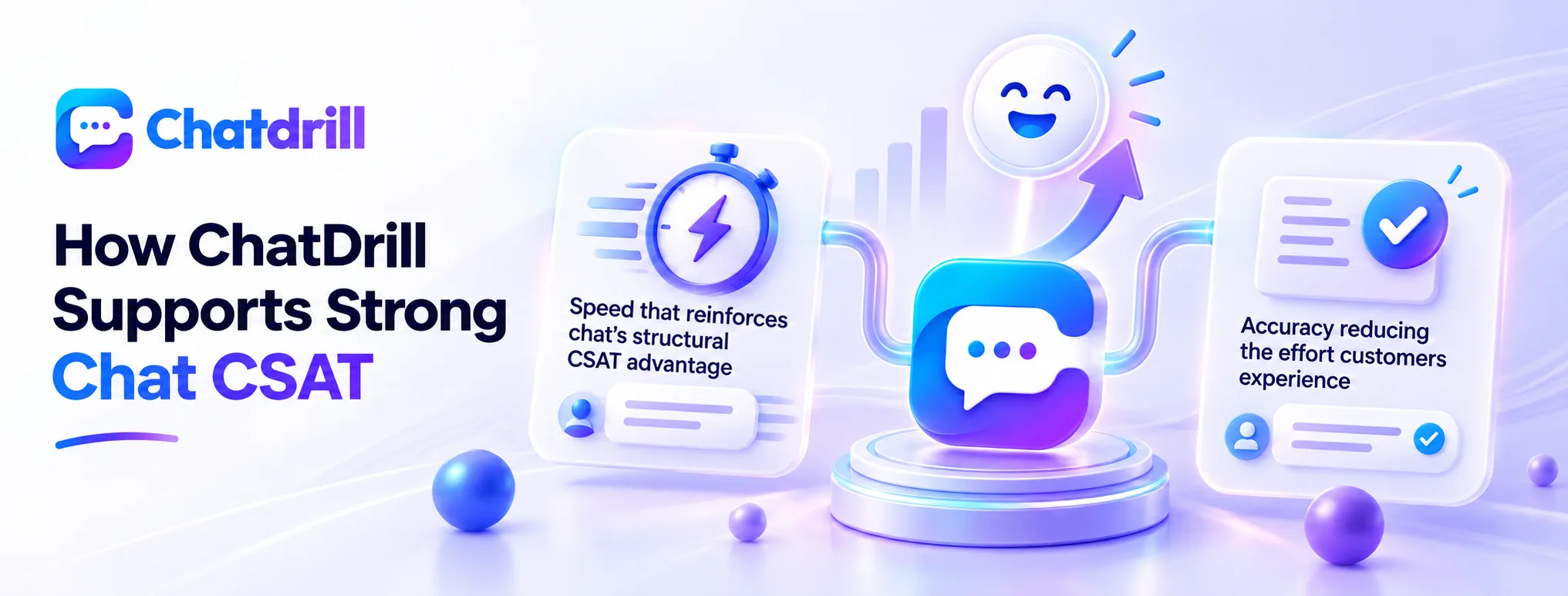
ChatDrill's fast, accurate AI responses directly target the two factors this guide identifies as chat's core CSAT drivers, helping a business reach or exceed the cited benchmark range.
Speed that reinforces chat's structural CSAT advantage
ChatDrill's AI responds to common questions within seconds, reinforcing the speed advantage this guide identifies as central to why chat outperforms other channels on CSAT.
This consistent speed, regardless of volume, protects chat's CSAT advantage even during high-traffic periods that would otherwise strain a purely human-staffed setup.
Accuracy reducing the effort customers experience
ChatDrill's AI, trained on your specific business content, delivers genuinely accurate answers, reducing the customer effort that this guide identifies as a second core driver behind chat's CSAT lead.
This combination of speed and accuracy positions a business using ChatDrill to reach or exceed the cited 82-88% CSAT range, rather than settling for a lower, less differentiated result.