
Determining what percentage of chats should genuinely be AI-resolved by 2027 benefits from looking at cited, credible industry projections rather than either an overly conservative assumption or an unrealistically ambitious one.
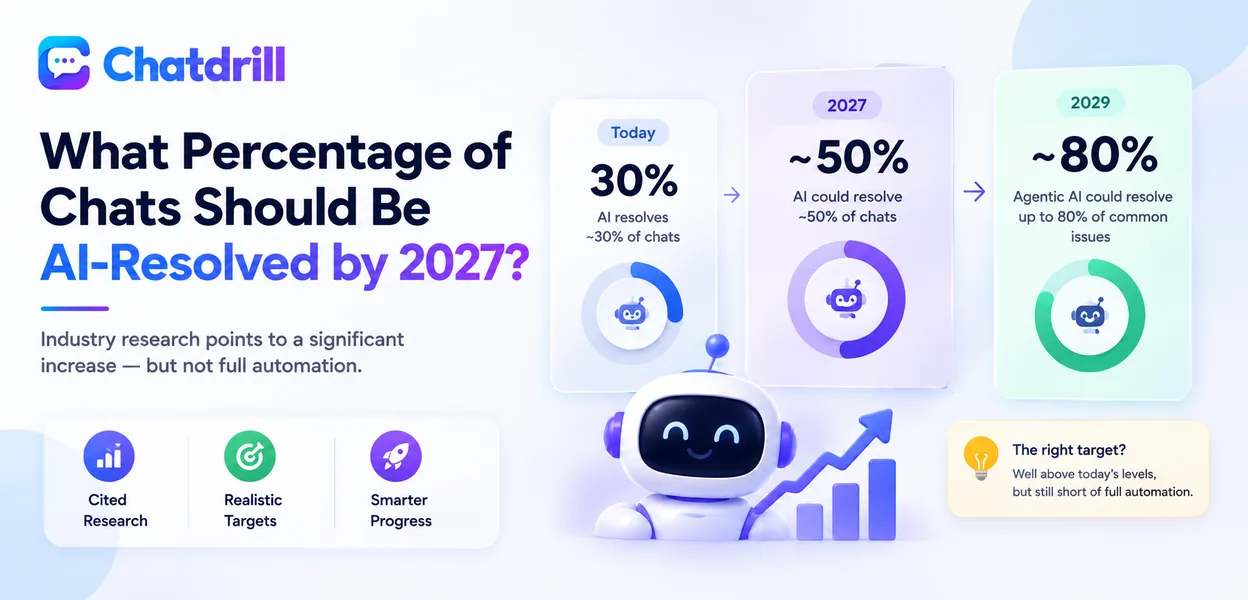
Quick answer Cited research from Salesforce's State of Service projects AI resolving roughly 50% of service cases by 2027, up from around 30% currently, while separate Gartner-cited projections suggest agentic AI could autonomously resolve as much as 80% of common customer service issues by 2029, meaning a reasonable target for most businesses by 2027 sits meaningfully above current levels but still well short of full automation.
Multiple cited sources converge on a meaningful, near-term increase from current AI resolution levels, even though the specific projected percentage varies somewhat between different research sources and their particular methodologies.
Understanding both the cited projections and what genuinely drives this trajectory helps a business set its own appropriate 2027 target, grounded in realistic industry direction rather than either hype or excessive caution.
This guide covers the cited 2027 projections, what's driving this trajectory, how to translate this into your own target, and how ChatDrill helps a business progress toward appropriate AI resolution levels.
Cited 2027 AI Resolution Projections
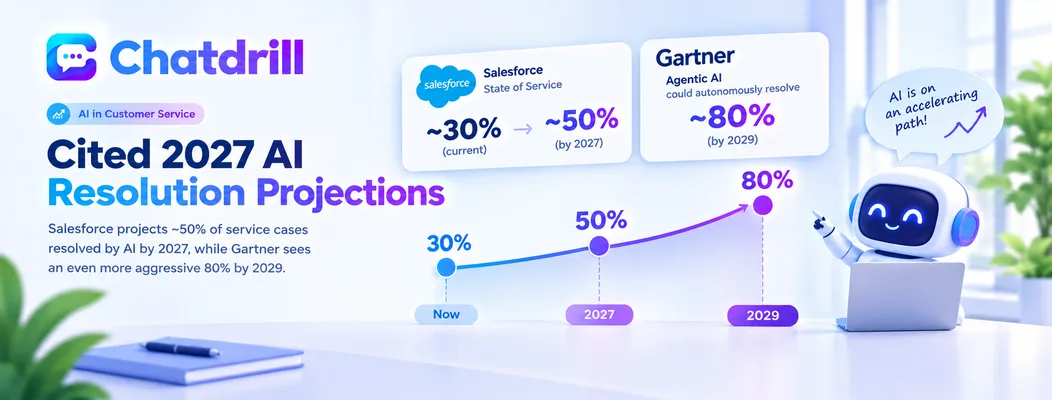
Cited Salesforce research projects AI resolving roughly 50% of service cases by 2027, up from around 30% currently, with more aggressive longer-term projections from Gartner extending further.
The Salesforce-cited near-term projection
Research citing Salesforce's State of Service report finds roughly 30% of service cases resolved by AI currently, with this figure projected to rise to approximately 50% by 2027 as adoption continues maturing across more organizations.
This specific, dated projection provides a genuinely useful near-term reference point for a business planning its own 2027 automation roadmap.
The more aggressive Gartner-cited longer-term view
Separate research citing Gartner projections suggests agentic AI could autonomously resolve as much as 80% of common customer service issues by 2029, a meaningfully more aggressive trajectory than the Salesforce-cited 2027 figure, reflecting continued technology maturation beyond the immediate near-term.
Comparing these two cited projections together suggests a genuinely accelerating curve, meaning 2027 likely represents a meaningful midpoint in an ongoing trajectory rather than a plateau.
What's Driving This Projected Trajectory
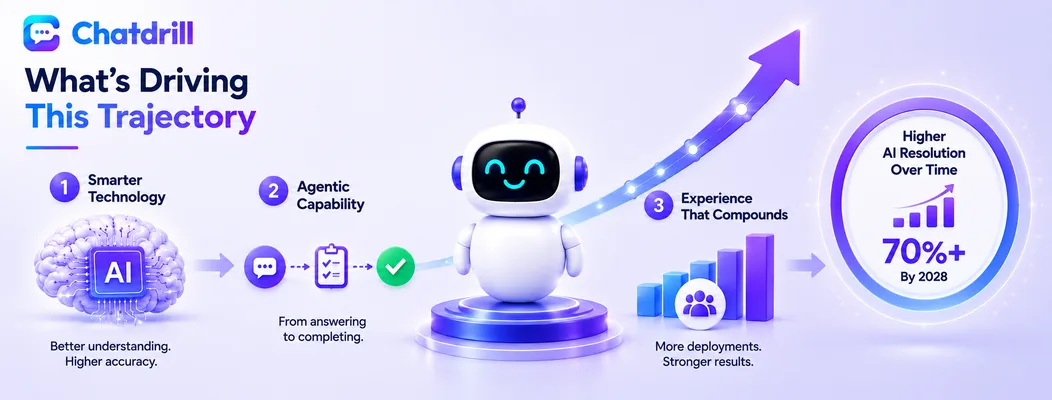
Improving natural language understanding, growing agentic task-completion capability, and accumulated deployment experience together explain the cited upward trajectory.
Technology capability improvements
Cited research consistently points to genuine, measurable improvement in natural language understanding and response accuracy as a core driver behind rising AI resolution rates, distinct from simple increased adoption alone.
This capability improvement means the same underlying AI investment increasingly resolves a higher share of questions correctly than an equivalent investment would have achieved just a year or two earlier.
The shift toward genuine agentic capability
Cited Gartner projections specifically highlight agentic AI, capable of completing tasks autonomously rather than only answering questions, as a key driver behind the more aggressive longer-term resolution percentage projections.
This shift from purely informational to genuinely task-completing AI meaningfully expands what counts as "resolved" beyond simple Q&A, directly supporting higher overall resolution percentages over time.
Translating This Into Your Own 2027 Target
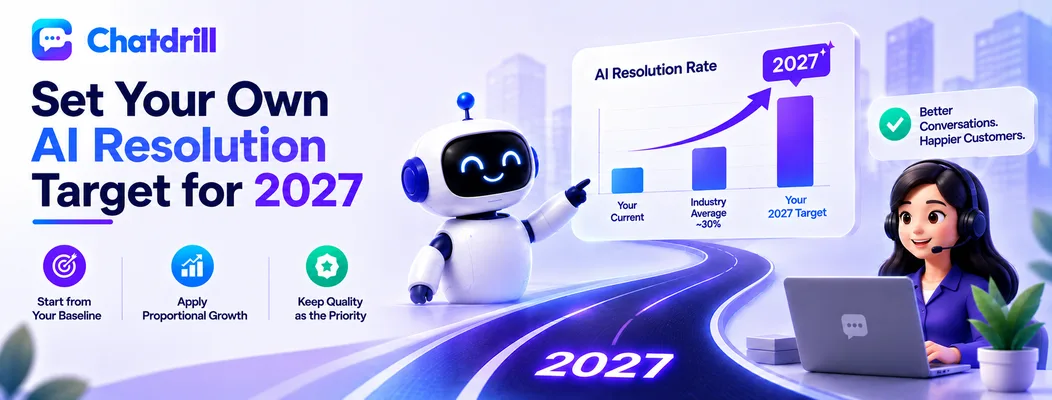
Starting from your own current AI resolution baseline and applying a proportional improvement trajectory produces a genuinely business-specific 2027 target.
Starting from your own genuine current baseline
Reviewing your own current AI resolution rate, rather than assuming the cited industry-wide 30% figure applies directly to your specific situation, provides the genuine starting point needed for a meaningful business-specific projection.
A business starting well below or above this cited average should reasonably expect a somewhat different 2027 trajectory than the general industry projection alone would suggest.
Applying a proportional improvement expectation
Applying a similar proportional improvement to the cited roughly 30%-to-50% industry trajectory, rather than the identical absolute percentage point increase, produces a more genuinely tailored target reflecting your own specific starting position.
This proportional approach respects that a business starting from a lower baseline has more room for percentage-point growth than one already performing above the general industry average.
What This Percentage Doesn't Capture
A rising AI resolution percentage shouldn't be pursued at the expense of genuine resolution quality, an important caveat given how directly this guide's own broader research warns against treating automation metrics as standalone success measures.
Quality still matters more than the raw percentage
Pursuing a higher AI resolution percentage without maintaining genuine accuracy and customer satisfaction risks the same containment-without-resolution trap covered in broader chatbot metric research, where a technically resolved conversation doesn't reflect genuine customer value.
This means the cited 2027 projections should inform ambition and pacing, not become a target pursued regardless of whether quality genuinely holds up alongside it.
The human-plus-AI model remains the realistic framing
Even at a projected 50% or higher AI resolution rate, a substantial share of conversations still genuinely benefit from human judgment, reinforcing that the realistic 2027 model remains complementary rather than a step toward eliminating human involvement entirely.
This framing matters for planning purposes, since it suggests continued investment in both AI capability and human agent quality, rather than treating one as a replacement for the other.
How ChatDrill Helps You Progress Toward Appropriate AI Resolution
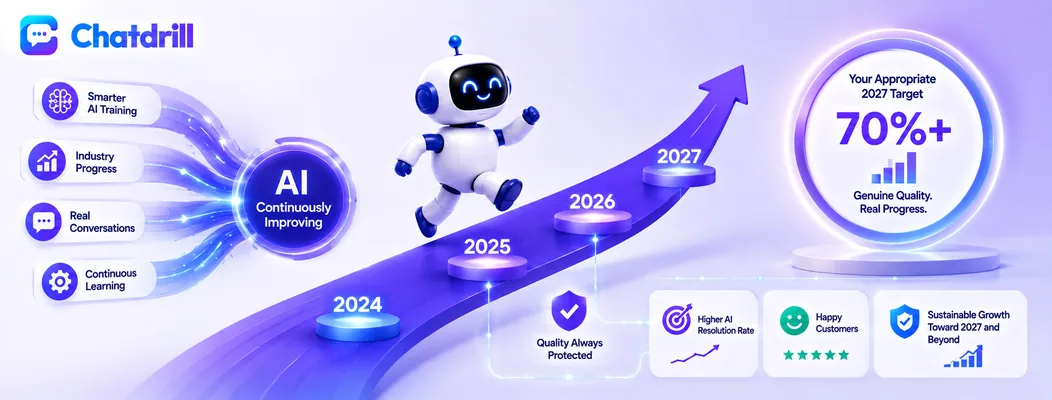
ChatDrill's continuously improving AI training and combined quality tracking help a business progress toward its own appropriate 2027 target without sacrificing genuine resolution quality.
AI capability that improves alongside industry-wide progress
ChatDrill's AI benefits from the same broader technology improvement this guide identifies as driving the cited industry-wide resolution trajectory, meaning your own resolution rate has genuine room to grow as the underlying capability continues advancing.
This alignment with broader industry progress means investing in ChatDrill today positions a business to benefit from ongoing improvement, not just its current, already-capable state.
Combined tracking to protect quality during growth
ChatDrill tracks AI resolution rate alongside genuine accuracy and customer satisfaction together, directly protecting against the quality-sacrificing trap this guide warns against as a business works to grow its own AI resolution percentage.
This combined approach ensures progress toward an ambitious 2027 target reflects genuine, sustainable improvement rather than a superficial metric increase achieved at customers' expense.