
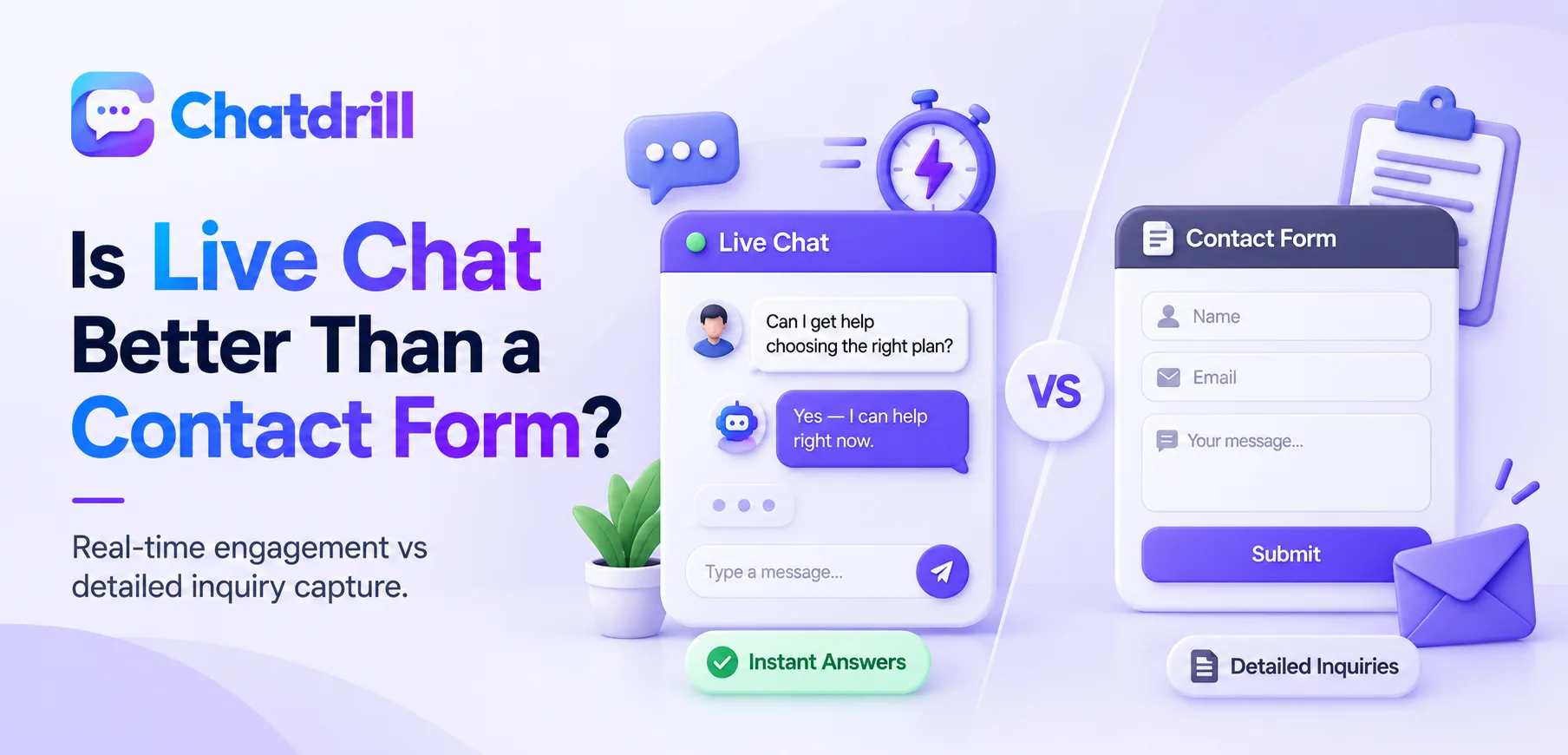
Comparing live chat against a contact form comes up constantly when a business is deciding how to handle website inquiries, and the honest answer is that each has genuine strengths depending on the specific situation rather than one being unconditionally better.
Quick answer: Live chat is generally better than a contact form for capturing genuine engagement and answering questions in real time, while a contact form still works well for detailed, non-urgent inquiries or when staffing doesn't support real-time response, meaning the better choice depends on your specific traffic and staffing situation rather than one being universally superior.
Live chat's core advantage is immediacy, capturing a visitor while they're still on the page and genuinely engaged, while a contact form's core advantage is patience, letting a visitor provide detailed information without requiring anyone to be available in real time.
Understanding which specific situations favor each option, rather than assuming chat is always the modern, superior choice, produces a more genuinely appropriate decision for your particular business and traffic pattern.
This guide covers the core tradeoffs, when each option performs better, common mistakes in choosing between them, and how ChatDrill supports a hybrid approach.
The Core Tradeoffs Between Chat and Forms
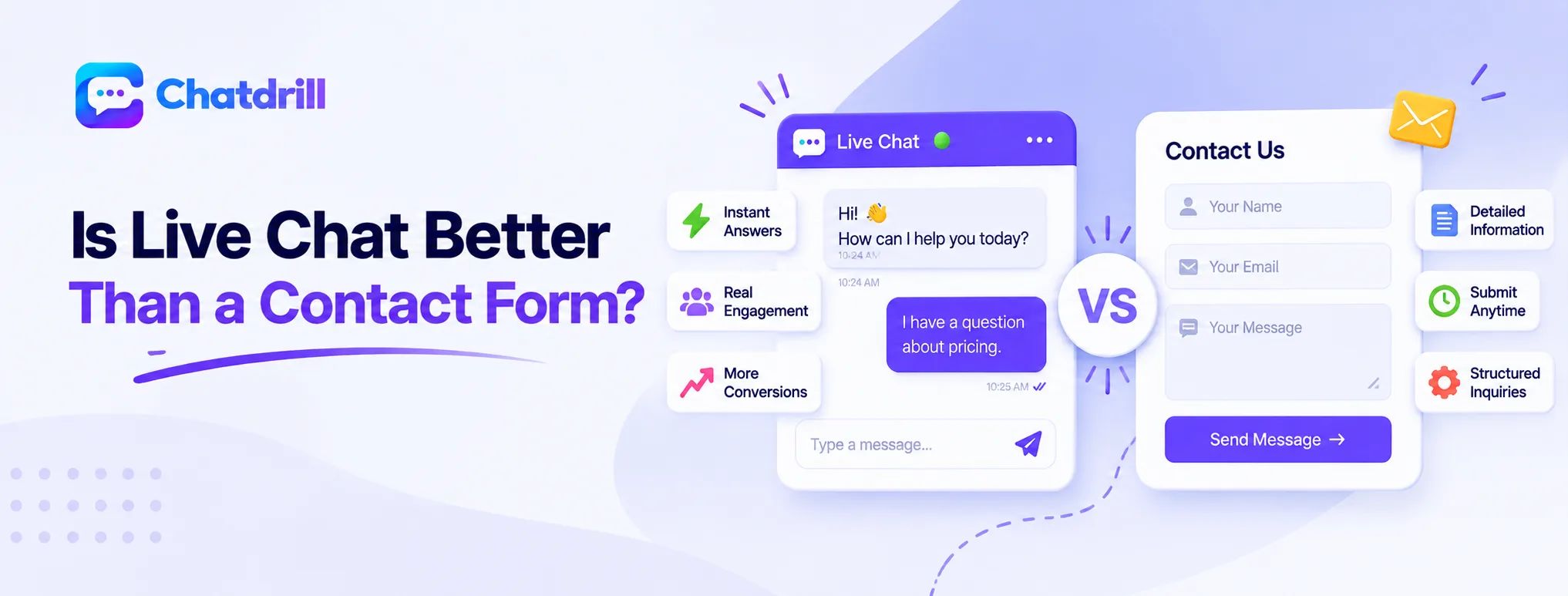
Chat offers immediacy and genuine engagement capture, while forms offer patience and structured, detailed information collection without requiring real-time availability.
Chat's immediacy advantage
Live chat captures a visitor's question at the exact moment of genuine interest, resolving it in real time rather than requiring them to wait, a meaningful advantage for a visitor with an urgent or simple question.
This immediacy also creates a more personal, conversational impression than a static form, which can matter for a business wanting to build genuine rapport during a first interaction.
The contact form's structured patience
A contact form lets a visitor provide detailed, structured information at their own pace, without requiring anyone on the receiving end to be immediately available, a genuine advantage for a business without consistent real-time staffing.
This structured format also works well for complex inquiries genuinely requiring detailed written explanation, rather than a quick, conversational back-and-forth.
When Chat Performs Better

Chat performs better for simple, quick questions, high-intent purchase moments, and any business genuinely able to staff real-time response consistently.
Simple, quick questions and high-intent moments
A visitor with a simple, factual question, or one at a high-intent purchase moment, benefits directly from chat's real-time resolution, since a form's inherent delay would risk losing that moment of engagement entirely.
This scenario represents chat's clearest advantage, situations where immediate resolution genuinely changes the outcome compared to a delayed response.
Businesses with genuine real-time staffing capacity
Chat's advantage only materializes fully when a business can genuinely staff it consistently, whether through human agents, AI, or both, since an unstaffed or slow chat widget underperforms a straightforward contact form.
A business without this genuine capacity may find a well-designed contact form actually delivers a better experience than an inconsistently staffed chat widget.
When a Contact Form Performs Better
A contact form performs better for detailed, non-urgent inquiries and for a business without consistent real-time staffing capacity.
Detailed, non-urgent inquiries
For an inquiry genuinely requiring detailed written explanation, a formal request, a complex technical question with supporting documentation, a structured form often serves the visitor better than a rushed, real-time chat exchange.
This structured format also creates a naturally documented record of the request, useful for inquiries requiring careful, considered follow-up.
Off-hours and inconsistent staffing situations
A business without genuine real-time coverage during all hours a visitor might reach out benefits from a form's ability to capture a complete inquiry regardless of whether anyone is immediately available to respond.
This makes a form a more honest, reliable choice than a chat widget promising real-time interaction it can't consistently deliver.
Common Mistakes in Choosing Between Them
The most common mistakes are assuming chat is always superior regardless of staffing reality, and offering neither option well rather than committing to doing one properly.
Assuming chat is unconditionally better
Deploying chat simply because it feels more modern, without genuine staffing capacity to support it, often produces a worse experience than a well-designed contact form a business can actually fulfill reliably.
Being honest about actual staffing capacity before choosing avoids this common, well-intentioned but ultimately counterproductive mistake.
Offering both poorly rather than one well
A business offering both chat and a form, but neither staffed or designed thoughtfully, tends to produce a worse overall experience than committing fully to whichever option genuinely fits its actual capacity.
Choosing deliberately, based on genuine staffing and traffic patterns, rather than offering every option superficially, tends to produce better results.
How ChatDrill Supports a Genuinely Hybrid Approach

ChatDrill's AI-assisted coverage extends genuine real-time responsiveness beyond typical staffing hours, while still supporting a fallback path for detailed inquiries better suited to a form.
AI extending real-time coverage beyond human staffing limits
ChatDrill's AI can provide consistent, accurate real-time response even outside typical human staffing hours, addressing the core staffing-capacity limitation that otherwise makes a contact form the more honest, reliable choice.
This extended coverage means a business can genuinely offer chat's immediacy advantage without the staffing gaps that would otherwise undermine it.
This matters especially for a business serving customers across multiple time zones, where genuine round-the-clock human staffing would otherwise be prohibitively expensive to maintain.
Supporting a form-based fallback for complex inquiries
For inquiries genuinely better suited to detailed, written explanation, ChatDrill can direct a visitor to a structured form or follow-up process, respecting that not every interaction is best served by real-time chat alone.
This flexibility reflects the genuinely hybrid approach this guide recommends, rather than forcing every inquiry type into a single, one-size-fits-all channel.
Designing the Handoff Between Chat and Form
A thoughtful hybrid setup makes the transition from chat to a form, or vice versa, feel like a natural continuation rather than an abrupt dead end.
Recognizing when to suggest the other channel
Training either a human agent or the AI to recognize when an inquiry is genuinely better suited to the other channel, and to suggest that switch clearly and helpfully, prevents a visitor from feeling stuck in a channel poorly matched to their actual need.
This recognition should happen early in the conversation where possible, rather than after significant back-and-forth that could have been avoided with an earlier, appropriate redirect.
Preserving context across the switch
Carrying forward whatever context has already been shared, rather than asking the visitor to start over on the new channel, respects their time and keeps the transition feeling like a genuine continuation.
This preserved context is what actually determines whether a hybrid approach feels thoughtfully designed or like two disconnected systems awkwardly stitched together.