
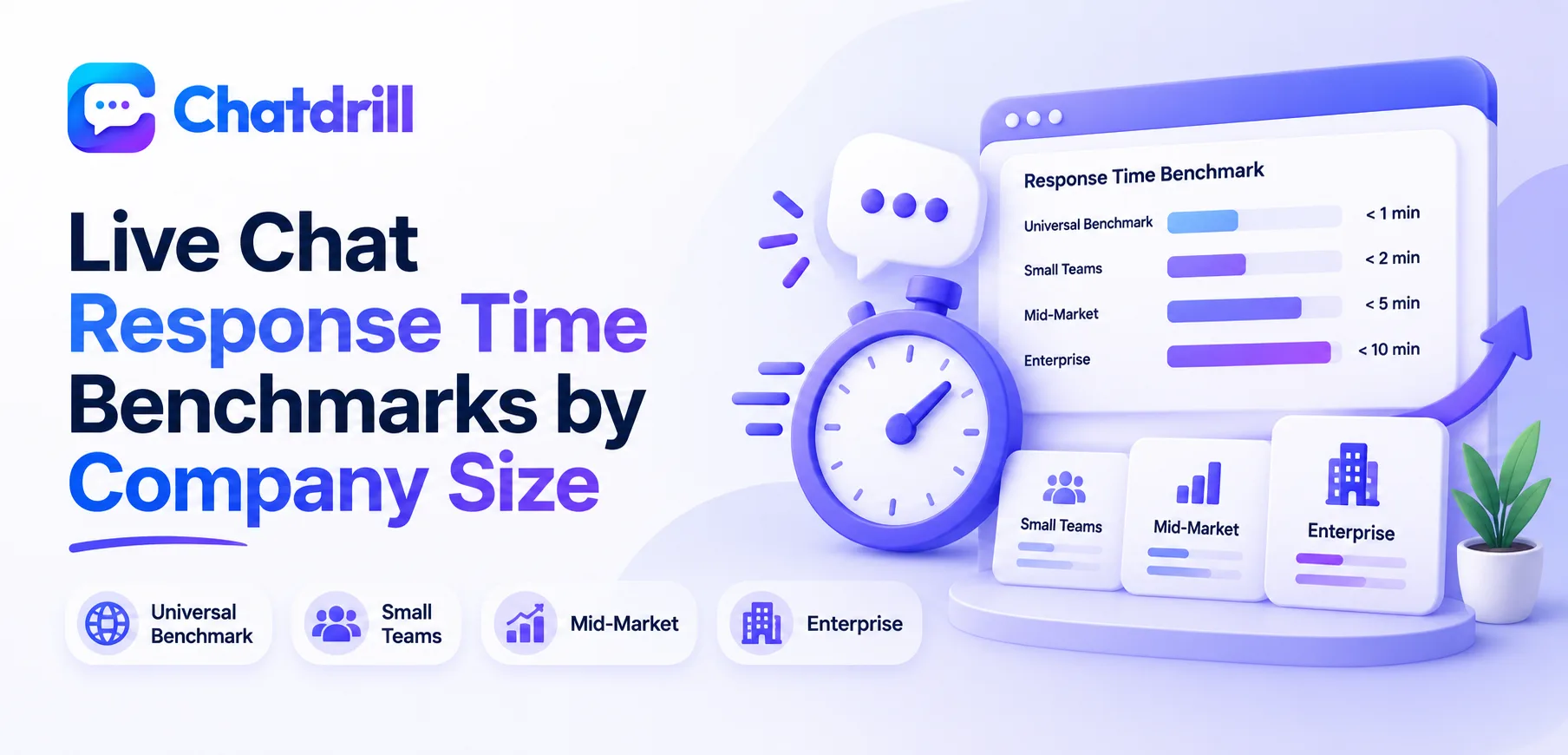
Live chat response time benchmarks get published constantly, but most published research organizes figures by industry or channel rather than explicitly by company size, making it genuinely useful to translate the available data into what different-sized teams can realistically aim for.
Quick answer Cited 2026 industry research points to a universal target of around 40 seconds for top-performing live chat teams regardless of company size, though smaller businesses with leaner staffing more commonly land in the 1 to 2 minute range, while enterprise teams with dedicated staffing and AI layered in increasingly approach that sub-40-second benchmark.
The core benchmark itself doesn't actually shift by company size, cited research from Zendesk and others consistently points to roughly 40 seconds as the mark of a strong-performing team, but the practical gap between that target and typical performance does vary considerably based on staffing depth and resources.
Understanding this distinction, a universal target versus size-dependent practical performance, helps a business of any size set a genuinely realistic internal goal rather than comparing itself unfairly against a very differently resourced competitor.
This guide covers the universal benchmark, how practical performance varies by company size, what drives that gap, and how ChatDrill helps teams of any size close it.
The Universal Benchmark Behind the Size Variation
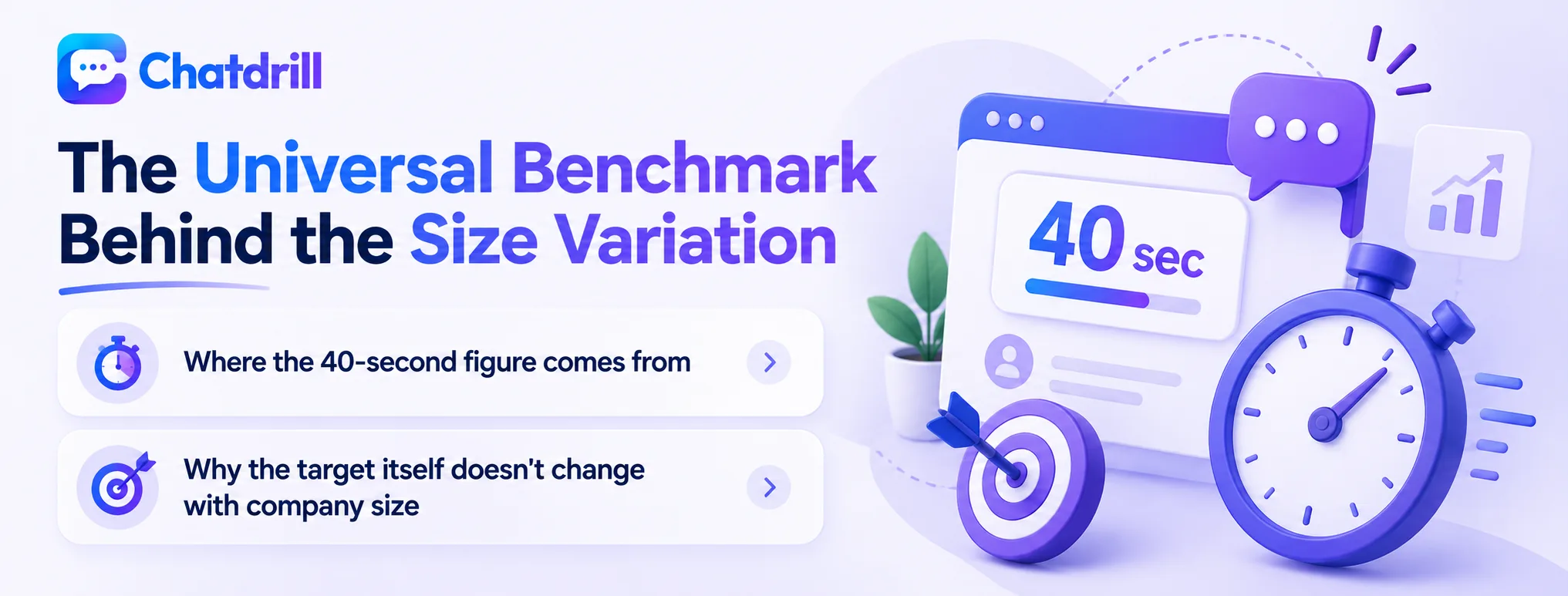
Cited research consistently identifies roughly 40 seconds as the mark of strong live chat performance, a target that applies in principle regardless of company size.
Where the 40-second figure comes from
Research citing Zendesk identifies 40 seconds as a strong live chat first-response benchmark, while separate research puts the broader cross-industry average first response time around 1 minute 35 seconds according to Tidio's Customer Service Benchmark data.
This gap between the roughly 40-second top-performer mark and the roughly 135 average reflects genuine variation in staffing and process quality across businesses of every size, not a size-specific ceiling.
Why the target itself doesn't change with company size
A customer's patience for a chat reply doesn't meaningfully depend on knowing whether they're chatting with a small business or a large enterprise, meaning the underlying expectation this benchmark reflects applies universally.
This is why the benchmark itself stays constant even though actual, typical performance varies considerably depending on the resources a given company can bring to bear.
How Practical Performance Varies by Company Size
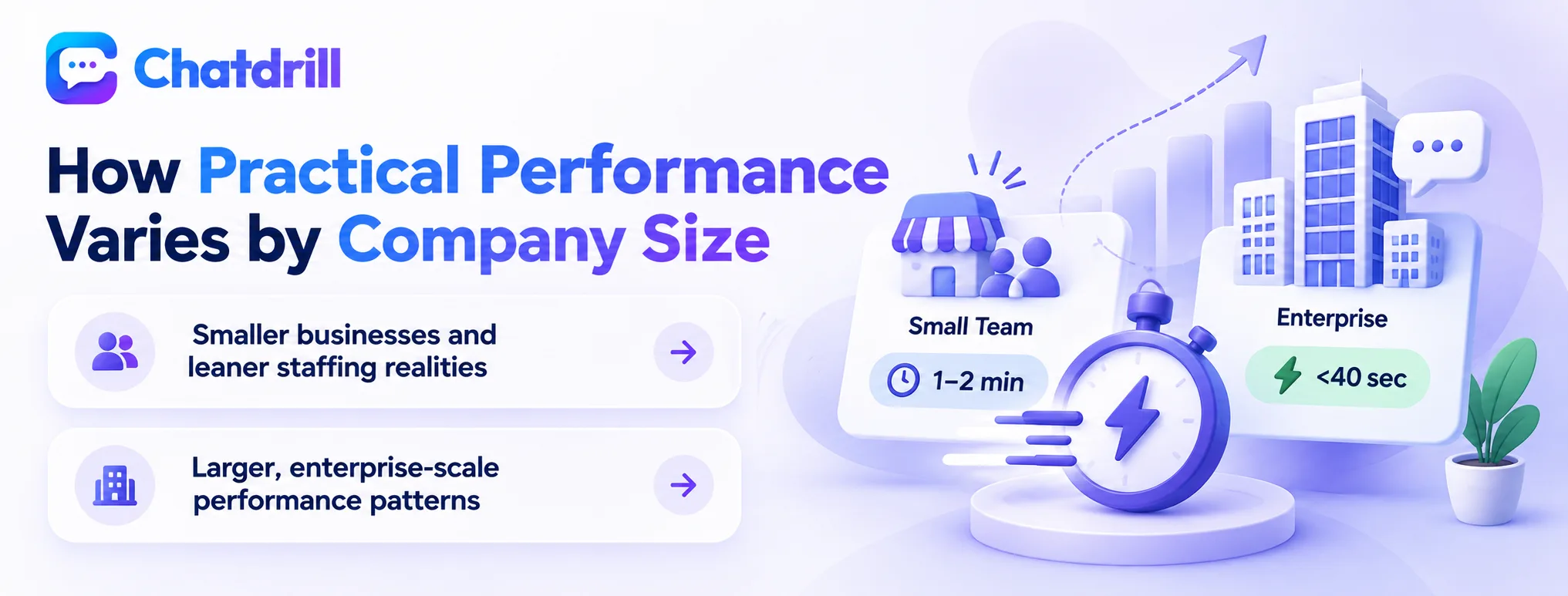
Smaller businesses more commonly land in the 1 to 2 minute range due to leaner staffing, while larger, better-resourced teams increasingly approach the sub-40-second benchmark.
Smaller businesses and leaner staffing realities
A smaller business without dedicated, always-on chat staffing more commonly falls into the 1 to 2 minute range or beyond, reflecting genuine resource constraints rather than a lack of commitment to service quality.
This gap is exactly the reason AI-assisted response has become particularly valuable for smaller teams, offering a way to approach the universal benchmark without requiring the staffing depth larger companies can afford.
Larger, enterprise-scale performance patterns
Larger organizations with dedicated support staffing and more mature AI deployment increasingly approach or hit the sub-40-second benchmark, reflecting the resource advantage that comes with scale.
Even here, cited research notes many organizations still fall short of this target, with average SaaS performance closer to a 70/60 pattern, 70% of chats answered within 60 seconds, according to Helpable's 2026 analysis.
What Actually Drives the Gap Between Sizes
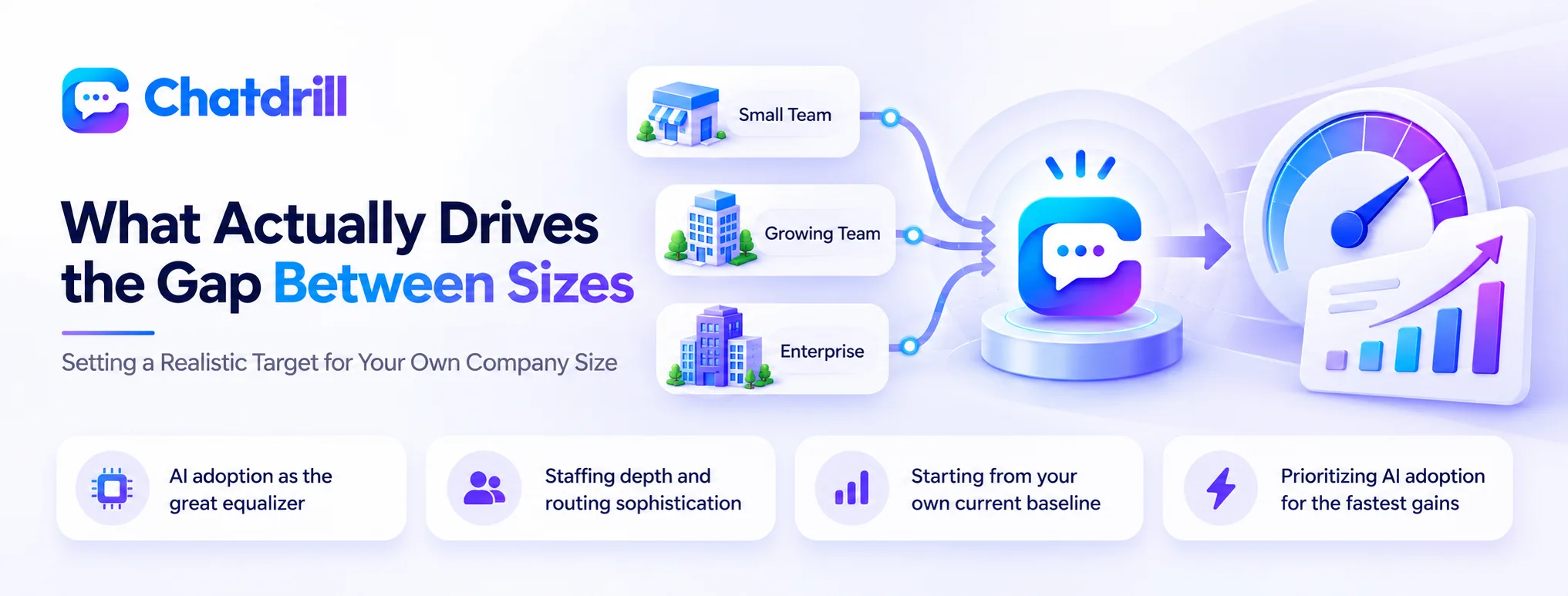
AI adoption, staffing depth, and routing sophistication explain most of the practical performance gap between differently sized businesses.
AI adoption as the great equalizer
Cited research finds AI can handle a large majority of initial chat interactions, with effective response time dropping to under 3 to 5 seconds for AI-eligible questions, a capability increasingly accessible to businesses of any size, not just large enterprises.
This accessibility means AI adoption specifically, more than raw staffing headcount, is closing much of the historical size-based performance gap.
Staffing depth and routing sophistication
Beyond AI, genuine differences in staffing depth and how intelligently conversations get routed to available agents still meaningfully separate performance at different company scales.
Cited research also notes that uneven routing, one agent handling several conversations while another sits idle, can make overloaded agents' response times three times longer, an inefficiency more common in smaller teams without dedicated routing logic.
Setting a Realistic Target for Your Own Company Size
Rather than comparing directly against a much larger or smaller competitor, grounding your target in your own realistic resource level while still aiming toward the universal benchmark produces a genuinely useful internal goal.
Starting from your own current baseline
Reviewing your own actual current response time data, rather than assuming a generic target fits your specific size and resources, reveals a genuinely realistic starting point for improvement.
Setting a target meaningfully closer to the universal benchmark than your current baseline, without expecting to close the entire gap immediately, produces a more sustainable improvement path.
Prioritizing AI adoption for the fastest gains
Given how directly AI adoption is closing the size-based performance gap, prioritizing this investment tends to deliver faster improvement toward the universal benchmark than staffing increases alone, especially for a smaller business.
This prioritization reflects the genuine, current data pattern rather than an assumption that only larger companies can meaningfully improve their response time.
How ChatDrill Helps Teams of Any Size Hit the Benchmark
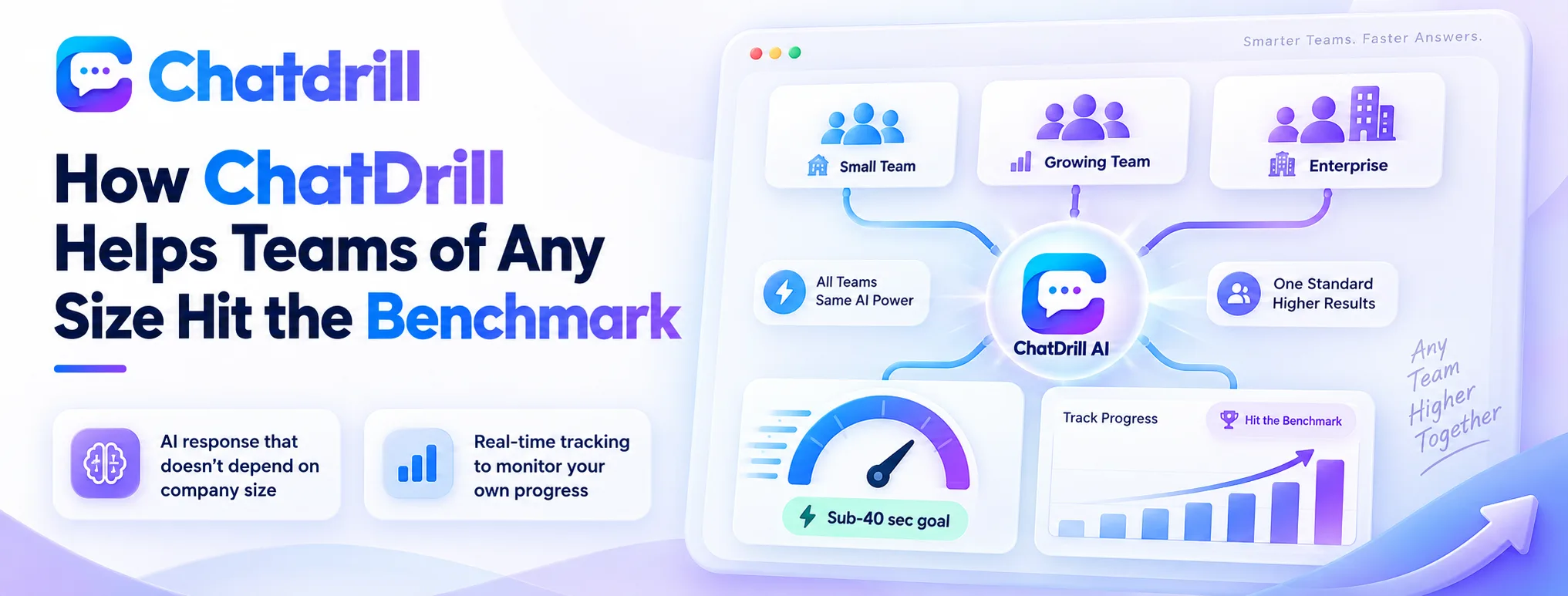
ChatDrill's AI-assisted response gives businesses of any size a practical path toward the universal sub-40-second benchmark, regardless of staffing depth.
AI response that doesn't depend on company size
ChatDrill's AI can respond to common questions in seconds, giving a small business the same fundamental speed capability that previously required the staffing depth only larger companies could afford.
This capability directly addresses the size-based gap this guide identifies, since AI response speed doesn't scale down for a smaller company the way human staffing capacity naturally does.
Real-time tracking to monitor your own progress
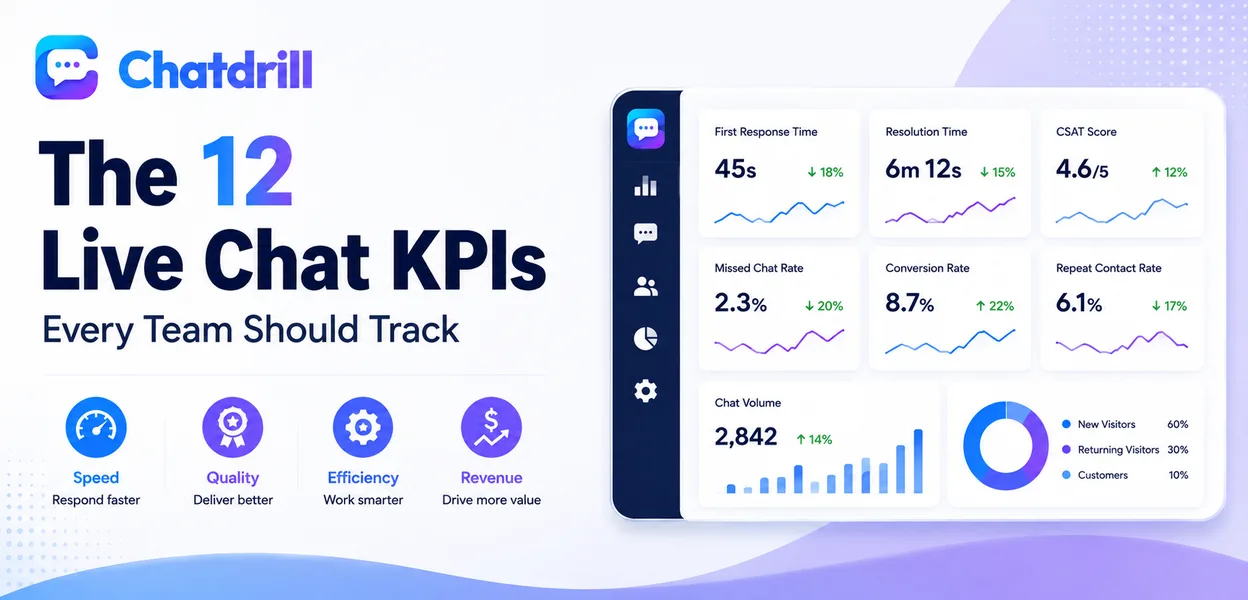
ChatDrill's dashboard tracks your actual first response time continuously, letting you monitor progress toward the universal benchmark regardless of your company's specific size or resource level.
This visibility helps any business, large or small, make grounded, evidence-based decisions about where further investment in speed would deliver the most value.