
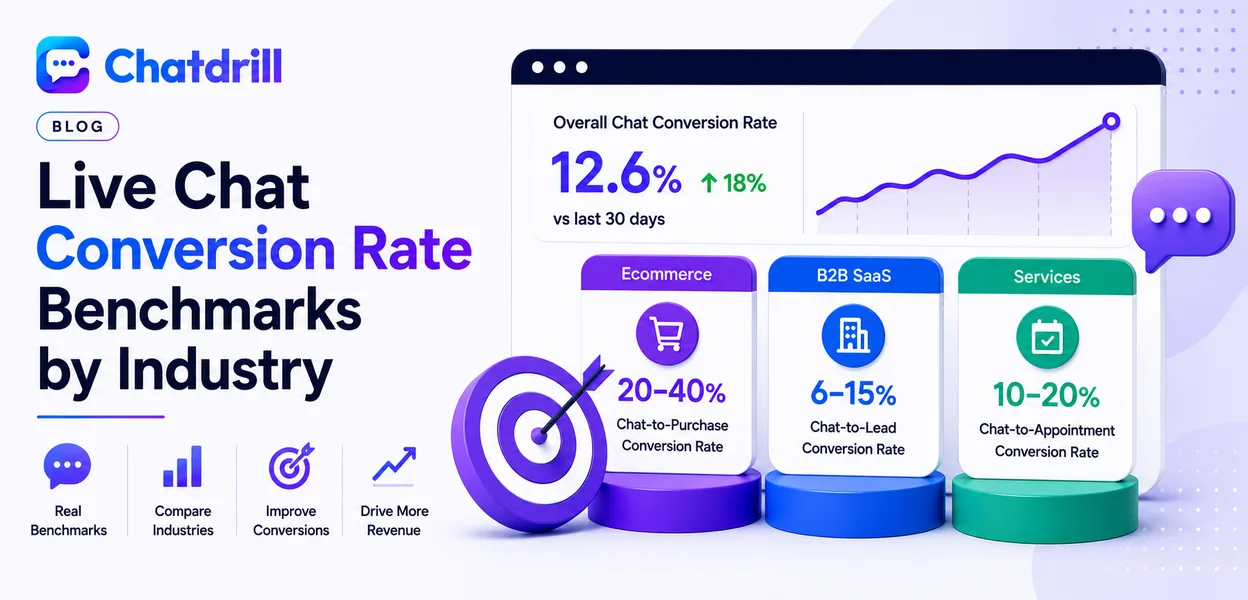
Live chat conversion rate benchmarks vary meaningfully by industry, with ecommerce typically seeing the highest chat-to-sale conversion given its transactional nature, while B2B SaaS sees lower but higher-value chat-to-lead conversion tied to longer sales cycles.
Comparing your own chat performance against a generic, industry-blind benchmark can be genuinely misleading, since what counts as a strong conversion rate in fast-moving ecommerce looks entirely different from a reasonable benchmark in a considered, longer B2B sales process.
This is also a metric worth defining precisely before comparing anything, since "conversion" itself means different things across contexts, a completed purchase, a captured lead, a booked demo, each with meaningfully different typical rates.
Beyond just knowing the numbers, understanding what actually drives higher conversion within a given industry, and how to benchmark your own performance against a credible baseline, matters more than the raw comparison numbers alone.
This guide covers what actually counts as a chat conversion, overall benchmarks across the category, benchmarks broken out by industry, what drives higher conversion rates, how to benchmark your own chat performance, and practical ways to improve conversion.
What Counts as a Chat Conversion?
A chat conversion means different things depending on business type: a completed purchase for ecommerce, a captured qualified lead for B2B, or a booked demo or appointment for a service business, each worth defining precisely before comparing rates.
Why definition matters before comparison
Comparing your ecommerce chat-to-purchase rate against a B2B company's chat-to-lead rate is comparing fundamentally different metrics, even though both get casually labeled "conversion rate."
Defining exactly what counts as a conversion for your specific business, before looking at any benchmark, is the necessary first step to a meaningful comparison.
This precision also matters internally, ensuring everyone on a team is measuring and discussing the same underlying metric when conversion rate comes up in a conversation.
Common conversion definitions by business type
Ecommerce typically defines conversion as a completed purchase following chat engagement; B2B SaaS typically defines it as a qualified lead captured or a demo booked; service businesses often define it as an appointment scheduled.
Some businesses track multiple conversion definitions simultaneously, a broader lead-capture rate alongside a narrower demo-booking rate, to get a fuller picture of chat's contribution at different funnel stages.
How this shapes what benchmark actually applies to you
Once your specific conversion definition is clear, you can identify the genuinely comparable benchmark, rather than anchoring on a generic industry-wide number that may reflect an entirely different conversion type.
This matching exercise is worth doing explicitly before drawing any conclusions about whether your own performance is strong, weak, or average relative to peers.
Overall Live Chat Conversion Benchmarks
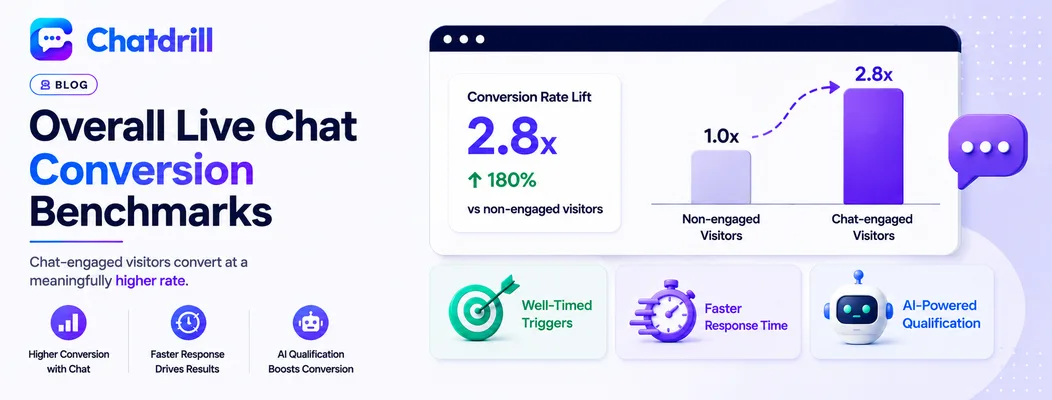
Across all industries, chat-engaged visitors typically convert at a meaningfully higher rate than non-engaged visitors, though the exact multiplier varies significantly based on how well triggers, qualification, and AI automation are configured.
The general engagement-to-conversion lift
Visitors who engage with chat consistently show a higher conversion rate than the overall site average, reflecting both chat's own influence and the fact that chat-engaged visitors often already show higher purchase intent.
Disentangling causation from correlation here is genuinely difficult, some of this lift reflects chat actively persuading a visitor, some reflects chat simply reaching visitors who were already more likely to convert.
Why blanket benchmarks should be treated cautiously
A single, industry-blind average obscures enormous variation based on trigger configuration, AI quality, and how well a specific business's chat strategy is actually implemented.
Treating any blanket benchmark as a rough directional reference, rather than a precise target, avoids over-indexing on a number that may not reflect your specific situation well.
What actually moves the needle across most contexts
Regardless of industry, faster response time, well-timed proactive triggers, and genuine AI qualification consistently correlate with higher chat conversion across the businesses that track this rigorously.
These universal drivers are worth prioritizing before assuming your specific industry has some unique factor explaining underperformance relative to a benchmark.
Conversion Benchmarks by Industry
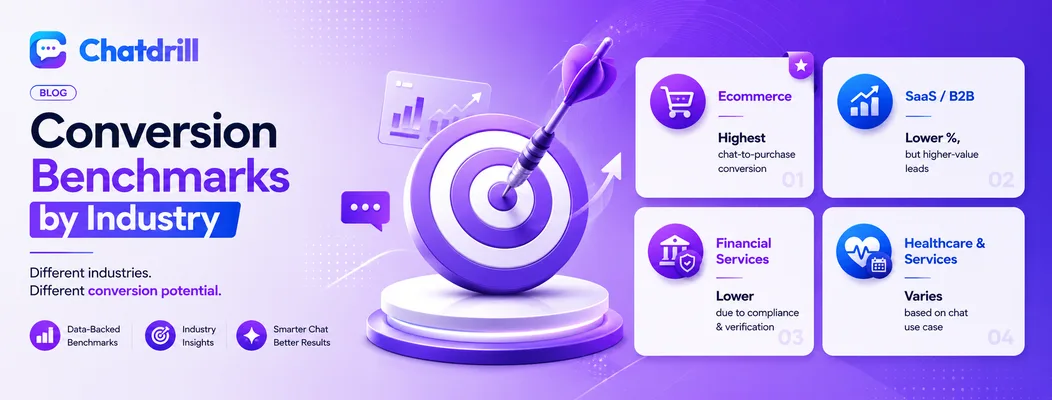
Ecommerce sees the highest chat-to-purchase conversion given its transactional nature, SaaS sees lower but higher-value chat-to-lead conversion, financial services trends lower due to compliance friction, and healthcare varies widely based on appointment versus informational chat use.
Ecommerce benchmarks
Ecommerce chat typically sees the highest direct conversion rates in the category, given the transactional, often lower-consideration nature of many shopping decisions compared to a longer B2B sales process.
This is especially true for chat engaged specifically on cart or checkout pages, where visitor intent is already high and chat's role is often resolving a final hesitation rather than building initial interest.
SaaS and B2B benchmarks
SaaS and B2B chat conversion, typically measured as lead capture or demo booking rather than an immediate purchase, tends to run lower in raw percentage but reflects a considerably higher per-conversion value given typical B2B deal sizes.
This category also sees the widest variation between companies with mature, AI-driven qualification chat and those with a more passive, unconfigured widget.
Financial services benchmarks
Financial services chat conversion trends lower on average, reflecting the additional friction of compliance requirements, verification steps, and generally more considered purchase decisions in this category.
Despite lower raw conversion numbers, chat still plays a meaningful role in this industry for building trust and answering the specific, often regulation-related questions that create hesitation.
Healthcare and service-based benchmarks
Healthcare and service-based businesses show wide variation depending on whether chat is used primarily for appointment booking, a more transactional, higher-converting use case, or general informational support.
This variation makes industry-wide healthcare benchmarks less reliable than in more uniform categories, worth benchmarking specifically against businesses with a similar chat use case rather than the industry broadly.
What Drives Higher Chat Conversion Rates
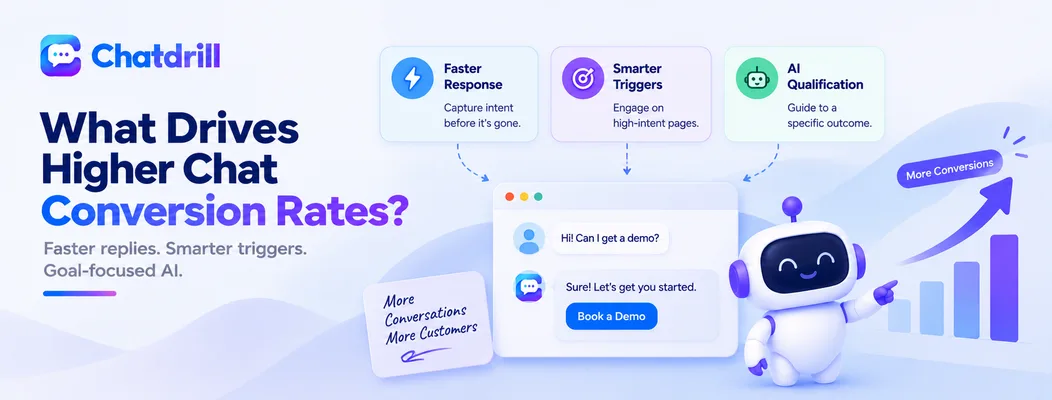
Higher conversion consistently correlates with faster response time, well-targeted proactive triggers on high-intent pages, and AI qualification that moves a conversation toward a specific outcome rather than passively answering questions.
Response time as a conversion driver
Visitors engaging with chat are often at a moment of active decision-making, and a delayed response risks losing that intent entirely as the visitor moves on or loses momentum.
Businesses that specifically track and optimize for faster first response time consistently see this correlate with improved downstream conversion, making it one of the highest-leverage levers available.
Trigger targeting as a conversion driver
A proactive trigger fired specifically on high-intent pages, pricing, checkout, comparison pages, converts at a meaningfully higher rate than one applied uniformly across a site regardless of visitor context.
This targeting requires understanding which specific pages on your own site correlate with genuine purchase or lead intent, rather than assuming a generic trigger strategy applies universally.
AI qualification as a conversion driver
AI that actively qualifies and moves a conversation toward a specific next step, a purchase, a booked demo, tends to convert meaningfully better than a passive chatbot that simply answers questions without directing toward an outcome.
This distinction between passive and directive AI configuration is often the biggest single factor separating strong and weak conversion performance among businesses using otherwise similar chat platforms.
How to Benchmark Your Own Chat Performance
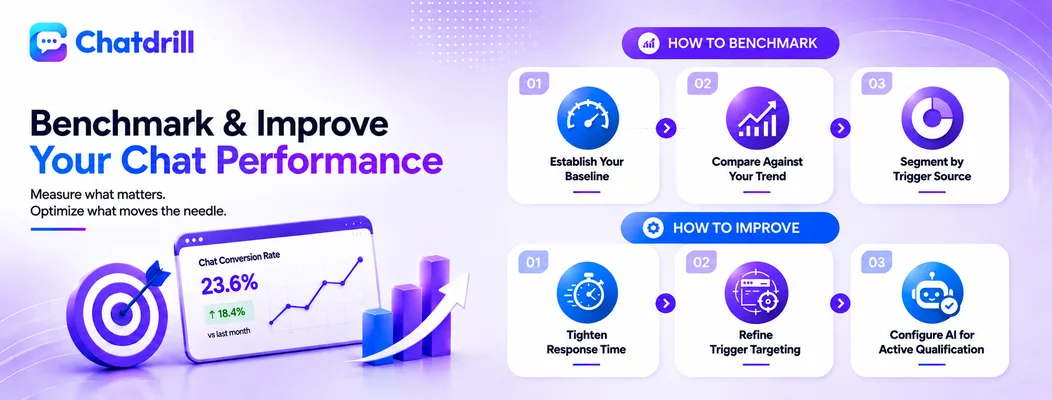
Benchmarking your own performance means establishing your current baseline first, comparing against your own historical trend more than external industry averages, and segmenting by trigger source to understand what's actually driving results.
Establishing your own baseline first
Before comparing against any external benchmark, establish a clear, accurate measurement of your own current chat conversion rate, using a consistent definition you'll track going forward.
This baseline becomes the more meaningful comparison point for measuring genuine improvement over time, since it reflects your specific business context precisely.
Comparing against your own trend, not just external averages
Tracking your own conversion rate trend month over month reveals whether specific changes, a new trigger, an AI configuration update, are genuinely moving the number in the right direction.
This internal comparison is often more actionable than an external benchmark, since it directly ties to changes you actually made and can control going forward.
Segmenting by trigger source
Breaking conversion rate down by which specific trigger or page drove the conversation reveals which parts of your chat strategy are genuinely working, rather than relying on one blended, less actionable average.
This segmentation often reveals that one high-performing trigger is driving most of your results, while others underperform and are worth reconsidering or removing.
Improving Chat Conversion Rate
Improving conversion rate reliably starts with tightening response time, refining proactive trigger targeting to focus on genuinely high-intent pages, and configuring AI to actively qualify and direct conversations rather than passively respond.
Tightening response time
Reviewing current response time data and identifying any specific time-of-day or day-of-week gap, then addressing it through staffing adjustment or expanded AI coverage, is often the fastest available lever for improvement.
This is worth prioritizing before more complex changes, since response time improvements tend to show measurable conversion impact relatively quickly.
Refining trigger targeting
Reviewing which pages currently have proactive triggers, and comparing that against which pages actually show the highest visitor intent, often reveals a mismatch worth correcting.
Testing a new trigger on a genuinely high-intent page not currently covered is a reasonable next experiment once existing triggers are optimized.
Configuring AI for active qualification
Reviewing whether AI is currently just answering questions passively, versus actively working to qualify a visitor and move them toward a specific next step, often reveals room for a meaningful configuration improvement.
This shift from passive to active AI configuration is frequently the single highest-impact change available to a business whose chat conversion has plateaued.