
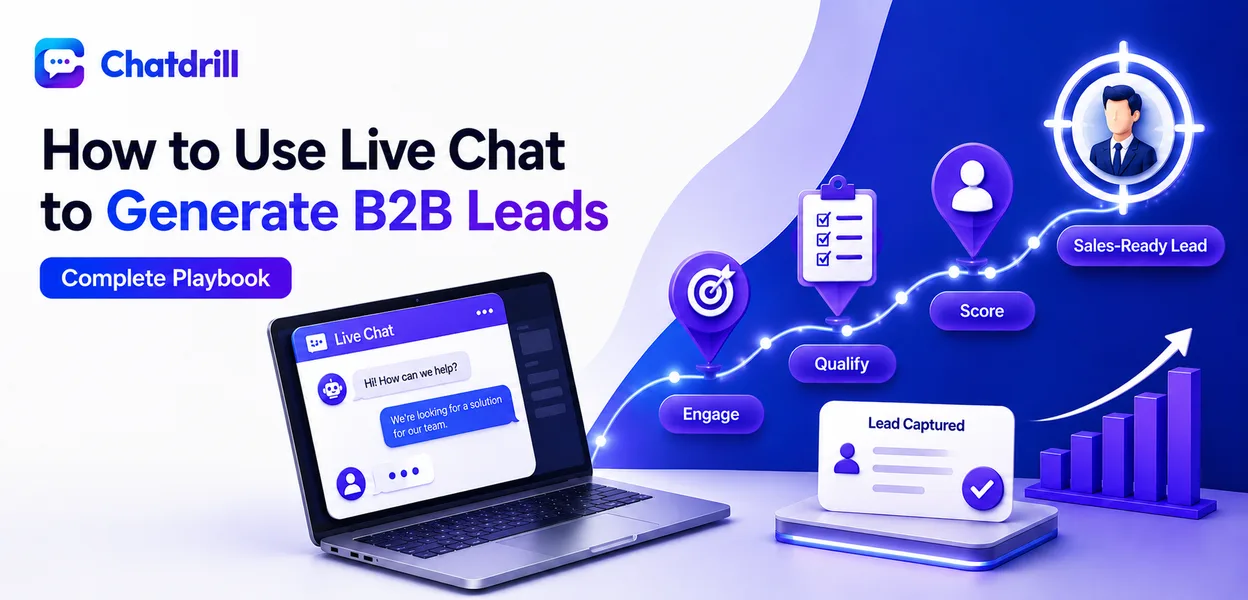
Live chat can do more for a B2B website than answer support questions, used well, it qualifies a visitor, books a demo, and hands a sales-ready lead to a rep before that visitor ever fills out a contact form.
Most teams don't get there by accident. A chat widget that simply waits for a click behaves like a support tool, not a pipeline channel, which is why the teams generating real leads from chat treat it with the same intentionality as a paid campaign, with defined triggers, qualification rules, and routing logic.
The opportunity is largest for B2B specifically because the buying process already involves real conversation, questions about pricing tiers, implementation, and fit that a static page can't fully answer. Chat puts that conversation exactly where a visitor already is, at the moment they're deciding whether to reach out at all, rather than asking them to take an extra step toward a form or a scheduled call before getting any real interaction.
This playbook covers what chat-based lead generation actually is, why it consistently outperforms slower channels, a step-by-step process for building it, how to measure whether it's working, and the mistakes that quietly undermine results.
What Is Chat-Based Lead Generation?
Chat-based lead generation is the practice of using a live chat widget, backed by qualification rules and AI, to identify a website visitor's intent and route sales-ready conversations to a rep in real time, turning a support channel into a measurable part of the sales pipeline.
Simple definition
In practice, it means a chat widget doesn't just answer questions, it asks a few of its own, scores the answers, and decides whether the conversation should reach a salesperson right now.
That last part, the decision, is what separates lead generation from ordinary support chat: a support-only widget treats every visitor the same, while a lead-gen setup actively differentiates a casual browser from someone ready to buy.
This distinction is worth being explicit about internally too, since a team that hasn't agreed on what "qualified" means will struggle to configure scoring rules consistently.
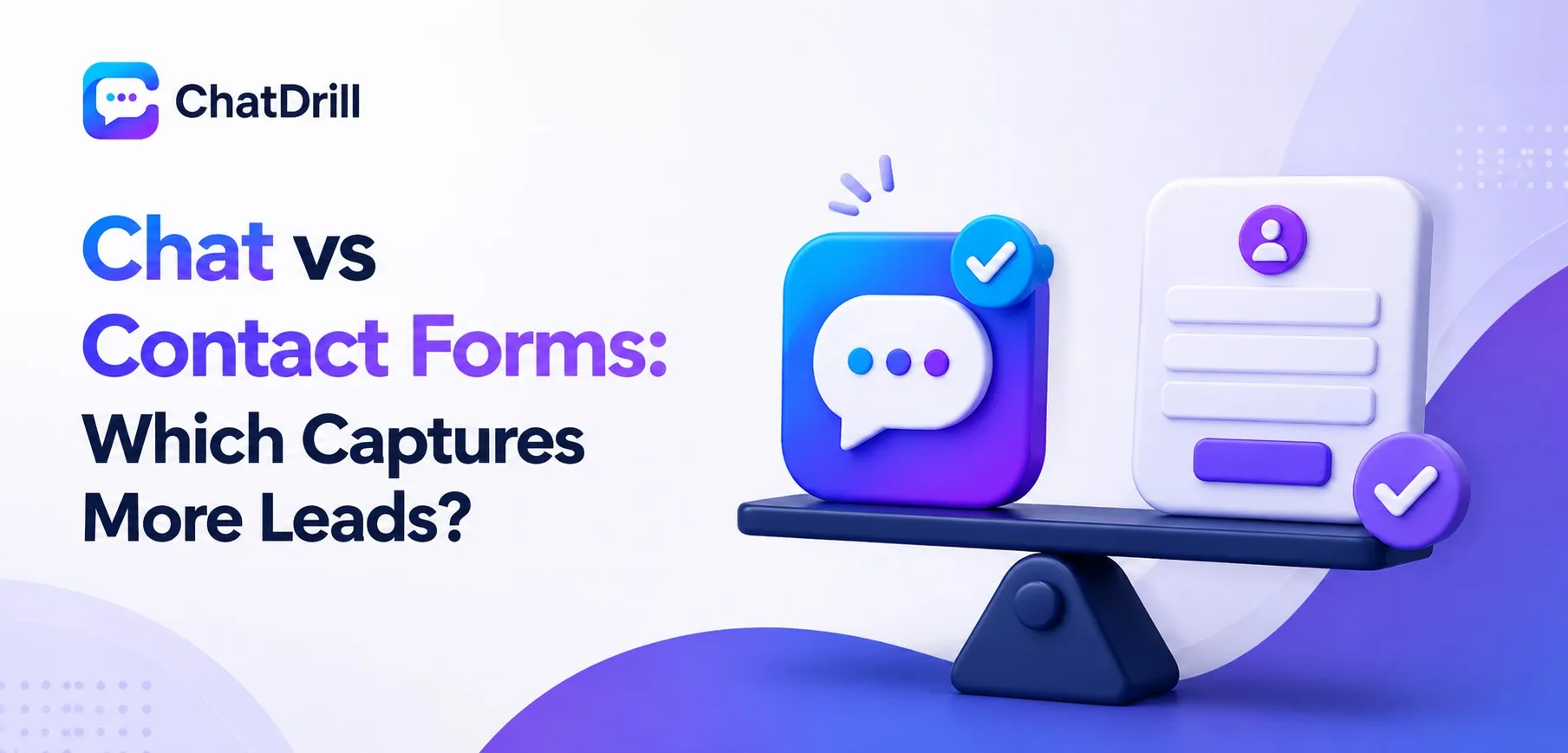
Chat lead gen vs contact forms
A contact form captures information and waits for someone to follow up later; chat captures the same information while the visitor is still on the page and can respond immediately.
The completion rate difference is significant too, a well-designed chat qualification flow tends to get more engagement than an equivalent static form, simply because it feels like a conversation rather than paperwork.
Forms still have a place, particularly for visitors who prefer not to chat in real time, but relying on a form alone leaves a meaningful share of high-intent traffic uncaptured.
Where it fits in the B2B funnel
Chat lead generation typically sits at the consideration stage, catching visitors already comparing options on a pricing or demo page, rather than top-of-funnel awareness traffic.
That's also why it pairs so well with other bottom-funnel efforts, retargeting ads and comparison content bring visitors back to exactly the pages where a proactive chat trigger does the most good.
Positioning chat this way, as a consideration-stage tool rather than a blanket presence across the whole site, also keeps qualification questions relevant to where a visitor actually is in their decision.
Why Live Chat Converts Better Than Other Channels
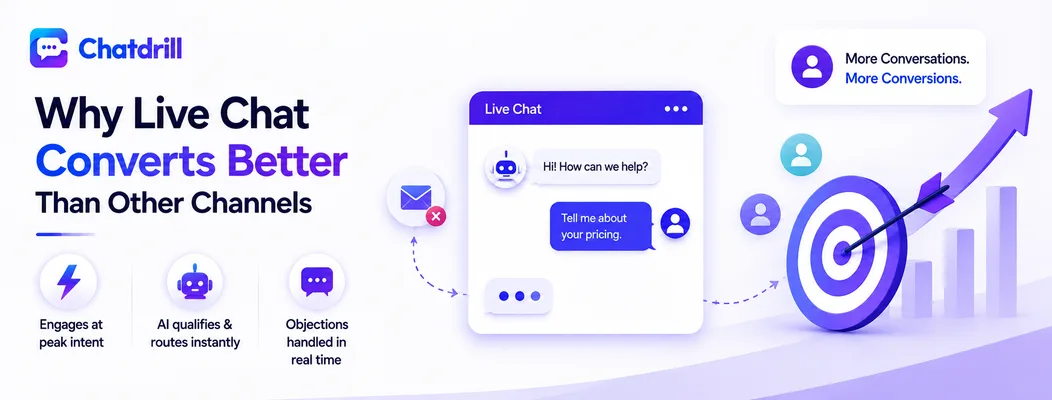
Live chat converts better than email or a contact form because it engages a visitor at peak intent, lets AI qualify and route the conversation instantly, and allows objections to be addressed in real time instead of over a delayed email thread.
Speed and buying intent
A visitor on a pricing page is actively evaluating; a chat prompt at that exact moment catches buying intent that a follow-up email sent hours later has already lost.
Intent is also perishable in a way most teams underestimate, a visitor who was ready to talk during their visit may have moved on to a competitor's site entirely by the time a delayed response finally arrives.
This is why speed, not just eventual accuracy, is treated as its own success metric in a well-run chat lead-gen program.
The role of AI qualification
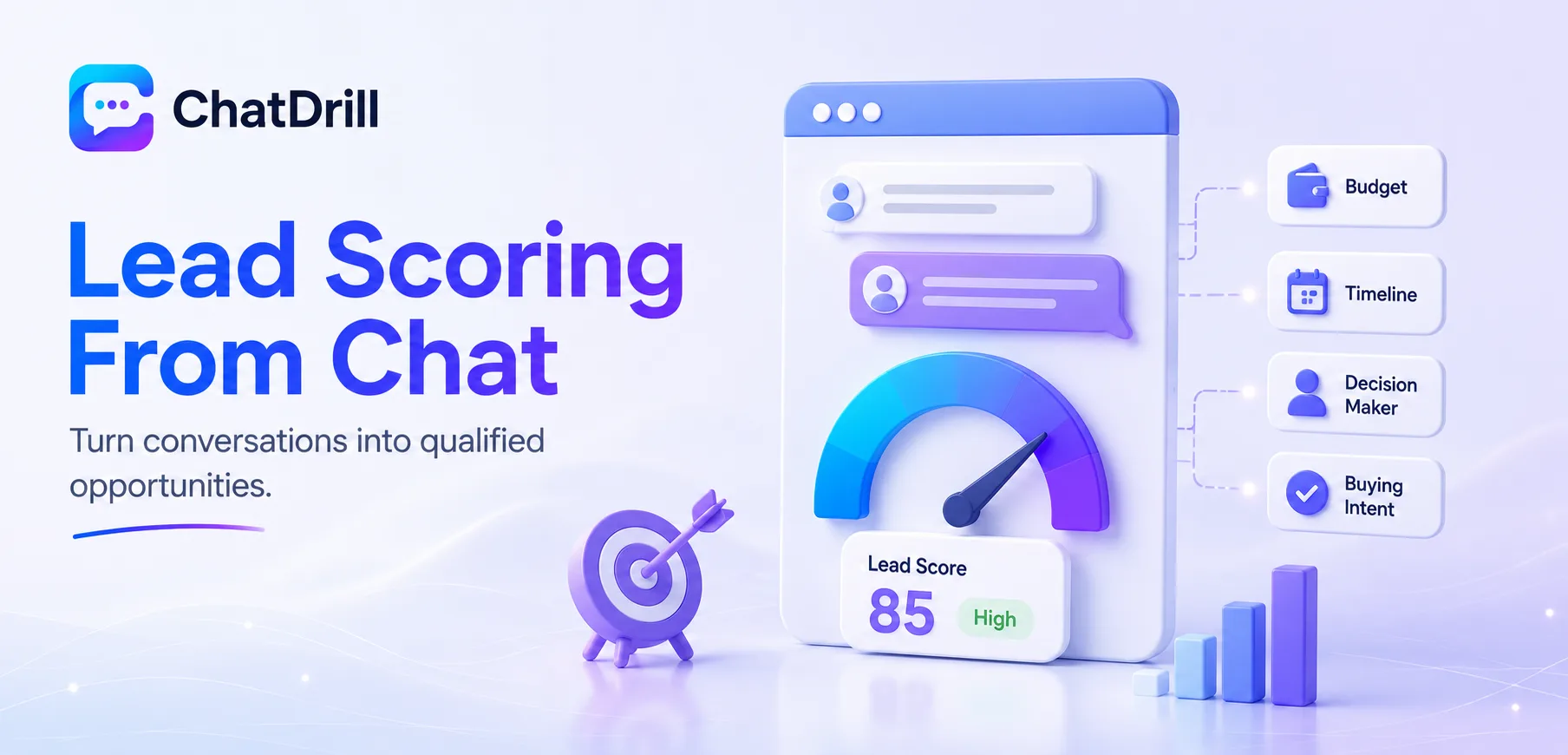
AI can ask about company size, use case, and timeline immediately, scoring the lead before a human ever needs to get involved, which matters most for the traffic that arrives outside business hours.
This also frees sales reps from spending time on unqualified conversations, since only the leads that clear a scoring threshold actually reach a rep's queue, keeping their attention on the conversations most likely to close.
Over time, reviewing which AI-scored leads actually converted helps refine the qualification questions themselves, tightening the signal the score is based on.
Real-time objection handling
A pricing concern raised in chat can be addressed in the same conversation, while the same concern raised over email often ends the interaction before it's ever answered.
This is particularly valuable for B2B specifically, where objections are often about fit, integration, or implementation timeline, questions that benefit far more from a real-time back-and-forth than a one-way email reply.
A visitor who gets a satisfying answer to an objection in the moment is also considerably more likely to continue the conversation toward booking a demo than one left waiting for a delayed reply.
The B2B Chat Lead Generation Playbook
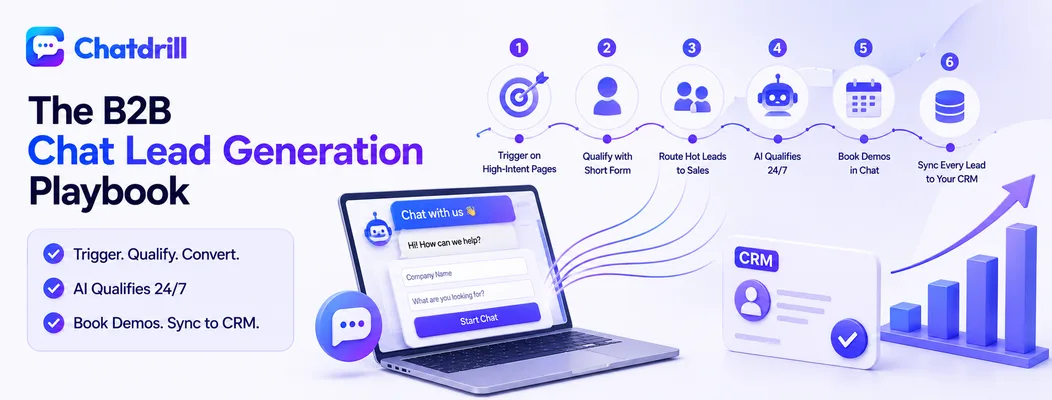
Building a chat lead-gen engine means triggering chat proactively on high-intent pages, qualifying visitors with a short form, routing hot leads to sales instantly, letting AI cover qualification around the clock, booking demos inside the chat window, and syncing every lead to the CRM automatically.
Step 1: Trigger proactive chat on high-intent pages
Set a proactive trigger on pages like pricing and demo requests, timed a short delay after arrival so it doesn't feel intrusive, since visitors there are already evaluating.
The specific delay matters more than it might seem, triggering immediately on page load tends to get dismissed as an interruption, while a 15 to 20 second delay lets the visitor actually engage with the page first.
It's worth testing more than one trigger message too, a version referencing the specific page tends to outperform a generic greeting by a meaningful margin.
Step 2: Qualify leads with a short pre-chat form
Two or three fields, company name and use case matter more than an email address alone, filter out casual browsing before an agent spends time on a conversation.
It's worth resisting the temptation to ask for more upfront, every additional field measurably lowers completion, and the AI can always ask follow-up questions conversationally once the chat is underway anyway.
For returning, already-identified visitors, it's worth skipping the form entirely and letting the conversation start immediately, since re-asking for information already on file tends to feel redundant and mildly frustrating.
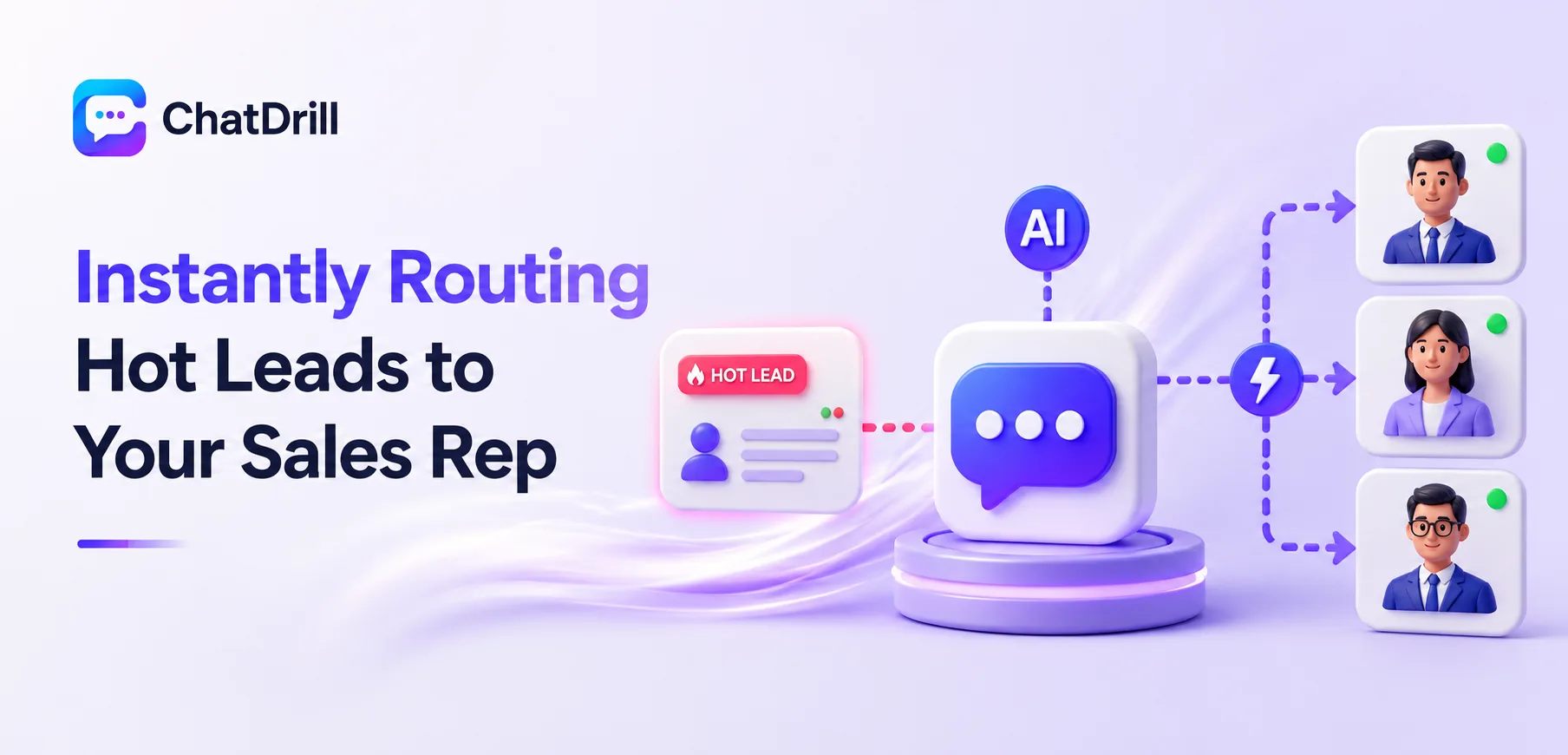
Step 3: Route hot leads to sales instantly
Keyword-based routing on terms like "pricing" or "switching from" can send a conversation straight to a sales rep instead of a general queue, since response speed matters more than most teams assume.
Pairing this with a Slack or mobile alert to the relevant rep, rather than relying on someone checking a dashboard, is often the difference between a lead getting a response in two minutes versus two hours.
It's worth building a fallback rule too, if the primary rep doesn't respond within a set window, routing automatically to a backup prevents a hot lead from silently going unanswered.
Step 4: Let AI qualify and score leads 24/7
Most B2B traffic arrives outside business hours; AI configured to ask qualifying questions and score the response means a lead doesn't wait until the next morning to hear back.
This is also where the ROI of AI chat becomes most visible, a business without after-hours coverage is effectively turning away a meaningful share of its highest-intent visitors simply because of when they happened to browse.
Reviewing a sample of after-hours AI conversations periodically helps confirm the qualification questions are still capturing the right signal as the product or ideal customer profile evolves.
Step 5: Book demos directly inside the chat window
Embedding a calendar directly in the chat removes the extra click to an external booking page, a small change that measurably lifts demo completion rates.
Triggering the booking flow automatically once a lead clears the qualification threshold, rather than waiting for the visitor to ask, tends to convert more of the qualified conversations into actual booked meetings.
Sending an immediate calendar confirmation from within the same conversation, rather than a separate email that might get missed, further reduces the chance of a booked meeting falling through.
Step 6: Sync every chat lead into your CRM
A great conversation is wasted if it never reaches the CRM; automatic sync, with the full transcript attached, keeps sales working from one system instead of chasing chat logs.
Attaching the transcript specifically matters here, a rep following up with full context from the original conversation closes at a noticeably higher rate than one working from a bare contact record alone.
It's also worth mapping lead score and source directly into CRM fields, so reporting on chat-sourced pipeline doesn't require manually cross-referencing two separate systems later.
Measuring Chat Lead Generation Success
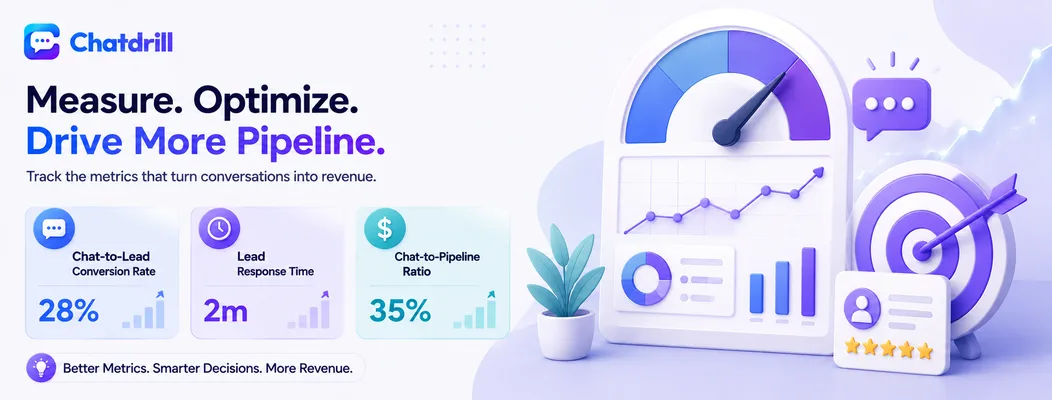
The metrics that matter most are chat-to-lead conversion rate, how fast a qualified lead gets a response, and what share of chat conversations eventually turn into real pipeline.
Chat-to-lead conversion rate
This is the percentage of chat conversations that become a qualified lead, the single clearest signal of whether qualification and triggers are actually working.
It's worth tracking this by page or trigger source separately, since a blended average often hides that one specific trigger, say, the pricing page prompt, is driving most of the results while others underperform.
Reviewing this monthly rather than quarterly makes it far easier to connect a change in the number to a specific configuration change made around the same time.
Lead response time
How quickly a routed, qualified lead hears from a human correlates directly with close rates; minutes matter more in B2B chat than most teams expect.
Tracking this specifically for chat leads, separately from other lead sources, tends to reveal whether the routing and alerting setup from step three is actually working the way it was designed to.
A sudden increase in this number is often the first sign that a routing rule has broken or a rep's notification settings have quietly changed.
Chat-to-pipeline ratio
Tracking how many chat leads actually become sales opportunities, not just conversations, shows whether qualification is filtering for the right signals or just generating volume.
A high number of chat leads with a low pipeline conversion rate is usually a sign the qualification questions need tightening, not that chat as a channel isn't working.
This metric is also the most useful one to bring to a conversation with sales leadership, since it speaks directly to pipeline impact rather than chat-specific activity.
Common Mistakes to Avoid
The most common mistakes are treating chat as a support-only channel, front-loading too many qualifying questions before a visitor gets any value, and letting a promising lead go cold once the chat window closes.
Treating chat as support-only
A widget configured only to answer questions, with no triggers or qualification, will generate far fewer leads than the same tool configured with sales intent in mind.
This is usually a configuration gap rather than a platform limitation, most tools capable of lead qualification simply aren't set up to use it, having been installed originally just to handle support volume.
Revisiting the original setup with fresh eyes, specifically asking what a sales-oriented configuration would look like, often reveals quick wins that were simply never turned on.
Asking too many qualifying questions upfront
A long pre-chat form drops completion rates fast; two to three focused questions outperform a longer intake every time.
The better pattern is progressive qualification, ask the minimum upfront, then let the AI or agent ask follow-up questions naturally as the conversation develops, rather than front-loading everything into a static form.
Testing form length directly, comparing a two-field version against a five-field version over a few weeks, usually settles the question with real data rather than guesswork.
Letting leads go cold after the conversation
Without an automatic CRM sync and follow-up sequence, a lead that didn't book a demo on the spot is often never contacted again.
Even a simple automated follow-up email referencing the specific conversation topic, sent within an hour of the chat ending, recovers a meaningful share of leads that would otherwise be lost entirely.
Reviewing which chat leads went cold after a month is a useful periodic exercise, since the pattern often points to a specific gap in the follow-up process worth fixing.
Real-World Chat Lead Generation Examples
The pattern behind successful chat lead generation looks similar across very different businesses: a well-timed trigger, a short qualification step, and fast routing to the right person, adapted to each company's specific funnel.
A SaaS company recovering pricing-page drop-off
A mid-sized SaaS business noticed a large share of pricing-page visitors left without any contact, so it added a proactive chat trigger timed to fire after 20 seconds on that specific page.
Within the first month, a meaningful share of those triggered conversations converted into qualified leads that hadn't previously been captured at all, simply by engaging visitors at the exact moment they were comparing plans.
The team also found that referencing the specific plan a visitor appeared to be viewing, rather than a generic greeting, further lifted engagement with the trigger.
A B2B service business qualifying leads after hours
A B2B services firm found that a large portion of its website traffic arrived outside business hours, when no one was available to respond to chat messages.
Configuring AI to handle after-hours qualification, asking about company size and timeline, meant leads were scored and routed the moment a rep came online instead of sitting unanswered overnight.
Over time, the firm also used transcripts from those after-hours conversations to refine what its AI asked, since certain follow-up questions consistently produced stronger qualification signal than others.
An agency using chat to book more discovery calls
A marketing agency embedded a calendar booking flow directly inside its chat widget, triggered automatically once a visitor's answers indicated genuine buying intent.
Removing the extra step of visiting a separate scheduling page noticeably lifted the share of qualified chats that converted into an actual booked discovery call.
The agency also tested offering two time-slot options directly in the chat rather than a full calendar view, which further reduced the friction of booking on the spot.
A software company reducing time-to-first-response for enterprise leads
An enterprise software vendor set up keyword-based routing so any chat mentioning terms like "enterprise" or "migrating from" was sent directly to a senior rep instead of a general queue.
That single routing change cut the time between a high-value lead's first message and a human response from hours down to minutes, directly improving how those conversations converted.
The company later extended the same logic to flag mentions of specific competitor names, routing those conversations to reps trained specifically on competitive positioning.
What these examples have in common
In each case, the business identified one specific moment of high intent, a page, a time of day, a keyword, and built a targeted response around it rather than trying to overhaul the entire chat experience at once.
None of these examples required a complex implementation, each was a focused change to triggers or routing that compounded into a meaningfully better outcome over time.
They also all involved measuring the specific change before moving on to the next one, rather than making several adjustments at once and losing the ability to tell which one actually worked.
How to apply these patterns to your own site
Start by reviewing chat and analytics data for the pages where visitors show the clearest buying intent, then build one trigger or routing rule around that specific pattern before expanding further.
Measuring the result of that single change before adding more complexity keeps the process manageable and makes it far easier to tell which specific adjustment is actually driving improvement.
Once a first pattern is validated, the same review process applied to a second page or segment tends to reveal the next highest-leverage change worth making.