
A meaningful share of website traffic arrives outside standard business hours, evenings, weekends, different time zones entirely, and every one of those visitors who leaves without engaging represents a genuine opportunity that a purely human-staffed chat operation simply can't capture.
AI-powered chat closes this gap by remaining genuinely available around the clock, capable of answering common questions, qualifying interest, and collecting contact information without requiring a human to be actively staffing the conversation.
The goal isn't necessarily to fully resolve every after-hours conversation, it's to ensure a genuinely interested visitor doesn't leave without a path forward, with their information and context ready for your team the moment business hours resume.
This guide covers why after-hours capture matters, what a strong after-hours AI setup needs, a practical implementation approach, and mistakes worth avoiding.
Quick answer: AI captures leads after business hours by staying available around the clock to answer questions, qualify interest, and collect contact details, turning what would otherwise be a missed opportunity into a warm lead ready for follow-up when your team is back online.
Why After-Hours Lead Capture Matters
A meaningful share of genuine buying interest occurs outside standard business hours, and without AI-powered coverage, this interest either goes unanswered or is captured only partially through a generic contact form.
The scale of after-hours traffic
Depending on your specific audience and time zone distribution, evening and weekend traffic can represent a substantial share of total visits, particularly for a business serving customers across multiple regions.
Reviewing your own analytics for traffic distribution by hour reveals exactly how much of your total opportunity falls outside typical staffed hours.
What's lost without after-hours coverage
A visitor with a genuine question who encounters no way to get it answered outside business hours often simply leaves, either abandoning the inquiry entirely or seeking the answer from a competitor instead.
This lost opportunity compounds over time, representing a consistent, ongoing gap rather than an occasional missed interaction.
What a Strong After-Hours AI Setup Needs
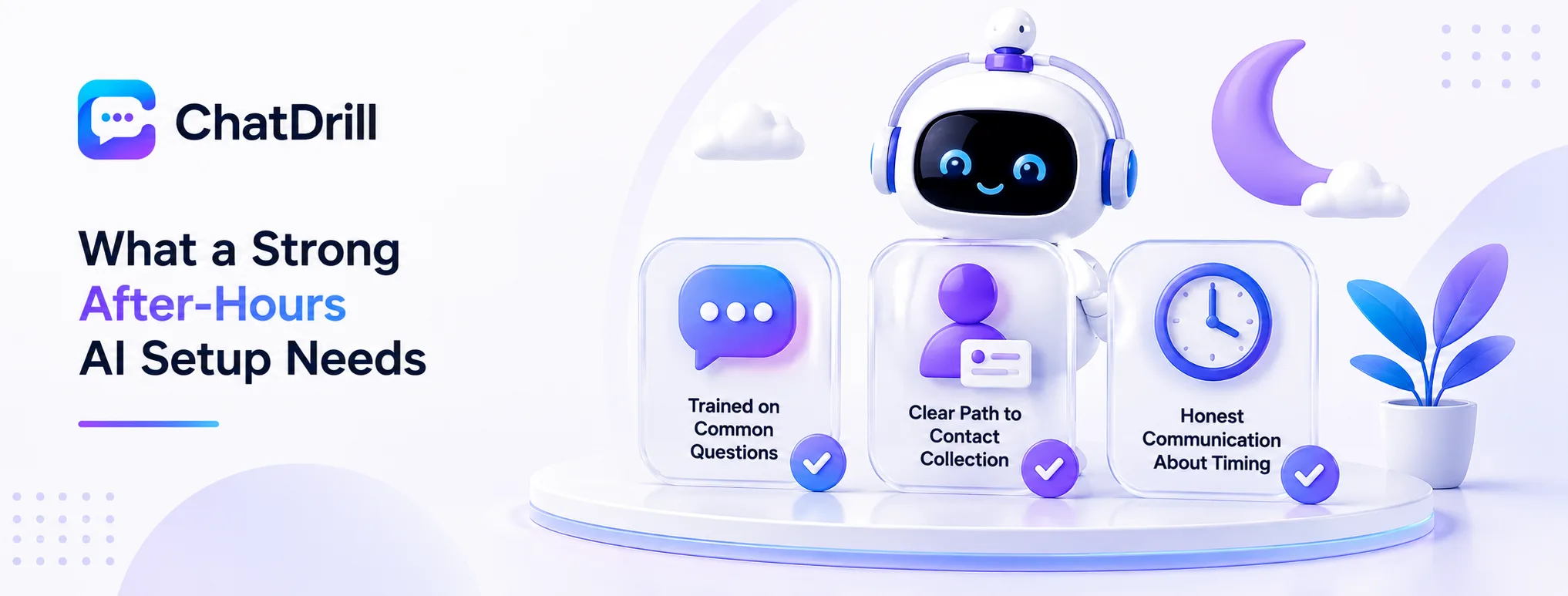
A genuinely effective after-hours setup needs AI trained on your most common questions, a clear path to collect contact information for follow-up, and honest communication about response timing.
Training on common after-hours questions
Feeding AI your actual, common questions, pricing, product basics, availability, ensures it can genuinely help an after-hours visitor rather than deflecting every question to a form.
This training investment matters especially here, since after-hours visitors have no alternative human option available, making AI's actual capability more consequential than during staffed hours.
A clear path to contact collection
For questions AI can't fully resolve, having a smooth, low-friction way to collect contact information ensures the interested visitor's information reaches your team even without immediate resolution.
This collection should feel like a natural continuation of the conversation, not an abrupt pivot to a generic contact form disconnected from what was just discussed.
Honest communication about response timing
Clearly communicating when a human will follow up, rather than leaving the visitor uncertain, sets appropriate expectations and reduces the frustration of an unanswered wait.
This honesty about timing, even when it means acknowledging a delay until the next business day, tends to build more trust than vague or overly optimistic messaging.
Implementation Approach for After-Hours AI Capture
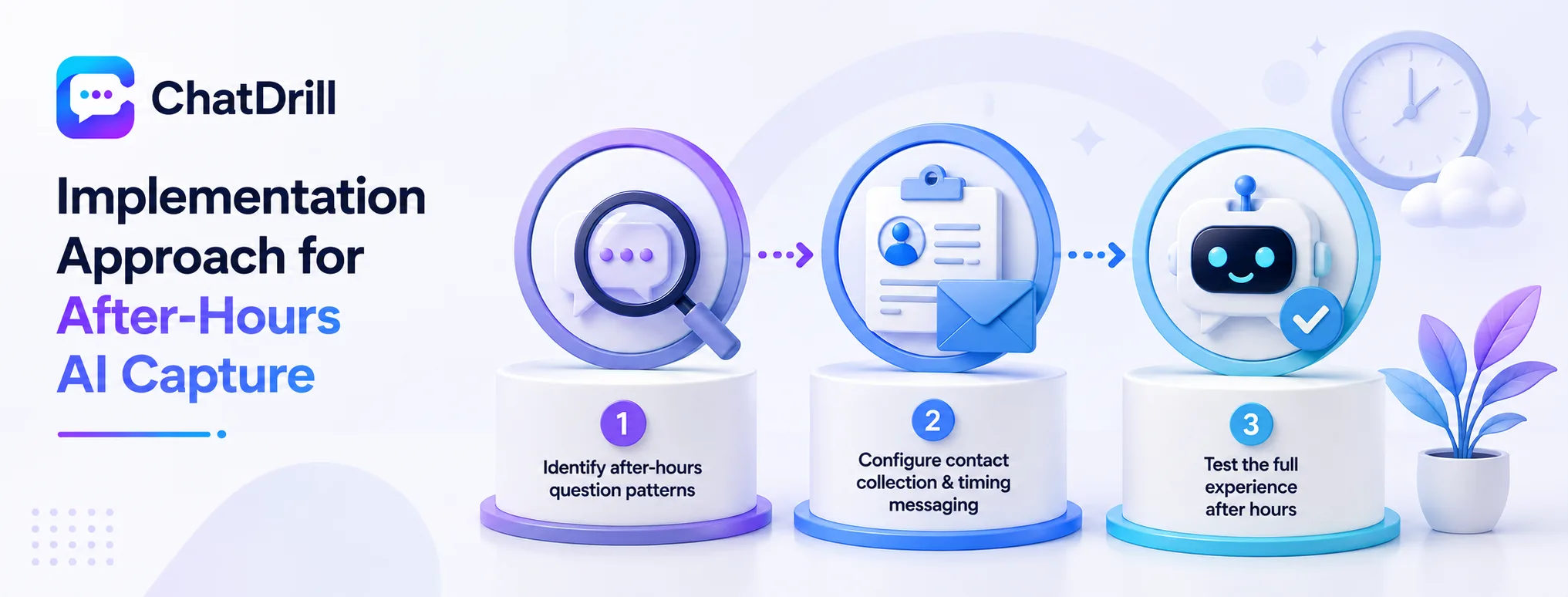
A practical implementation identifies your actual after-hours question patterns, configures AI and contact collection specifically for this scenario, and tests the full experience outside business hours before relying on it.
Step 1: Identify after-hours question patterns
Reviewing past chat logs or support tickets specifically from outside business hours reveals whether after-hours visitors ask genuinely different questions than daytime traffic.
This analysis informs whether your existing AI training already covers these patterns or whether specific after-hours-focused training content is worth adding.
Step 2: Configure contact collection and timing messaging
Setting up a smooth handoff from AI conversation to contact collection, along with clear messaging about when a human will follow up, completes the after-hours experience design.
This configuration should feel genuinely helpful rather than a consolation-prize fallback, respecting that the visitor may have a genuinely time-sensitive need.
Step 3: Test the full experience after hours
Genuinely testing the chat experience during actual off-hours, not just simulating it during the day, confirms the after-hours configuration works exactly as intended when a real visitor encounters it.
This test should include the actual handoff to a human the next business day, confirming the collected lead information and context genuinely reaches whoever picks it up.
Common Mistakes With After-Hours AI Capture
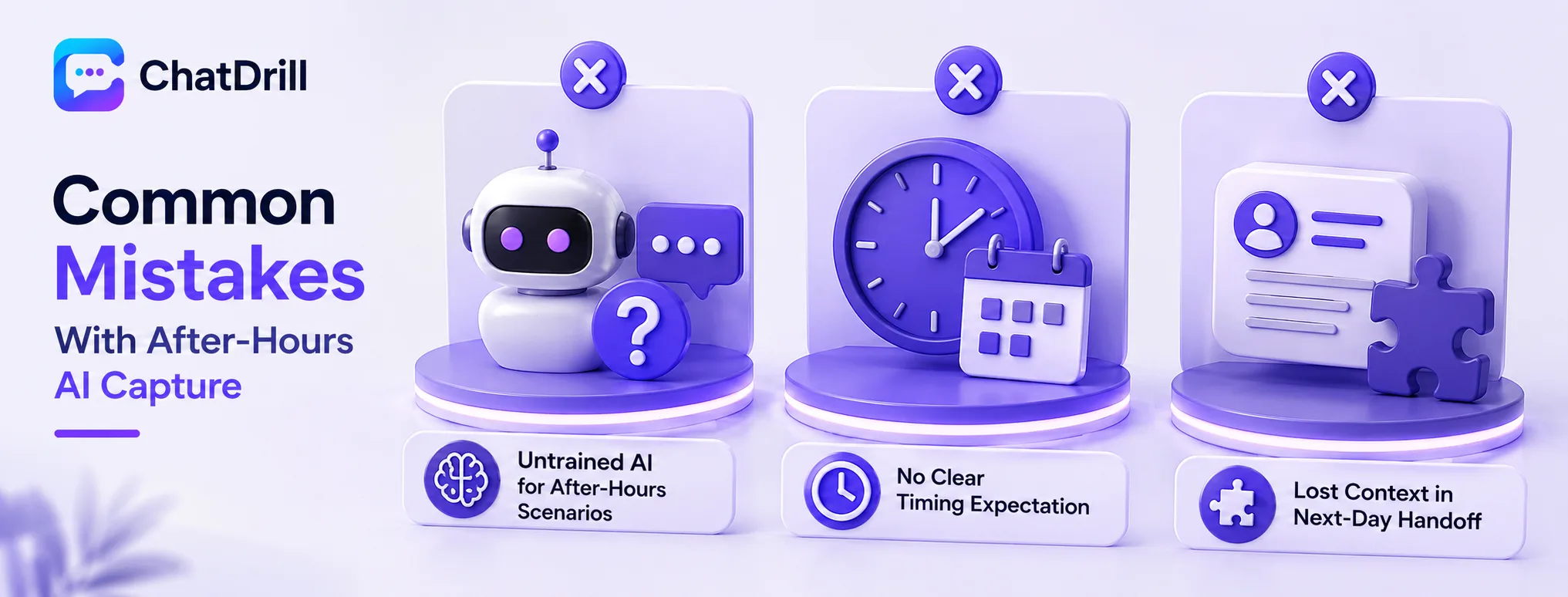
The most common mistakes are leaving AI untrained on genuinely common after-hours questions, providing no clear timing expectation for follow-up, and losing conversation context between the after-hours chat and next-day human follow-up.
Untrained AI for after-hours scenarios
Assuming your existing daytime AI training automatically covers after-hours questions without verifying this can leave genuine gaps unaddressed exactly when no human alternative is available.
Reviewing after-hours-specific question patterns directly, rather than assuming coverage, ensures this scenario gets appropriate attention.
No clear timing expectation
Leaving a visitor uncertain about when they'll actually hear back creates unnecessary frustration, especially compared to a clear, honest statement about expected follow-up timing.
This clarity costs little to provide and meaningfully improves the after-hours experience even when full resolution isn't immediately possible.
Lost context in the next-day handoff
A lead who provided context during an after-hours conversation, only for that context to be lost by the time a human follows up the next day, experiences a frustrating, disjointed interaction.
Ensuring conversation context genuinely carries through to whoever picks up the follow-up preserves the value of what was already discussed after hours.
Measuring After-Hours Capture Success
Tracking after-hours lead volume, follow-up conversion rate for these leads specifically, and AI resolution rate during off-hours reveals whether this coverage is delivering genuine, measurable value.
After-hours lead volume and conversion
Tracking how many genuine leads are captured specifically outside business hours, and how many convert after next-day follow-up, quantifies this tactic's direct contribution to your overall pipeline.
Comparing this conversion rate against daytime-captured leads reveals whether after-hours leads convert differently, informing how much priority they should receive in follow-up.
AI resolution rate during off-hours
Tracking how many after-hours conversations resolve fully through AI, without requiring next-day human follow-up at all, quantifies the direct efficiency this coverage provides.
A ChatDrill setup with genuine after-hours training, for a business using it, makes this resolution rate straightforward to track directly.