
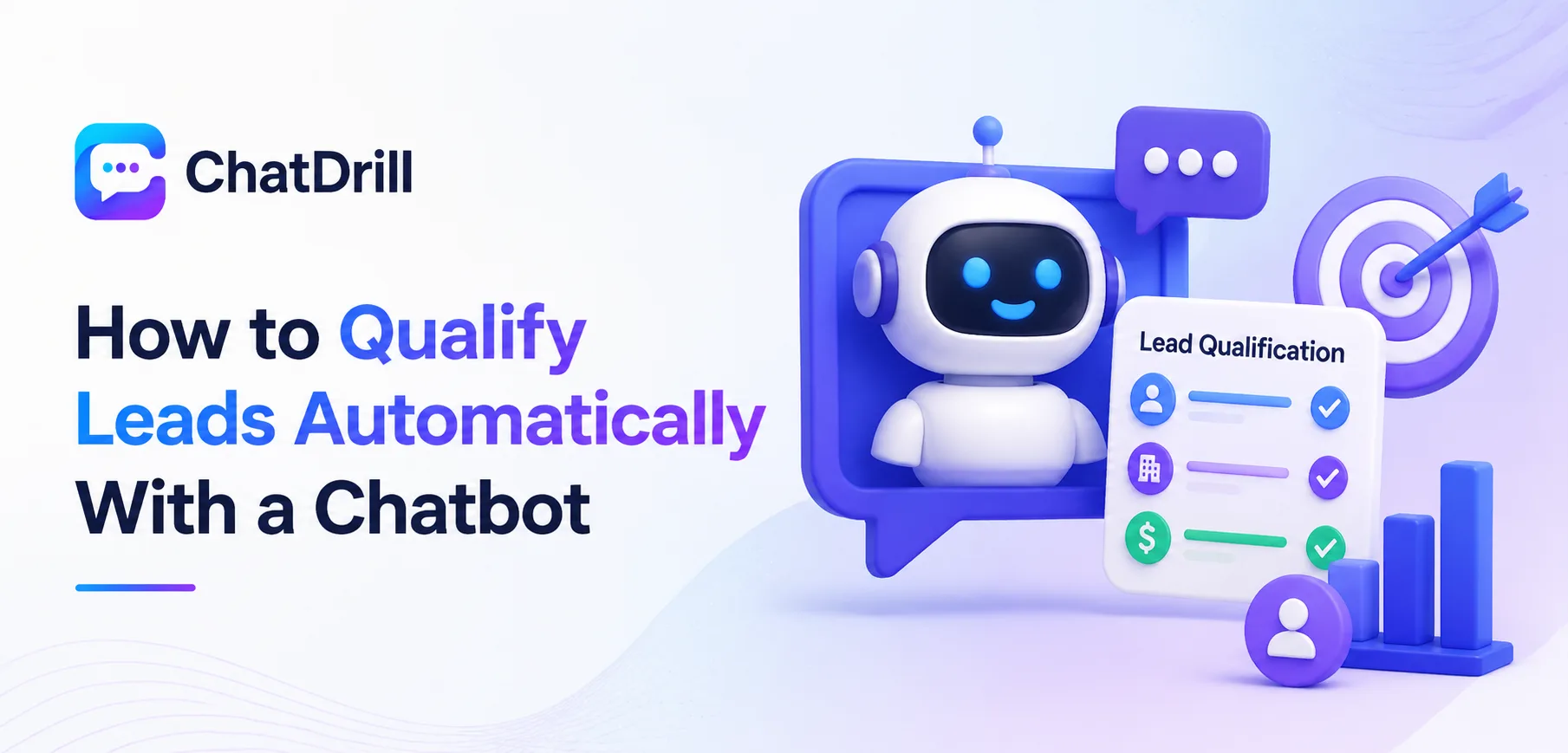
Automatic lead qualification means a chatbot asks the right questions, scores the answers, and routes a conversation to sales, all without a human needing to manually review every incoming chat before deciding whether it's worth a rep's time.
This matters most for businesses fielding meaningful chat volume, where manually triaging every conversation to determine genuine sales interest becomes a real time cost, and where a delay in that manual review can mean a hot lead cooling off before anyone reaches out.
Done well, automatic qualification doesn't just save time, it improves lead quality reaching sales, since the qualification questions can be designed specifically to surface the signals that actually predict whether a lead is worth pursuing.
Getting this right requires more than just enabling a generic AI feature, it means deliberately designing a qualification flow, defining what "qualified" actually means for your specific business, and building the scoring and routing logic to act on that definition consistently.
This guide covers what automatic lead qualification actually means, how to design a qualification flow, a step-by-step process for building one, how to score and route qualified leads, common mistakes to avoid, and how to measure whether it's working.
What Automatic Lead Qualification Actually Means
Automatic lead qualification means a chatbot independently asks relevant questions, interprets the answers, assigns a score reflecting likely fit and intent, and routes the conversation accordingly, all without requiring a human to manually triage each conversation first.
Simple definition
Rather than every chat conversation waiting for a human to determine whether it's worth pursuing, a qualification-capable chatbot does this triage itself, in real time, as the conversation unfolds.
This automation doesn't replace human judgment on genuinely qualified leads, it filters and prioritizes so a rep's time goes toward conversations already shown to be worth pursuing.
The result is a meaningfully faster path from initial visitor interest to an actual, prioritized sales conversation, compared to a manual review process introducing delay at every step.
Why manual qualification doesn't scale
As chat volume grows, manually reviewing every conversation to determine genuine sales fit becomes an increasingly significant time cost, one that automatic qualification removes almost entirely.
This scaling problem is exactly what makes automatic qualification worth investing in specifically once a business's chat volume grows past what a small team can reasonably triage manually.
What genuinely "qualified" means for your business
Before building any automated flow, defining precisely what makes a lead qualified for your specific business, company size, budget, timeline, use case, is the essential first step everything else builds on.
Skipping this definition step and jumping straight to building a generic flow tends to produce a qualification system that scores leads inconsistently with what your sales team actually considers valuable.
Designing a Qualification Flow
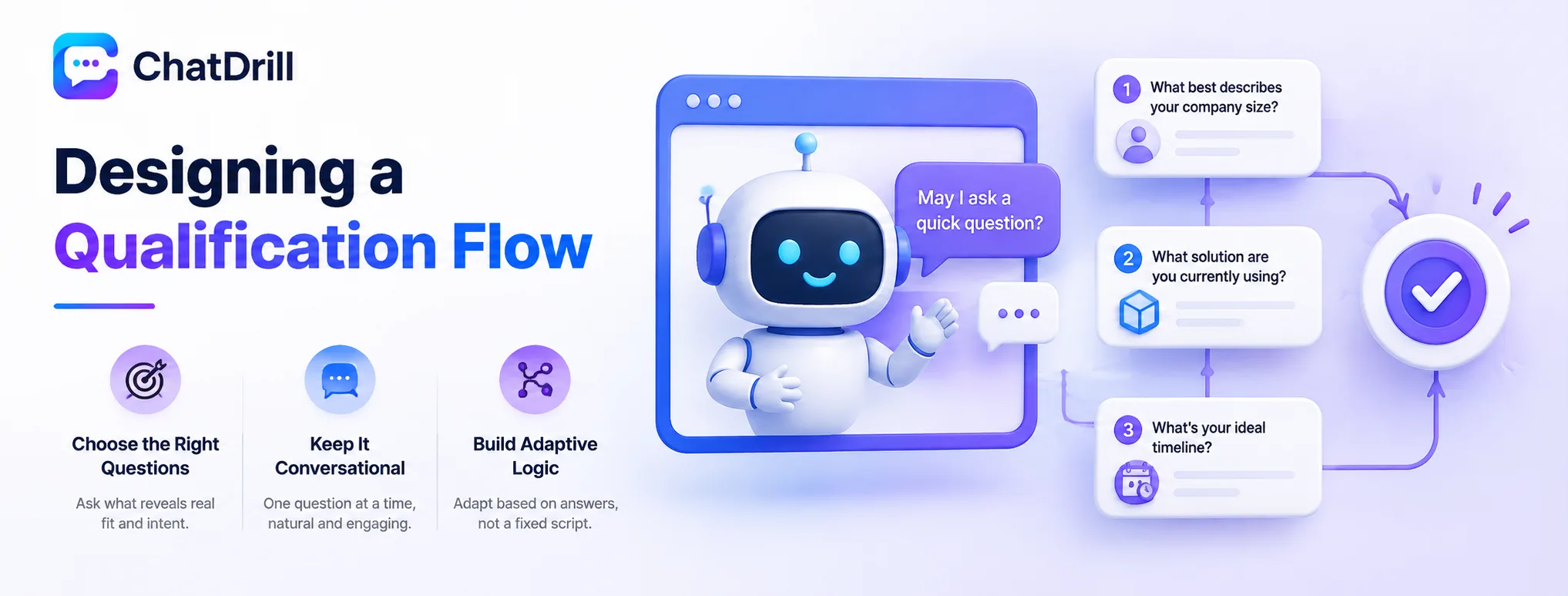
A well-designed qualification flow asks two to three focused questions that reveal genuine fit and intent, feels conversational rather than like a rigid form, and adapts based on earlier answers rather than following one fixed script regardless of context.
Choosing the right questions
The strongest qualification questions reveal genuine signal, company size, current tooling, timeline, budget range, rather than generic questions that don't actually differentiate a qualified lead from an unqualified one.
Reviewing what your sales team actually asks during a discovery call is a useful starting point for identifying which questions genuinely matter for your specific qualification criteria.
Keeping the flow conversational, not form-like
Questions asked one at a time, in natural language, feel considerably less intrusive than a rigid, form-style sequence presented all at once.
This conversational framing also allows the AI to react naturally to an answer, asking a relevant follow-up rather than mechanically proceeding through a fixed script regardless of what was just said.
Building in adaptive logic
A strong flow adapts based on earlier answers, skipping irrelevant questions or asking a different follow-up depending on what's already been revealed, rather than asking every visitor the identical fixed sequence.
This adaptiveness is what separates a genuinely intelligent qualification flow from a simple, static form disguised as a conversation.
Step-by-Step: Building an Automated Qualification Chatbot
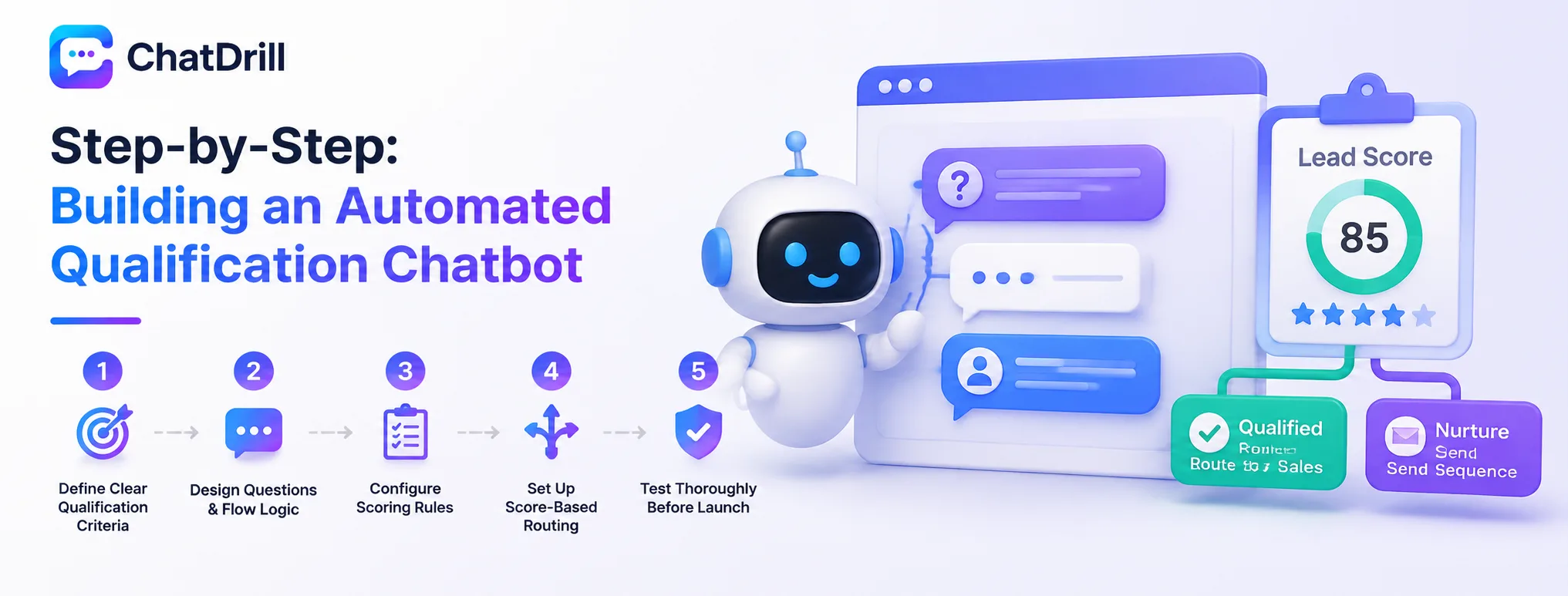
Building an automated qualification chatbot involves defining your qualification criteria clearly, designing the specific questions and flow logic, configuring scoring rules, setting up routing based on that score, and testing thoroughly with real scenarios before launch.
Step 1: Define clear qualification criteria
Work with sales to define exactly what makes a lead qualified, specific, measurable criteria rather than a vague general sense, since this definition drives every subsequent step.
Documenting this criteria explicitly, rather than keeping it as informal shared understanding, ensures the eventual automated flow reflects it accurately.
Step 2: Design the questions and flow logic
Translate the qualification criteria into two or three specific, conversational questions, with adaptive logic determining what follow-up, if any, comes next based on each answer.
Reviewing this design with the sales team before building it live catches any misalignment between what's being asked and what sales actually needs to know.
Step 3: Configure scoring rules
Assign a scoring weight to each possible answer, reflecting how strongly it signals genuine fit, letting the system calculate an overall qualification score automatically as the conversation unfolds.
Starting with a simple, easy-to-understand scoring model and refining it based on real results tends to work better than an overly complex system built before any real data exists.
Step 4: Set up score-based routing
Configure routing rules so a lead clearing a defined score threshold routes immediately to sales, while a lower-scoring lead goes into a nurture sequence or general queue instead.
This routing logic is what actually acts on the qualification work, without it, scoring alone doesn't produce any practical business benefit.
Step 5: Test thoroughly before launch
Run the flow through a range of realistic scenarios, a clearly qualified lead, a clearly unqualified one, an ambiguous edge case, confirming the scoring and routing behave as intended in each case.
This testing phase catches configuration issues while the stakes are low, rather than discovering a routing error only after real leads have already been mishandled.
Scoring and Routing Qualified Leads
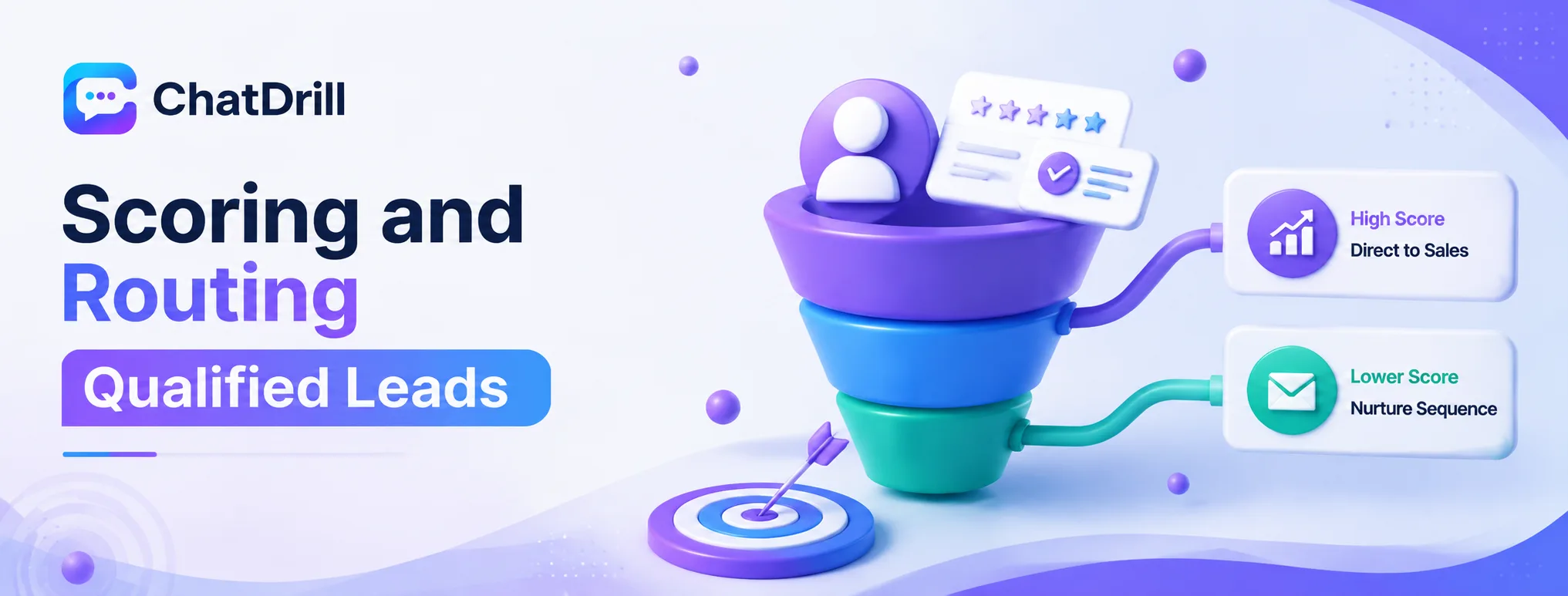
Effective scoring weights each answer based on how strongly it predicts genuine fit, while routing sends high-scoring leads directly and immediately to sales, with lower scores flowing into a nurture sequence rather than being discarded entirely.
Weighting answers by predictive strength
Not every qualifying question carries equal weight, a specific budget confirmation typically predicts genuine intent more strongly than a general interest statement, and scoring should reflect that difference.
Reviewing which specific answers actually correlated with eventual closed deals, once enough data exists, helps refine these weights toward genuinely predictive accuracy rather than initial assumptions.
Setting a sensible routing threshold
The score threshold for immediate sales routing should reflect a genuine confidence level, not an arbitrarily chosen number, worth calibrating based on real conversion data as it becomes available.
Setting this threshold too low floods sales with low-quality leads; setting it too high risks missing genuinely qualified leads that scored just below an overly conservative cutoff.
Nurturing rather than discarding lower scores
A lead that doesn't clear the immediate-routing threshold isn't necessarily worthless, worth flowing into an automated nurture sequence rather than being dropped entirely from further follow-up.
This nurture path captures value from leads that may become genuinely qualified later, once their timeline or budget situation evolves.
Common Qualification Mistakes to Avoid
The most common mistakes are asking too many questions upfront, using generic questions that don't reveal genuine signal, and never revisiting scoring weights based on real conversion outcomes over time.
Asking too many questions upfront
A long qualification sequence drops completion rates fast, two to three focused questions consistently outperform a longer, more exhaustive intake process.
The better approach is asking the minimum needed for an initial score, then gathering additional detail conversationally as the relationship develops further.
Using generic, non-differentiating questions
A question that every visitor answers similarly, regardless of actual fit, wastes a valuable qualification opportunity without providing genuinely useful signal.
Reviewing whether each question in your flow actually differentiates qualified from unqualified leads, based on real outcome data, catches this gap.
Never revisiting scoring weights
Scoring weights set once at initial launch, and never revisited against actual conversion outcomes, tend to drift out of alignment with what genuinely predicts a qualified lead over time.
A periodic review comparing scored leads against their eventual outcomes keeps the scoring model accurate as your business and customer base evolve.
Measuring Qualification Success
Measuring success means tracking what percentage of AI-scored qualified leads actually convert to real pipeline, how sales feels about the quality of leads they're receiving, and whether the automated flow is genuinely faster than the manual process it replaced.
Tracking conversion of scored leads to pipeline
The clearest measure of qualification success is whether leads scored as qualified actually convert into genuine sales opportunities at a meaningfully higher rate than unscored or lower-scored leads.
This data, tracked over time, also feeds directly back into refining scoring weights toward greater predictive accuracy.
Getting direct feedback from sales
Beyond the raw conversion numbers, directly asking the sales team whether lead quality genuinely feels improved provides a qualitative check the numbers alone might miss.
This feedback loop, done regularly rather than once at launch, catches a scoring model that's technically converting well but still frustrating the sales team in some specific, addressable way.
Comparing speed against the prior manual process
Measuring how much faster a qualified lead reaches sales under the automated flow, compared to whatever manual process it replaced, quantifies one of the clearest, most concrete benefits of the investment.
This speed improvement is often the easiest benefit to demonstrate concretely when justifying the qualification system's value internally.