

Live chat's ROI is genuinely calculable, but only if you account for the multiple ways it generates value, recovered sales, reduced support costs, and new lead conversion, rather than looking at just one of these in isolation and understating the real picture.
The formula itself is straightforward once you have the right inputs, the harder part is actually gathering accurate numbers for each value category and being honest about the full cost side of the equation too.
Getting this calculation right matters for making a genuine business case, whether you're justifying continued investment, deciding between platforms, or expanding chat coverage to more of your business.
This guide covers the core formula, what to include on both sides of the equation, a practical calculation approach, and mistakes worth avoiding.
Quick answer: Live chat ROI equals the total value generated (recovered sales, support cost savings, and new leads converted) minus the total cost of running chat (platform fees and staff time), divided by that total cost, expressed as a percentage.
The Core Live Chat ROI Formula
The core formula is total value generated minus total chat cost, divided by total chat cost, expressed as a percentage, capturing the net return relative to what you're actually spending.
The formula itself
ROI equals (total value generated minus total cost) divided by total cost, multiplied by 100 to express it as a percentage, a standard ROI structure applied specifically to chat's inputs and outputs.
This structure forces clarity about what actually counts as value and what actually counts as cost, both of which deserve careful, honest definition before plugging in any numbers.
Why both sides need equal rigor
Overstating value while understating cost, or the reverse, produces a number that looks impressive or damning but doesn't reflect genuine business reality.
Applying the same rigor to both sides of the calculation is what makes the resulting ROI figure genuinely useful for decision-making rather than just a persuasive-looking number.
What to Include in Total Value Generated
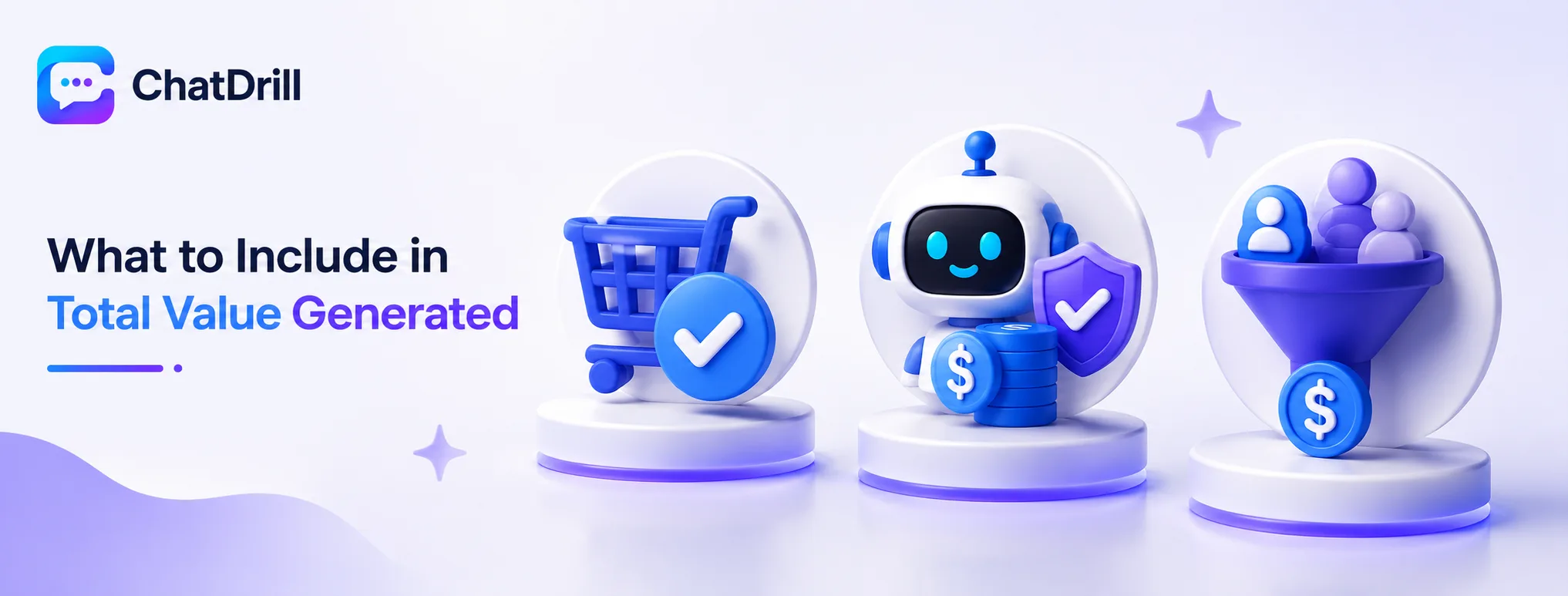
Total value includes recovered sales from cart or checkout interventions, support cost savings from AI deflection, and new revenue from chat-qualified leads that convert.
Recovered sales from chat interventions
Tracking sales specifically attributable to a chat conversation, a triggered cart-recovery message that led to a completed purchase, quantifies chat's direct revenue contribution.
This tracking requires connecting chat engagement data to actual purchase outcomes, worth setting up explicitly if not already in place.
Support cost savings from AI deflection
Multiplying the number of conversations AI resolves without human involvement by your average cost per human-handled contact quantifies the labor cost genuinely saved.
This calculation benefits from a fully loaded cost-per-contact figure, agent time, overhead, tooling, rather than just base salary, to avoid understating the real savings.
Revenue from chat-qualified leads
Tracking the eventual closed revenue from leads originally qualified or captured through chat quantifies this often-significant but easy-to-overlook value category.
This requires connecting chat data to your CRM's closed-won data, worth confirming is genuinely tracked if you haven't calculated this specific figure before.
What to Include in Total Chat Cost
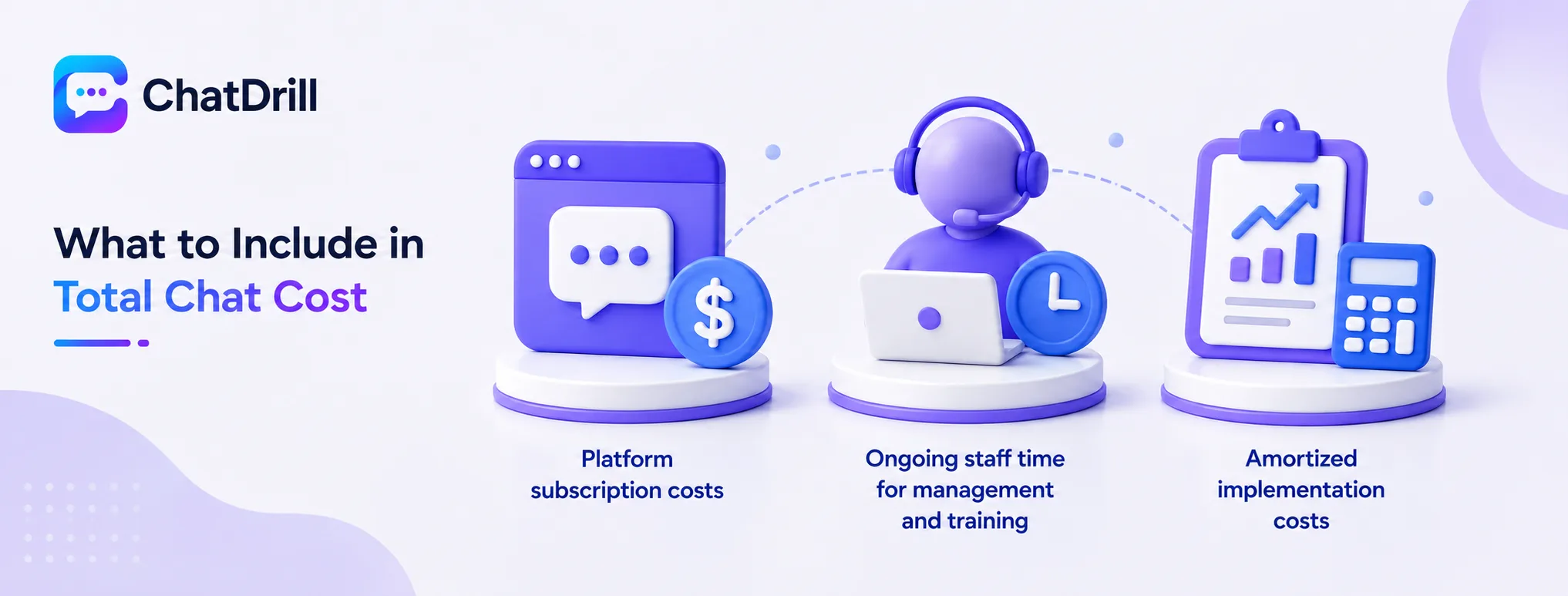
Total cost includes your chat platform's subscription fee, any ongoing staff time spent managing and training the AI, and implementation or setup costs amortized over a reasonable period.
Platform subscription costs
Your chat platform's recurring subscription fee is the most straightforward cost input, typically available directly from your billing records.
This should reflect your actual current plan cost, not a promotional or introductory rate that may not persist long-term.
Ongoing staff time for management and training
Time spent by staff maintaining AI training content, reviewing conversations, and managing configuration represents a genuine, often underestimated cost worth including explicitly.
Estimating this time reasonably, even if not tracked with perfect precision, produces a more honest total cost figure than omitting it entirely.
Amortized implementation costs
Initial setup time and any implementation costs, spread reasonably over a defined period like a year, should factor into cost especially in the early months after launch.
This amortization prevents an unfairly harsh first-year ROI calculation that doesn't reflect the ongoing, lower-cost reality once initial setup is complete.
A Practical Calculation Walkthrough
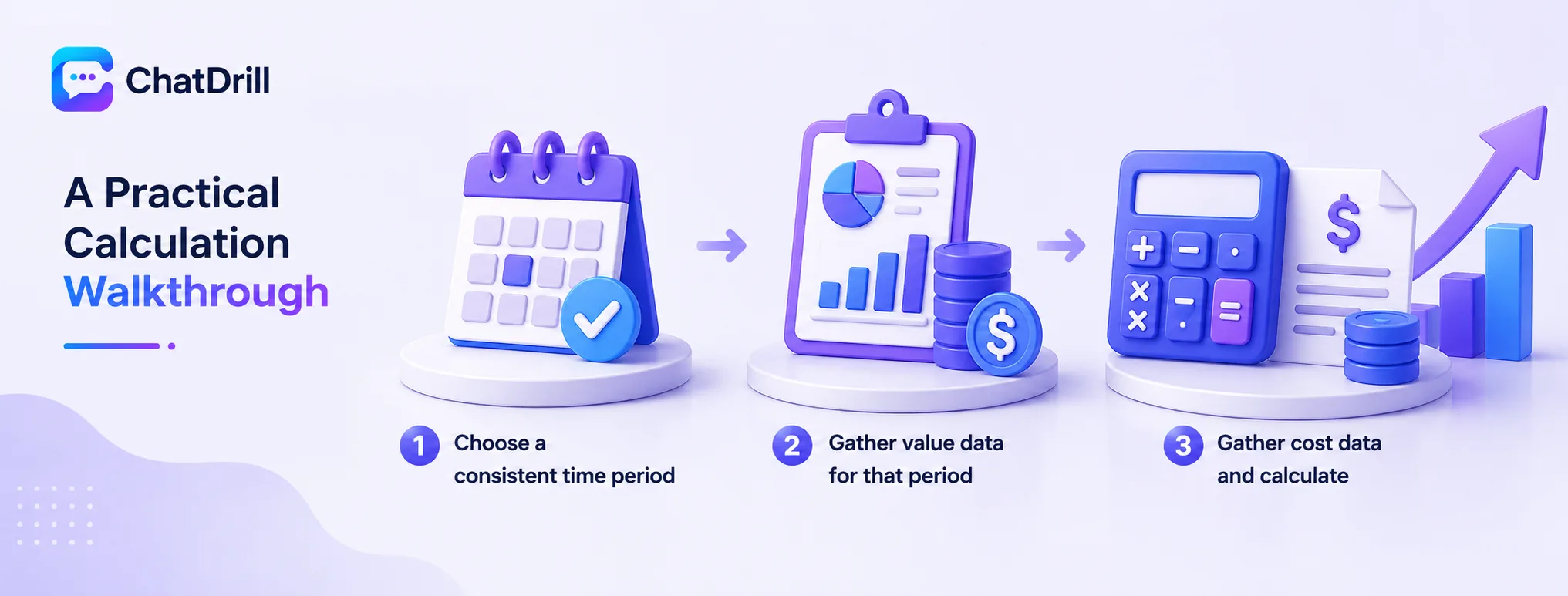
Calculating your actual ROI means gathering real data for each value and cost category over a consistent time period, then applying the formula to arrive at a defensible, honest figure.
Step 1: Choose a consistent time period
Selecting a specific period, typically a quarter or a year, for both value and cost data ensures you're comparing genuinely comparable figures rather than mismatched timeframes.
This consistency is a small but important detail that prevents an accidentally skewed calculation.
Step 2: Gather value data for that period
Pulling recovered sales, support cost savings, and chat-qualified lead revenue specifically for your chosen period, from your analytics and CRM data, provides the value side of the equation.
This step often takes the most effort, given how many disconnected systems the required data might live across.
Step 3: Gather cost data and calculate
Compiling platform fees, staff time cost, and amortized implementation cost for the same period completes the inputs needed to apply the formula directly.
Running the actual calculation, then sanity-checking the resulting percentage against your general business intuition, confirms the figure is plausible before presenting it further.
Common Mistakes in Calculating Chat ROI
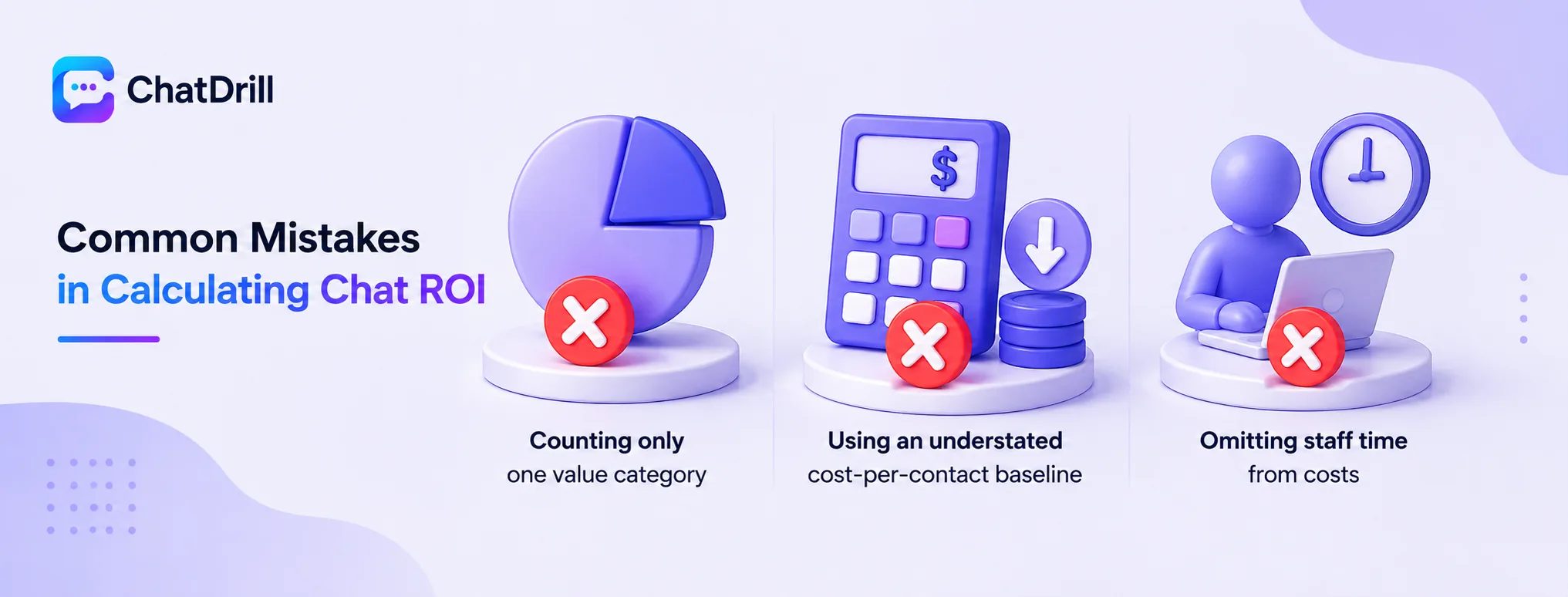
The most common mistakes are counting only one value category instead of all three, using an understated cost-per-contact figure, and omitting staff time from the cost side entirely.
Counting only one value category
Calculating ROI based only on support cost savings, while ignoring recovered sales and lead-generation revenue, significantly understates chat's genuine total value.
Including all three value categories, even with reasonable estimates where precise data is harder to gather, produces a more complete and honest picture.
Using an understated cost-per-contact baseline
Calculating support savings using only base agent salary, without overhead and tooling costs, understates the genuine savings from AI deflection.
A more complete, fully loaded cost figure produces a more accurate and ultimately more persuasive ROI calculation.
Omitting staff time from costs
Presenting only platform subscription cost, while ignoring the genuine staff time spent on ongoing management, overstates the net ROI by understating the real cost side.
Including a reasonable estimate of this time, even if not tracked with perfect precision, keeps the calculation honest and defensible.