
A landing page's entire job is converting a specific, focused visitor intent into a specific, focused action, and every unanswered question a visitor has represents a real risk they'll leave to find that answer elsewhere, or simply give up.
Live chat addresses this directly by giving visitors a way to resolve hesitation without leaving the page, keeping them in the conversion flow rather than losing them to a search for information your landing page didn't include.
The businesses seeing the clearest lift from this tactic aren't just adding a generic chat widget, they're identifying the specific objections that landing page's traffic typically has and addressing those directly through both proactive messaging and AI training.
This guide covers why chat fits landing pages specifically well, how to identify what to address, a practical implementation approach, and mistakes worth avoiding.
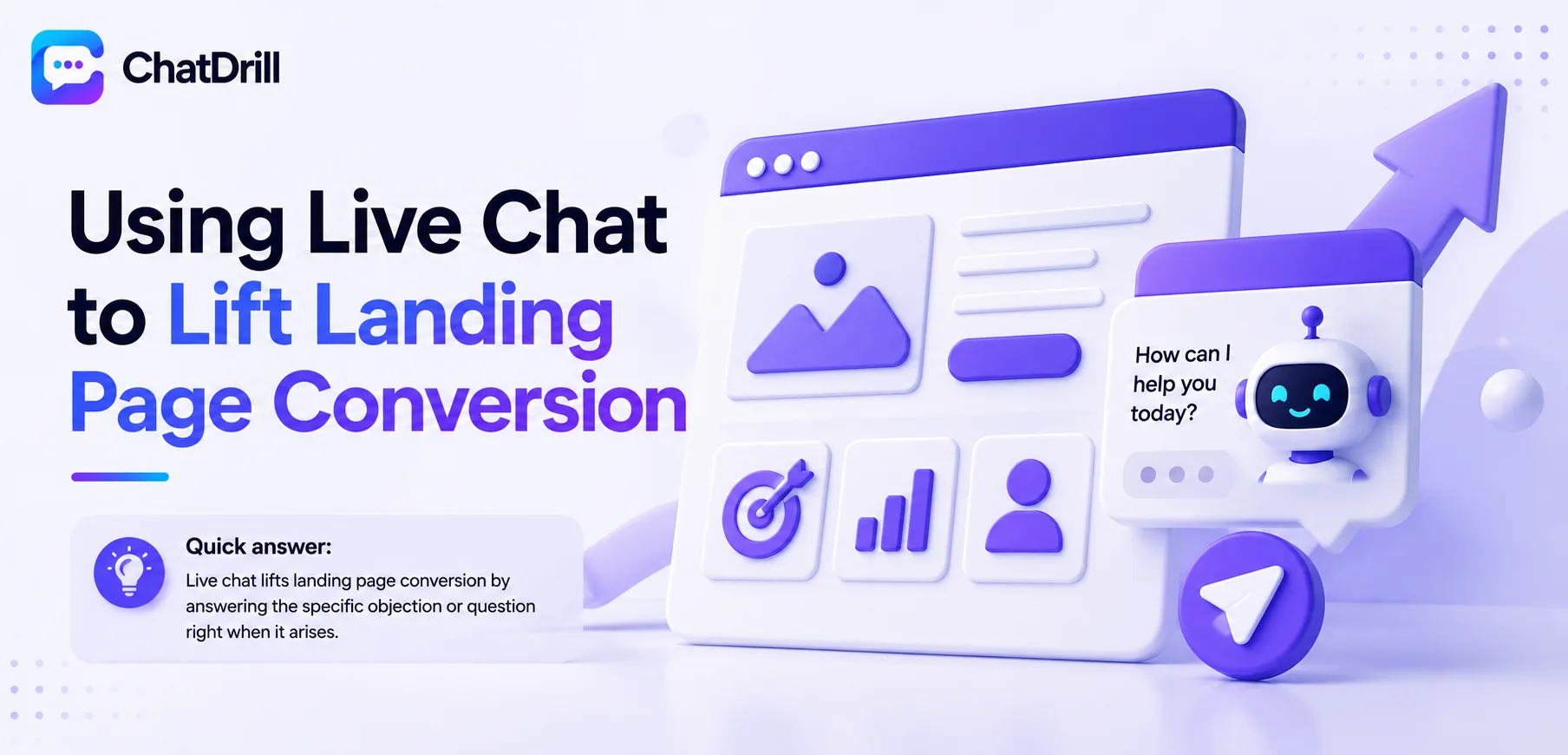
Quick answer: Live chat lifts landing page conversion by answering the specific objection or question keeping a visitor from converting right at the moment it arises, functioning as a real-time alternative to the visitor leaving the page to search for an answer elsewhere.
Why Chat Fits Landing Pages Particularly Well
A landing page's focused, single-purpose design makes it easier to predict what specific hesitation a visitor might have, letting chat address that hesitation directly rather than generically.
The focused-intent advantage
Unlike a general website page with many possible visitor intents, a landing page typically drives from a single campaign or traffic source with a genuinely predictable, narrower set of likely questions.
This predictability makes it considerably easier to design chat triggers and AI training that address the actual, most common hesitation for that specific page's traffic.
Keeping visitors in the conversion flow
A visitor who leaves your landing page to search for an answer, even briefly, risks not returning, either finding a competitor's answer instead or simply losing momentum.
Chat that resolves the question right on the page keeps that conversion momentum intact, addressing the exact friction point without requiring the visitor to leave.
Identifying What to Address on Your Landing Page
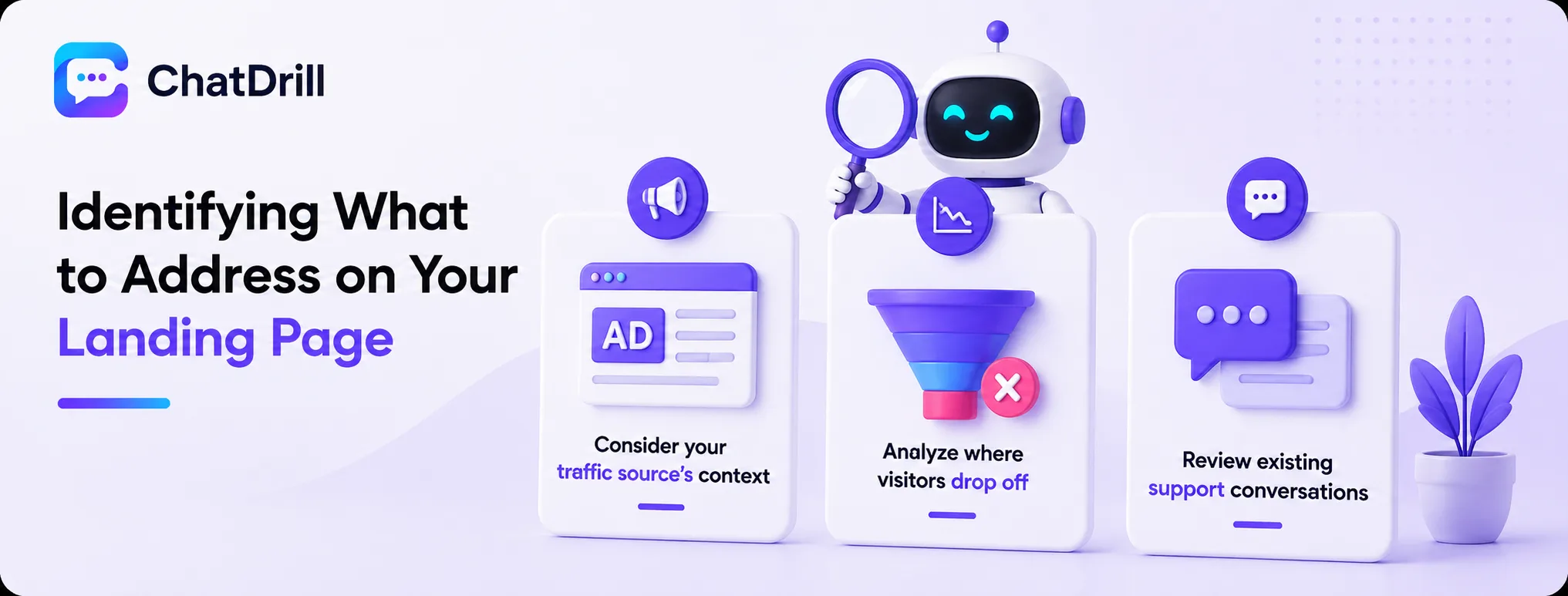
Identifying what chat should address means reviewing your actual traffic source's likely context, analyzing where visitors currently drop off, and checking existing support conversations for recurring related questions.
Considering your traffic source's context
A visitor arriving from a specific ad campaign or referral source often carries a particular expectation or question shaped by whatever messaging brought them to the page.
Reviewing what your ad copy or referral context actually promised reveals what a visitor might reasonably expect chat to help clarify or confirm.
Analyzing where visitors currently drop off
Reviewing analytics for where visitors typically abandon the page, a specific section, right before a form, reveals where hesitation is concentrated and worth addressing proactively.
This drop-off data is often more revealing than assumption alone, since the actual friction point isn't always what internal stakeholders initially expect.
Reviewing existing related support conversations
Checking past support tickets or chat conversations related to whatever this landing page is promoting reveals genuine, recurring questions worth addressing directly on the page itself.
This grounding in real customer language also helps write more natural, relevant trigger messaging than a generic assumption would produce.
Implementation Approach for Landing Page Chat
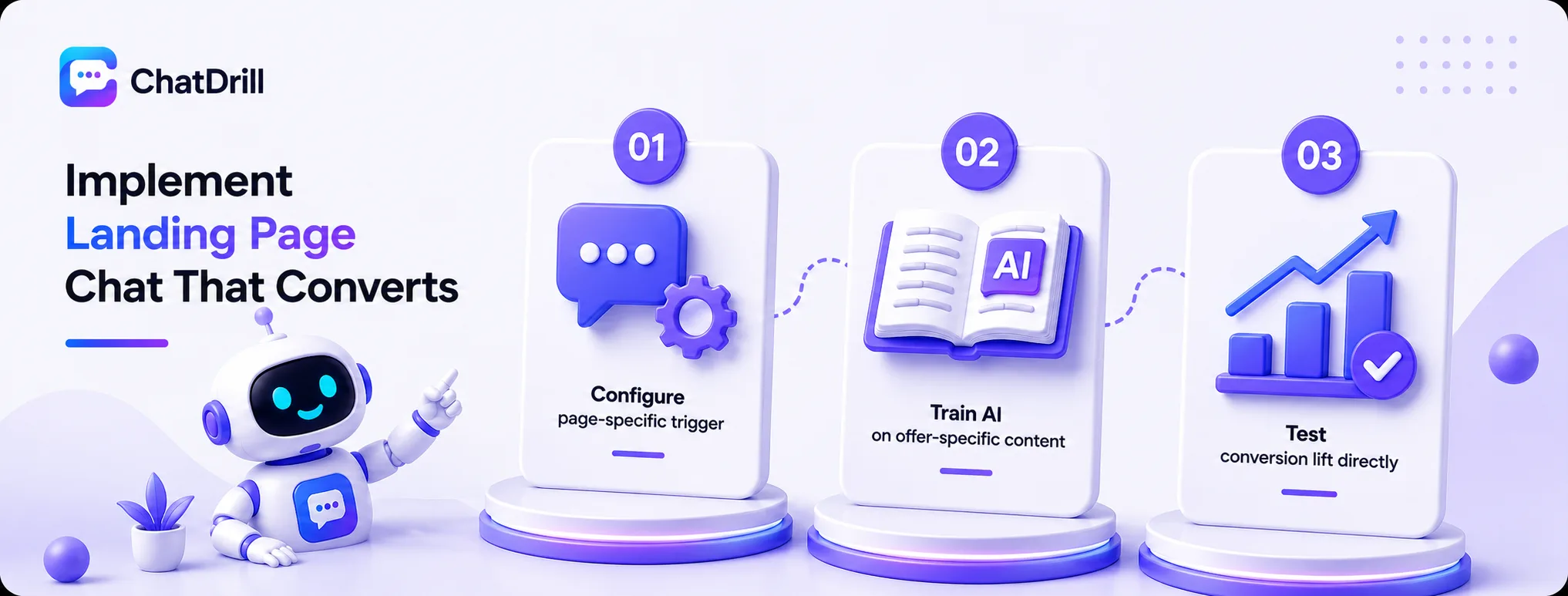
Step 1: Configure a page-specific trigger
identified hesitation, trains AI on content specific to this landing page's offer, and tests the resulting conversion lift directly against a control.
Step 1: Configure a page-specific trigger Setting up a trigger unique to this landing page, referencing the specific offer or campaign context, rather than a generic site-wide message, addresses the predictable hesitation this traffic actually has.
This specificity is what separates a genuinely effective landing page chat setup from simply having chat present on the page without real tailoring.
Step 2: Train AI on offer-specific content
Feeding AI genuine details about this specific offer, promotion, or campaign ensures it can answer questions with real accuracy rather than generic product information that might not match what the ad promised.
This training should be reviewed and updated whenever the underlying campaign or offer changes, keeping the chat experience aligned with what actually drove the visitor there.
Step 3: Test conversion lift directly
Comparing conversion rates between visitors who engage with chat and those who don't, ideally through a genuine A/B test with chat present versus absent, quantifies the actual lift chat is providing.
This direct measurement confirms whether the investment in landing-page-specific chat configuration is delivering real business value.
Common Mistakes With Landing Page Chat
The most common mistakes are using the same generic chat setup as the rest of the site, failing to align chat training with the specific offer, and not measuring whether chat actually lifted conversion versus just assuming it did.
Generic, non-page-specific setup
Deploying the same chat trigger and training used elsewhere on the site to a landing page misses the opportunity to address this page's genuinely predictable, specific hesitation directly.
A landing-page-specific configuration, even a relatively simple one, tends to outperform a generic setup given how much more targeted it can be.
Misalignment between chat and the actual offer
AI giving generic product information when a visitor arrived expecting details about a specific promotion or campaign creates a disconnect that can undermine rather than support conversion.
Keeping chat training current with whatever the landing page is actually promoting at any given time avoids this credibility gap.
Not measuring actual conversion lift
Assuming chat is helping without directly measuring conversion rate differences risks continuing an investment that isn't actually delivering the value assumed.
A genuine test comparing conversion with and without chat confirms whether the tactic is working for this specific page rather than relying on general assumption.