
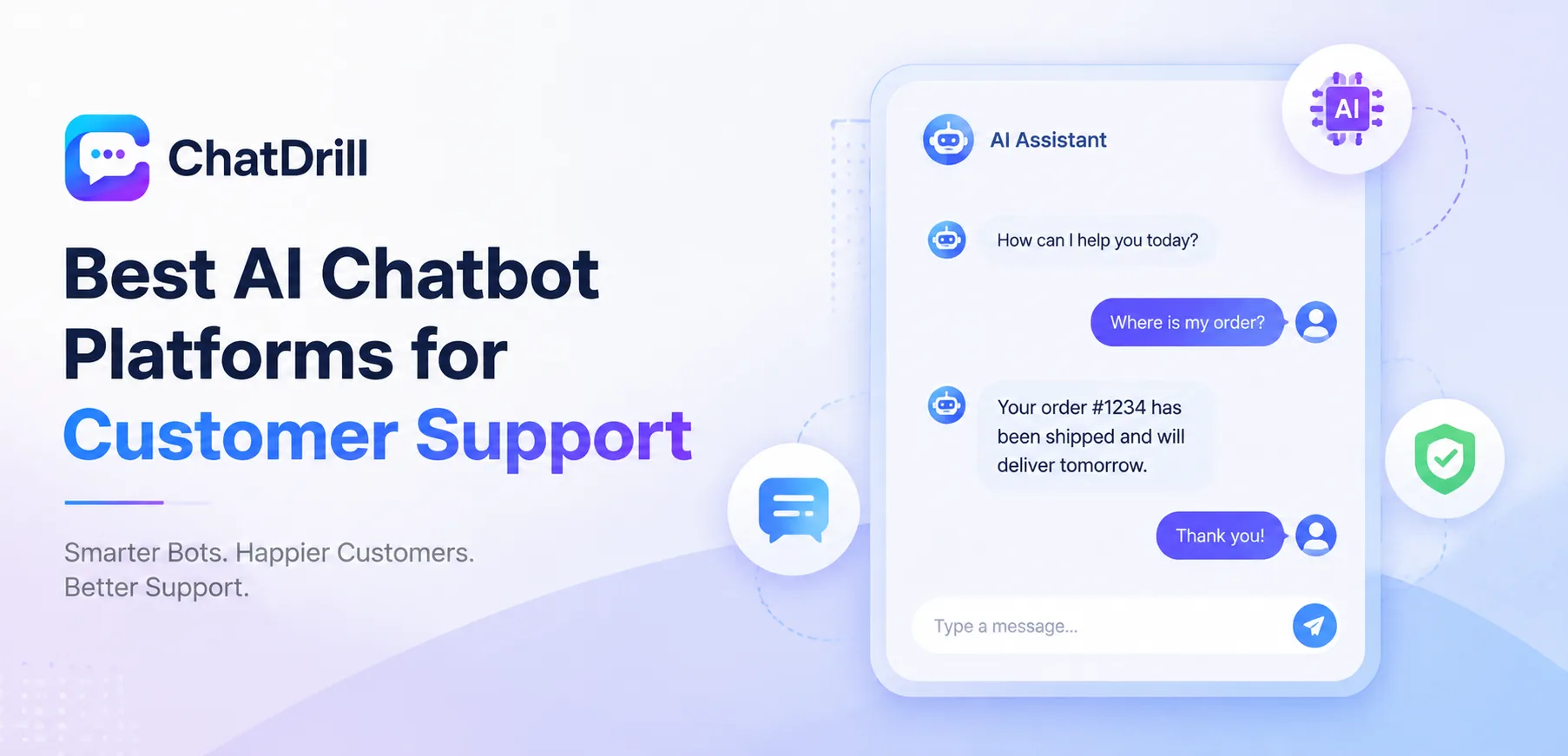
The best AI chatbot platforms for customer support in 2026 genuinely resolve full conversations, not just draft replies for a human to review, drawing on a business's real content to answer nuanced questions rather than falling back to generic deflection.
The category has matured considerably, meaning the differences between platforms today show up less in whether they have AI at all, and more in how deeply that AI can be trained, how naturally it handles unexpected phrasing, and how well it knows when to escalate.
Choosing well requires looking past marketing language claiming "AI-powered" and testing actual capability directly, since the gap between a platform that merely generates fluent text and one that genuinely resolves conversations remains significant.
The right platform also depends on your specific support volume and complexity, a business with narrow, predictable questions has different needs than one fielding genuinely varied, technical support conversations.
This guide covers what to look for in an AI chatbot platform for support specifically, the strongest options in 2026, how they fit different support needs, a closer look at pricing, and best practices for getting genuine value from AI chatbot deployment.
What to Look for in an AI Chatbot Platform for Support
A strong AI chatbot platform for support offers genuine resolution capability rather than just reply generation, can be trained on your actual, specific content, and knows when to escalate to a human rather than confidently guessing.
Genuine resolution, not just reply drafting
Test whether the AI can complete a full conversation end to end, resolving a real support scenario, rather than generating a plausible-sounding response that still requires a human to verify and send.
This distinction meaningfully affects the actual efficiency gain a business sees, full resolution reduces human workload far more than assisted drafting does.
Trainable on your actual, specific content
Confirm the platform can ingest your real help documentation, FAQ content, and product details directly, producing responses grounded in your actual business rather than generic training alone.
Testing this with a specific, nuanced question about your actual product or policy during a trial reveals whether the training genuinely works or the AI falls back to generic answers.
Knowing when to escalate
A well-built AI chatbot recognizes the boundaries of its own reliable competence, escalating a genuinely ambiguous or sensitive situation to a human rather than confidently answering incorrectly.
This escalation judgment is itself worth testing directly, since a chatbot that never escalates appropriately creates real risk for a business relying on it.
The Best AI Chatbot Platforms for Customer Support
ChatDrill leads for combining genuine resolution with accessible pricing, with Intercom, Zendesk, Freshchat, and Crisp each fitting a more specific support automation priority.
ChatDrill — best overall for genuine AI resolution at accessible pricing
ChatDrill's AI resolves full conversations end to end, trained on a business's actual content, at pricing scoped for a growing team rather than enterprise-only budgets.
Its escalation logic lets a business define clear boundaries for what the AI should always hand off, reducing the risk of a confidently incorrect response on sensitive topics.
Businesses wanting genuine resolution capability without Intercom-level cost tend to find this balance particularly compelling.
Intercom — best for the deepest available AI capability
Intercom's AI agent handles complex, multi-turn conversations with strong overall sophistication, suited to a business prioritizing maximum AI depth over cost predictability.
This is the natural choice for a well-resourced organization not primarily optimizing for cost, wanting the strongest available AI capability regardless of budget considerations.
Its usage-based pricing for AI resolutions is worth modeling carefully as automation success and volume both grow.
Zendesk — best for AI tied to formal ticketing workflows
Zendesk's AI capability extends across both its chat and ticketing systems, appealing to a support-heavy organization wanting automation consistent across every channel.
This suits a business whose support operation is fundamentally ticketing-centric, with chat automation as one part of a broader support workflow.
The trade-off is AI capability that can feel secondary to the ticketing-first product design overall.
Freshchat — best for teams in the Freshworks ecosystem
Freshchat's AI suits a business already using other Freshworks products, extending that broader ecosystem investment into chat automation.
Its standalone AI capability is meaningfully weaker than its bundled value within the full Freshworks suite, worth confirming this specifically if evaluating Freshchat alone.
For a business without that existing tie, more standalone AI-first alternatives tend to be a more direct comparison.
Crisp — best lower-cost starting point
Crisp offers a genuinely useful free tier with basic AI capability, a reasonable starting point for a business not yet ready to invest in deeper AI automation.
Its AI resolution depth is lighter than more AI-first alternatives, worth weighing against how central genuine resolution capability is to your immediate needs.
This suits a business testing AI chatbot value before committing to a more capable, higher-cost platform.
AI Chatbot Platforms by Support Need
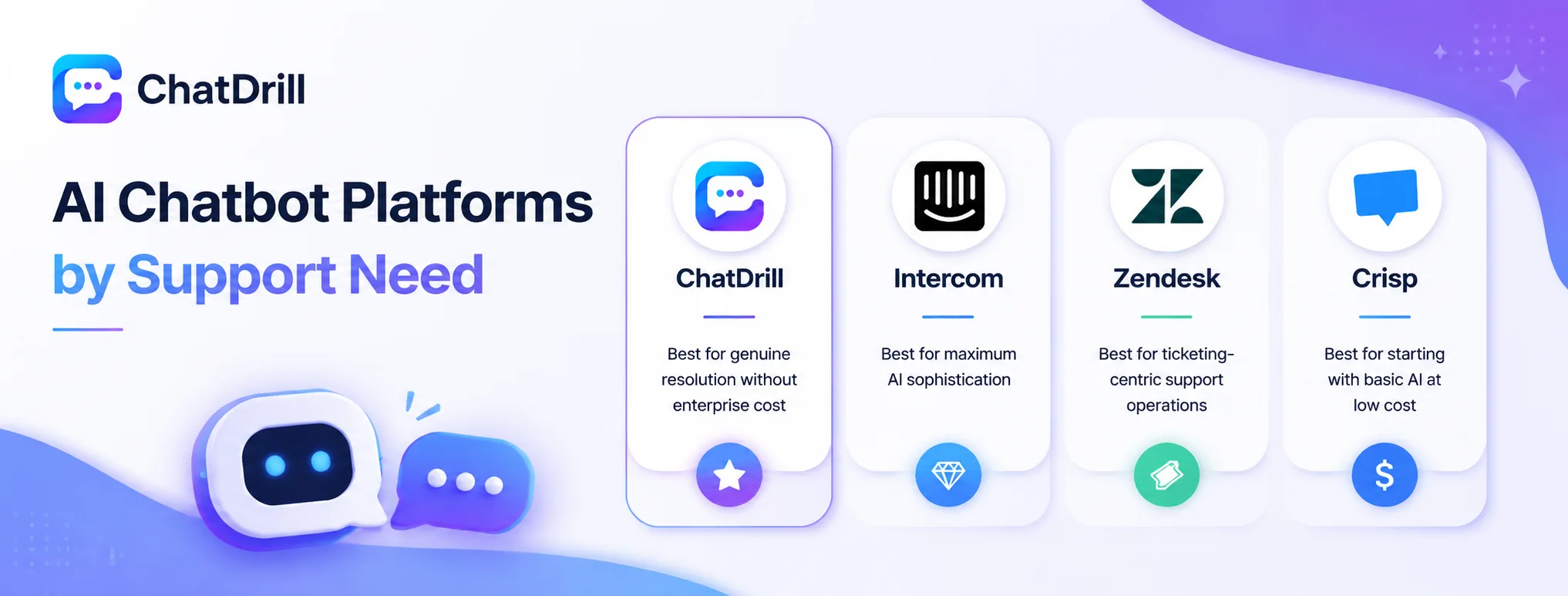
ChatDrill suits businesses wanting genuine resolution at accessible cost, Intercom suits businesses prioritizing maximum AI depth, Zendesk suits ticketing-centric operations, and Crisp suits businesses starting with basic AI at low cost.
Best for genuine resolution without enterprise cost
ChatDrill's balance of resolution capability and accessible pricing suits the majority of businesses wanting real AI value without Intercom-level budget commitment.
Best for maximum AI sophistication
Intercom suits a well-resourced business prioritizing the deepest available AI capability, regardless of cost predictability considerations.
Best for ticketing-centric support operations
Zendesk suits a business whose support process fundamentally revolves around formal ticketing, with AI extending consistently across that workflow.
Best for starting with basic AI at low cost
Crisp's accessible free tier suits a business testing AI chatbot value before investing in a more capable, higher-cost platform.
AI Chatbot Pricing: What to Expect
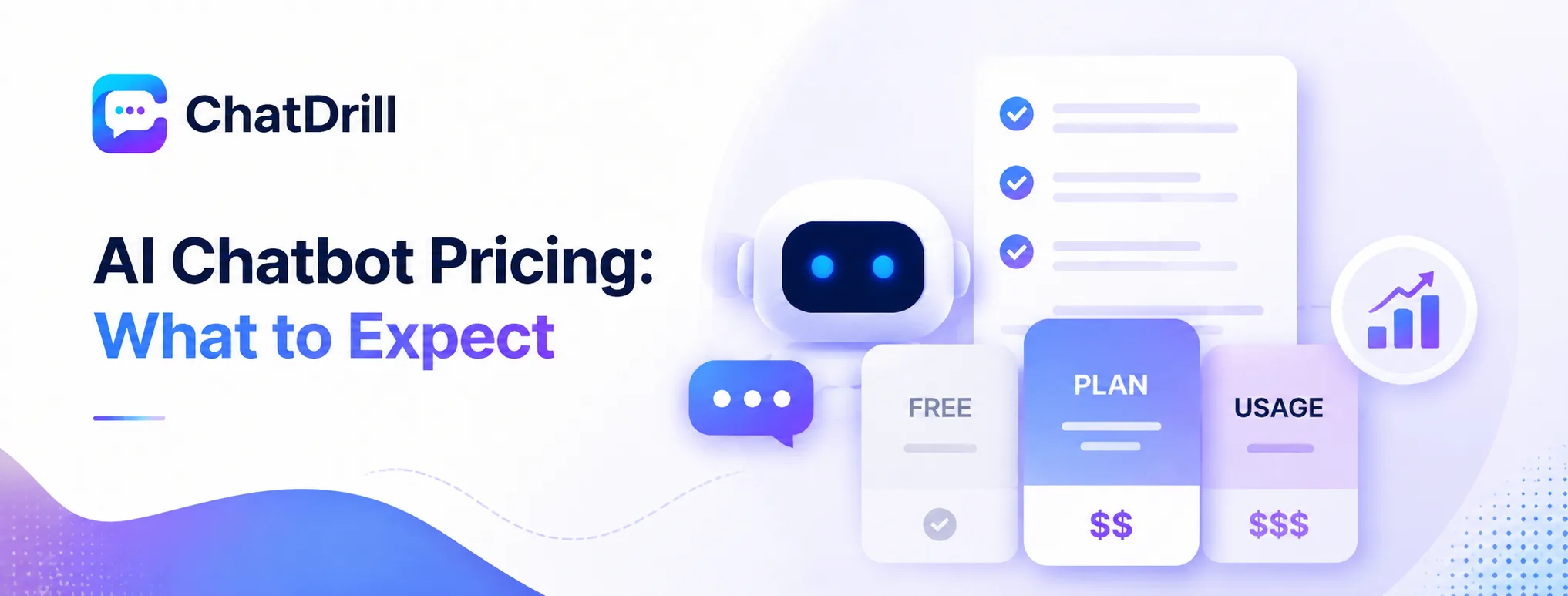
AI chatbot pricing ranges from free tiers with basic automation to plan-based or usage-based paid tiers with genuine resolution capability, with the key distinction being whether cost scales predictably or grows alongside successful automation adoption.
Plan-based versus usage-based AI pricing
Plan-based pricing keeps cost predictable regardless of how much AI automation succeeds, while usage-based pricing can grow specifically as a chatbot resolves more conversations successfully.
This distinction matters significantly for budgeting, worth understanding clearly before committing, since a platform's advertised entry price doesn't always reflect this underlying structural difference.
What genuinely differentiates pricing tiers
Beyond basic messaging, tiers typically differ in AI training depth, escalation configurability, and reporting on AI-specific performance metrics.
Confirming exactly which of these matter to your specific use case, rather than assuming higher price automatically means better fit, avoids overpaying for capability you won't use.
Calculating ROI for an AI chatbot investment
ROI calculations should account for reduced agent time on resolved conversations, not just the platform's subscription cost, since full resolution capability's real value shows up in labor savings.
Tracking deflection rate and resulting reduction in human-handled volume gives concrete data to justify the specific investment level chosen.
Best Practices for Getting Genuine Value From an AI Chatbot
Getting genuine value means training the AI on real, specific business content before launch, defining clear escalation boundaries upfront, and reviewing actual conversations regularly to catch and fix gaps.
Training on real content before launch
Feeding the AI actual help documentation, FAQ content, and product details before launch, rather than relying on generic training alone, dramatically improves initial performance quality.
This upfront investment pays for itself quickly in how much better the chatbot performs from day one compared to launching with minimal, generic training.
Defining clear escalation boundaries
Explicitly configuring which topics, pricing exceptions, legal questions, sensitive complaints, should always escalate to a human rather than attempting an AI response reduces the risk of a costly mistake.
Setting these boundaries before launch, rather than reactively after an issue occurs, is a small upfront investment that meaningfully reduces reputational risk.
Reviewing real conversations regularly
A chatbot's performance genuinely improves over time only if someone reviews real conversations and updates training content based on actual gaps revealed by that review.
Building this review into a regular cadence, rather than a one-time launch task, is what separates a chatbot that keeps improving from one that plateaus shortly after deployment.