
An early-stage startup needs customer support tooling that can be set up in an afternoon, costs little to nothing at low volume, and doesn't require a dedicated support hire to manage, priorities that look very different from what a mature support organization optimizes for.
Most enterprise-grade support platforms are built around exactly the opposite priorities, deep configurability, complex routing, extensive reporting, none of which a two or three person founding team has the time or need to use in the first year.
The right tool at this stage is one that gets out of the way: fast to install, cheap or free at low volume, and capable of automating just enough of the repetitive work that a founder answering support messages between other tasks isn't overwhelmed.
As the company grows, the tool that made sense on day one won't necessarily be the right one at fifty customers or five hundred, which is worth planning for even while making the initial choice.
This guide covers what a startup should actually look for, the strongest tools available in 2026, how they fit different early-stage priorities, a closer look at pricing at startup scale, and what to watch for as the tool needs to scale alongside the company.
What Early-Stage Startups Actually Need From Support Tools
Early-stage startups need support tools that install quickly without developer time, cost little or nothing at low conversation volume, and include enough automation that a small, non-specialized team isn't overwhelmed by repetitive questions.
Speed of setup over depth of configuration
A founder or early hire setting up support tooling rarely has a spare week to configure it, making a tool that works well with sensible defaults far more valuable than one with more configuration options.
This priority inversely correlates with what enterprise buyers often value most, extensive customization, making many enterprise-oriented platforms a poor fit at this specific stage.
Cost that scales with actual usage, not assumed future scale
A startup's chat or ticket volume in month one bears little resemblance to month twelve, making a tool with a genuinely usable free tier or low-cost entry point far more sensible than committing to enterprise pricing upfront.
Overpaying for capacity a startup won't use for months, or years, ties up capital better spent elsewhere in an early-stage business.
Enough automation to prevent founder burnout
Without some automation, a founder handling support alongside product and sales work can quickly become overwhelmed by even a modest, repetitive volume of the same few questions.
Even basic AI or rule-based automation covering the most common questions frees meaningful time for the actual founder-level work that a support tool itself can't replace.
What to Look for in a Startup Support Tool
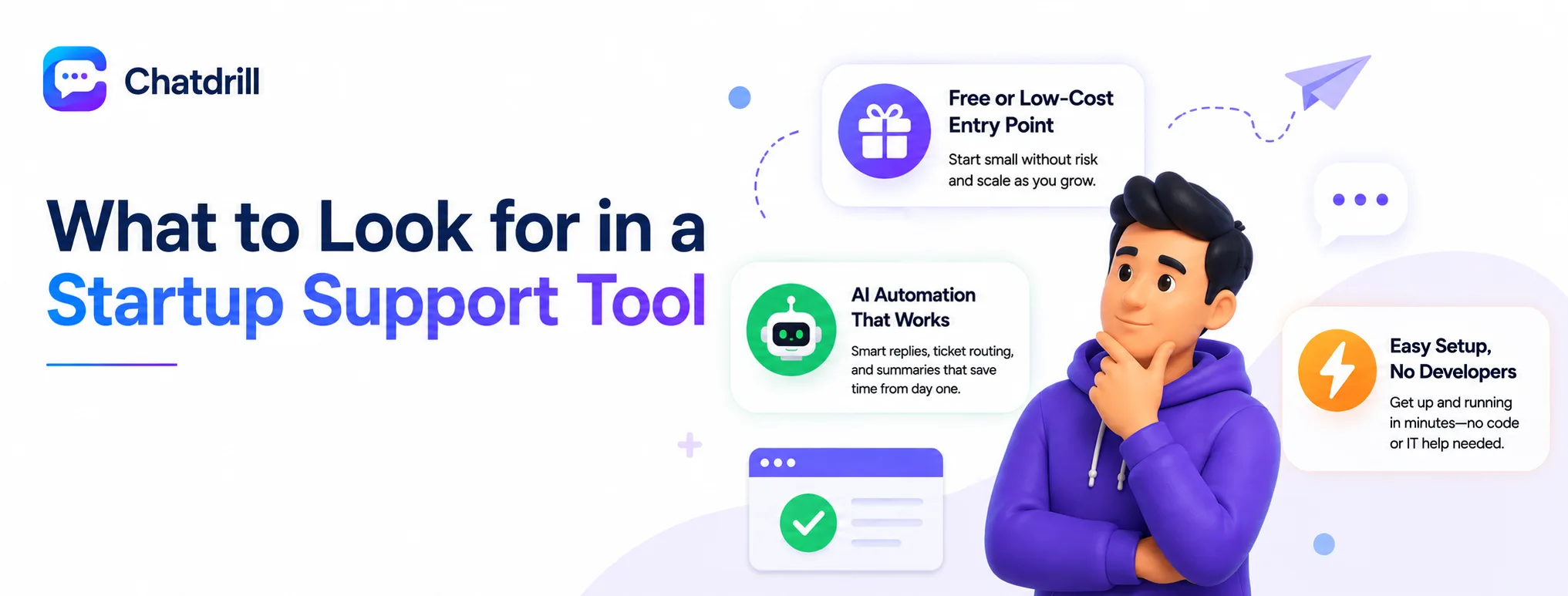
A strong support tool for a startup offers a genuinely usable free tier or low-cost entry point, AI automation that works well without heavy configuration, and a setup process that doesn't require developer involvement to get live.
A genuinely usable free tier
Look specifically for a free tier that includes real functionality, not just a crippled trial meant to force an early upgrade, since a startup genuinely needs to operate on this tier for a meaningful stretch of time.
Testing the free tier directly against your actual expected early-stage volume reveals whether it's a real starting point or a thinly disguised sales funnel.
AI automation with minimal setup
A startup rarely has the time to spend weeks training a chatbot, so AI that performs reasonably well with a small amount of initial content, an FAQ page, basic product info, matters more than maximum configurability.
Testing this directly with a handful of real customer questions during a trial confirms whether the AI genuinely helps or requires more setup investment than a small team can spare.
No developer required to get live
A tool that installs through a simple script or plugin, without needing engineering time to integrate, keeps support tooling from competing with product development for scarce early-stage engineering resources.
This matters even for a technical founding team, since engineering time is almost always better spent on the product itself than on support tool integration in the earliest months.
The Best Customer Support Tools for Early-Stage Startups
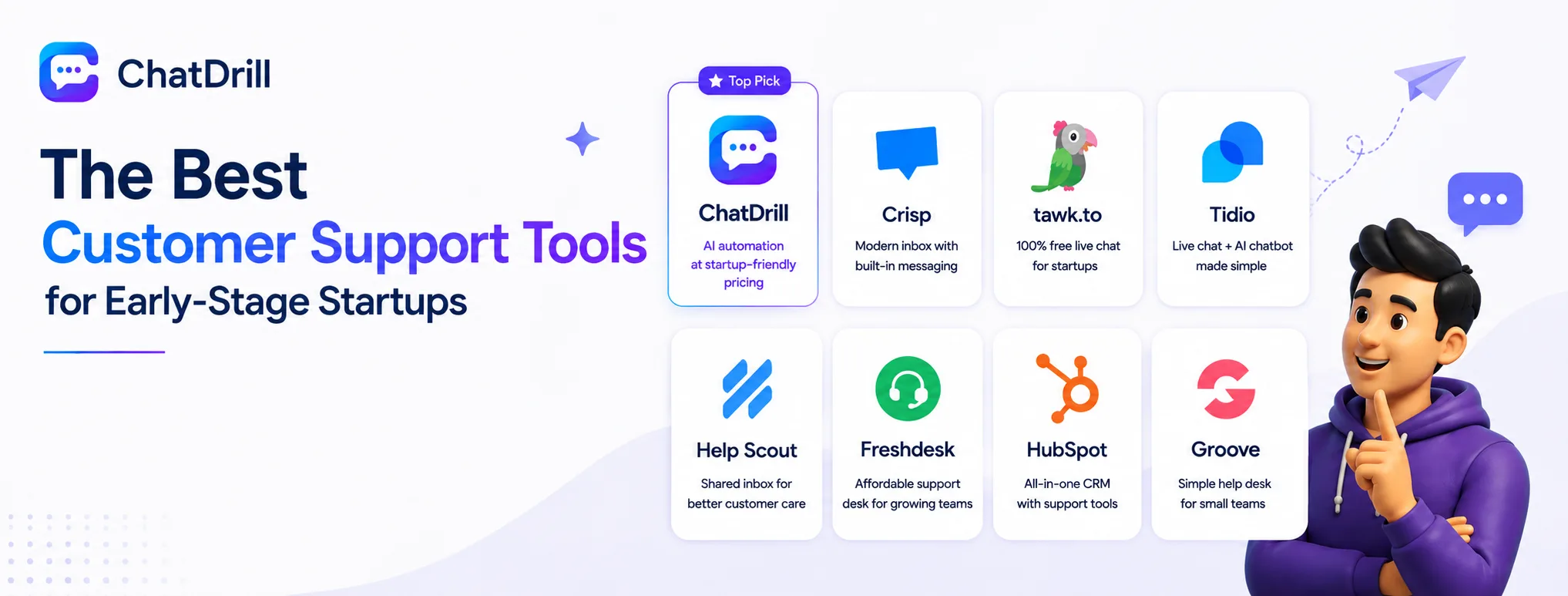
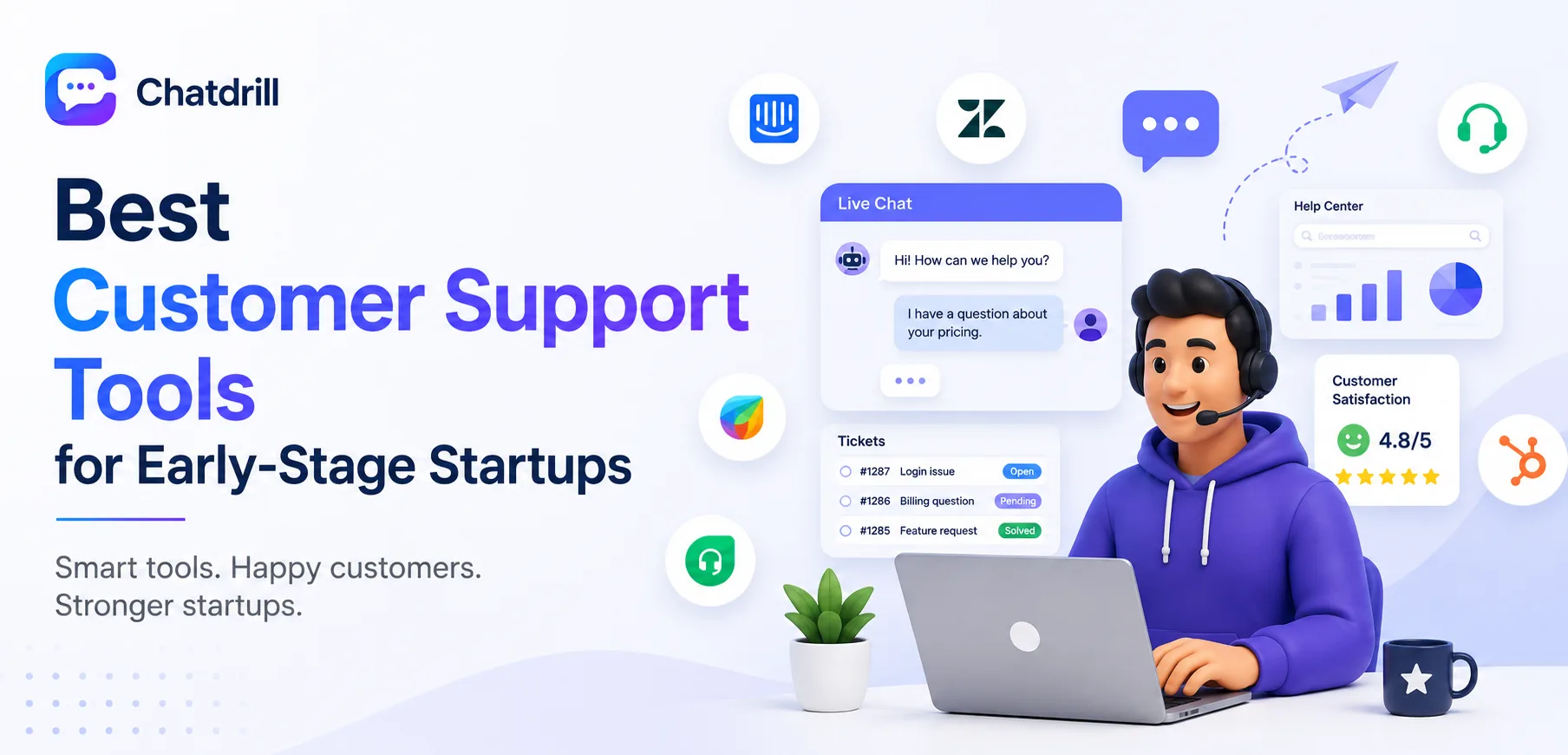
ChatDrill leads for AI automation at startup-friendly pricing, with Crisp, tawk.to, Tidio, Help Scout, Freshdesk, HubSpot, and Groove each fitting a more specific early-stage priority.
ChatDrill — best overall for startups wanting AI from day one
ChatDrill includes AI chatbot automation and a shared inbox in its entry-level paid plans, giving a startup meaningful automation without needing to wait until it can afford an enterprise platform.
Its setup is fast enough that a non-technical founder can have a working, AI-trained widget live within an afternoon, a genuine priority at this stage.
Startups specifically prioritizing early lead qualification alongside support tend to find this balance particularly well suited to a small team wearing multiple hats.
Crisp — best free tier for a genuinely zero-budget start
Crisp's free tier offers a real, usable unified inbox across chat and email, making it a sensible landing spot for a startup not yet ready to spend anything on support tooling.
Its co-browsing feature, while capped on the free tier, hints at deeper functionality available as the startup grows and eventually upgrades.
This is the natural first stop for a very early-stage team, with the expectation of reassessing needs once the free tier's limits become a genuine constraint.
tawk.to — best for unlimited agents at no cost
tawk.to remains the most fully free live chat widget available, with unlimited agents at no cost, appealing to a startup with several early hires all needing chat access.
AI automation requires a paid add-on, worth weighing against ChatDrill's included automation if AI is a genuine early priority rather than a later addition.
For a startup purely optimizing for cost with several team members needing access, this remains difficult to beat on price alone.
Tidio — best for an early-stage ecommerce startup
Tidio's product-aware AI chatbots suit an early ecommerce startup specifically, handling shopping and order questions with more relevance than a generic chat widget.
Its fast Shopify integration in particular reduces setup time for a founder already juggling many other early launch tasks.
Startups outside ecommerce are less likely to find Tidio's specific strengths as valuable compared to more general-purpose options on this list.
Help Scout — best for a lightweight, human-first approach
Help Scout's shared email inbox with a lighter chat layer suits a startup that wants simplicity and a personal touch over deep automation in its earliest support interactions.
This fits a startup whose founders want to personally handle every early customer interaction, rather than routing heavily through AI from the very start.
Its pricing and design both reflect a small-team focus, avoiding the enterprise complexity that would be wasted on a founding team this size.
Freshdesk — best for a startup that wants formal ticketing early
Freshdesk offers a free tier with genuine ticketing functionality, a reasonable choice for a startup anticipating a need for structured ticket tracking sooner rather than later.
This suits a startup in a more support-heavy industry, healthcare or fintech for instance, where formal ticket documentation matters even at a small scale.
Most consumer or lighter-touch B2B startups are unlikely to need this level of ticketing formality quite this early.
HubSpot — best for a startup building on HubSpot's free CRM
HubSpot's free CRM includes basic chat and ticketing, a natural fit for a startup already building its sales and marketing motion around HubSpot from the start.
The support tooling itself is lighter than a dedicated platform, but the CRM integration is genuinely native rather than bolted on.
For a startup not already committed to HubSpot's ecosystem, this advantage disappears, making other options a more direct comparison.
Groove — best simple, low-cost helpdesk for a small team
Groove offers a straightforward, lower-cost helpdesk built specifically with small teams in mind, without the complexity of an enterprise-oriented platform.
Its simplicity suits a startup that wants a small step up from a pure chat widget without jumping straight to a heavier, more configurable platform.
Teams anticipating rapid growth should weigh this against how much room Groove's simpler feature set leaves for future scaling needs.
Startup Support Tools by Priority
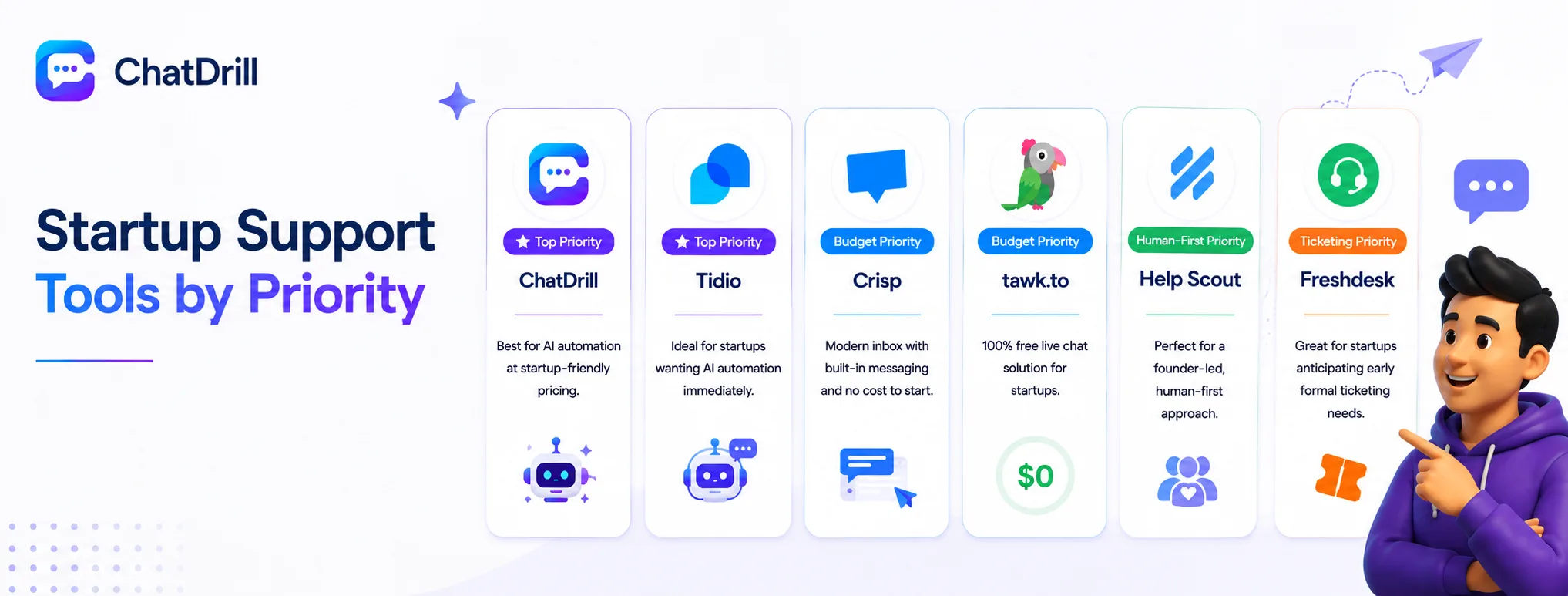
ChatDrill and Tidio suit startups wanting AI automation immediately, Crisp and tawk.to suit a genuinely zero-budget start, Help Scout suits a founder-led, human-first approach, and Freshdesk suits a startup anticipating early formal ticketing needs.
Best for AI automation from the earliest days
ChatDrill and Tidio both include AI that performs reasonably well without extensive setup, a priority for a founding team with no time to spend fine-tuning a chatbot.
Between the two, ChatDrill suits a broader range of early-stage businesses, while Tidio leans specifically toward ecommerce.
Best for a genuinely zero-budget start
Crisp and tawk.to both offer meaningful free access, letting a pre-revenue startup get support tooling live without any initial spend.
Either is a sensible starting point with the expectation of upgrading once the startup has revenue and a clearer sense of its actual support needs.
Best for a founder-led, human-first approach
Help Scout's lighter, more personal design suits a founding team that specifically wants to handle early customer conversations directly rather than routing through heavy automation.
This approach works well while volume is genuinely low, worth revisiting as conversation volume grows past what founders can personally sustain.
Best for early, formal ticketing needs
Freshdesk suits a startup in a more regulated or support-heavy industry that anticipates needing structured ticket documentation even at an early stage.
Most consumer and lighter B2B startups can reasonably defer this level of formality until later in their growth.
Startup Support Tool Pricing: What to Expect
At startup scale, pricing ranges from fully free to a modest monthly cost for AI-inclusive plans, with the key decision being whether to prioritize a longer free runway or pay modestly from the start for genuine automation.
What free tiers typically include and exclude
Free tiers generally cover basic chat and a shared inbox, with AI automation, advanced reporting, and deeper integrations reserved for paid plans across most platforms in this category.
Understanding this trade-off upfront avoids assuming a free tier covers everything a startup might eventually need as it grows.
When it's worth paying even at an early stage
If AI automation would meaningfully reduce a founder's time spent on repetitive support questions, a modest paid plan can be worth the cost well before revenue would otherwise justify software spend.
This calculation is worth revisiting specifically once support volume starts eating into time that could go toward product or sales work instead.
Planning for the next stage of growth
Choosing a tool with a reasonable growth path, rather than one that requires a disruptive full switch the moment the startup scales, saves a migration effort during an already busy growth phase.
This is worth weighing even at the earliest stage, since starting on a tool with no reasonable upgrade path can mean revisiting this whole decision sooner than expected.
What to Watch for as Your Startup Scales
As a startup grows, watch for chat volume outpacing the founding team's manual capacity, AI deflection rate plateauing as questions grow more varied, and reporting needs outgrowing what a free or entry-level tier provides.
Chat volume outpacing manual capacity
A clear sign it's time to invest more in tooling is when support volume starts measurably delaying responses or crowding out other founder priorities.
This is usually a gradual shift rather than a sudden one, worth checking in on periodically rather than waiting for an obvious breaking point.
AI deflection plateauing as questions diversify
As a product and customer base grow more complex, the same basic AI setup that worked well early on may start missing a growing share of more varied questions.
Reviewing AI performance periodically, and investing in richer training content as the product evolves, keeps automation value from quietly declining over time.
Reporting needs outgrowing the current tier
Once investors or a growing team start asking for real support metrics, response time trends, resolution rates, a free or entry-level tier's basic reporting may no longer be sufficient.
This is often the first genuine trigger for upgrading to a paid tier or a more capable platform, worth anticipating rather than reacting to after the fact.