
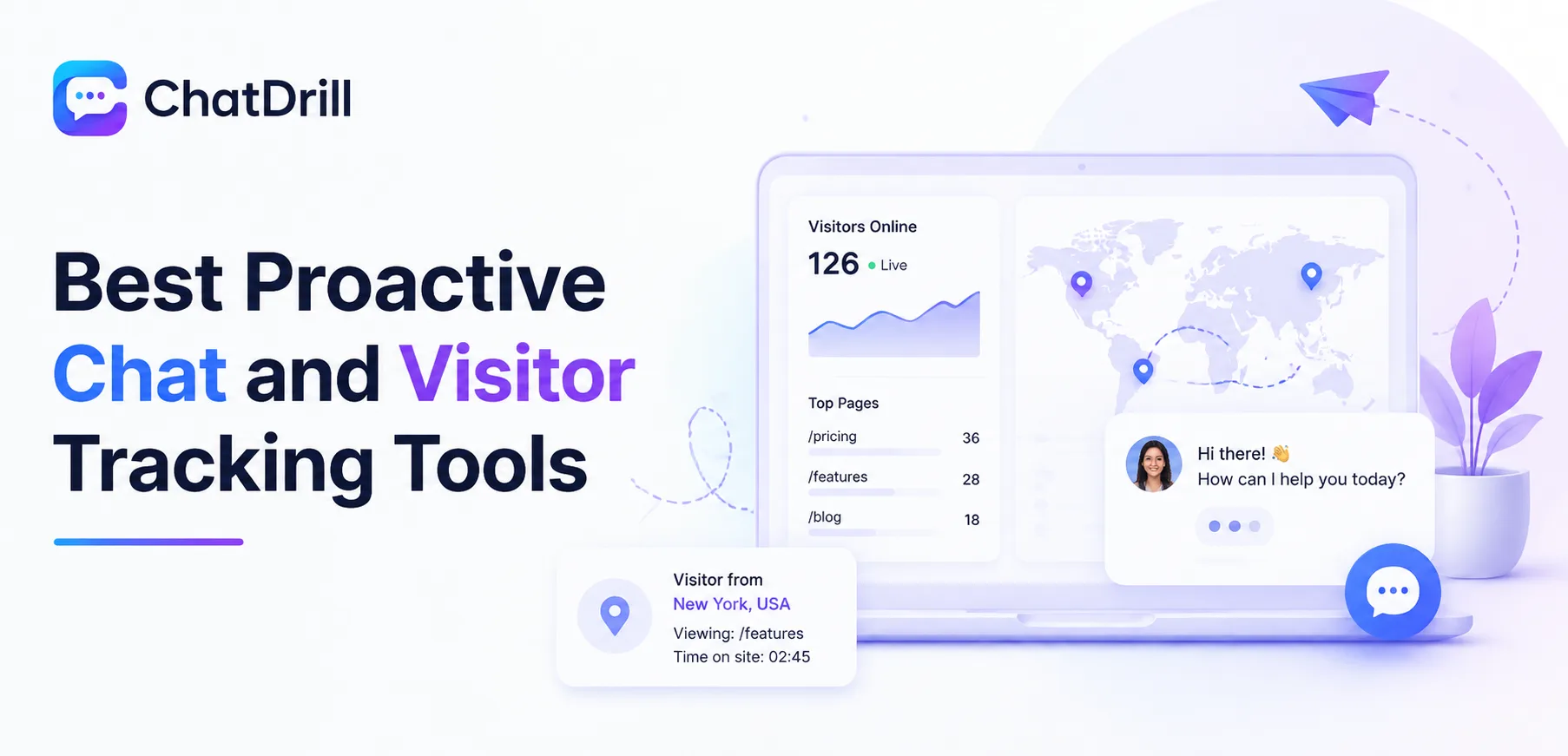
Proactive chat and visitor tracking tools let a business see what a visitor is doing on a site in real time and reach out at the right moment, rather than passively waiting for a visitor to click open a chat widget on their own.
This matters because a purely passive widget misses the visitors most worth engaging, the ones lingering on a pricing page, showing exit intent, or revisiting a product multiple times, exactly the behaviors that signal genuine buying interest.
The best tools in this category combine two capabilities: visibility into visitor behavior, pages viewed, time spent, referral source, and the ability to act on that behavior through a well-timed, contextually relevant proactive chat prompt.
Getting this right is a genuine skill, not just a technical setup, since an overly aggressive proactive trigger feels intrusive while a well-timed one feels genuinely helpful, and the difference between the two often comes down to careful configuration rather than the tool itself.
This guide covers why proactive chat and visitor tracking matter, what to look for in these tools, the strongest options in 2026, how they fit different use cases, a closer look at pricing, and best practices for triggering proactive chat effectively.
Why Proactive Chat and Visitor Tracking Matter
Proactive chat and visitor tracking matter because they catch the visitors most likely to convert, exactly the ones showing hesitation or high intent, at the moment that engagement actually makes a difference rather than waiting passively for a click.
What passive chat misses
A widget that only opens on click misses the meaningful share of visitors who would have engaged with a nudge but weren't going to take the first step themselves.
This gap is largest specifically for high-intent visitors experiencing hesitation, a pricing page visitor with a question they didn't think to initiate chat over on their own.
How visitor tracking makes proactive chat actually useful
Without visibility into visitor behavior, a proactive trigger is essentially a blind guess about timing; with tracking, it can be based on genuine signals, time on page, scroll depth, page sequence.
This behavioral context is what separates a well-timed, relevant proactive prompt from one that feels random or poorly matched to what the visitor is actually doing.
The business impact of getting this right
Well-configured proactive chat, informed by real visitor tracking, consistently outperforms passive chat on engagement and conversion metrics, since it catches intent at its peak rather than waiting for it to fade.
This impact compounds specifically on the pages where visitor intent is highest, pricing, checkout, comparison pages, making targeted proactive triggers there especially valuable.
What to Look for in a Proactive Chat and Visitor Tracking Tool
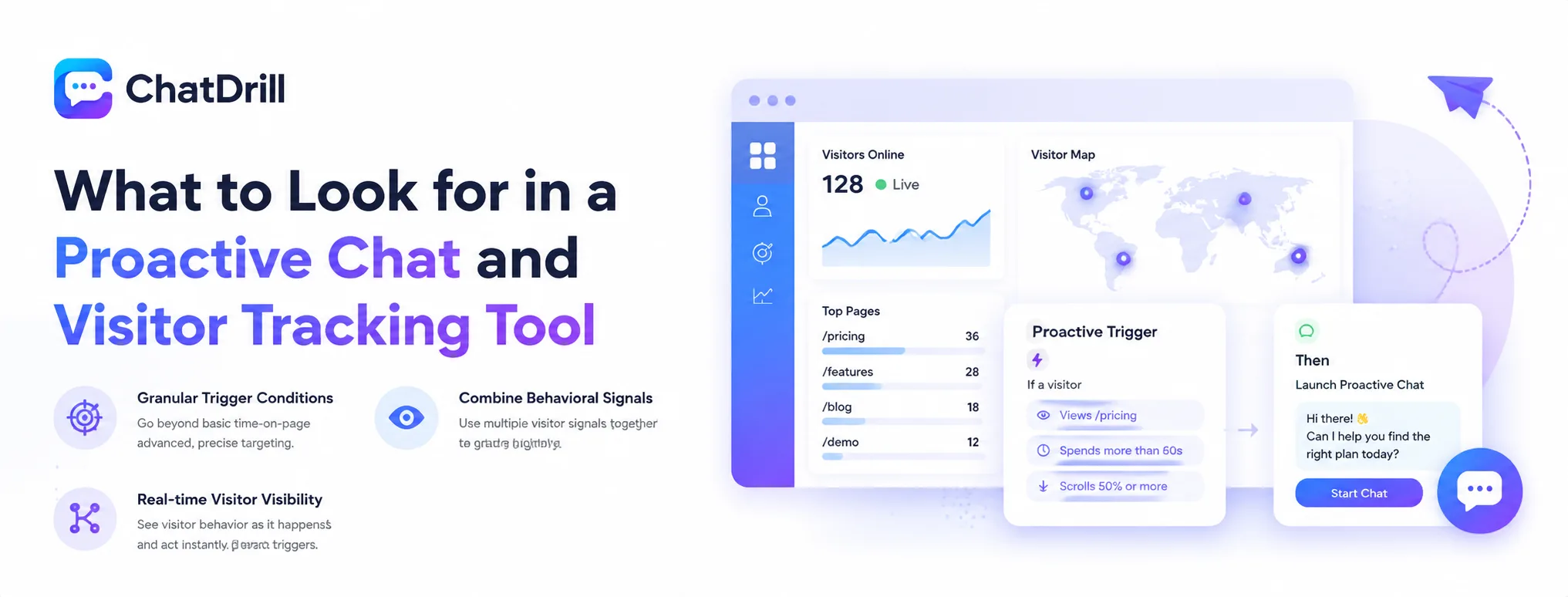
A strong proactive chat and visitor tracking tool offers granular trigger conditions beyond basic time-on-page, real-time visitor behavior visibility for agents, and the ability to combine multiple behavioral signals into a single, well-targeted trigger.
Granular trigger conditions
Look for triggers that go beyond simple time-on-page, supporting conditions like scroll depth, specific page sequences, exit intent, and referral source for more precisely targeted engagement.
This granularity is what allows a truly well-tuned proactive strategy, rather than a single blunt rule applied uniformly across every page.
Real-time visitor visibility for agents
Beyond automated triggers, agents benefit from seeing live visitor activity, which page someone's on, how long they've been there, letting a human proactively reach out with informed context.
This visibility also helps an agent respond more relevantly once a conversation starts, understanding what a visitor has already been looking at.
Combining multiple signals into one trigger
The strongest tools let you combine conditions, a visitor on the pricing page for over 30 seconds who also scrolled past the FAQ section, rather than relying on any single signal alone.
This combination capability is what separates a genuinely sophisticated proactive strategy from a basic, single-condition trigger setup.
The Best Proactive Chat and Visitor Tracking Tools

ChatDrill leads for combining granular triggers with AI-driven follow-through, with Intercom, Drift, HubSpot, and Crisp each fitting a more specific proactive engagement use case.
ChatDrill — best overall for granular triggers with AI follow-through
ChatDrill supports detailed, combinable trigger conditions and pairs proactive engagement directly with AI qualification, so a well-timed prompt leads into a genuinely productive conversation rather than just an opener.
Its real-time visitor visibility gives agents context to jump into a proactively triggered conversation with relevant information already in hand.
Teams specifically wanting proactive engagement that converts into real qualification, not just increased chat volume, tend to find this combination particularly effective.
Intercom — best for sophisticated behavioral segmentation
Intercom's product tour and messaging tools support genuinely sophisticated behavioral segmentation, suited to a team wanting deep customization of who sees which proactive message and when.
This depth comes with more setup complexity than a simpler tool, worth weighing against how much segmentation sophistication is genuinely needed.
Teams with a mature marketing operations function tend to extract the most value from this level of configurability.
Drift — best for pipeline-focused proactive engagement
Drift's proactive chat is built specifically around converting website visitors into sales conversations, with triggers tuned toward pipeline generation rather than general engagement.
This focus suits a B2B sales-led business specifically, less relevant for a business prioritizing general support engagement over pipeline generation.
Teams choosing Drift are typically prioritizing sales conversion above broader visitor engagement use cases.
HubSpot — best for teams wanting tracking tied to a full CRM
HubSpot's visitor tracking ties directly into its broader CRM and marketing suite, letting proactive chat triggers connect with a visitor's full known history across marketing touchpoints.
This suits a team already invested in HubSpot's ecosystem, where a unified view across marketing and chat data adds real value.
Teams not already on HubSpot are unlikely to find enough standalone tracking value to justify adopting it purely for this purpose.
Crisp — best lower-cost entry into proactive triggers
Crisp offers basic proactive triggers even on its lower tiers, a reasonable starting point for a smaller team not yet ready to invest in more sophisticated behavioral tracking.
Its trigger granularity is lighter than more advanced alternatives, worth weighing against how precisely targeted a team's proactive strategy actually needs to be.
This suits a business testing proactive chat as a concept before committing to a more feature-rich, higher-cost platform.
Proactive Chat Tools by Use Case
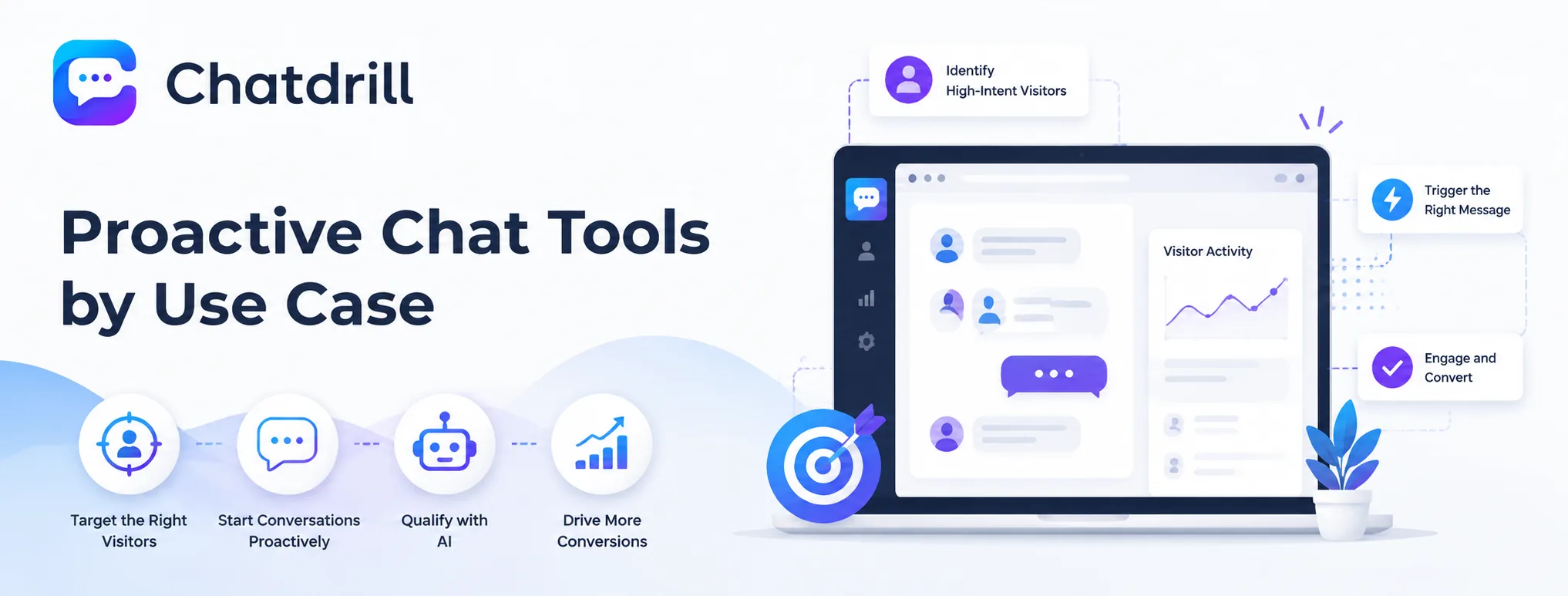
ChatDrill suits teams wanting proactive engagement paired with AI qualification, Intercom suits sophisticated segmentation needs, Drift suits pure sales-pipeline focus, and Crisp suits teams starting with basic triggers at lower cost.
Best for engagement paired with genuine qualification
ChatDrill's combination of granular triggers and AI follow-through suits a team wanting proactive engagement to lead directly into productive, qualified conversations.
This fits a business where proactive chat is meant to drive genuine pipeline or resolution, not just raise engagement metrics alone.
Best for sophisticated behavioral segmentation
Intercom's depth suits a team with a mature marketing function wanting fine-grained control over exactly who sees which message under which conditions.
This sophistication is worth its added complexity specifically for a team with the resources to configure and maintain it well.
Best for pure sales-pipeline focus
Drift's pipeline-oriented design suits a B2B sales-led business whose primary proactive chat goal is converting visitors into sales conversations.
This fits a business prioritizing pipeline generation clearly above broader support or general engagement use cases.
Best for starting with basic triggers at lower cost
Crisp's accessible pricing suits a team wanting to test proactive chat's value before investing in a more sophisticated, higher-cost platform.
This is a reasonable starting point with the expectation of upgrading once proactive chat's value is validated for the business.
Pricing for Proactive Chat and Visitor Tracking Features
Basic proactive triggers are increasingly included even at lower pricing tiers, while granular, combinable trigger conditions and deep behavioral segmentation typically require a higher-tier or premium plan across most platforms in this category.
What's typically included at lower tiers
Simple time-on-page or click-based triggers are commonly available even on lower-cost or free plans, giving a business a basic proactive capability without premium spend.
This baseline is often sufficient for a business just starting to experiment with proactive engagement before investing in more sophisticated targeting.
What premium tiers typically add
Combinable, multi-condition triggers, deeper behavioral segmentation, and tighter CRM-tied tracking are the features most commonly reserved for higher, premium pricing tiers.
Confirming exactly which specific trigger conditions are available at a given tier, rather than assuming full sophistication is included, avoids an incomplete evaluation.
Justifying the investment in more advanced tracking
The ROI case for premium proactive chat features rests on measurable conversion lift from more precisely targeted engagement, worth tracking explicitly to justify the incremental cost.
Running a focused test on one or two high-value pages before a broader rollout gives concrete data to support this investment decision.
Best Practices for Triggering Proactive Chat Effectively
Effective proactive chat triggers reference something specific about the visitor's actual behavior, use a sensible delay rather than firing immediately, and avoid over-triggering on every page indiscriminately.
Referencing specific visitor context
A trigger message referencing the specific page or product a visitor is viewing performs meaningfully better than a generic greeting, since it signals genuine relevance rather than a random interruption.
This specificity is one of the highest-leverage, lowest-effort improvements available to an existing proactive chat setup.
Using a sensible delay before triggering
Firing a trigger immediately on page load tends to feel intrusive and gets dismissed quickly, while a 15 to 20 second delay lets a visitor engage with the page first before the prompt appears.
This delay is worth testing and tuning specifically for each page, since the right timing can vary based on how quickly a visitor typically forms intent on that specific page.
Avoiding indiscriminate over-triggering
Applying an aggressive proactive trigger uniformly across every page, rather than reserving it for genuinely high-intent pages, tends to feel intrusive and can actually reduce overall engagement.
Reserving proactive triggers for the pages where they genuinely add value, pricing, demo requests, high-intent product pages, produces better results than blanket application everywhere.