

A PR crisis or sudden bad press spike creates a genuinely urgent, high-stakes surge of concerned inquiries, and how quickly and consistently a business responds through every available channel meaningfully shapes how the situation is ultimately perceived.
Quick answer: Live chat handles a PR crisis or bad press spike by giving concerned customers an immediate, direct, and consistently accurate channel to get real answers, rather than being left to speculate based on incomplete news coverage or social media commentary, while pre-approved, careful messaging ensures every response stays consistent with the company's official position.
Live chat offers a uniquely direct, real-time channel during this kind of moment, letting a concerned customer get an actual, consistent answer rather than being left to piece together an interpretation from incomplete news coverage or social media speculation.
Understanding how to prepare chat specifically for this scenario, with appropriate care given the genuine sensitivity involved, helps a business manage a difficult moment as responsibly and consistently as possible.
This guide covers the role chat plays during a crisis, specific preparation tactics, common mistakes, measuring the response effectiveness, and how ChatDrill supports crisis-period chat.
The Role Chat Plays During a Crisis or Press Spike
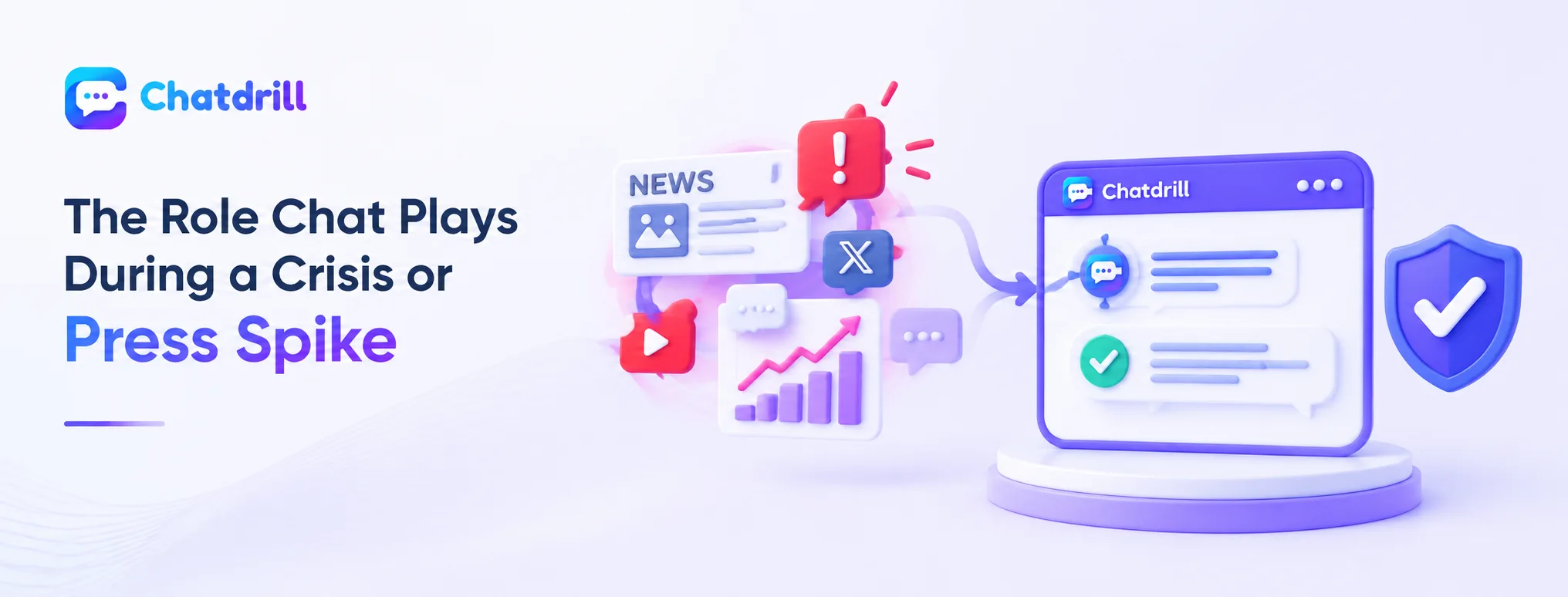
Chat provides a direct, consistent channel for concerned customers during a crisis, reducing reliance on incomplete external speculation.
Providing a direct alternative to speculation
A concerned customer during a PR crisis, without a direct, reliable channel to a real answer, often turns to news coverage or social media commentary that may be incomplete, speculative, or simply inaccurate, potentially amplifying concern beyond the situation's actual scope.
Chat gives this same concerned customer a direct path to an accurate, consistent answer, reducing this reliance on secondhand, potentially unreliable interpretation.
This direct channel matters especially given how quickly speculation can spread and compound during a genuinely high-attention moment, making a reliable, accurate alternative source genuinely valuable.
Maintaining consistency across every interaction
During a crisis, ensuring every single customer interaction, whether human or AI-handled, reflects the same, carefully considered official messaging prevents the confusion and potential credibility damage that inconsistent responses across different conversations would create.
This consistency requirement during a crisis specifically deserves more careful attention than typical, routine chat operation, given the genuinely higher stakes involved.
Specific Preparation Tactics for Crisis Situations
Preparing pre-approved messaging in advance with legal or communications input, and establishing clear escalation rules for anything outside that messaging, both protect response quality.
Preparing pre-approved messaging with appropriate input
Working with your legal or communications team to prepare careful, accurate, pre-approved language addressing the specific situation ensures chat responses, whether from AI or human agents, stay consistent with the company's carefully considered official position.
This preparation should happen as quickly as the situation allows, since chat conversations will likely begin addressing the topic almost immediately once a crisis becomes publicly visible.
Establishing clear escalation rules for edge cases
Defining clearly which specific questions AI or standard agents can address using pre-approved messaging, and which genuinely need escalation to a specifically designated crisis-response team member, prevents an unprepared response to a question outside the carefully considered messaging.
This escalation clarity matters considerably more during a crisis than during typical operation, given how much more consequential an inconsistent or inappropriate response could be in this specific context.
Common Mistakes During Crisis Chat Handling
Allowing AI or agents to improvise responses without pre-approved guidance, and being too slow to update messaging as the situation evolves, both create genuine risk.
Being too slow to update messaging as the situation evolves
Allowing improvised responses without guidance
An AI or agent improvising a response to a sensitive crisis-related question, without pre-approved guidance to work from, risks introducing an inconsistent or inadvertently problematic statement precisely when consistency and care matter most.
Ensuring chat operates strictly within pre-approved messaging boundaries during a crisis, escalating anything genuinely outside that scope, directly prevents this significant risk.
Allowing improvised responses without guidance
An AI or agent improvising a response to a sensitive crisis-related question, without pre-approved guidance to work from, risks introducing an inconsistent or inadvertently problematic statement precisely when consistency and care matter most.
Ensuring chat operates strictly within pre-approved messaging boundaries during a crisis, escalating anything genuinely outside that scope, directly prevents this significant risk.
Being too slow to update messaging as the situation evolves A crisis situation often develops and changes over hours or days, and messaging prepared for the initial moment may become outdated or even inaccurate as new information emerges, requiring prompt updates to stay genuinely current.
Establishing a clear, fast internal process for updating chat messaging as the situation develops prevents customers from receiving outdated or inconsistent information as circumstances change.
Measuring the Crisis Response Effectiveness
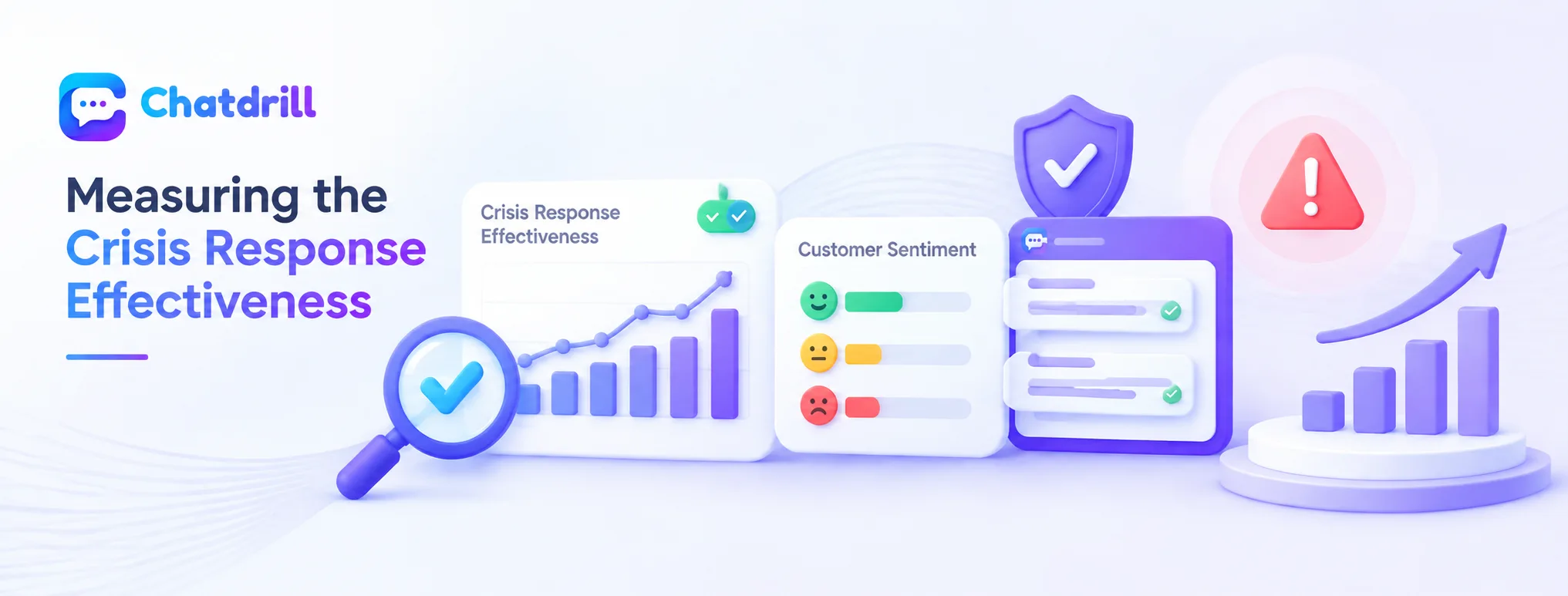
Tracking customer sentiment through the crisis period
period reveals whether the response approach genuinely held up.
Auditing response consistency across conversations
Reviewing a sample of actual crisis-period conversations for consistency with the approved messaging reveals whether the escalation and guidance rules this guide recommends genuinely held up in practice.
This consistency audit matters both for immediate course-correction if inconsistency is found, and for improving crisis preparation processes for any future situation.
Tracking customer sentiment through the crisis period Monitoring genuine customer sentiment expressed through chat conversations during the crisis period, alongside broader sentiment indicators, helps assess whether the direct, consistent chat channel is genuinely helping manage concern.
This sentiment tracking provides a more complete picture than technical response metrics alone, reflecting the genuinely qualitative, reputation-sensitive nature of a crisis situation.
Tracking customer sentiment through the crisis period
Monitoring genuine customer sentiment expressed through chat conversations during the crisis period, alongside broader sentiment indicators, helps assess whether the direct, consistent chat channel is genuinely helping manage concern.
This sentiment tracking provides a more complete picture than technical response metrics alone, reflecting the genuinely qualitative, reputation-sensitive nature of a crisis situation.
How ChatDrill Supports Crisis-Period Chat Handling
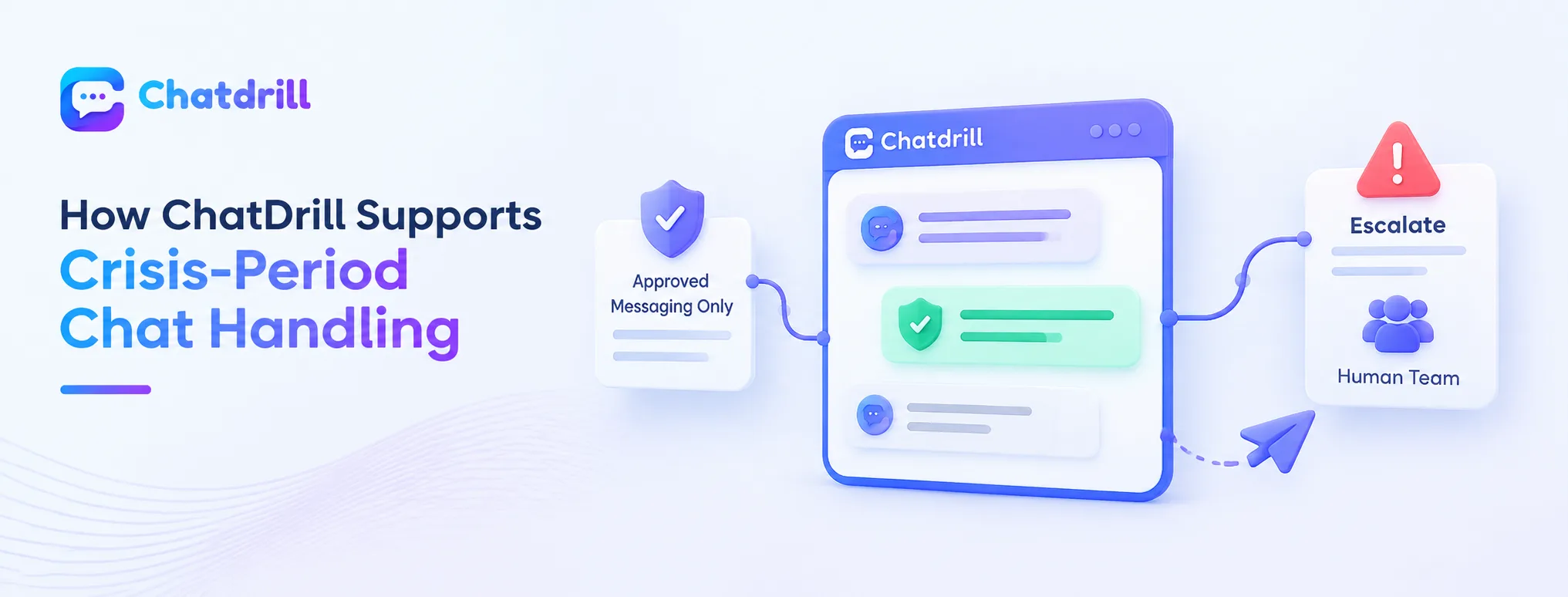
ChatDrill supports configurable messaging boundaries and escalation rules, helping keep every crisis-period response consistent with pre-approved, carefully considered guidance.
Configurable boundaries keeping responses within approved messaging
ChatDrill's AI can be configured to respond strictly within pre-approved messaging for sensitive, crisis-related topics, reflecting the consistency this guide identifies as essential during a high-stakes situation.
This configurability helps prevent the improvised-response risk this guide identifies as a serious concern, ensuring AI-handled conversations stay within carefully considered boundaries.
Clear escalation rules for anything outside that scope ChatDrill supports configuring clear escalation rules directing genuinely edge-case or sensitive questions to a designated human team member, reflecting the escalation clarity this guide recommends for crisis situations specifically.
This escalation capability ensures nothing genuinely outside prepared messaging gets an unprepared, potentially risky automated or improvised response.
Clear escalation rules for anything outside that scope
ChatDrill supports configuring clear escalation rules directing genuinely edge-case or sensitive questions to a designated human team member, reflecting the escalation clarity this guide recommends for crisis situations specifically.
This escalation capability ensures nothing genuinely outside prepared messaging gets an unprepared, potentially risky automated or improvised response.